


-rick-
-
Posts
1367 -
Joined
-
Last visited
-
Days Won
6
Everything posted by -rick-
-
ESP32 S3 m5Stack Cores3 swmbo friendly watering system!
-rick- replied to Pocster's topic in Boffin's Corner
I think @Pocster wants to do it for the 'fun' of it. Maybe mistress is away? -
It's not just smarthomes. The trend for EVERYTHING to need an app is so annoying. I like the idea of various smart features (never lived in an automated place) but key for me is that it should add things on top, not make things harder. If you can't invite your families oldies and technophobes to stay at your house without them asking how to make something work you are doing something wrong. The basic stuff should work even if the smart stuff is broken and it should all work without the internet.
-
I agree, I suspect that it might not come across in some of my posts but my thoughts are to try and keep things simple and avoid complexity. - Do do the calculations about how much piping you need to emit enough heat - Build a layout that allows you to output that heat at very low temperature - Within reason try to avoid different length loops and transit areas where pipes group densely (hallways can be heated by the heat from loops traversing the hall way to other areas, doesn't need it's own loops), etc - Minimise crossing movement joints (make sure you follow best practice where crossing happens to allow the pipes to move in the slab) You don't need to design everything to the nth degree, the low temperature nature builds flexibilty so everything doesn't have to be perfect. @Gus Potter I think would suggest to have more shorter loops with some overprovision on the assumption that loops will fail. This is my main disagreement. I think it adds complexity that is detrimental to the chances of a successful install. If you are paying someone to install pipes, rather than paying them to install more than you need and the complexity that comes with that, pay for an independent witness to test the system after it is layed, before slab pouring and after the slab has solidified but not fully hardened. That way you can detect faults and get them fixed at the right time rather than living with a damaged system long term. Edit: Overall, if you are paying people to install the heating system, they should be involved in the UFH design and also be able to be the witness during installation (if they aren't installing the pipes)
-
I took 50 years as that's what the pipe manufacturers are claiming is the lifetime of their pipes. If you are putting pipes into an insulated raft that is also the foundation you are unlikely to rip that up for the lifetime of the building. Definitely not proposing to spend significant time or effort on it. From my POV, not worrying about precisely where kitchen units go, etc, at UFH design stage just means less dependencies on progress. You can get on with UFH install while still deciding between a couple of kitchen options, etc.
-
I think that also describes some of my issues with what Gus has said. To me, if you are building in redundancy, you are adding more pipe than needed. If you are adding more pipe than needed you are: 1. Adding more work, materials, cost. 2. Making the installation more complex 3. Reducing the pipe spacing and therefore making bend radii tighter (more chance of kinks, etc) 4. Increasing the number of pipes that have to feed into manifold(s) which increases problems of local heating in the area, and produces installation risk with potential overlapping pipes, pipes closer to the surface than intended, etc. In a low temp system you retain an awful lot of flexibility to increase output just by adjusting the water temp by a degree or two and adjusting flow rates. Adding extra pipes just adds complexity and risk. Though it should be said, in a low temp system with thick slab, flexibility is more limited anyway no matter how many pipes you have due to the response time of the system. In return you get a more efficient system that you can just turn on and leave on and not have to think about.
-
My reasoning for putting pipes everywhere is that in 50 years rooms get rearranged. Kitchens get moved to entirely different areas. Partitions go up, come down. Assuming you are designing a very low temperature system with a thick slab (one with floor temps targeting 1-2 degress above room temp) then the impact of some units on top of some pipes should be minimal. You can leave small air gaps at the top of the kickstand that won't be visible. I completely understand why you don't want to put pipes under units if you are designing a higher temp/fast response system.
-
Concrete floor as a finished surface. The results are in.
-rick- replied to saveasteading's topic in Floor Structures
Watching the Restoration Couple on Youtube. I think their ~400m2 floor came to about £37m2 inc dry shake, powerfloated, not polished though. Said the dry shake bags added up to £2k. That is the concern. Keeping it sealed. -
Concrete floor as a finished surface. The results are in.
-rick- replied to saveasteading's topic in Floor Structures
It's funny in a way. You see that picture as a warning to avoid and as someone interested in a concrete floor as a finished surface see that as exactly what I'd expect (except if done in a domestic project I'd expect the movement joints to be filled more neatly and would personally have gone for a coloured concrete shake). -
Advice required on Polished concrete floor alternatives
-rick- replied to Jakekibb's topic in General Flooring
@IanR did a poured resin floor that might be an alternative: Microcement exists but isn't cheap. The only other suggestion that comes to mind is exploring commercial concrete contractors rather than 'polished concrete' specialists. I've no real-world experience, just researching for a future build but if you haven't already looked, have a look at https://concria.com/dry-shake-floor/ and their polishing system. Would only work on a large floor area without obstructions, but if thats what you have then might be a lot cheaper than conventional polished concrete. -
Advice required on Polished concrete floor alternatives
-rick- replied to Jakekibb's topic in General Flooring
Concrete can work with the right design. Does need careful thought though and I certainly don't think it's worth a premium price. -
Thats the right thing to do. Worked as intended then! Good to know of the problem straight away. Though if it really made an impression on you maybe you had the pressure a bit too high
-
In a low temp system I'd guess not. My planning around this is to aim to not worry about kitchen cabinets etc. Seems like extra effort to try and route around things and in the event the layout is changed in future might you end up with an area of floor that is a touch cooler than others (I can't see it affecting room temp but might be noticable with feet on the floor).
-
I thought it was profitable including the satellite launches but could have misunderstood. They are raking in billions a year and thair launch costs are extremely low because of rocket reuse.
-
Cost wise, Starlink is already profitable so any 5G add on service doesn't have to worry about paying for that. AFAIK the Starlink mobile service is mostly text only where it exists. Voice calls maybe coming but not sure it's going to have much in the way of data. It can be good as fill in in sparsely populated areas but the cells are too big to handle normal usage.
-
Video showing a bit more of what’s in the ceiling IMG_8617.mov .
-
Appreciate that, it's why I'm not rushing to do it and asking lots of questions, it's not leaking right now so I can afford to take my time. I think it's approachable in my situation because: 1. There is a ball valve isolator about 10m away from my front door that I know works because I used it yesterday when the fitting was leaking. I can use that for isolation and it's close enough that I can reach it in a hurry if something goes wrong. 2. I am at home most of the time and wouldn't be leaving any new change unattended. Feel free to tell me I'm crazy. I'm not sure it is. I can't see a plasson option for a 90 elbow MDPE->copper so I'd have to take the copper above the plasterboard, 90 there and then convert to MDPE with a straight coupling, while stiff the MDPE pipe still has a bit of flex in it. I'll attach a video showing the space available. IMG_8615.mov If I have to cut the MDPE pipe back anyway from the elbow and attach a straight coupler there then it's the same number of fittings either way. The prices on the pipestock website for the right tools are low enough that the right tools isn't a barrier. Given the access available I think I'd prefer to use a ratcheting plastic pipe cutter than a hacksaw (feel I'd make a right mess of the pipe with a hacksaw). That all sounds fine. I'm home most of the time anyway so this isn't a problem.
-
I thought the full fibre products fed back the fibre direct to the local exchange (which should have at least some degree of backup power and be prioritised to restoration in event of an outage). Not sure if they have generators or not (I would guess they do in places with frequent outages). So maybe outages isn't such a worry?
-
Right so Plasson it is. Plasson Compression or Push fit? For the elbow: https://www.pipestock.com/plasson/pushfit-fittings/plpf-elbow-90 (350107 - 32mm push-fit) https://www.pipestock.com/plasson/compression-fittings/plmf-elbow-90 (352354 - 32mm compression) For the copper connection: https://www.pipestock.com/plasson/pushfit-fittings/coupling-pe-x-copper (350068 - 32mm to 28mm push fit) https://www.pipestock.com/plasson/compression-fittings/adaptor-male-bsp (352288 - 32mm to 1 1/4"/28mm compression) Plus 32mm pipe liners x 3: https://www.pipestock.com/pipe-liners The order process recommended a Boa Strap Wrench as well for the compression fittings. This will be my first time doing something like this so a few more questions: 1. Will I need to/should I be prepared to trim the ends off these MDPE pipes to get a good end? 2. If so, I assume I need pipe cutters. Deburring tool? Probably try and find a short length of pipe as well as a straight connector as there isn't much slack anywhere. 3. If using compression to the copper side, do I need PTFE/thread sealant? New olive? 4. If using push-fit, should I plan to cut the pipe and make a new fresh end? So pipe cutters and wire wool? 5. No pipe liner required for the copper end if using push-fit, right? 5. Anything else I'm not thinking of?
-
😆 I am the leaseholder. Would dearly like not to be but stuck here until the cladding issue on this building is fixed (even then flats in London are not in high demand right now so I'm likely stuck here for a while). So what should I do? This is the second time this fitting has leaked after tank maintenance. Trust it, despite it being very loose (even after pushing back on as best I could with the access)? Replace with same fitting? Or something else?
-
FWIW these fittings are approx 20 years old. Google suggests a known failure of them is o-rings failing due to age (15-20 years).
-
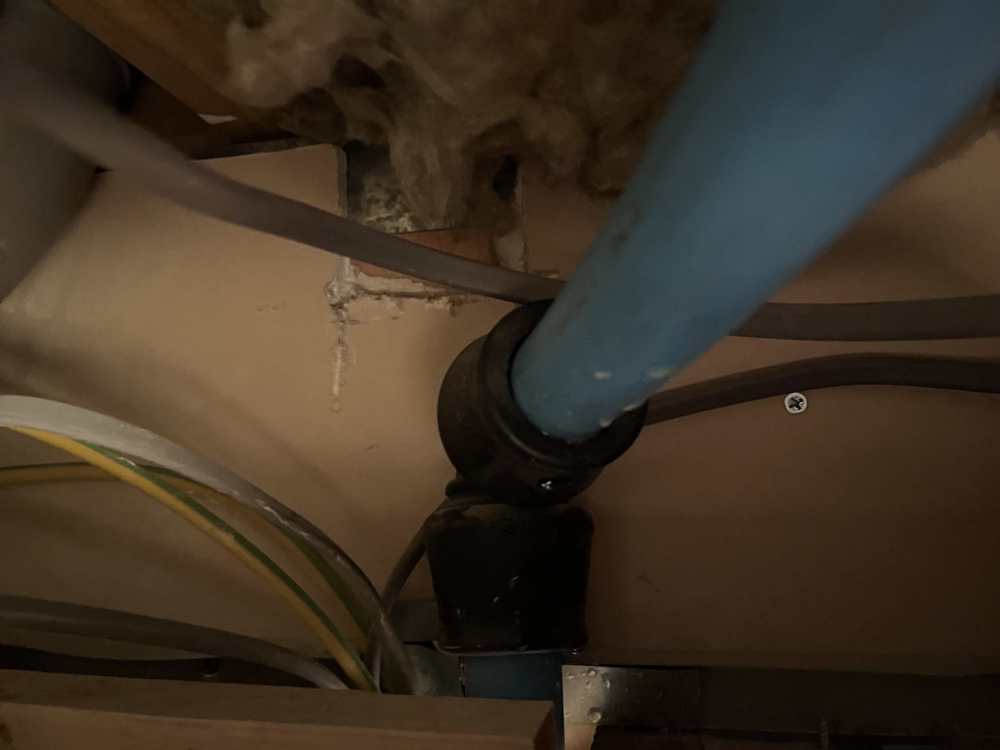
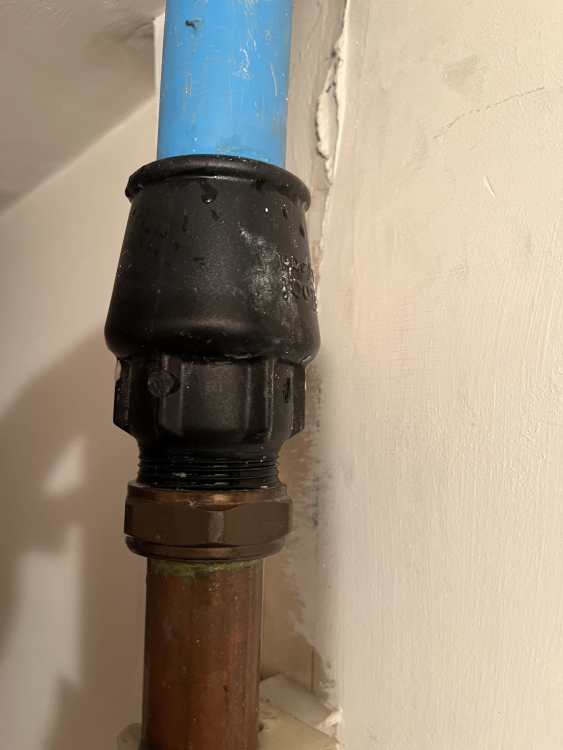
Looks like the existing are Talbot: https://www.plumbingforless.co.uk/plumbing/atplas-talbot-mdpe-fittings/talbot-elbows/talbot-pushfit-90-degree-elbow-32mm-e2784
-
Certainly once the pressure was off and I felt the pipe it was possible to push the fittings on by another inch with zero resistance. Pipe was completely free to move. When the pressure was turned back it pushed the fitting back out with some force as I was trying to hold it tight. Shouldn't the joint seem stiff/tight even with no pressure? Just had a look on the Plasson site, nothing that matches these fittings on there (at first glance). I meant compression MDPE like this, in case that wasn't clear: https://www.pipestock.com/mdpe/mdpe-pipe-fittings/mdpe-elbow-90
-
My flat is fed from a 32mm OD (25mm ID???) MDPE pipe. Today the water maintenance company were here to disinfect the tank on the roof and as part of that isolated the supply. When the supply came back on the right angle MDPE fitting in my ceiling started letting a lot of water out of it. Seems like the fitting loses its seal when the pressure is off and then is at risk of blowing off the pipe when the pressure comes back. Managed to isolate at the meter and with extra hands reintroduced pressure while holding the fitting in place and now pressure is back on with no leaks. However, my confidence in these fittings is now shot and I want to replace them. I assume I need to get compression type fittings. Should I favour any specific brand? Any gotchas I should look out for?
-
Looks interesting. Wonder how their multizone stuff works with building regs.
-
Does have temperature but says don't rely on it. If you haven't seen the intro video it's worth a watch. Really like the Home Assistant integration UI + zone configurator.


