


-rick-
-
Posts
1367 -
Joined
-
Last visited
-
Days Won
6
Everything posted by -rick-
-
Magnet + reed switch is by far the most reliable method. Anything involving an IR beam requires an IR emitter, which will fail in time. PIR (ie, passive) is more reliable but won't tell you a window is open, only that someone is near a window. I don't know how manufacturers fit the reed switches if you order that option but it would seem feasible for them to install them in such a way that they can sense not whether the window is open or closed, but rather whether the window is closed and secure (ie the latch is engaged) or not.
-
Thanks. I guess I was thinking you were referring to circular/bulb style ones. bulb style with controllable CCT seems pretty difficult to find outside the wireless 'smart' bulbs which I don't think is a good solution.
-
Funny you mention that. A fellow director of the RTM for my building was saying the same thing today about Thames. In other buildings he manages sounds like the pressure has dropped significantly in the recent past. Mrs. Alien 😆 I suppose my priors are that unvented systems usually have much higher pressure/flow than pumped vented systems. Maybe that doesn't apply in your case. Fair enough.
-
Got an example of these DALI fittings and what they cost?
-
What were your reasons for not converting to unvented in the end? (I know that would only be for the DHW side given what you've said about the CH pipework).
-
I've not currently got a build. Just researching things. They all seem to use the same Chinese motors these days. Can maybe save a lot if you order the motors from Aliexpress and fit them to normal blinds (just need to make sure the blinds you get have the right type of tube. (Obviously check import costs, etc). As someone who really wants to hardwire everything the current market is annoying. Either really high end/cost hard wire, or the battery/wireless ones. The wired but not super high end ones tend to lack other features. I believe that a number of the battery ones can be wired in to charge permenantly. So basically you can wire in USB chargers to them. Doesn't help with control though.
-
I agree you can do it with a single acting button but it's less flexible. Also, things like blinds could really do with 'up' and 'down'.
-
As I said earlier I think there is some argument about this within the electrical profession. I'm not an electrician, just vaguely aware. I think the argument is that people are expected to go into a meter box to read a meter, switch switches (for isolation, resetting trips). They are not expected to go inside a consumer unit, but are expected to lift the protective flap to switch breakers (and that element of a consumer unit is double insulated).
-
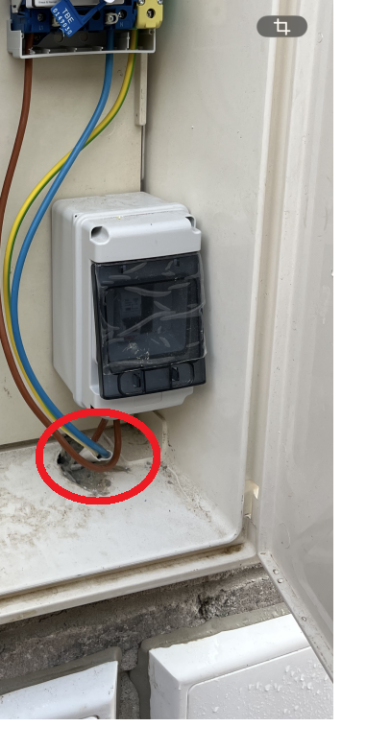
In the circled area you can see that this is a T+E cable with the outer shealth stripped. This means the remainder of the cable is single insulated. The other tell is the thickness of the cables.
-
Not to me. The images show double insulated tails not single insulated cables.
-
He is definitely at the high/craftsman end of the market and I bet charges for it as well.
-
Saw something on efixx the other day along this lines. It's an argument that has been used by some installers but IIRC there is push back possibly with a recent clarification to say no.
-
Sure and agree. I tend to think that we should not have rules in place we don't expect many to follow hence why I don't think registration should be required. However, I think we've already covered how as long as these things meet regs then registration is just bureaucracy not a safety matter. Preventing non-compliant devices should be dealt with by focusing on ensuring the retaillers don't sell them.
-
Yep. Agree. Though you are assuming these plants would provide 100% of energy during the cold periods. Far from it. It would be there to augment existing supply not sure by how much but it will be a big difference. It would also be spread over many plants and the production side is relatively easier than LNG (as it's slow, not needing to compress at the speed that LNG plants do). But storage is a huge issue. For that reason I wonder if we do end up going down this sort of route we end up converting hydrogen to methane before liquifying it. Horrendously inefficient but also if done as a way to use summer excess (on massively overbuilt solar so that the deficit during winter is smaller) then might still make sense especially if it means existing natural gas users can switch to this supply too without retooling. To be clear its not a valid option for wide scale use but for some niche usecases where electric heating is not an option it might make sense. We imported 25% of our gas via LNG in 2024, this contingency capacity would less than 25% of our existing gas usage.
-
This and long term this is where hydrogen can be useful. Use excess solar during the summer to make hydrogen, store it for peaker use in winter. All done in one site, no need to pipe it anywhere. Other note is that batteries can fill all the short term responsive capacity that peaker/stored hyrdo used to do. The only thing batteries can't really do is longer duration peaker load. ie, those 1-2week super cold winter periods.
-
Possible, there is so much private capital / startups persuing fusion right now, feels like we are on the edge of major progress. (A lot of the hard bits have been done already, still plenty left though) But I think this bet is more that green hydrogen boilers, etc, are unlikely to happen at any scale at all. Other technologies are a better option.
-
Have a look at Scolmore click. Not sure it does what you want but there is a lot of interchangability there. Swapping a switch module you like into different faceplates. Not used them. Just looked at them to see if their range solved the retractive switch issue and it looked like they might (with compromises). Screwless adds a extra level of difficulty. 3-way retractive (on-off-on) is rare enough as it is.
-
Not sure but am pretty sure that they are just replacing older less efficient ones with fewer more efficient and cleaner ones + a unfathomable quantity of solar, wind, nuclear, etc (to our eyes).
-
Just because you ditch notification doesn't mean the products don't have to comply with standards. Go after retaillers selling non-compliant systems (it will only be the Amazon/ebay/aliexpress type stuff anyway and those will be a problem whatever you do with notification)
-
If multiple systems became a problem it would be possible to introduce technical measures for one inverter to detect others and shutdown if found. I doubt it would be necessary thought (and of course would only be present in new compliant systems anyway)
-
That's not quite right is it? I thought they couldn't refuse G98. So within current regs every household can install 16A of solar with just a notification which is not refusable. The grid has to cope and if it can't the co's have to make changes. G99 can be refused but the basis G98 is just notification. Also, inverters will shut off if the voltage gets too high (before the voltage gets dangerously high) so installing too much capacity will self regulate to a degree with each user generating less than they would otherwise expect. I believe the 800W limit comes from keeping it to a size where things are easily absorbed by the grid. Whatever update to the rules they make I would expect them to be such that you are not allowed to install more than 800W capacity using this scheme. Any more than that and you need normal G98 and electrician install. Less than that and maybe technically G98/some form of registration required but if it doesn't happen it's not going to cause problems.
-
To summarise: We should want to reduce dependence on imported fuels. Given our current situation and available resources by far the quickest, cheapest and easiest way to do this is to build more solar, wind and battery storage. Everything else is more expensive and slower.
-
Proposed changes to Permitted Development rights for small wind turbine
-rick- replied to FarmerN's topic in Wind Generation
And this is the thing to fix. As said earlier, you fix the root cause, don't apply regulations on top based on the assumption that you are too weak to fix the cause. Not sure what you mean by physical check. You won't be able to tell much by physically looking at products. (product depending, egregious things more obvious but lots of subtlties no) By checking the certificates what I mean is communicating with the labs who supposedly issued them to check they are geniune and confirm they relate to the product in front of you. Historically most of the China Export stuff hasn't even bothered to go to the stage of faking these certificates. They just put some general (not product specific) certificates up and call it a day. Amazon should be checking this stuff on things on their store. They don't and offload the responsibility to the seller (not sure that legally holds up in the first place but if it doesn't the law can be changed). Going after Amazon (and aliexpress, etc) would stop a lot of the crap stuff getting in. High street retaillers, etc, are already pretty good. -
Proposed changes to Permitted Development rights for small wind turbine
-rick- replied to FarmerN's topic in Wind Generation
Other countries have made big progress by having customs and/or trading standards equivalent go pick up stuff off the shelves and verify it and then penalise the importers if the right certifications don't exist. You are never going to zero but dodgy imports can be reduced significantly with a bit of enforcement effort. With a lot of electronics (depending on what it is) there are 3rd party testing requirements that have to be done by licensed labs so if those certifications aren't available it's pretty easy to stop. Rules are less strict on other things so it would be harder to stop fake 'CE' imports of toys, etc. -
Post Grenfell I can't see that happening here, for larger blocks anyway. Maybe below 11m.

