-rick-
-
Posts
1367 -
Joined
-
Last visited
-
Days Won
6
Everything posted by -rick-
-
Gus and I have debated this before. My position is you should design the loops to output the heat you need at very low temps. Within reason more shorter loops vs fewer longer ones makes sense. Less than 100m but close to it is about the ideal loop length IIRC. But I wouldn't deliberately add extra loops if it throws off your heat output calcs, etc. In the event of a loop failure, firstly you want to find it and fix it before the concrete gets really hard and in the event that isn't possible then because you have designed the system for very low temperatures, you should be able to compensate for the loss by running temps a bit higher and adjusting flow rates.
-
A pre-requiste before pouring any concrete is testing loop flow and pressurising the loops. If flow is not right it needs fixing before the pour. Ideally monitor the pressure during the pour. If something goes wrong (unlikely), then reaslising it as the pour happens likely makes it easier to isolate where the problem is. You obviously wouldn't stop a concrete pour but if you get on to the repair straight away before the concrete has full cured the job will be a lot easier. Having said that, I believe that modern Pex-Al-Pex pipe is significantly more robust than pipes used in previous decades so as long as everything is tested in good condition before the pour then the pour shouldn't be an issue.
-
Sleeplessness and self-building and self-help
-rick- replied to ToughButterCup's topic in General Self Build & DIY Discussion
The makings of an entertaining TV show! -
Suspected it might be something like that, just seemed like a lot of work to do that vs putting it somewhere to the right of the cyclinder below the PRV (though can't see what else it feeds before that). Gotcha, no permanent bypass/isolation option for that? Other installations I've seen have that hard plumbed. Edit: and while I'm at it, why two TRVs? Two setpoints or capacity?
-
Nice pipework. Sorry this is off-topic, but what's going on here?
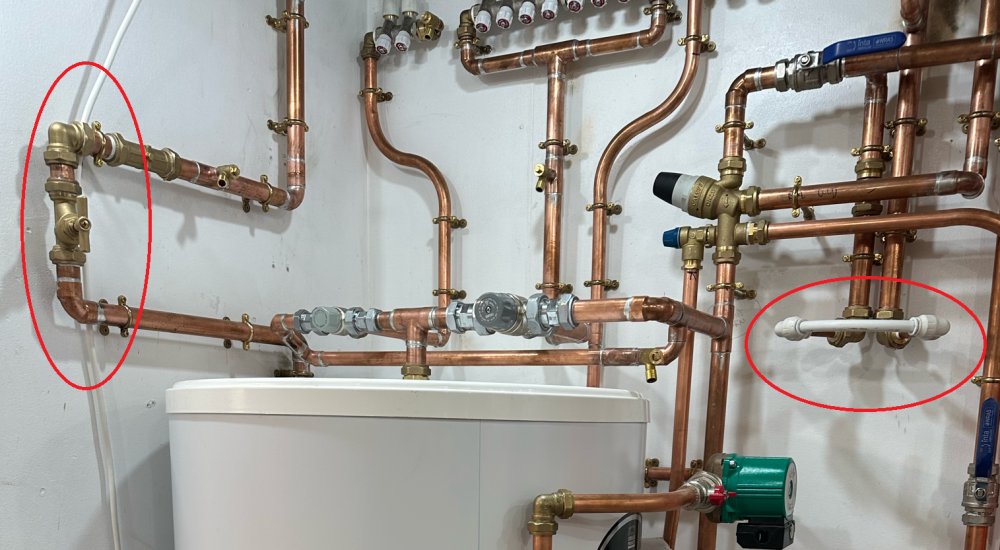
-
Sleeplessness and self-building and self-help
-rick- replied to ToughButterCup's topic in General Self Build & DIY Discussion
While I'm not building I definitely have times when sleep is a problem due to a brain that doesn't want to switch off. Definitely agree that finding something distracting to do in hour or two before bed helps (book, tv, game). While something relaxing can be good, I think being a distraction is the main thing, something that grabs your attention. Also, I find not eating within a few hours of bed and no caffine after about 2:30pm is important too. -
How much of that is the wood? Walnut is pricey, but so is the cost of getting someone to mill down your own tree. Curious how that stacks up?
-
It's a regs requirement isn't it?
-
Nice! Thats the first time I've seen the transparent blocking approach to having an open stair that complies with regs. Be interested how that works out (cleaning, etc). Handrail to be installed on the right?
-
Low points: and how to get out of them
-rick- replied to ToughButterCup's topic in General Self Build & DIY Discussion
Is this why @Onoff put so much effort into his gate? -
So the same situation as with Gas boilers then? John is optimizing to the maximum extent possible. But even unoptimised this new heat pump was outperforming his old (and he has written a lot about how his old setup was better than a gas boiler).
-
Related to this thread Alec from Technology connections just posted a long video on justifying the move to 100% renewables in economic and security terms (in the context of the US not UK). Not strictly the same point as @Beelbeebub is making but similar. Unless you have watched his videos before I wouldn't recommend watching. It's long and most of his points are likely well known to people on this forum but I still learned things. Stand outs: 1. For the amount of money spent on fuel to drive a petrol car during it's life he could buy multiple times (6?) the amount of solar panels needed to generate enough electricity to run the car in Chicago in winter time. 2. If you take the land area currently used in the US to produce corn that is used to make ethanol to go into fuel and covered it in solar panels you'd produce a multiple of the existing US annual electricity produce from just that area. 3. In terms of of how far you can drive a car, a wind turbine operating is outputing equivalent energy to a shower head flowing petrol.
-
Nothing is ever simple. But plenty of other countries have more sensible models for their energy pricing proving that moving to a more sensible model is possible. Any change takes effort and time though and with politics here being what it is, that has been in short supply.
-
@Mattg4321 Not quoting what you said because I'm not directly replying to your points but this is in response. Firstly, this I find this topic difficult to discuss, both because it is an emotive one with lots of strongly held views which means I want to be careful not to be misunderstood and also it's one where I have more casual knowledge. With some topics I dive into the detail and can feel relatively confident talking about them (I have a reasonable idea of what I know and what I don't). Here I don't. I've had to look up the definition of 'racist' and 'ethnicity' and neither precisely aligns with the common usage of the terms in my experience. Frankly from my perspective the precise definition doesn't matter but it's difficult to have the discussion without that. Looking at the definitions I still don't feel I can talk confidently about what an ethnic group is (the word is often used linked to race but the definitions focus far more on culture). My statement on english ethnicity doesn't necessarily stand up and should be read as a statement that there is no defining genetic/biological grouping for 'English'. Because I can't talk confidently about the topic I can only talk from my personal perspective. From that perspective Rishi Sunak was born in England and has a British passport, therefore he is English (and also British). Someone who says that because he has brown skin he is not English is being racist. I know KK is talking ethnicity and could argue that my definition above is about nationality but that doesn't hold up if you deny someone the ability to call themselves English or claim English nationality because of the colour of their skin which KK is effectively doing by saying Sunak can only be British. In my book, you can say Rishi Sunak is not 'White English' as per that form but you can't say he is not English. This is also quite off-topic and I've gone beyond my comfort level talking about this subject so this will be my last contribution here. It's debatable whether this adds anything of value and I almost didn't post but I didn't want to leave my previous statement without further explanation.
-
A white person born in england to two white immigrant parents would never be questioned as to whether they were English. They would look and sound like the locals and it just wouldn't come up. Making a distinction (and therefore providing different treatment) about someone due to the colour of their skin meets the definition in my book. There is also no such thing as an 'English' ethnicity. Nationality sure (though we are weird in this country with British being the formal nationality).
-
-
I read this as requiring the line be below 20kV and serving a single customer. (But I think this is just the Google summary, not checked the actual law).
-
The regs say kV - kilovolts, not kVA - kilovoltamps. Totally different things. I can see how this reg applies if they want to extend a 20/33kV line onto a pole near the property and pop a transformer on it. But if the existing line is low voltage already then this doesn't make sense. 23kVA is 230V x 100A, not 33kV x 0.7A Has someone at the DNO got their wires very much crossed? If you are in a garden of existing property it's not like you should need to go to a higher voltage due to distance.
-
White staining and welding on leadwork
-rick- replied to Great_scot_selfbuild's topic in Skylights & Roof Windows
That was my first thought on reading this thread. Didn't want to say anything earlier as my experience is limited (only seen the work done on the building I'm in and I wasn't directly involved in it). However, I agree, this looks awful compared to the work done on the roof of my apartment building. -
Many insurance policies include legal cover. Asking them for the legal help might be more valuble than talking about whether they care about the specific repairs. Would only go this far if normal push back on builders doesn't work. Mortgage company would be very interested in things that could affect long term value of the property but as a new build you should in theory already be covered and as long as the leak is fixed then the rest is cosmetic and I doubt they care about that. Not sure I would want to contact mortgage company for something minor like this (so long as the leak is fixed). All in, redoing this bit of plasterboard is not a huge or expensive job so as long as you are persistent with them consuming their time it will be cheaper for them to do the work rather than argue.
-
Are they defunct? The website they give in the video seems dead. www.sahp.info Whats the website in your earlier screenshot?
-
No practical experience so hopefully someone with some will be along but fill the gaps with foam? I guess you'd want something with a little give in it to allow for movement.
-
Have the precast slabs already been grouted? I thought the screed layer was often used as grout to tie everything together on precast? (Depends on how it's specified).
-
Excellent job (assuming the intention is to provide motivation to get on with the main job asap). Curtain on three sides must make it extra enjoyable to use!
-
Sounds like this switch is for the immersion. It wont heat up the house but will give you hot water. If the immersion was drawing 3kw when your wife flicked the switch off a small spark inside the switch is not terribly unusual.