

.jpg.c21f3ac78c9b7efd90cbdcb312744dc5.jpg)
jack
-
Posts
7462 -
Joined
-
Last visited
-
Days Won
41
Everything posted by jack
-
.jpg.c21f3ac78c9b7efd90cbdcb312744dc5.thumb.jpg.7adcad4c0e384f5ecd7d56b0618df6e5.jpg)
Total energy consumption per m2 per annum
jack replied to NSS's topic in Energy Efficient & Sustainable Design Concepts
So as usual, it's people that are the problem! Bloody people! -
I demolished your house, but I'm not moving the debris!
jack replied to laurenco's topic in Demolition
Every time I look in (twice a year, maybe), that thread is still in the top 10. -
Total energy consumption per m2 per annum
jack replied to NSS's topic in Energy Efficient & Sustainable Design Concepts
I took it as a pop at the people that couldn't give a toss etc, definitely not a pop at you. I take your point, but an EPC rating of A, B, C etc is supposed to be easy to understand. Maybe people just look at that but it doesn't mean anything to them, whereas digging only a small amount more would let them determine how much the house would cost to heat? -
I demolished your house, but I'm not moving the debris!
jack replied to laurenco's topic in Demolition
GBF?- 192 replies
-
- 1
-

-
- demolition
- cowboys
- (and 2 more)
-
soundproofing floors/ceilings in MBC timber frame
jack replied to Besidethewye's topic in General Self Build & DIY Discussion
How long are your spans though? Our bedroom is the room with the noticeable bounce, and has the longest spans in the house at over 5m (no other room has more than 4m). Also, one end of the joists in only that room sit on a steel that's about 7m long. If you walk past the chest of drawers, the mirror on top wobbles, so it isn't just me! There's some bounce in the other rooms, but it's is definitely worse in our room. Noise transmission is bad everywhere though. -
soundproofing floors/ceilings in MBC timber frame
jack replied to Besidethewye's topic in General Self Build & DIY Discussion
We have a surprising amount of squeaking in those areas where we didn't get around to screwing down the chipboard. Unfortunately, the main place this happens is our bedroom. Drives me mental. Once I finish the more important stuff I'll be pulling the carpet up and adding some screws to try and reduce it. I'm also a little surprised and disappointed by how bouncy the floors are. Again, this is something that no-one else in the house notices or cares about, but I find it distracting (I'm really easily distracted ) -
I demolished your house, but I'm not moving the debris!
jack replied to laurenco's topic in Demolition
Context Watson, context.- 192 replies
-
- 1
-

-
- demolition
- cowboys
- (and 2 more)
-
I demolished your house, but I'm not moving the debris!
jack replied to laurenco's topic in Demolition
Christ, what do you want, a Blue Peter badge?- 192 replies
-
- 2
-
-
- demolition
- cowboys
- (and 2 more)
-
I demolished your house, but I'm not moving the debris!
jack replied to laurenco's topic in Demolition
To be clear, is that what you're saying happened in this thread? -
I demolished your house, but I'm not moving the debris!
jack replied to laurenco's topic in Demolition
"Kneejerk empathy"? Good lord, what a hideous phrase! What's wrong with starting with empathy, then moving on to the best practical advice we can come up with collectively for the current situation, tempered with advice for those who follow so they don't make the same mistake? I'm sure you've learned plenty from the site - it isn't all just hugs and drum circles. And yet Jeremy candidly admits that several things went wrong, despite the fact he's clearly a highly capable human and spent a lot of time researching and planning. Bully for you. Sounds like you have it all worked out and everything will be perfect until the day you move in. Nevertheless, in the unlikely event you do hit an unforeseen roadbump, you can be sure there'll be kneejerk empathy and practical advice here if you want it.- 192 replies
-
- 6
-
-
- demolition
- cowboys
- (and 2 more)
-
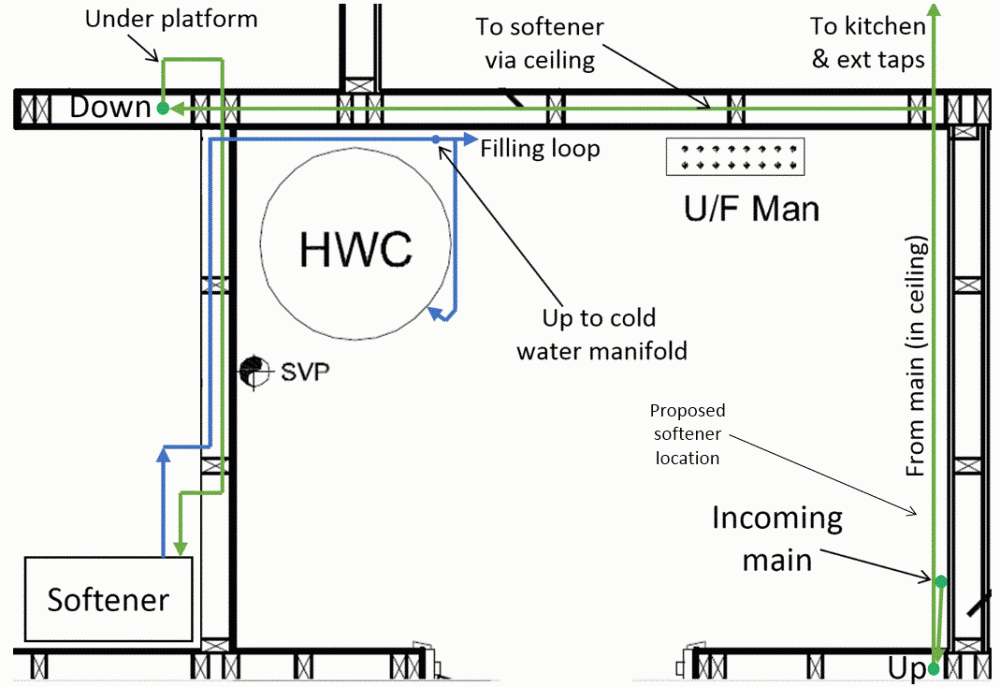
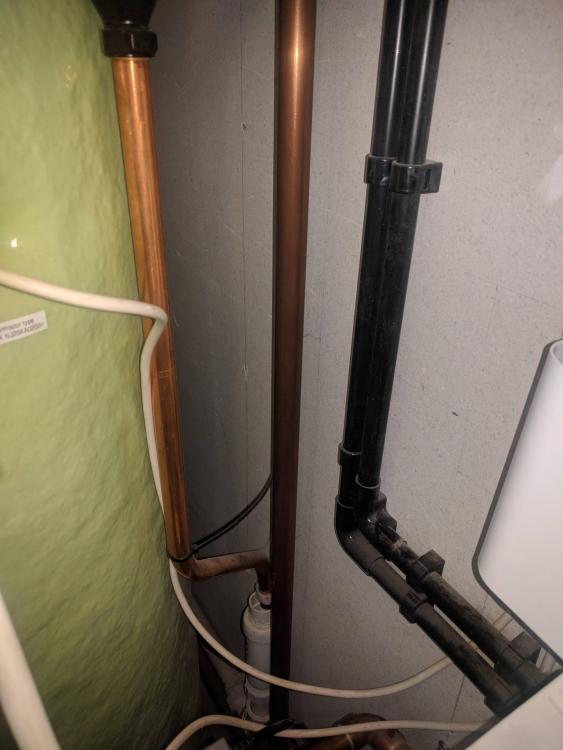
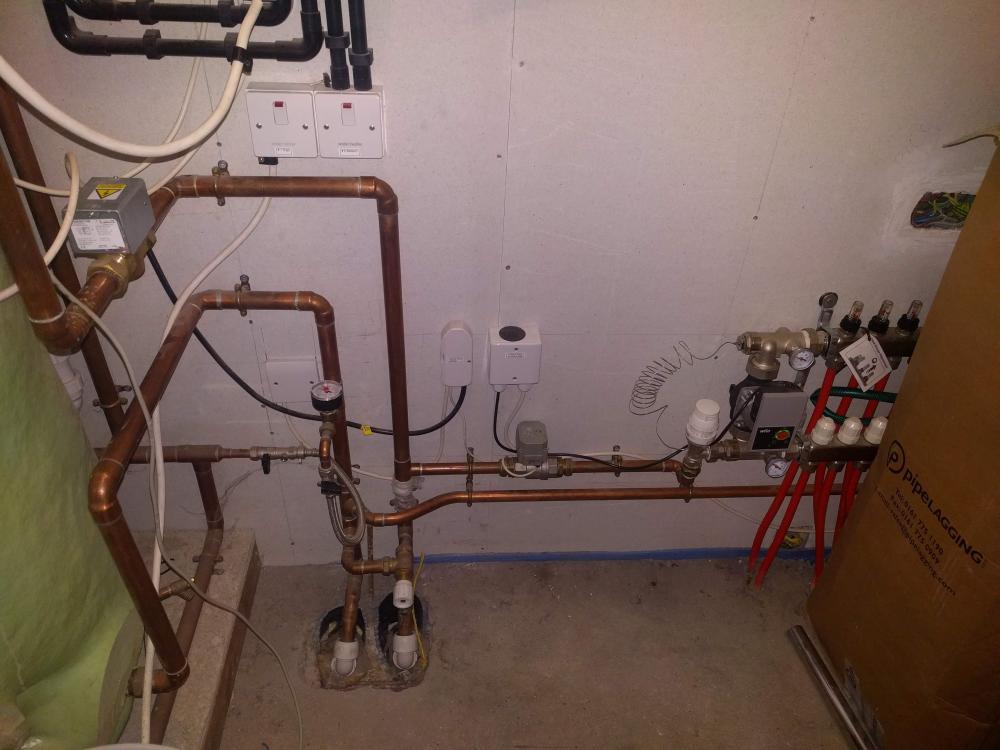
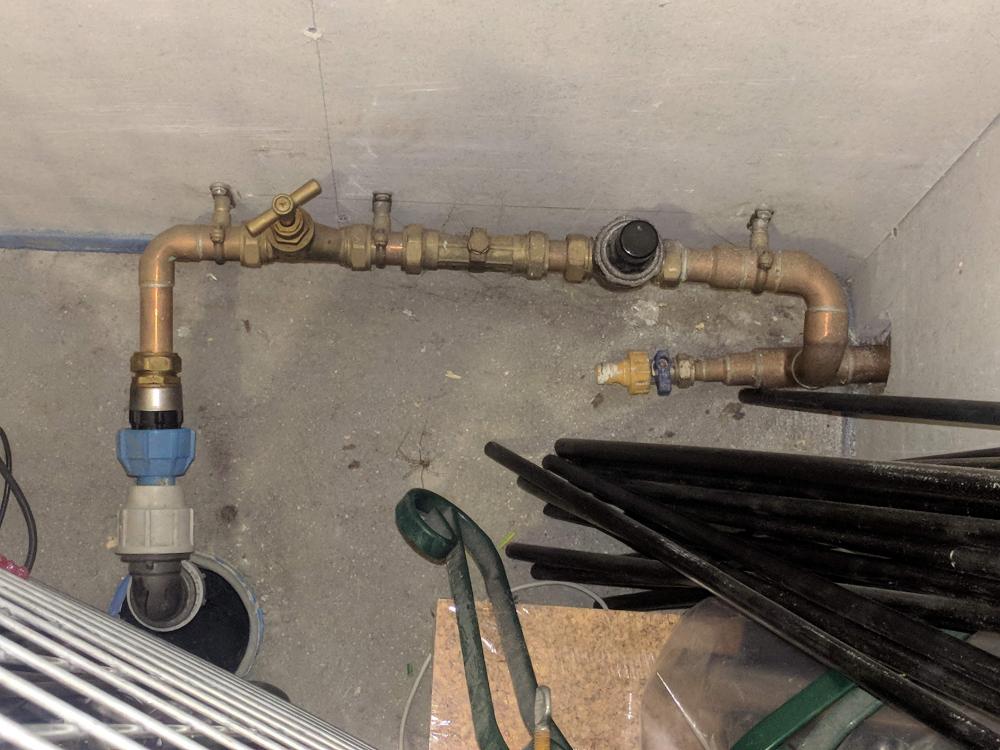
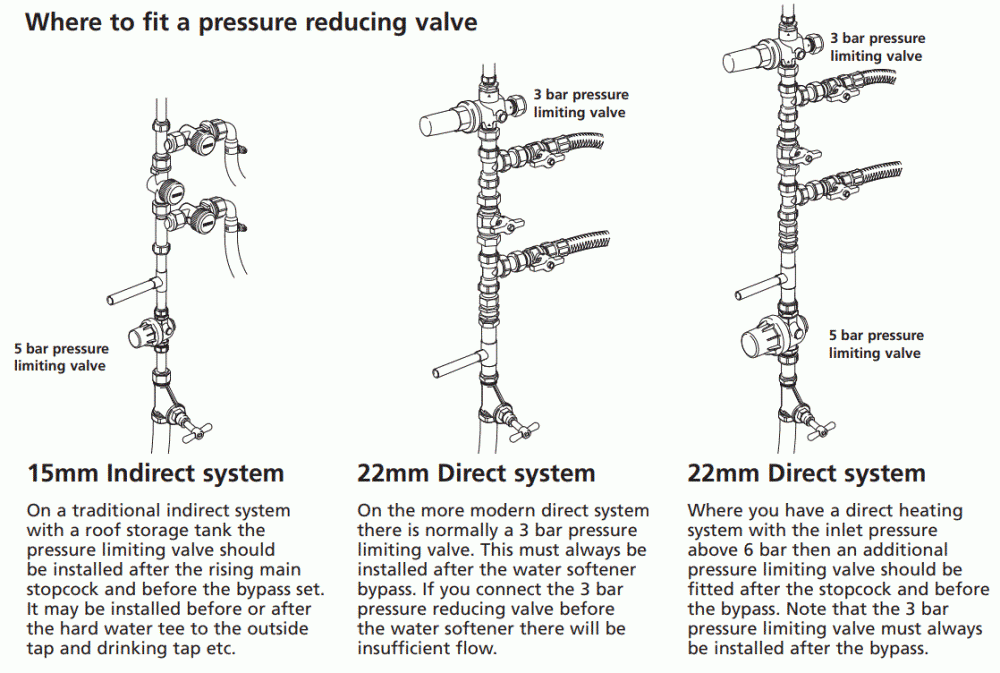
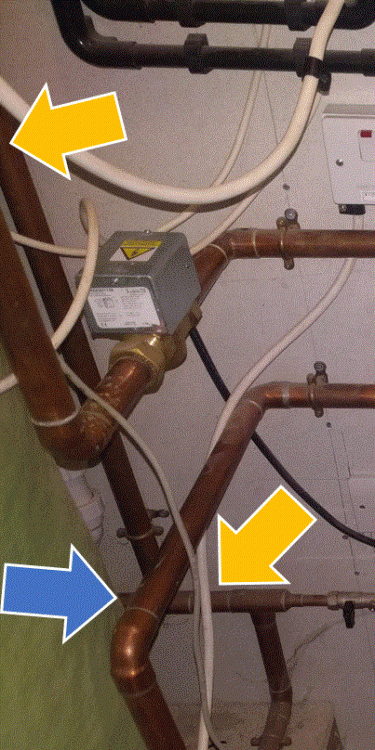
Grab a cup of coffee - even for me this post is stupidly wordy (although there are pics too). We were put on the spot about an installation position for our water softener during the build. That, coupled with a remarkably stupid set of decisions I made about plant room layout, meant it's ended up in a really inconvenient place in our utility room. We'd like to move it before we install built-in furniture in the utility room in the near future. I've located a potential new position, on a shelf (yet to be built) at about waist height in the plant room. It's good for the incoming main, less good for drainage, and possibly a bit annoying for connecting softened water into the existing pipework. Here's how it is at the moment: I haven't shown the existing drain from the softener, but it basically goes through the wall to the SVP. Just near the label "Up to cold water manifold loop" in the diagram above, there's an open waterless trap taking the output from the HWC tundish: Here're a photo of that general area (which is very congested - I'm tidying up all the wiring and insulating the pipework as part of all this): So now for the questions. DRAINAGE The initial thinking was a trap at the unit, running a drain along the right hand wall on the floorplan above, then hiding it in the wall along the top of the diagram above, before joining it to the drain from the MVHR which is on the other side of the wall north of the HWC. However, reading the installation details for our softener, the 10mm OD flexible drain pipe they supply can go up to three metres from the unit, and more if your pressure is above 2 bar (which ours is). I therefore can't see why we can't just join the flexible drainpipe to some microbore copper and run that on the surface of the wall at a slight fall to the open waterless trap that the tundish uses. It would be thin enough to slip comfortably behind the existing pipework. Anyone see a problem with that approach? There's also an overflow outlet, which they say should ideally go to the outside of the house, but which at the moment just discharges into a separate open trap beside that for the drain. Is there any reason not to just duplicate the microbore setup for the overflow and have that drain to the airless trap too? Might be a bit crowded, but presumably I can just attach a flared bit of pipe to the top of the trap to give some more space for everything to discharge into? WATER TO SOFTENER This should hopefully be relatively easy, because the softener is going right near where the water comes into the house: Presumably we could we just turn the first elbow after the PRV so that it heads upwards, then connect into that (see diagram from softener installation manual below). The pipe going into the wall would be redundant, and the filling loop could be reinstated just above the elbow. Edited: that won't work - still need the unsoftened water for kitchen and exterior taps of course! So slightly more complicated - need to either connect in where the current filling loop is or muck about with another T and moving one or both of the existing elbows downstream of the PRV. Criticisms? Better ideas? WATER FROM SOFTENER This may be the tricky bit. It seems to make sense to try and connect in the region between the yellow arrows (blue arrow shows existing soft water supply): I could take the softened water from the softener, up the wall, then along two edges of the ceiling (adjacent the wall) and down to an elbow into a T within this area. There's room - just - to do this. Again, any criticisms or better ideas? POSSIBLE PRV CHANGES At the moment, the PRV is before the water softener, which according to the installation manual isn't right. We have over 6 bar static pressure, so I'd like to take this opportunity to change the existing PRV for a 5 Bar version, and then put an adjustable TRV (set to 3 bar) and pressure valve after the water softener, as shown in the right hand example here: Seems reasonably straightforward to just replicate this going up the wall, yes? OLD PIPEWORK At the least, it seems I need to cut and cap off the branch from the T at the top righthand corner of the first diagram in this post, and do something similar near the blue arrow above. The plan would be to drain the dead leg between these two points as well as possible and then cap it off inside the wall/ceiling at each end. Anything else I need to consider with this? Another minor point: because this room isn't finished, I can still in theory remove wall and ceiling boards to access any of the existing pipework. Not sure whether that makes it any easier or opens up options for more creative solutions (eg, could I go up into the ceiling from the softener, turn across and connect into the redundant pipe going along the top of the north wall, then turn back over the ceiling and down to elbow/T in as described above. Quite a lot neater for not too much more work?) Sorry for the complexity of this question, but the current softener location has bugged us since the day it was installed, and this is our best chance to get it fixed before we finalise the joinery in the utility room and (finally!) finish the plant room. Oh, and my plan is to get a plumber to make the actual connections once I've got a precise plan, but feel free to try and convince me I can do this myself. Many, many thanks as always.
-
You can use a flexible (ie, film) plastic tubing for this. Cheap, but it can get shredded in windy weather.
-
I demolished your house, but I'm not moving the debris!
jack replied to laurenco's topic in Demolition
The concept is colloquially known as putting the contract in the drawer. Even so, for complex and/or long term commercial relationships, periodic contract review is often healthy. Agreed. We've all met poor tradespeople, and there are doubtless some gormless self-builders, but I can't see any point in unpleasant generalisations. Yes, with hindsight, a clearer agreed scope of works would have helped, and yes, possibly the demo guy is an arsehole who's preyed on someone who wasn't up on the finer nuances of demolition and waste removal. But we are where we are, and it's a FACT that without any written contract, the OP is put in a much more difficult position. The discussion is for his benefit (what does he do given he's here?) as well as for others who are reading this in the future before they engage a demolition contractor ("oh, I need a demolition contract that specifies who's taking the waste from the site"). Shall we just, as Declan says, take a breath and try to stay constructive? Sounds like a decent outcome, well done for dealing with it head on. And wow, £1900 quid back for the copper roof - sounds like he was getting an amazing deal before you pushed back!- 192 replies
-
- 1
-
-
- demolition
- cowboys
- (and 2 more)
-
I demolished your house, but I'm not moving the debris!
jack replied to laurenco's topic in Demolition
The worst contractor we had onsite, and the only one we ended up sacking 10% of the way through their job, was the outfit that did our brick slips. They were recommended by the company that supplied the brick slips and backing system, but in the end the people who did the work were basically labourers rather than the brickies that were promised. I've said on BH before that a bright 8 year old would have done a better job. I broached the subject of quality with them, reasonably forcefully the second time, even going so far as to offer to increase the fixed price to ensure they had the time to do the job properly. Despite assurances that the work would improve, in the end we had to let them go, which we did via text exchange on a Sunday night. They agreed it was the best thing, then in the next text told me how much we owed them (quite a lot, apparently!) for the work to date. Bearing in mind I was going to have to pay someone to undo the pile of shite that they'd left us with, I asked them to give me a breakdown of how they'd come to this amount, only to get a threateningly aggressive text saying that we knew what their day rates were (we didn't - it was a fixed price job), and to pay up immediately. Didn't sleep much that night. Got some advice from a family friend who's an ex builder turned project manager for big projects up in London: pay them and move on. The last thing you want is more stress over a few hundred quid. Even if you get them to reduce their costs slightly, you could still arrive onsite one morning to find a tin of gloss paint slung over your new windows and doors (this had happened to him on a job). Long story short: even owing someone money is no guarantee that you're in the driver's seat. Even if you can avoid paying them, you can still lose money, because you'll need to pay extra to undo the bad work, then possibly pay someone more to come in on an urgent basis to do the job right. Before we started the build, I'd read everything you'd said about yours. I remember feeling that by just following your lead we could avoid making any mistakes. Oh how long ago that feeling seems!- 192 replies
-
- 3
-
-

-
- demolition
- cowboys
- (and 2 more)
-
MVHR - flies!
jack replied to readiescards's topic in Mechanical Ventilation with Heat Recovery (MVHR)
No external filter on ours, and we rarely get anything in the internal filters that an external filter would have stopped. However, our inlet is on the flat roof over our garage, so possibly a little out of the way for casual insects -
I demolished your house, but I'm not moving the debris!
jack replied to laurenco's topic in Demolition
I'd have assumed at least the above ground stuff would be taken away, although it's always better when these things are specified up-front. Do you have anything at all in writing - even an email is good enough. It seems very unusual that they'd demolish, then go away while you clear, then come back and scrape/level. On the other hand, if they're saying you're responsible for getting rid of the spoil, then they've just officially stolen from you by taking the metals, windows, and wood etc that by their own argument was your responsibility. Up to you whether you want to push back. Our demo guys were nice enough but there's no way I'd have stood toe to toe with them in an argument.- 192 replies
-
- 1
-
-
- demolition
- cowboys
- (and 2 more)
-
At least they responded and gave an honest answer. Neither is necessarily a given!
-
Cost of creating 20 meters of site access driveway.
jack replied to epsilonGreedy's topic in Project & Site Management
+1 I nearly got bounced off one going over what seemed like a reasonably small bump at moderate speed. I hadn't strapped in because I was only moving it a short way, but it gave me new respect for what those big bouncy tyres could potentially do. -
soundproofing floors/ceilings in MBC timber frame
jack replied to Besidethewye's topic in General Self Build & DIY Discussion
Resilient bar -
soundproofing floors/ceilings in MBC timber frame
jack replied to Besidethewye's topic in General Self Build & DIY Discussion
Do whatever you can to reduce noise via the floors, imo. One of the things I'm disappointed by with our build is how bad sound transmission is from the (carpeted) upstairs floors. My noisiest, danciest child has the room immediately above my study and at times it sounds like elephants are being thrown around. If I were doing this again, I'd insist on a screed upstairs rather than relying on chipboard and sound insulation. That said, I'm highly sensitive to noise, and it doesn't really worry my wife. -
No, it's extracts from comments made in relation to a single test performed on a single installed unit (+ control installation) in Australia.
-
Fitting a Key Safe - Best Place
jack replied to Ferdinand's topic in General Self Build & DIY Discussion
That was the best one I saw. There are a few under different brand names that look familiar, from memory. Not sure if they actually contain the same "guts". I had to break into the property we were renting when we locked ourselves out. Climbed from a wheelie bin onto the flat roof over the kitchen, then used a screwdriver to lever open the PVC window to a bedroom enough to get in a bit of bent steel and turn the lever to open. In within 30 seconds! The takeaway was that even upstairs windows should be deadlocked, although I suspect that's of far less importance if you have decent wooden windows. -
Yes, it is. However, I can't see why the fact that you don't personally choose the website wording is relevant. One way or the other, your company is contradicting itself. If you know what she means, then can you please explain it to me? I understand what you mean by the desirability of keeping it collegiate. I'd prefer that option myself, but we've now had pages of dialogue without a straight answer to some pretty fundamental questions. I'd actually love it if it were shown properly that this system works, because that would mean that there's clearly something we don't understand about the chemistry of water and dissolved minerals. It would also mean an opportunity for getting most of the benefits of softened water without the cost of salt and the environmental impact of wasted water used for regeneration. I think you're probably right. This is about the fifth time I've responded where I've thought "that's it, if there isn't a straight answer this time, I'm out"!
-
I disagree that I've said or done anything unfair. @Polly told us earlier that she has a scientific background, so I assume that when she refers to a "colloidal suspension", she knows what that means. A colloidal suspension of aragonite comprises crystalline solids in water, so everything I've said on that point applies. @Polly has had several opportunities to correct my understanding, and/or clarify or add to her own statements about this. She's chosen not to. [Edited this section a bit after posting] No, not unfair. You've posted their quote plus my first sentence. The very next thing I said was: "And if your answer is that this phrasing is intended to involve a comparison with actual soft water rather than implying you're doing any softening, then in my opinion this sentence intentionally misleads through the use of "softer" instead of "soft"." I think the language intentionally misleads the reader to think that the water is being softened, rather than this being a comparison with softened water. That's my reasoned opinion, which I understand you might disagree with. I don't, however, think I've said anything unfair. Again, @Polly chose not to address this point. What about this, on the page you end up at if you click on "Domestic" from the home page: Seems pretty unequivocal to me. All that said, I posted a page or two ago that they may actually meet at least one definition of "soft" water. So why do they keep pushing the "we don't soften, we condition" line? Do they soften, as they say in the quote above, or do they condition but not soften, as they repeatedly emphasise elsewhere in this thread? I just want unambiguous language and straight answers to straight questions. If you think that's unfair, cool.

-
Fitting a Key Safe - Best Place
jack replied to Ferdinand's topic in General Self Build & DIY Discussion
We stayed in a holiday unit last year that used one of these (one of the most common units you see, with a very well known brand name and rotary dial code). As we were packing up to leave, we learned that my younger son had had a bit of a play with the key safe and accidentally changed the code before shutting it. After trying for a few minutes to open it with various combinations near the old one, I did an internet search to see how easy they were to get into. I was surprised to learn that a sliver of aluminium from a drink can and 30 seconds was all that was needed for me to get in on my first attempt. I reckon that with practice you could be in within 10 seconds. I spent a bit of time looking for higher security versions after this, but wasn't convinced about any of the options I could find. Personally, when we get around to this, I'll likely conceal a hardened, key-lockable version somewhere well out of sight in the back garden, and then put the key to that and the garden gate in a code-lockable one near the front door. It's only likely to be used in emergencies, as we have good friends and family nearby who keep spare keys anyway.
.jpg.c21f3ac78c9b7efd90cbdcb312744dc5.thumb.jpg.7adcad4c0e384f5ecd7d56b0618df6e5.jpg)


