marshian
-
Posts
1605 -
Joined
-
Last visited
-
Days Won
6
Everything posted by marshian
-

Increasing amount of hot water from immersion heater
marshian replied to Little Clanger's topic in Boilers & Hot Water Tanks
I think of it like that too - Loft temp in the spring/summer/autumn in daylight hours can regularly be above 30 Deg C for most of the day and has occasionally hit low 40's I have a data logger recording temp and humidity up there because I was concerned about pipes freezing in the winter after I moved the cold water tank to a better location and increased the length of all the pipework by 3m This winter (when temps are cooler) the plan is to increase the level of insulation up there which will lower the cold temps further -
Increasing amount of hot water from immersion heater
marshian replied to Little Clanger's topic in Boilers & Hot Water Tanks
We have a 114 Litre tank (Ish) we heat water once a day between 7am and 8am to around 50 deg (this fluctuates a bit because the water heating is timed rather than to a set temp point) This gives us enough water for 2 showers AM and 2 showers PM - I have data logging temp sensor at top of tank and another at the bottom However this means our graphical representation looks a little weird but fundamentally once the morning showers are done the water at the bottom of the tank is replaced with water from the cold store in the loft above Our energy usage in summer for water heating is much lower than the winter where the cold store tank (cold loft) is at a much lower temp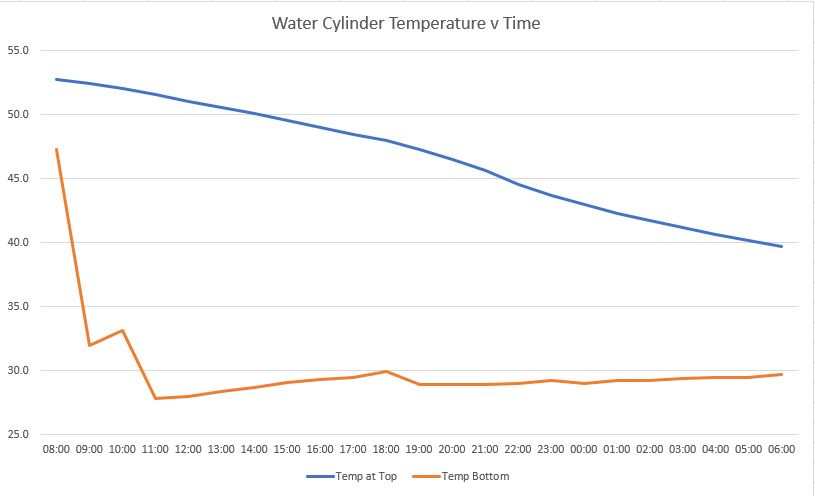
-
Assuming S or Y Plan - How close is that rad to the HW tank return to the boiler pipework? (is it just pipework stealing heat by convection?)
-
Mains Water Usage - What do you use?
marshian replied to Ferdinand's topic in General Self Build & DIY Discussion
Old topic but I got our water bill today and we used 97 Litres per person per day (70,500 litres per year) Previous years have been consistently around the 110 Litres per person per day The one outlier was 2021 when I'm pretty sure a leaking cistern (that I hadn't noticed) drove up the usage to 160 Litres per person per day -
A - Restrict the feed with an isolation valve? B - Add a small length of capped pipe vertically before the cistern connection - creates a pressure absorber with no mechanical parts to worry about Upstairs in my house the toilets are all gravity feed so no issues with shut offs causing pipe work noises - downstairs I have one on mains pressure I tried A but it was still filling very quickly and causing pipework noise so I did B and that made the pipework silent
-
How to calculate heat load…
marshian replied to G and J's topic in Energy Efficient & Sustainable Design Concepts
Stick your postcode in here https://www.degreedays.net/?gad_source=1&gclid=EAIaIQobChMIsoL13PmohAMVG7CDBx27swedEAAYASAAEgJ_bPD_BwE Will find the nearest weather station to you and if you want you can download the temps by hour for up to 36 months or HDD data as a value by day Excellent data resource for me as I have 3 weather stations within 10 miles of me The HDD data I find really useful to compare if improvements (Boiler/insulation etc) are working or not - my base line target is 3.7 kWh per HDD - if I use more than then I've left a door open or I've got my boiler set up wrong!!! -
The other tip I got years ago to stop wood splitting when nailing close to the end was blunt the sharp tip of the nail (turn it upside down - sharp side up on a hard surface and hit it once with a hammer to flatten the point) - it's always worked for me (I think the theory is it crushes it's way thro the wood rather than forcing the wood around the nail which then forces it to split if close to the end)
-
How to calculate heat load…
marshian replied to G and J's topic in Energy Efficient & Sustainable Design Concepts
No idea but once I'd got the basics right and refined the ACH to a more sensible level it was pretty damn close in terms of heat loss - Annual usage was probably a little higher than actual but I did make a couple of errors - one room somehow I screwed up the wall heights and it's heat loss was huge compared to the adjacent room. My only advice is check and check again until you are 300% happy with everything before generating the final report. I didn't know there was a free version but I was very happy with the detail provided from the paid version - it produced a 25 page report broken down in sections covering lots of aspects. -
How to calculate heat load…
marshian replied to G and J's topic in Energy Efficient & Sustainable Design Concepts
Sorry for threadjack - it happens it's not meant to Sign up here https://heat-engineer.com/home Pay £12 and use their online tool - all you need to know is house dimensions and u values for the fabric of the building It will give you your heat loss at pre-determined external temp and annual energy demand -
How to calculate heat load…
marshian replied to G and J's topic in Energy Efficient & Sustainable Design Concepts
Happy to take one for the team so to speak 😉 OT - Which Viessmann did you go for?? -
How to calculate heat load…
marshian replied to G and J's topic in Energy Efficient & Sustainable Design Concepts
Trying to optimise an unsuitable boiler to be as efficient as possible on Ch as well as HW - I went down a rabbit hole looking for Alice and was doing DHWP manually With new boiler I'm back to once per day - once I have DHWP and Weather comp working I'll run with once per day as the start of the heating period and then happy with the results/efficiency I'll go back to monthly (I hope) -
How to calculate heat load…
marshian replied to G and J's topic in Energy Efficient & Sustainable Design Concepts
Do you want the full sad story or the precis? I'll stick with the precis I think but in a nutshell I've been a smidge OCD with meter readings (for smidge you can expect very OCD * See Note) Summer water heating is easy to measure no CH to worry about and our daily kWh usage averages out at 4.2 kWh Winter water heating needs a bit more input energy wise - mains water is colder - loft tank is colder and boiler starts from a lower ambient temperature but a bit of math has that as a factor of 15% increase so 4.8 kWh as a daily average Roughly 182 days a year at 4.2 = 766 kWh 182 days a year at 4.8 = 876 kWh Annual Gas usage 7800 so HW (766 + 876) is 21% of the total used Cooking whilst a small percentage is also easy to work out when you aren't using CH or HW Only two people in the household typically 2 showers each daily and Mrs BC likes a long hot bath once a week - ~112 Litre Hot water tank heated to 50 every morning and normally lasts 18 hrs *Note - Just to clarify how OCD - During the course of 2023 from Jan 1 to Dec 31 I have 1,658 meter readings tabulated in a spreadsheet (cross referenced against HDD and House/Water temps and boiler parameters) -
How to calculate heat load…
marshian replied to G and J's topic in Energy Efficient & Sustainable Design Concepts
I did a similar activity when validating my heat loss calcs - compared it with heat input once all the rooms were at target temp on the coldest day we during winter and it was pretty close. Enough for me to be confident that my replacement boiler didn't need to be 24 kW. We traditionally heat only before we need it (mornings and afternoon/evenings) I wasn't confident enough to purchase an 11 kW boiler so settled for a 16 kW version (min output for 11, 16, 19, 25 or 32 kW all have the same 3.2 kW minimum) -
Fixed Speed or Modulating (CH/HW Circulation pump)
marshian replied to marshian's topic in Boilers & Hot Water Tanks
Old Pump - Grundfos 15/50 Selectric 3 Speed (it was 25 years old to be fair - purchased in 1999 for £47.99 as a direct replacement for the previous 15/50 which was fitted when the house was built in 1982) This has been replaced with DAB Evosta3 60/130 DAB PN - 60193271 Max Flow rate - 3.6m3/h Max Head 6m -
How to calculate heat load…
marshian replied to G and J's topic in Energy Efficient & Sustainable Design Concepts
When I did my heat loss study it used -2.3 based on location (Norfolk) -10 is a little bit OTT for East Anglia The Heat study came out at 14,500 kWh per year for CH and HW (HW was assessed at 3285 kWh of that overall figure) However they use a really high ACH rate due to the age of my house which I disagreed with (it has quite an impact) Our overall gas usage per year is down to 7800 (CH and HW) CH is 77.5% of our usage, HW is 21% of our usage and cooking is 1.5% -
Fixed Speed or Modulating (CH/HW Circulation pump)
marshian replied to marshian's topic in Boilers & Hot Water Tanks
Yeah the flow rate info and head is quite useful info - it's actual consumption is also handy I don't think it's actually as powerful as the old 15/50 so was expecting to have to run it a little faster speed wise ( I need to do a little experiment to confirm that) House does have two separate roomstats - one in the hall which if that ever gets to target it will turn off the boiler and one in the main living room which takes a fair while to get up to temp due to room dimensions and rad position (Long room - single rad at one end) -
Fixed Speed or Modulating (CH/HW Circulation pump)
marshian replied to marshian's topic in Boilers & Hot Water Tanks
Useful comments I'll try to get my head round that - thank you Rad circuit is very well balanced (EB4 TRV bodies with flow restrictors so every rad pretty much gets the flow it needs at a sensible flow temp) Main flow and return is all 22mm copper with just 15mm copper tails from the flow and return to the rads (it's all lagged below the ground floor with decent foam lagging) no microbore or plastic anywhere. I'm pretty sure I know what to set the weather compensation curve up from a slope perspective the last few years I've managed to bring the previous boiler flow temp down from 80's to low 50's but any lower was pretty much a bust as min flow temp was 39 (38 was off) and even range rated to 10kW it's initial fire up was 75% of it's max (24kW) so it very quickly shot past the set point if less than 50 was tried The Viessmann system boilers are four pipe (I'm pretty sure) as well as not fitting inside a 300mm Kitchen wall cupboard - I didn't want the disruption of ripping up floors to run a second flow and return for the HW element of the boiler when a heat only with DHWP can do the same with a two pipe set up. -
Fixed Speed or Modulating (CH/HW Circulation pump)
marshian replied to marshian's topic in Boilers & Hot Water Tanks
Sorry should have stated that DHWP was because I'd had the boiler set up with weather compensation - Long story but the Viessmann specialist didn't quite understand what I was asking for and didn't even know about the HW demand box that tells the boiler it's doing HW Currently S Plan with NC valve for HW and NC valve for CH (this one is being swapped out for NO valve to finish the set up properly) I'm reluctant to dump all the TRV's yet but if I find I can run without and just keep the EB4 Bodies which have internal flow limiters and put a decorators cap over them I will By Pass valve is a legacy of the old boiler which unless I had a little bit of flow thro it the boiler stalled in warm up and short cycled like crazy once the house was coming up to temp due to 4.5 kWh heat loss and 10 kW min boiler output was planning on having it set so it only opens when there is just one rad still calling for heat....... -
Recently changed the house boiler From Flexicom 24HX (24kW with a 2.4 Modulation - ie 10 kW min) (Set up as Y plan) To Viessmann 100W 16 kW with a 5.0 Modulation - ie 3.2 kW min) (Currently set up as S Plan) Both are "heat only" boilers but the Viessmann (once the rest of the parts arrive) will be set up to run DHWP During the commisioning process the old Grundfos 15/50 pump speed lever sheared/failed and the pump was jammed on max speed. I was going to replace it with another one identical but it seems only refurbished ones are avaliable so as it's 20 years old and given excellent service I'd rather get something new. I've now replaced it with DAB Evosta3 which has three modes of operation Regulation with Proportional Differential Pressure (3 Speed or 6 Speeds) Regulation with Constant Differential Pressure (3 Speed) Regulation with constant curve (3 Speed) My brain can't cope with this level of options House has 13 rads all with TRV's and there is a ABV in the airing cupboard that will need adjusting once the autumn/winter/spring heating requirement kicks in I currently running it on pump speed 1 as I'm only using the boiler once a day for HW Any help in understanding what would work best
-
I'd definately do that..... I'd also be seeing if 1. Store temp was actually 52 or something much lower 2. What temp it was heating the store to on the legionaires cycle Quick on line math ignoring the COP of the heat pump from here https://www.omnicalculator.com/physics/water-heating Store temp 50 at start Store temp 60 at end Volume of water 300 L Energy required 3.5 kWh So 41.6 kWh is bonkers
-
That's a hefty wack of energy on a weekly basis I do a legionaires cycle once a week to coincide with Mrs BC's Friday bath - I heat the 114 litre tank to 60 deg instead of the normal 50 and the energy used is between 3.6 and 4.5 kWh depending on tank temp at the start. I heat it 1 hr before it's needed so the tank sits at 60 deg for that time I do have a vented system but have no concerns about storing water at 52 degrees - if Mrs BC didn't want a Friday bath I wuldn't bother to do a sterilising cycle - we use pretty much all the HW on a daily basis Some good articles here https://www.heatgeek.com/hot-water-temperature-scalding-and-legionella/
-
A couple of years ago it took me several months of every weekend to do the insulation retrofit install on my suspended ground floor. Working from the crawl space under the house (I had finished floors in most of the rooms that I was reluctant to rip up, ceramic tiled and oak boarding) but I have absolutely no regrets. It has had a bigger individual impact on energy reduction than double glazed windows, cavity wall or loft insulation did. I only wish I'd done it 33 years ago when we moved in to the house - I was younger, fitter and it would have hurt less!!!
-
Suspended Timber Floor insulation - critique my plans please.
marshian replied to SoliD's topic in Heat Insulation
I did very similar and I used treated tile batten to hold the PIR up (I did all my insulation from below the suspended floors as I have a 2-3 ft crawl space.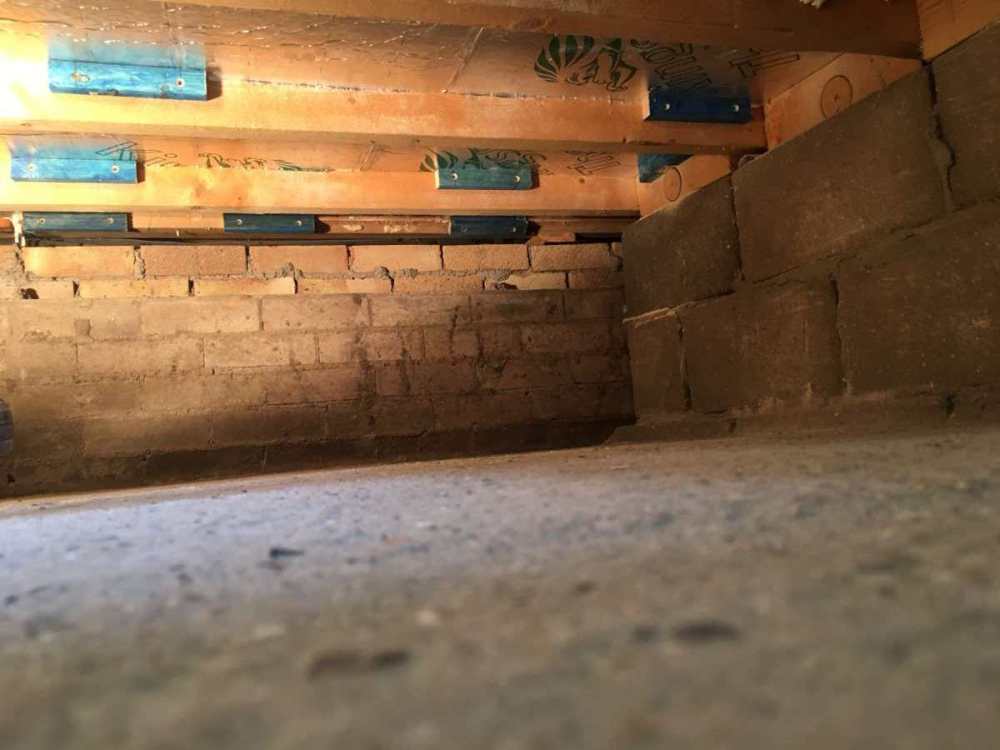
-
Replacement of domestic steel gas pipe between gas meter and kitchen
marshian replied to DaveAF's topic in Gas Pipework
I have a steel pipe in the same configuration - well actually slightly worse - I have three legs on it 1. Boiler (1m Max) 2. Old gas fire removed and pipe capped (5m Max) 3. Kitchen hob (2.5m Max) It's been like that since the house was built in 1980 - Having a suspended floor and access to underneath I can confirm there has been negligible external corrosion over the past 40 plus years However I've never had boiler cover other than a manufactures warranty (same goes for any other electrical appliance where "extended cover" is available. I effectively self insure I divert a small sum every month to building society account to cover repairs/replacements for anything that breaks. As a result next week I'm replacing my boiler (which is 15 years old) before it fails - I'm not having to fund it on a credit card - it's a well researched choice (my current boiler was probably a poorly researched choice at the time) and is coming out of the "household fund" I've also previously done the same with pet insurance which is always a battle to keep to an affordable level as pets get older (although I recognise that this is probably a higher risk process) It's quite surprising how much people do pay on appliance cover - my neighbour does everything that way and he said his monthly cost was £260 - I put away £100 a month and it seems to work for me I may reduce that once I've paid the balance on the boiler replacement as it'll have a 10 year warranty but as it's going to be down to £550 (ish) I may keep it the same till it's built up above £1000 again -
@JohnMo my thanks also for that handy tip - could not work out how to tag users - so simple now you've pointed out how to do it