marshian
-
Posts
1605 -
Joined
-
Last visited
-
Days Won
6
Everything posted by marshian
-

Baxi 105e Instant-end of service life advice please.
marshian replied to FlatMax's topic in Boilers & Hot Water Tanks
I did the sane thing many years ago - had a glow worm boiler that had given sterling service so chose another glow worm the same KW rating - it was a big mistake!!!! I didn’t take into account insulation improvements to the house, SUDG, CWI improved Loft insulation etc boiler was massively oversized - couldn’t do DHWP, had a terrible modulation level 24 KW max 10 kW min and as a result cycled like a twat in shoulder seasons and wasn’t that great in the winter either find a better boiler as @JohnMo says - preferably with same pipework configuration and flue position and get some real benefits and savings with a better modulation -
Better way to control water UFH system?
marshian replied to Munchincocopops's topic in Underfloor Heating
What make and model boiler - does it have the functionality to do DHWP (Domestic Hot Water Priority) if it does then you wouldn’t have to run the boiler at 70 deg all the time just to satisfy the HW tank recharge temp required you coud probably drop the boiler temp to 60 - 65 and still get a decent volume of HW at a slightly lower temp storage -
If we are talking about basic plumbing (not derogatory term - just simple basic plumbing) then 30 years ago I was in the same boat....... I had two poor jobs done by local plumbers which disappointed me - a lot - despite paying what I thought at the time was a high cost for a half days work. I decided like many DIY aspects that if I couldn't get a decent job done by a professional I would buy the tools I needed to do the job myself as I needed them. With a little research from books originally and later from the internet with a little practice I trained myself to gas solder copper, later to bend pipes to reduce the number of joints (aka risk of failures) and most recently bought a pressfit tool which is a bloody game changer for my next job on the list. Unless of course you are time constrained in which case you have my sympathy for the lack of interest.
-
Sorry about that - I’ll see if I can delete my post
-
Mine is set up with normally open on the CH side normally closed on HW side call for HW opens the normally closed on the HW and signal from the now open HW valve tells the CH valve to close but I guess it can be done in other ways I liked the simplicity of valves being exercised all year (ie in summer when the CH valve would do nothing for months) and both valves only consuming any power during the short HW recharge period
-
What type of Thermostat if any?
marshian replied to RichardDIYPlumber's topic in Central Heating (Radiators)
Indeed............ -
^ WHS - your heat loss determines your cost to heat the house - how you put that heat into the house doesn't matter Std scheduling of central heating in the UK are normally 10% lower than 24/7 heating but if your boiler can modulate to a low level and you run lower flow temps the consistant temp profile can reduce that 10% I could go back to scheduled heating and get a 10% reduction in my energy use but it would save me just £15 in gas over a year - that's not even a decent evening in the pub If you improve the heat losses of the building (Improved insulation or insulation under the floor then you can expect to reduce the cost of heating the house because you've reduced the "heat loss"
-
What type of Thermostat if any?
marshian replied to RichardDIYPlumber's topic in Central Heating (Radiators)
Just as we did before TRV’s were even a thing 😉 -
As @JohnMo said heat moves to cold - Insulation can slow down the movement I would not consider an overlay UFH system on a ventilated sub floor unless there was insulation under the sub floor and that's a very disruptive process if you are living in the house @Sparrowhawk and myself have both done it and the improvement is great in terms of energy saving but it requires careful thought and preparation - sub floors are vented for a reason You really need to do a room by room heat loss - if you have this information you can size radiators to the room requirements and flow temps to maximise boiler efficiency - this video from Urban Plumbers will help to simplify the process of room by room heat loss I'm running flow temps in low 30's - Return temps are mid to high 20's - Boiler efficiency is 97.5% when doing CH To get to this position I know exactly what my heat loss is in every room at -2.4 Dec OAT I have no UFH it's all radiators in all 13 rooms. The radiators are all sized to match the heat loss at low flow temps (Boiler is weather compensated and DHWP) Every rad has the correct flow rate supplied by Danfoss RAS-B2 "pressure independent" TRV valves - I have all TRV's set to max (ie no intervention to manage room temps) If you don't know your room by room heat loss you can't size your rads correctly for each room If you've oversized rads you'll get overheating and need TRV's to manage room temps - this will shrink your CH circuit and result in more cycles so more energy used If you've undersized some rads you need to up the flow temp to get those rooms to temperature - this will result in rooms where rads are correctly sized overheating so you'll use TRV's to control the overheat and it's the same result as over sizing rads It's all just maths at the end of the day and it's not even difficult maths
-
What type of Thermostat if any?
marshian replied to RichardDIYPlumber's topic in Central Heating (Radiators)
You could just shut the valve down to restrict the flow and manage the room temps Hot swapping rad valves without draining down can be done - but you need plenty of towels and everything near to hand -
Still working out which is best. Until the Wiser I've been running on manual boost as required, now exploring other options. One of my rooms has pretty much all its two external walls as not thermally broken aluminium double glazed floor to ceiling sliding doors and is hugely lossy. I don't really use the room so until now I've not be actively controlling the temperature there (just leaving some radiators relatively low and the room gets whatever heat comes from them when the heating is on for the other rooms). This arrangement has its downsides and I'm hoping that the efficiency gain of being able to run the boiler at a lower temp offsets the additional gas that I expect to need to regulate that rooms temperature (early signs not inspiring confidence). Edit: I opened your big boiler journey thread earlier, not (re-)read it all yet but plan to. Thanks! Sounds like you have a similar issue to one of my rooms Good luck reading the Viessman thread it's taken me a while to get to grips with it!!! It's still got some niggles!!! Yep I think they can be good but they also a layer of WTF which can be confusing Came across that one in the wiser forums. Opinions are mixed as to whether it's a benefit on a good modulating boiler. (Mine goes from 30kw to 6kw) Edited 7 minutes ago by -rick- It's not really anything to do with the boiler ability - more an algorithm in the Wiser control program - it's especially bad with multiple "smart" TRV's and 24/7 heating but it can just as easily do the same with a single room stat Main Room with thermostat (or multiple rooms with "Smart" TRV's) get close to target temp and Wiser switches off the boiler - it's one of the reasons my Wiser hub doesn't have a connection to the boiler now - I'm running 24/7 with WC and TRV's are set to temp limiters (just above target temp - so it was interpreting that as potential house over heat and shutting down the boiler Switching it to "oil" reduced the frequency of that intervention - it's just something to bear in mind when setting target temps or placement of the thermostat. I'm still a fan of the Wiser system - I've just dialed out the clever - I don't need or want ECO I'm running flow temps below 35 deg - I don't need Comfort because I'm not scheduled heating slots and WC is doing all the hard work. The App interface is brilliantly simple just don't try and make it complicated
-
Was not aware of that - thanks for the heads up
-
Sorry I was directing the question to @gaz_moose My wiser unit isn't connected to the boiler at all - I'm heating 24/7 😉 Boiler is set up with DHWP and WC already Wiser schedule for HW switches the boiler to recharge the cyl via a HW Demand box so there is actually no need to connect Wiser to the boiler. I will eventually connect it again just to use the away function but right now I just use the Viessmann app to do that...
-
Having had Wiser for a few years now and gone down the route of smart TRV's and micro control of rooms my advice is keep it really simple if you are running a scheduled heating process (if 24/7 ignore me) 1. Set up base programme for Heating and Hot Water like you would an older digital programmer 2. Device lock the Room Thermostat (so it can't be boosted accidentally - this is a fun game for all the family) and control in the app 3. Make sure the away facility does not apply to HW 4. Steer clear of ECO and Comfort Modes until you are very comfortable with the system 5. If you notice the boiler being turned off mid cycle - change the boiler type to Oil.
-
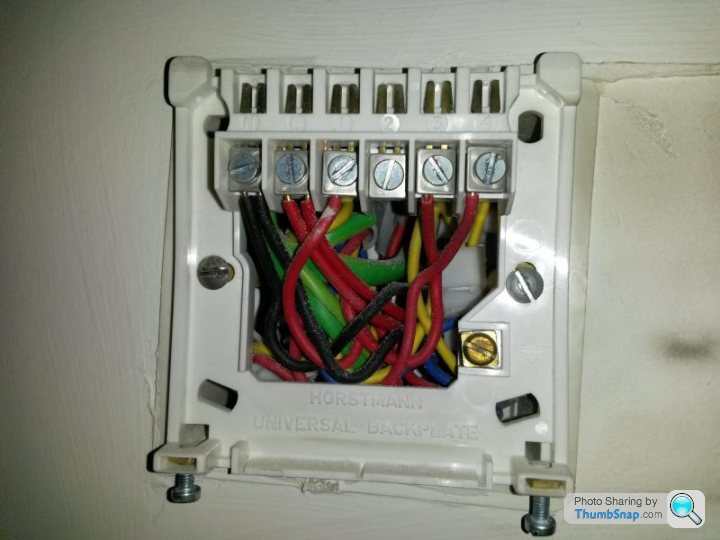
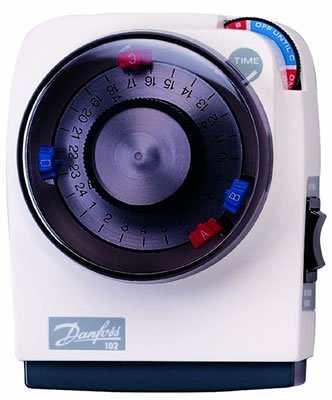
Is your old controller base unit mounted on a universal backplate - sometimes called industry std backplate? If it is a wiser hub should be easy to install no "gas safe" engineer required I replaced my original controller below (library image as the original item got trashed by a toaster - don't ask some people are just stupid) With a Danfoss 24/7 digital programmer that had a universal back plate - so I had the headache of working out what the wires did what on the original. No smoke escaped from the wires so once done further swaps of the controller have been isolate power - remove old - replace with new and power up.
-
@damspt That looks like a decent sized tank - has it got a declared capacity on the side label? I'm struggling to understand how 3 showers exhaust the HW - we can have up to 4 showers per day from a tank that is 115L and only heated once a day to ~50 deg C Have you got a HW circulation loop running? A loop that ensures HW is avaliable instantly at the taps without running lots of water first - they can be horribly parasitic in terms of depleting available HW if they aren't minimised to "TOU" (Time of use)
-
Unless you get TRV's on UFH I reckon the comment below confirms it's all rads
-
Or 1. heat the water to a higher temperature in the cheapest period 2. Change the tank for one with a larger capacity
-
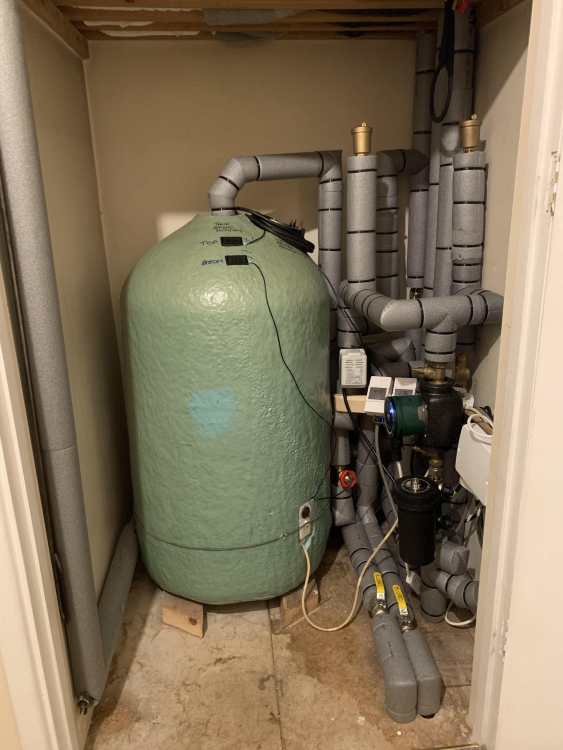
Ignoring the unusual behaviour the boiler occasionally has........ I've done some changes to the system configuration it was covered elsewhere but I though it would be handy to document it here as well I've replaced all the Drayton EB4 TRV Bodies (6 position variable orifice) with Danfoss RAS-B2 TRV bodies - these are "Pressure Independant" flow regulators with flow rate settings of between 10 L/Hr and 135 L/Hr (max flow rate) The aim of the changes was to convert to fully open system and stop the Wiser TRV's from intervening on the 4 rads where I couldn't reduce the flow enough with the EB4 bodies (even on the smallest orifice setting) Once I've got stable room temps as a result of the correct flow rates for the WC flow temp the Wiser "Smart" TRV's are being removed and replaced with std Danfoss ones - Hopefully I can recover some on the cost with selling on a well known auction site. I also took the opportunity to re-configure the "Plant Room" (OK Airing Cupboard - picture below) 1. London loop on the HW outlet of the tank (early days but it already seems to have reduced standing tank losses) 2. Re-pipe the bypass so it's after the CH zone valve (it was before so when I restricted the flow thro the HW tank coil it opened the damn bypass and defeated my efforts to slow down the flow thro the coil!!!) 3. Combined 22mm Feed and vent for CH (removing the old 15mm feed) - it's solved all the issues with air ingress and got rid of another pipe in the cold loft 4. Generally remove a load of joints (from previous versions being adjusted) and clean up the lagging 5. Replaced a compression fitting with press fit that was used as an emergency fix years ago!! Outside the Plant room 1. Convert all the panel rads to TBOE from BBOE with Danfoss RAS-B2 flow control TRV bodies 2. Covert the vertical rads and towel rails to Danfoss RAS-B2 flow control TRV bodies and reconfigure the pipework
-
I have wiser too - the app is pretty good - the system is fairly reliable and if you just want the ability to remote switch on or off it's a pretty simple interface - Just one word of warning I went down the route of "smart" TRV's on every radiator - I'm now unwinding that and fitting "dumb" TRV's on every rad (battery life and simplification of the schedule now I'm running WC on the boiler are the main drivers for this - they are just "fancy room temp sensors" once you run a weather compensated flow temp.)
-
Why is your usage low between 10:00 and 3:30 are you running a set back temp during the day?
-
get some temp (and humidity) displays for the main rooms - they aren’t expensive and run on cell batteries that last a year
-
Isn't that what I said??
-
You don't need detailed apps - you just need to understand the process that is going on regarding your DHW and CH Example if it helps (Gas boiler) I heat my water every day at 6.00 am to 6.30 am - as a result of this I can download the half hourly energy data from Octopus and I know that the duration and energy cost of providing the house with DHW I'm running CH 23.5/7 (with DHWP "Domestic Hot Water Priority so for 30 mins my house doesn't get CH) with WC We still cook with gas but that's pretty much a constant and only amounts to 1% of our annual energy usage
-
WHS ^ After Council Tax the Central Heating "CH" and Domestic Hot Water "DHW" costs are the biggest expenditures in running a home (excluding food because it's based on household size) Minimising those costs can result in a decent annual saving. @damspt what room temps are you targeting - one of the benefits of a low temp heating regime (be that ASHP, GSHP or low temp gas boiler) is you can reduce room temps compared to traditional UK scheduled heating regime where you blast the house with heat during times of occupancy and then allow it to cool down outside those periods. I'm running Bathrooms at 20, Living spaces at 19 to 20, Bedrooms at 18 to 19.5 and all other areas 17 to 18. Moving from room to room you don't notice the small temp differences and the whole house feels "comfortable"