marshian
-
Posts
1605 -
Joined
-
Last visited
-
Days Won
6
Everything posted by marshian
-
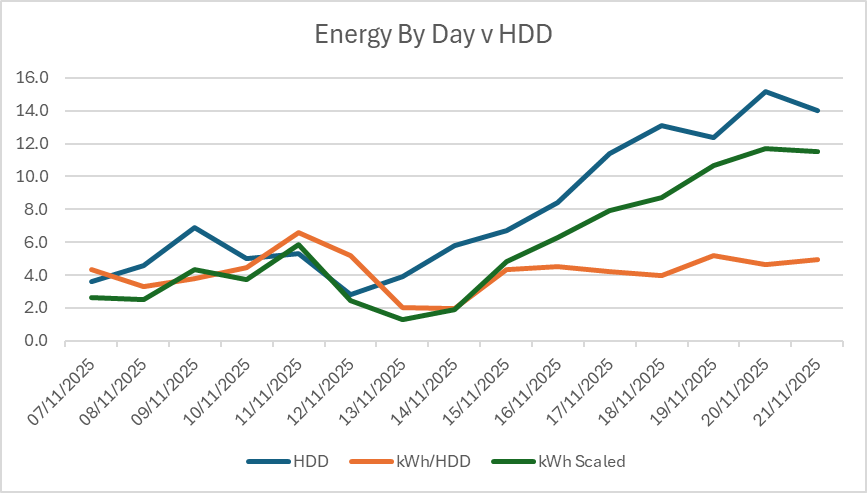
 JFYI No DHW energy usage is included in “total kWh” per day in data above it’s not contributing to space heating so I remove it for HDD calcs - my target is 4.0 kWh per HDD - most of the time heating 24/7 I’m in the ball park (it does trip above when there are significant changes in OAT over a short period of time)
 -
Base is 16.5 (once daily average temp falls below this heating is required - have a few years data that backs it up) Base temp was worked out using on-line regression tool with 2 years of daily heating data (with HW/cooking energy usage removed) it’s an 1980’s build that I’ve tried to bring kicking and screaming into a more insulated state - biggest issue is it’s shape - fundamentally it’s a T shape so a number of rooms have 3 external walls (north facing frontage being the worst areas for heat loss) I was planning on re-running the regression tool after this winter to see if the most recent improvements have made any difference (loft insulation increased to 300 mm from a depth of 75mm to 150 mm)
-
Exactly - My house heat loss is calculated to be 4.0 kWh at -2.4 Deg C OAT So if we have 24 hrs of -2.4 Deg C (or that as a average over the whole day) I can realistically expect to use 96 kWh for space heating plus another 5 kWh for HW requirements if I run the heating 24/7 Reality is those days are maybe just a handful of days a year rest of the winter time it's somewhere between 2 and 7 deg C
-
My overnight electricity usage is pretty much 0.3kWh as a background - it's just the day time increase isn't that large unless there is a reason - like laundry, dishwasher, oven etc
-
HDD data for my house by day Raw Data below - I scaled the total kWh per day by dividing by 6 (so 25% or the other two (HDD and kWh per HDD get lost at the bottom Either way weather gets colder energy usage goes up or house gets colder - choice we have to make in winter (or a choice we don't get to make) Date HDD kWh/HDD kWh Scaled Total kWh 07/11/2025 3.6 4.34 2.60 15.6 08/11/2025 4.6 3.30 2.53 15.2 09/11/2025 6.9 3.77 4.34 26.0 10/11/2025 5.0 4.43 3.69 22.2 11/11/2025 5.3 6.60 5.83 35.0 12/11/2025 2.8 5.21 2.43 14.6 13/11/2025 3.9 2.02 1.31 7.9 14/11/2025 5.8 1.94 1.87 11.2 15/11/2025 6.7 4.33 4.84 29.0 16/11/2025 8.4 4.50 6.30 37.8 17/11/2025 11.4 4.19 7.95 47.7 18/11/2025 13.1 3.99 8.72 52.3 19/11/2025 12.4 5.17 10.68 64.1 20/11/2025 15.2 4.61 11.68 70.1 21/11/2025 14.0 4.94 11.53 69.2
-
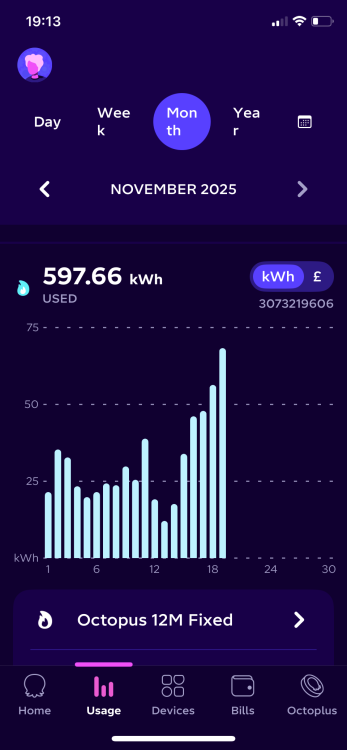
same here from average of 25 kWh per day to over 70
-
Blimey - we've never hit that sort of base line on Electric - 3 loads of washing, some with tumble drier (some with dehumidifier) and a load thro the dishwasher and we peak at 16 kWh in a day Average daily for the year is 9.5 kWh but typical base number is around 7 to 8 kWh and I regard that as above average
-
I do - how on earth can you know if improvements are actually improvements otherwise 😉 Octopus makes life easy from that perspective you can export by 30 min intervals your energy consumption - Add in HDD data and you have an instant bench mark for what ever set up you have
-
Exactly this ^ Doesn't mater what heat source you are using the colder it is the more energy you will use to keep the house at a constant temp Just over a week ago I was using 15kWh a day on "Space Heating" (OAT was Min 11.3 and Max 15.8) Yesterday I used 70 kWh on "Space Heating" (OAT was Min -2.1 and Max 3.2) Average for November will end up at ~30 kWh I see no point panicking about costs during a cold snap it's just part of the UK weather patterns
-
Being "super efficient but cold" or being "slightly less efficient and warm"? Me I'll take the cooler option but Mrs Alien would rapidly be Mrs Ex-Alien (Divorces are a lot more expensive than energy) so I compromise and take the slightly less efficient option
-
On a system with 19 rads that's a good way to get very bored Provided you are on a water meter - Easier way to get system volume is to empty the system with a full drain down - then when refilling read the water meter before and after to get system volume (best done when no-one else is at home so they don't flush a toilet or run a bloody bath!!!) and either make a small allowance for air trapped in system or allow yourself time to bleed out the air before reading the meter In reality most of the inhibitors are supplied in a container with a recommended dose for 100 Litres so if system volume is significantly above 100 Litres add 2 bottles My system is 151 litres so I add 2 bottles
-
cost of a power flush buys a lot of gas at 6p per kWh - if a power flush us lets say £500 you’d be better of using it to purchase 8500 kWh of gas - that’ll more than cover most of the winter needs.
-
OK Allen Key in the centre - anticlockwise to open more clockwise to close would be my guess
-
Looks like the party is over....
marshian replied to Beelbeebub's topic in Air Source Heat Pumps (ASHP)
You don't need to understand WC - It's really not hard Houses lose heat As the OAT drops the house heat loss increases You need to put in more heat to maintain the house temp WC just changes the flow temp with ref to the OAT to compensate for the losses based on OAT Get your curve right and there is no change to the internal temp regardless of the OAT Bingo house internal temps don't change because boiler / ASHP flow temps do -
Did it get warm previously? If you haven't fiddled with it since last time it worked why do you think is suddenly become shut It's more likely your issues are with other rads stealing the heat before the flow gets to this rad - decorated any rooms recently?
-
Looks like the party is over....
marshian replied to Beelbeebub's topic in Air Source Heat Pumps (ASHP)
Similar here (I won't repeat myself here) except I've not transitioned to ASHP yet. I've still got the "smart" TRV's but they are serving me well whilst I get the Danfoss RAS-B2 rad valves aligned to the room temps (the app gave me a starting point for all my T22's and single K33 but it's not great for vertical rads - once that's done conventional TRV heads are going on (Just as temp limiters for solar gain in the shoulder seasons) and WC can take care of the house temps 24/7 -
Top Mounted Vertical Immersion
marshian replied to John Carroll's topic in Boilers & Hot Water Tanks
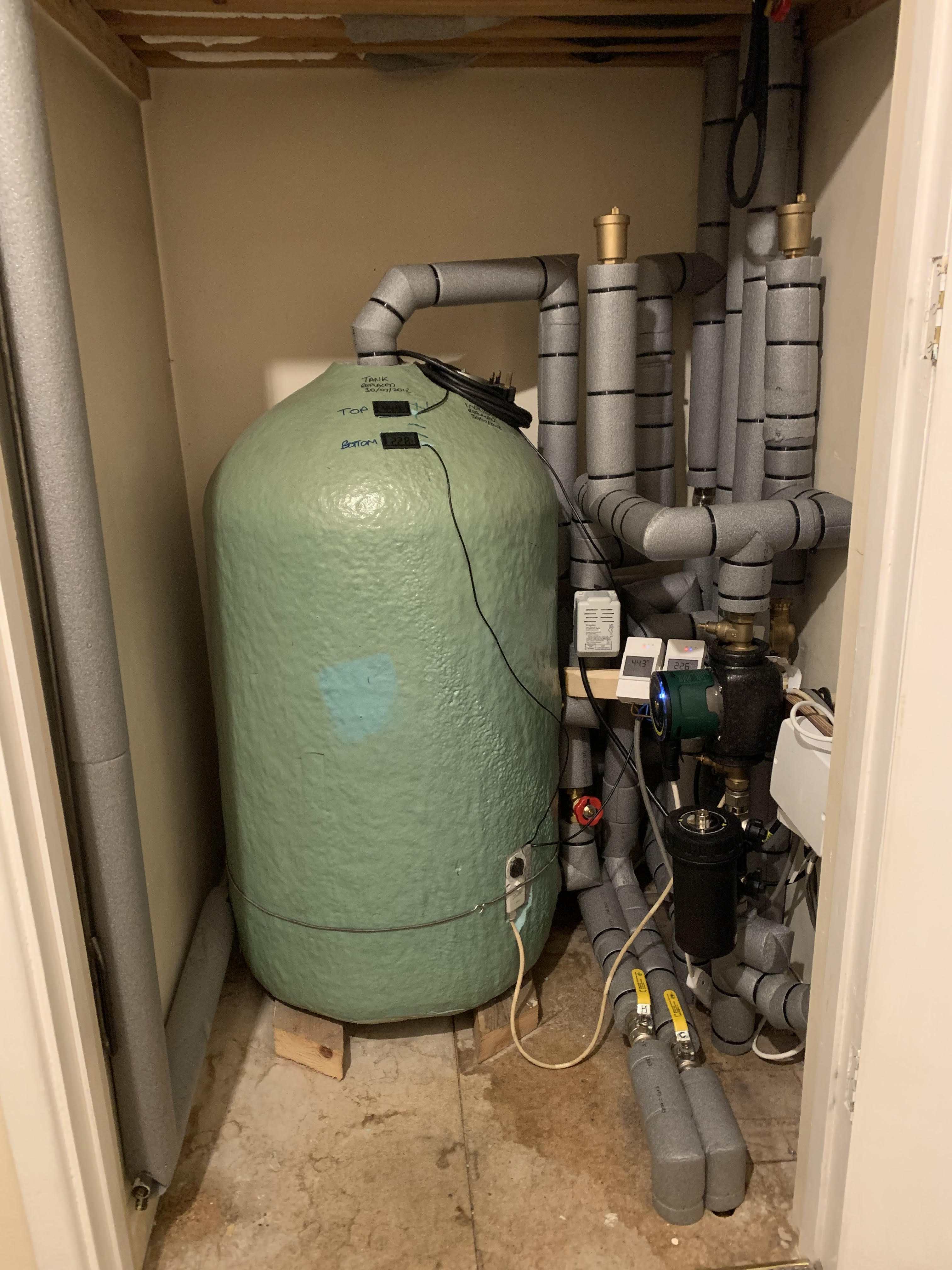
Yeah it's perfect for the two of us in a 4 bed detached - no need to worry about Legionaires when we pretty much deplete all the water every day Thank you - It's a bit busy in there but I've tried to keep it neat - the insulation is decent Tubolit Polyethylene Pipe Insulation (not skimpy DIY store stuff) with almost identical OD for 15mm or 22mm so I have a tube mitre block set up for 30, 45 and 90 deg cuts I pre-make 90 deg bends and glue them with off cuts (from the last time I did any insulation below the floor) and then I only have to fit bends and then measure the length between them and cut the lengths accordingly -
Top Mounted Vertical Immersion
marshian replied to John Carroll's topic in Boilers & Hot Water Tanks
No idea - certainly it seems like it's got a pretty wide hysteresis judging from the overshoot It's been in there since 2012 when the tank was replaced - previous tank was un-insulated copper tank with a puffer jacket that developed leaks after fitting a water softner. Tank replacement is on the list of things to do when I can justify the expense. -
Top Mounted Vertical Immersion
marshian replied to John Carroll's topic in Boilers & Hot Water Tanks
Single element electric immersion - Gas boiler Off because system drained down Hmmm it's not very long - 3KW draw - Tank capacity is about 114 Litres (guess based on our daily water usage - up to 4 showers at 30 L each one blended from 50 deg C HW temp to comfortable shower temp) I can heat enough water with it for Mrs BC's bath night but I need to set it to 60 deg temp to ensure she doesn't run out of water mid pour Won't be till next Spring when I do the adjustments to the heating circuit under my suspended ground floor - was on the list for this year but I've missed my window I think that would be the case for a side mounted immersion depending on where the temp is picked up from We only have the immersion for "emergencies" (boiler failure or replacement and when the system is drained) it's always been on a three pin plug (for 34 years!!!! - it's on the list to put it on a wall switch but I only ever thing about doing it when it gets used which isn't often - this is the second time in 12 mths) -
Looks like the party is over....
marshian replied to Beelbeebub's topic in Air Source Heat Pumps (ASHP)
Is that considering the utterly dreadful efficiency of 50-60% of a CCGT - I get your point about transmission issues (and losses) for gas supply but I'm running a gas boiler at 97.5% efficiency on CH and 89% on HW What about the electricity transmission losses? -
Top Mounted Vertical Immersion
marshian replied to John Carroll's topic in Boilers & Hot Water Tanks
OK I had the system drained down to do so other work (it was planned for summer but well life gets in the way) Work 1. London loop on the HW outlet of the tank (early days but it already seems to have reduced standing tank losses) 2. Re-pipe the bypass so it's after the CH zone valve (it was before so when I restricted the flow thro the HW tank coil it opened the damn bypass and defeated my efforts to slow down the flow thro the coil!!!) 3. Combined 22mm Feed and vent for CH (removing the old 15mm feed) - Thank You @John Carroll it's solved all the issues with air ingress and got rid of another pipe in the cold loft 4. Generally remove a load of joints (from previous versions being adjusted) and clean up the lagging 5. Convert all the main rads to TBOE with Danfoss RAS-B2 flow control TRV bodies Anyway what I needed to say was Immersion stat is set to 55 Deg C (well mid way between 50 and 60) After heating it overshot by a large margin - Tank temp at the top was 60 deg C when it cut out 1 shower later and tank temp at the top was down to 50 and the immersion cut in again Turned it up to 60 because bath night and top of the tank was nearly 70 when the immersion cut out She hadn't finished pouring the bath before the immersion fired up again top of the tank was reading 60 So I'm guessing the temp sensor is lower down the element. Can't do any more tests because the system is now refilled and I'm back on gas and I've finished lagging what I call the plant room (Others might call it an Airing cupboard) Just to be clear - the water damage on the floor is legacy from previous occupants When I replace the tank I'm probably going to replace the floor as well because it's quite crusty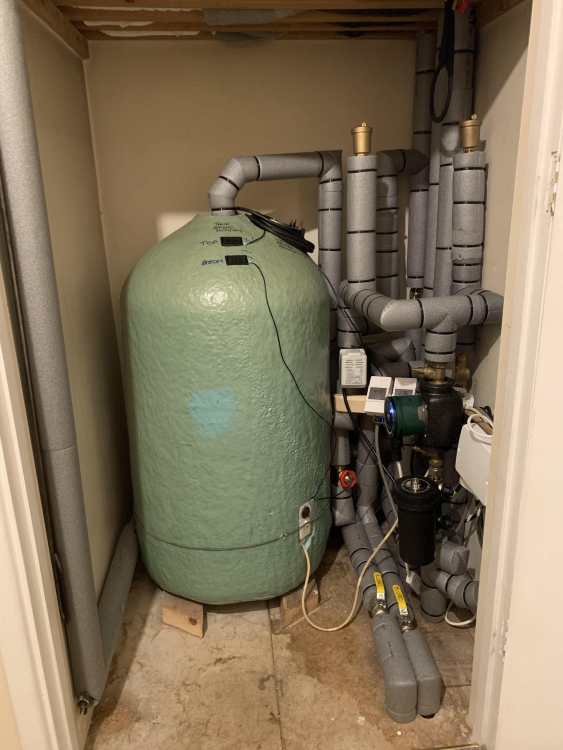
-
I can't get a kitchen pass two nights running so this week I'm out (Cos NMR club evening is Wed)
-
Laundry room sink / appliance plumbing wobble…
marshian replied to Omnibuswoman's topic in General Plumbing
Excellent. -
Having had fun with all the permutations of pump settings on a DAB pump my only advice is to check again after a day and again after a week PP and CP on my pump initially look fine but flow rate drops over a few days - I have no clue why but the only solution for me was to go to a CC setting as there the flow rate stays constant.
-
Laundry room sink / appliance plumbing wobble…
marshian replied to Omnibuswoman's topic in General Plumbing
If I can avoid them I will and I'll use solvent weld as much as possible but if I have no choice then that's what I try to do when I do use one. Downside of an 80's house where several people have had their fingers on the plumbing over the years