marshian
-
Posts
1605 -
Joined
-
Last visited
-
Days Won
6
Everything posted by marshian
-

Worcester Bosch Greenstar 8000 System Boiler Issues
marshian replied to EinTopaz's topic in Boilers & Hot Water Tanks
That does appear to be rather odd behaviour How big is the circuit volume? -
Worcester Bosch Greenstar 8000 System Boiler Issues
marshian replied to EinTopaz's topic in Boilers & Hot Water Tanks
Then you probably want to give the boiler the ability to run at whatever kW it can or potentially your warm up time will be extended. We used to run a similar process with the old boiler - Summer to Autumn transition - boost for a couple of hours when you feel the house needs it. Moving thro to fixed scheduled heating in the winter months increasing the scheduling period to ensure the house was at target temp when we got in from work Mrs Alien is a stupidly light sleeper and mornings were an issue because if I set the schedule earlier in the morning it woke her so we had to compromise on heating early in the mornings. Then back to boosting whenever required for the spring transition But I found it very unsatisfactory, temps swings, rapid cool down because you aren't putting any warmth into the fabric of the building (so it can't give it back to slow down the temp drop) Needed to heat rooms to a much higher temp to feel the warmth. Moving to weather compensated flow temps enabled me to run lower target room temps - with a little bit of set back on the boiler overnight - house is just so much more comfortable all the time and the additional gas usage compared to scheduled heating isn't worth worrying about (for us it works out to £60 extra a year) -
Well despite having a number of hedgehogs thro the garden during the evenings we've only had one take up residence the other one is being ignored. I'll leave it where it is over winter and then maybe relocate it next year as it's probably the location that doesn't suit (no kerb appeal probably)
-
Baxi 105e Instant-end of service life advice please.
marshian replied to FlatMax's topic in Boilers & Hot Water Tanks
Saturdays usage in graphical form But you can extract it in 30 min slots in excel format - once you have that you can use HDD data to get a very good picture of your heat loss if heating 24/7 - on a schedule it's not going to be as accurate but it'll give you a good guide PS the peak at 06:00 to 06:30 was my water heating slot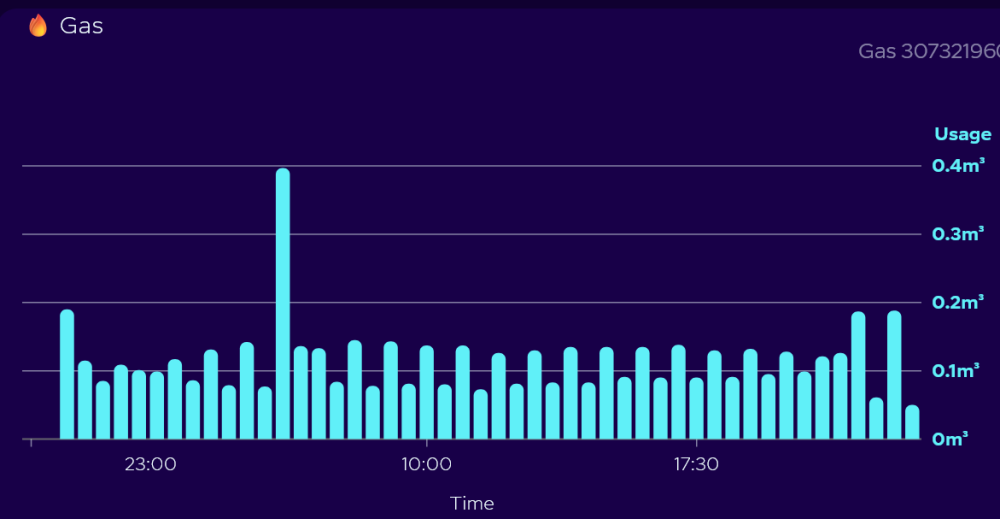
-
Baxi 105e Instant-end of service life advice please.
marshian replied to FlatMax's topic in Boilers & Hot Water Tanks
I wouldn’t range rate it at all if heating to a schedule to start with but I’d assess the warm up time and consider range rating only if house heat up was very fast - even then I’d probably not bother with scheduled heating and that’s coming from someone who has range rated boilers in the past but only when they’ve been grossly oversized maybe monitor your gas usage over the winter period and look at it again with a bit of data from octopus (where you can get a massive amount of half hourly data) -
Worcester Bosch Anti Fast Cycling
marshian replied to John Carroll's topic in Boilers & Hot Water Tanks
Yeah just making a cheaper product range with less functionality with a 24kW condensing fas boiler with a 10kW min that hit the circuit with 65% of max on every restart I had to utilise the anticycle table to manage the boiler fires to a sensible number of cycles per hour - it had a 39 deg min flow temp but it was hopeless trying to run that low 45 deg was just about possible in shoulder seasons but once in winter proper it was 50 or above which meant it short cycled a fair bit -
Worcester Bosch Anti Fast Cycling
marshian replied to John Carroll's topic in Boilers & Hot Water Tanks
It took me a long time to get my head round the Vaillant/Glow Worm table for anti cycling It's heavily linked to the flow temps used - basically at higher temps you really don't get much anti cycle time at all regardless of what you set the parameter to.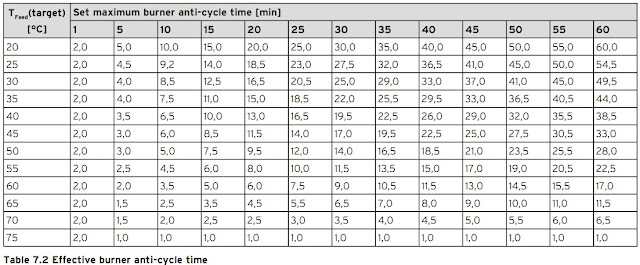
-
Worcester Bosch Greenstar 8000 System Boiler Issues
marshian replied to EinTopaz's topic in Boilers & Hot Water Tanks
Depends if you are heating to a schedule or 24/7 If heating to a schedule - you really want the boiler to throw whatever kW is needed to bring the house up to temp and you might want the pump to be managed by the boiler. If heating 24/7 - you are just asking the boiler to replace the heat lost (per hour) - in this case range rating (with a margin to allow for extreme temps) and pump speed could be completely different settings wise. -
Worcester Bosch Greenstar 8000 System Boiler Issues
marshian replied to EinTopaz's topic in Boilers & Hot Water Tanks
OK seen that now Someone as clever as @John Carroll would probably be able to tell how much kW is being thrown at the circuit based on the flow temp, return temp and flow rate - probably -
Worcester Bosch Greenstar 8000 System Boiler Issues
marshian replied to EinTopaz's topic in Boilers & Hot Water Tanks
What's the return temp? -
Worcester Bosch Greenstar 8000 System Boiler Issues
marshian replied to EinTopaz's topic in Boilers & Hot Water Tanks
The boiler will be looking at the flow temp and putting in the kW required to keep a steady temp - if it modulated down any more than it is the flow temp would drop Drop the target temp and you'll see it reduce the modulation and then increase it again to maintain the target flow temp. Once the warmer water from the rads start coming back to the boiler - the energy required to maintain the target temp is reduced so at that point it will modulate down further. Till the boiler gets to the point where the temp rises above the target temp and at that point when on min modulation the boiler will allow a certain number of degrees above flow temp before shutting down and waiting for the circuit temp to fall -
Worcester Bosch Greenstar 8000 System Boiler Issues
marshian replied to EinTopaz's topic in Boilers & Hot Water Tanks
Next question is how did a HEX get blocked in a relatively new system install? What is the source of the blockage? My concern would be it blocking up again if it is found to be the issue -
Exactly my starting point is pretty low already - my flow temps are only good when I'm heating 24/7 - I can get away with a very small set back but the house does need a little solar gain to recover I think it might heat for longer if the boiler responded correctly to being range rated but as it seems to hate being range rated I'm not going to try any more to work with a higher DT at the boiler. House is a comfortable temp all the time so it works as it is System Noise since I fitted the pressure independant TRV bodies is super quiet Boiler doesn't seem to be unhappy with a higher flow rate and a 6 deg DT
-
Just did some quick an dirty calculations on burn time v HDD ranges At HDD between 0 and 4.9 Boiler runs for 19% of the time so 11 mins in every hour (Sample 10 Days) (in reality it runs for 20 mins in two hours) Between 5 and 9.9 Boiler runs for 35% of the time so 21 mins in every hour (Sample 24 Days) Between 10 and 14.9 Boiler runs for 56% of the time so 33 mins in every hour (Sample 14 Days) Between 15 to 20 Boiler runs for 69% of the time so 40 mins in every hour (Sample 2 Days)
-
I think at colder temps it would have been less of an issue but with current set up this isn't an issue either. Fundamentally the boiler "burn" time just increases as it gets colder outside and the "coast" period gets shorter - it still pretty much cycles once per hour - length of the burn and coast periods just change. He'd read some research by Viessmann indicating that a higher DT was better for condensing efficiency. He worked out my flow rate was 3 times what the house needed!!
-
My thoughts exactly - with an open system every rad getting the correct flow rate to meet the heat loss of the rooms I wasn't sure why a higher DT was going to drive any more efficiency.
-
At a DT of 6 Deg at the boiler for the period before the change usage was 2.0 kWh (OAT was 10 Deg) Boiler burning once per hour - Boiler at start fires at 58% and then over the the 90 secs it slowly modulates down before settling on the min output of 10.8% for the rest of the cycle. At a DT of 11 Deg at the boiler for the period after the change usage was the 2.2 kWh (OAT was still 10 Deg) But the boiler was cycling 3 times in an hour (I think the additional gas used was as a result of the more frequent initial fires when for the first 90 sec it fires at 58% and then over the the 90 secs it slowly modulates down with the higher target temp the modulation stayed at a slightly higher rate for longer before settling on the min output of 10.8% for the rest of the cycle. I actually learnt something from the exercise (or rather remembered previous boiler behaviour) sometimes it helps to write down my thoughts. So my heating circuit is pretty close to 130 Litres with all rads open with a flow rate of 9 litres per min it takes 15 mins for the return water to start to rise and the boiler flow temp starts to increase until the over temp point is reached At WC Flow temps the boiler allows an overshoot of the target temp of 4 Deg C Target flow temp is 27 Deg C but the boiler runs until the flow temp hits 31 deg C (Basically extending the burn length) When the burn is finished the circuit cools down to around 4 deg below the target so 23 Deg C (this takes around 20 mins ish) With a higher flow temp and the same return (so a wider DT) and a slower flow rate 3 lires/min the return water stays fairly low and as the boiler is targeting a higher flow temp it runs a little harder for longer. The time it takes for the return temp to drop to the restart point is much quicker - I think possibly because the warmer water never gets back to the boiler during the burn period (Typically the restart temp point was reached in 10 mins) I wouldn't call it short cycling and at 3 cycles per hour it's still much lower than 6 cycles per hour limit
-
Baxi 105e Instant-end of service life advice please.
marshian replied to FlatMax's topic in Boilers & Hot Water Tanks
Where do you sit on this table?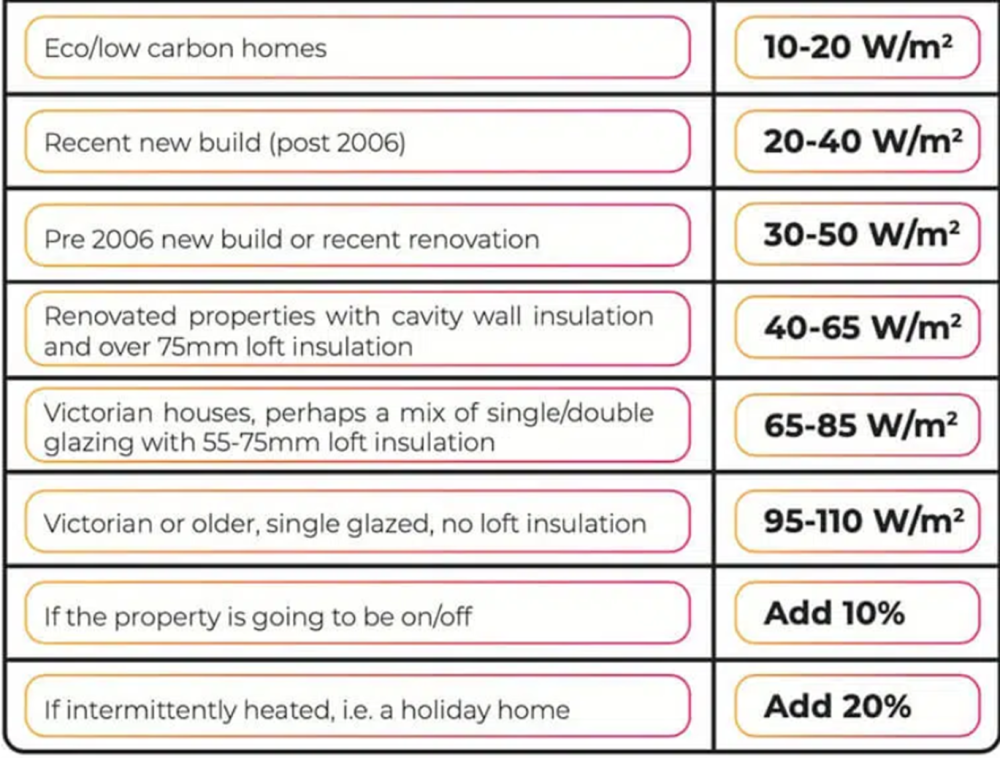
-
Worcester Bosch Greenstar 8000 System Boiler Issues
marshian replied to EinTopaz's topic in Boilers & Hot Water Tanks
Brings back memories of the first time I went under my suspended ground floor.......... I ended up gathering up all the brick rubble mortar chunks, empty drinks cans and sandwich wrappers and then section by section sweeping up all the small stuff When I eventually got round to insulating between the floor joists it was a much nicer place to be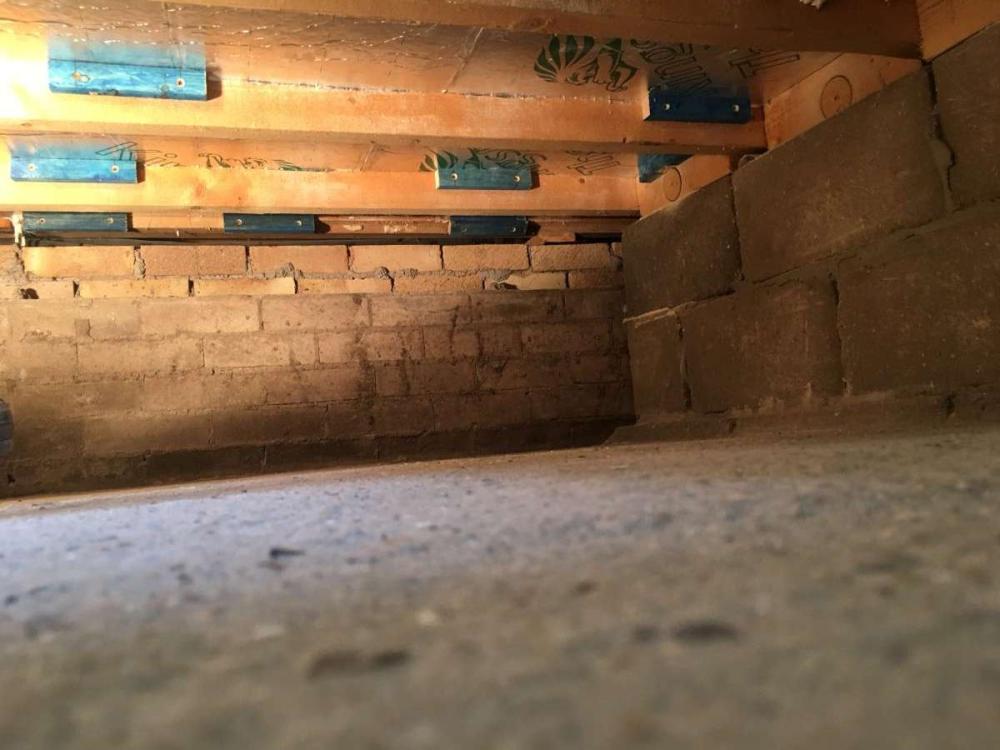
-
Mean yes 29 Flow temp 32 - return 26 but a burn time of 25 mins and coast of 25 mins = 50 mins for a cycle Increased flow temp to 36 - return stayed at 26 so yes mean increased to 31 However no house over heat because burns were 3 x 7 mins and coasts between burns of 10 mins (3 x 7 plus 3 x 10 = 51 mins for 3 cycles but crucially only 21 mins of actual heating time in the same period) I see no benefit to a higher DT at the expense of increase cycling but I maybe missing something
-
I'd probably agree based on his content However today I've tried to get a wider DT (I manged to get it to just over 10 by reducing pump speed and lowering the flow rates thro the rads) and whilst the boiler managed the situation it did it by increasing the cycling and shortening the burn times (Flow temp 36 - return temp 26) The house didn't overheat but I can't see the point of increasing the level of cycling for a higher DT
-
Had a discussion with Andrew Millward on a Viessmann Boilers Owners Facebook group (Andrew is a heating engineer who posts stuff on Youtube - they tend to be shorts and often of a technical nature - not so polished as "Urban Plumbers" or "Heat Geek" but good content all the same) He thinks I'm running the boiler with a far too narrow DT with 3 times the flow rate I could use if I increase the DT and suggested I target a DT at the boiler of 12 Deg rather than 6 Deg. He believes it will be more efficient with a larger DT. So I did a repeat of my earlier condensate collection and efficiency calculation - 97.23% was the result pretty much identical to previous. So I'll adjust all the flow rates thro the rads, tweak the Weather Compensation curve to target a higher flow temp (maybe 40 Deg C which should give me a return of 28 Deg C so not far off my current 32 F 26 R) and see if that makes any difference to the boiler behaviour. Fundamentally the return temp drives the condensing efficiency improvement so I don't think it will make much difference. I think it will possibly result in fewer cycles a day (currently 1 fire per hour plus a HW cycle a day) so 22 to 25 a day so boiler runs longer which may get a small benefit in terms of eff but my biggest concern is upping the flow temp target might result in a bit more creaking pipes - I remember how much they creaked every time the boiler fired on scheduled heating with higher flow temps and I like how little they do now.
-
Worcester Bosch Greenstar 8000 System Boiler Issues
marshian replied to EinTopaz's topic in Boilers & Hot Water Tanks
That to me is normal - after a period of time the HEX, Flow and Return are all going to equalise temp wise until the boiler fires up again when the HEX and flow pipe are going to rise rapidly. The return pipe will only start to rise when it's recieving warmer return water from the heating circuit if the emitters can't transfer all of the heat into the rooms -
Agreed
-
Cold pipe or Hot Pipe? Bathrooms are normally warmer that other rooms - if it's a cold pipe it could be condensation forming on the pipe rather than an actual leak when the bathroom has a high humidity level (ie when having a bath)