


marshian
-
Posts
1623 -
Joined
-
Last visited
-
Days Won
6
Everything posted by marshian
-

First year of ASHP power use
marshian replied to Post and beam's topic in Air Source Heat Pumps (ASHP)
6100 - ASHP usage of 2650 is 3450 Electric used by other appliances so that's a little over the average but then so are we at around 3600 (2 people in 4 bed house with a reasonable level of tech/convenience) The scop is good too!!! -
First year of ASHP power use
marshian replied to Post and beam's topic in Air Source Heat Pumps (ASHP)
I think @Post and beam was declaring the electric consumption of the heat pump rather than the heat generated (which would work out as a cop of 1) @Post and beam if you are pulling usage data out of Octopus it can be a bit flakey - I've reverted to the old consumption page because it doesn't have missing data as often as the current consumption data extract -
Hmm that's interesting..... With my 115 Litre old tank I'd have to heat the water to 60 deg C (was my legionaires cycle once a week) for it to stand a chance of a long soak in a bath that makes Mrs Alien happy (That would be initial fill and a couple of top ups) which would pretty much mean I got just enough warm water left for a shower. With my new 180 Litre tank I'm doing it to 55 Deg for her bath night (I'm just doing it earlier to allow for a longer heat soak) and she had her normal bath with top ups and I had a shower and then we both had showers the following day and still didn't run out of HW Rest of the week we heat to 45-48 Deg C I'm thinking I might drop it to 50 Deg for bath night and maybe move to a once a month "60 deg sanitisation cycle" - temp isn't going to be much different to daily target and it uses a fair chunk of energy to get the tank up to 55 compared to 48
-
Apologies.............
-
I've had a cold water store in the loft for the 35 years we have been in this house - I've never found anything in it except for a little bit of sand and limescale - am I alone in feeling left out of this joyous discovery?
-
Shower enclosure layout choices
marshian replied to Super_Paulie's topic in Bathrooms, Ensuites & Wetrooms
I really really like that............... I couldn't do it in either of our shower areas because solid structural walls but if I ever get to build a house I'm stealing that -
Made me laugh - it was a sad laugh tho How many people would consider setting up their heating system to be more efficient or even getting a heating engineer in to do it Rads not balanced or correctly sized to the room, flow temps not adjusted with the season just set to a fixed temp and left there all winter - I've said it before but the move from non condensing boilers to condensing boilers was mostly wasted in terms of efficiency improvements for many houses in the UK because the rads stayed the same and so did the flow temps.
-
Discount Offers of the Week
marshian replied to Ferdinand's topic in General Self Build & DIY Discussion
I always find multi-packs leave me with screw sizes I'll never use - for the number of screws it's good value (compared to normal price) but it's not enough for me to stop buying the brand I always default to, I only buy in boxes of 100 or 200 in the sizes I always use and they all go in a couple of carry cases. -
When we extended the house we wanted the extension to contain an ensuite In order to do this we had to consider using 1. Macerator pump unit 2. External soil pipe and vent 3. Internal soil pipe (boxed) 1 was easiest, 2 would look horrible but was a better option than 1, 3 was the most work but overall would give the perfect result of not using 1 or having unsightly external soil stacks I'm with @Nickfromwales except I'd rather sh*t in my hands and then clap over my head than go down the macerator route
-
Keeping stuff mould and rust free in integral garage
marshian replied to Sparrowhawk's topic in Garages & Workshops
Late to the party but I'll add my thoughts Background (to my garage issues) Attached single garage, single skin brick, wooden trusses with concrete tiled roof, no insulation, no loft boarded - only entry point up and over metal door and no window It was horrible in summer as the south facing roof gathered all the heat from the sun and radiated it down into the garage - with only one entry it was impossible to get a airflow thro it It was horrible in winter, pretty much same temp as outside - tools went rusty, wood got mouldy In spring and autumn I saw lots of issues with condensation as a result of temp swings It was too small to store both a car and a motorcycle so sub optimal for my car and motorcycle habit Action I extended it (doubled the length to a tandem garage) added a SUDG'd side door and a SUDG'd window at the back of the extension - same roof type. Fully boarded the ceiling with plasterboard, Added loft insulation between the trusses and then chip-boarded the floor for light storage. Fitted an insulated roller shutter door. According to my temp monitoring It's never been below freezing in the winter - typically it never goes below 5 Deg C It's never been above 26 Deg C in the summer - I can open side door, window at the back and the roller shutter a foot or so and when I'm fabricating in there the thro draft keeps the air clear. I bare metalled a car door that had a big crease in it filled with filler - pulled the crease out welded up the holes and was going to put some paint on it but hung it on the wall awaiting paint - I've never actually got round to that - it's still not rusty!!! I've a complete bare shell from a classic rally car that was shot blasted and etch primed years ago (it's my retirement project if I ever get to retire!!!) So my advice is insulate the heck out of it - make sure you have the option to ventilate when needed and set up some form of monitoring that can give you the heads up when humidity or temp is likely to be a problem I use sonoff TH-100 with a single sensor for temp and humidity and it will log hourly data for both temp and humidity and store it for up to a year - it uses a tiny amount of power and it's connected to the house wifi and with an app on my phone I can view it whenever I want. I think I paid £25 for the unit and sensor (It can be linked to devices and programmed to switch on or off at preset points - ideal if you want to run a dehumidifier or greenhouse tub heater) -
UFH balancing and understanding how it works
marshian replied to peredelkin's topic in Underfloor Heating
if rads are sized correctly you can run low temps to rads as well as UFH (same temps even) then with DHWP set up can run elevated temps for hot water tank I'm running 55 deg flow temp when doing hot water tank recharge and rest of the time running WC on rads and even at OAT if -2.5 deg C the boiler flow temp doesn't go above 33 deg C house is 80's detached with CWI and SUDG windows and doors, 300mm of loft insulation and 75mm of kingspan PIR under the suspended ground floor - all I did in nearly all of the rooms was change T11 rads to T22 -
Thank You - makes life a little simpler
-
UFH balancing and understanding how it works
marshian replied to peredelkin's topic in Underfloor Heating
Why on earth is the boiler running at 65 Deg C for UFH? What is the lowest temp the boiler can run at? Is your system doing HW and UFH and is it set up as DHWP? -
Next job is to understand how to wire this into the system As a temporary upper limit safety measure I'm using the original tank stat as a pipestat on the coil return it's not resting there it's got a spring wire underneath to hold it on 🙂
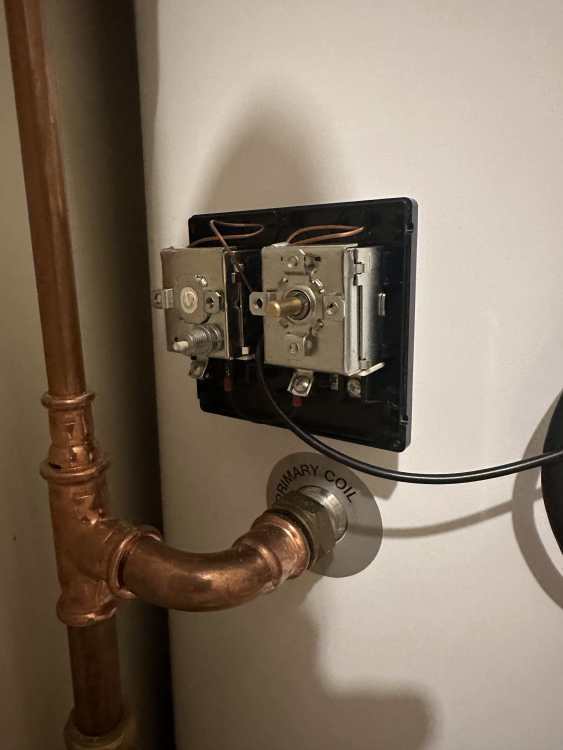
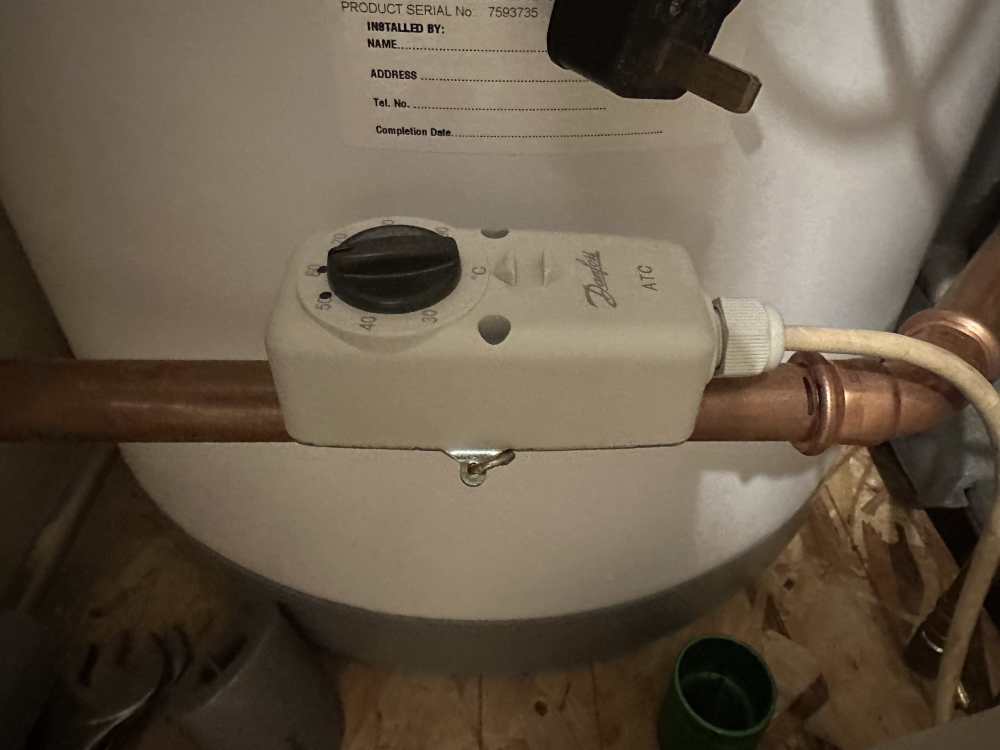
-
this exactly what I did when Mrs Alien used all her strength to jam it down - once out the sink stayed without a plug for months It doesn't help when she uses bleach every week down plug holes - eventually I replaced it with a swivel type (o ring seal) that also got bleached and the o ring swelled up so now doesn't close nicely - bloody woman thinks the solution to every cleaning is bleach - half my house maintenance tasks are replacing stuff ruined by bleach!!!!
-
Grant documentation says 1.61 kWh over 24hrs and energy lost at a rate of 67 W
-
Was having a conversation with a mate on whatsapp and he decided to put part of the comments above into AI Yes — those numbers suggest the new cylinder is substantially better, not just marginally better. The nice thing is that his temperature-decay measurements let us put sensible numbers on it. For a hot-water cylinder, a first approximation is \[ Q = m c_p \Delta T \]with water \(c_p \approx 4.186\text{ kJ/kg·K}\). So, for every 100 litres of water, a cooling rate of 1 °C/hour corresponds to about: \[ \frac{100\times4.186}{3.6}=116.3\text{ W} \]Therefore, at his measured rates: Cooling rate Heat loss per 100 L 200 L cylinder equivalent 0.60 °C/h 69.8 W 140 W 0.50 °C/h 58.1 W 116 W 0.40 °C/h 46.5 W 93 W 0.19 °C/h 22.1 W 44 W So if, for example, these were roughly 200 L cylinders, he's effectively gone from somewhere around 90–140 W of standing heat loss to around 44 W at that part of the temperature range. That's roughly a 60–65% reduction in heat loss, based simply on the measured cooling rate: \[ 1-\frac{0.19}{0.50}\approx62\% \]And it may be nearer 68% if the old cylinder was normally doing 0.6 °C/h. There is another interesting way of looking at his actual example. If the old tank went from 50 → 40 °C in 20 h, a 200 L tank lost approximately: \[ 200\times4.186\times10 = 8372\text{ kJ} \]or: \[ \approx2.33\text{ kWh} \]So that's about 2.3 kWh of stored hot-water energy disappearing every 20 hours. With the new tank at 0.19 °C/h, after 24 h: \[ 50-(24\times0.19)=45.44^\circ C \]A 200 L tank has then lost: \[ 200\times4.186\times4.56 \]≈ 1.06 kWh. So you're comparing roughly: old: ~2.3 kWh lost in 20 h versus new: ~1.1 kWh lost in 24 h That's a pretty striking difference. There's one subtlety, though. Heat loss isn't actually constant in °C/hour. It's approximately proportional to the temperature difference between the cylinder and the room: \[ \dot Q = UA(T_{tank}-T_{room}) \]so the temperature ought to decay exponentially rather than in a perfectly straight line. At 50 °C in a 20 °C room, there's a 30 °C temperature difference; at 40 °C there's only 20 °C. Consequently the old cylinder losing 0.5–0.6 °C/h near 50 °C is actually worse thermally than that simple 20-hour average makes it look. The London loops are relevant too. They're intended to reduce thermosyphon circulation along hot-water pipes — hot water rising out of the cylinder pipework, cooling, and creating a slow natural circulation loop. But if the new cylinder manages 0.19 °C/h even before the associated pipework has been fully insulated, that's particularly impressive. It suggests most of the improvement is inherent to the cylinder itself: better factory insulation, fewer thermal bridges, improved penetrations/fittings, etc., rather than just clever pipework. I'd be quite interested to see what happens after he lags all the new pipework. If he got down to, say, 0.15 °C/h, a 200 L cylinder would be losing only about 35 W at that operating point. So I'd reply to him something along the lines of: your new hobby may be slightly obsessive, but unfortunately your measurements say it's working — you've apparently cut the standing heat loss by something like two-thirds. 😄 If you know the actual cylinder volume, I can calculate the losses in watts, kWh/day and £/year quite accurately from his figures. the bit in bold made us both laugh
-
New Tank Fitted over the weekend Grant Tank - 180L 2.7m2 coil surface area couple of errors in pipework configuration that are resulting in increased heat loss but I'll fix them over the next couple of weeks. meantime a quick experiment on boiler efficiency (compared to old tank data) revealed Boiler efficiency Old tank when heating HW - efficiency was 88.97% (condensate volume 157 grams - condensate stopped after 10 mins of a 30 min cycle due to return temp being above 54 deg) New tank when heating HW - efficiency is 93.29% (Condensate volume 332 grams was generating condensate all the way thro the 45 min cycle) Can show workings if required....... Heat Loss Old Hot water tank fully lagged pipework - london loops everywhere (U loops on any hot outlets from tank) best I could get in term of temp decay in the tank was 0.4 deg per hour (most of the time it was 0.5 to 0.6 deg per hour) so heat a tank to 50 deg and 20 hours later it would be down to 40 deg (thats a just bearable shower according to SWMBO) New Tank - no lagging on pipework yet and minimal london loops and the tank losses are down to 0.19 deg per hour - so heat a tank to 50 deg and 24 hours later it's still over 45 deg - I think I need a better hobby!!!! PS Yes I need to fit a tank stat PPS The tank is set up as a vented tank (so no G3 certification is required)
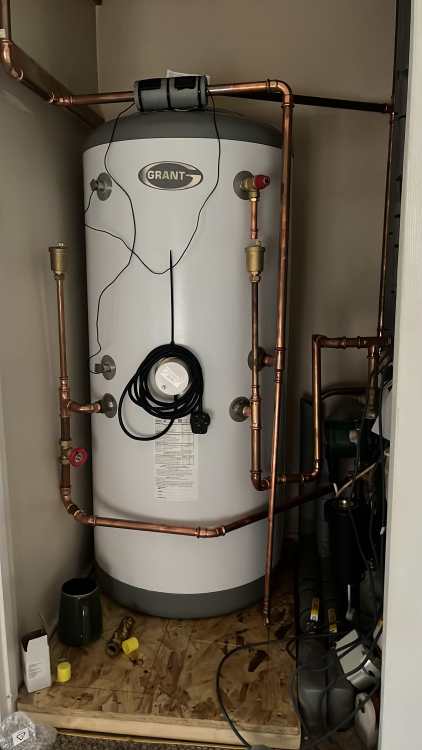
-
Waste water capture and re-use
marshian replied to stephanh's topic in Environmental Building Politics
I’m not sure on the crop yield - As a rule rabbit food goes on Mrs Alien’s plate and rarely mine -
Waste water capture and re-use
marshian replied to stephanh's topic in Environmental Building Politics
Mrs Alien used the wrong water tank on her lettuces - it had the washing machine "wash" water in it...................... Apparently soaking the leaves in a weak citric acid solution gets rid of the taste of persil (I'm not so sure.............) -
Waste water capture and re-use
marshian replied to stephanh's topic in Environmental Building Politics
"Smart" water meter - gives me hourly total usage so not difficult to pin down a very accurate usage for anything at all - just make sure what ever you want to measure is done in the hour and try not to use other things during that hour note down the activity and the hour when it happened and a day later you can see exactly what the water usage is You can fit an aerator or flow restrictor above the shower head and reduce the water consumption without really impacting the feel of the shower We have large (ish) rainfall style shower heads so normally rubbish with a gravity feed hence booster pump on H & C supply but they are still less than 8 l/min - guessing cos never actually measured that....... -
Waste water capture and re-use
marshian replied to stephanh's topic in Environmental Building Politics
Most of a normal summer we don’t run out of water for the garden (plants, fruit trees and veg patch) with 1100 litres of rainwater storage This summer has been very dry so washing machine water, washing up water and bath water harvesting has been in full swing washing machine each cycle is 6 litres from the wash cycle and 24 litres from the rinse cycles (wash water for shrubs and rinse water for veg) - we do 5 wash loads a week so a reasonable qty. washing up water goes on the cherry tree and surrounding shrubs Mrs BC likes a bath once a week and thats normally 80 litres and that gets mixed with Wash cycle water. showers are normally 30 litres each so 120 litres a day max - I’ve never bothered to try and harvest that water we aren’t harvesting as such just minimising mains water usage on the garden which normally is none I think I’ll add a mini (500 litre IBC) as that could go behind the shed and act as a buffer for dry periods -
Stupid question… install shower mixer upside down?
marshian replied to Del-inquent's topic in General Plumbing
I have a thermostatic mixer shower running on hot and cold gravity feed (boosted by a pump) It's plumbed the wrong way round "Hot goes to cold" and "cold goes to hot" the result is to get a cooler shower you turn the temp knob clockwise and to get a hotter shower anti-clockwise - I will one day re-plumb it but meantime it's just me and Mrs Alien that use it and we rarely adjust the temp anyway - it works fine (It annoys me that I got it wrong a lot mind) -
DHW heating and boiler efficiency.
marshian replied to MrPotts's topic in Central Heating (Radiators)
It may well do that - it may also decrease the pump speed if the gate valve is fully open It's why a little experimentation is useful Last year our average summer daily HW needs required 1 x 4.5 kWh per day - we didn't run out of HW between reheats every 24 hrs This year is 1 x 3.25 kWh per day - we don't run out of HW this year either Parameters I've adjusted are pump speed, gate valve restriction and HW tankstat temp setpoint I need a better hobby -
DHW heating and boiler efficiency.
marshian replied to MrPotts's topic in Central Heating (Radiators)
I think it's a bit more nuanced and people give advice based on their own set up (I'm just as guilty of that which is why I try to ref my current set up when responding) If we look at the process and what we are trying to do when batch heating water there is some sound reasons for controlling flow rate via a gate valve and or pump speed Slower the pump speed the gate needs to be more open - speed the pump up and you'll need to close the gate valve more We want the HW supplied by the boiler to spend as long as possible in contact with the cooler water in the tank to allow as much heat transfer as possible We want the water to flow in at the top of the coil and out at the bottom so at every point in the coil the HW from the boiler is able to transfer heat because the water outside the coil and in the tank is cooler as you go down the tank Pump speed can have an effect - if you have a boiler that doesn't control the speed of the pump then you need to establish the lowest pump speed possible to maximise the time in the coil However - there is absolutely no point screwing the flow down to a point where the flow rate in the circuit is insufficient for the boiler resulting in repeated short cycling as this a massive waste of gas. So the target is to heat the water in the tank in preferably one burn so initial start up losses are minimised.





