marshian
-
Posts
1605 -
Joined
-
Last visited
-
Days Won
6
Everything posted by marshian
-
Mate has a farm, chickens, sheep, horses and a few domestic pets - below is what he uses to keep the numbers low
-
Gas usage in kWh for the three days by hour Yellow marked cells are where it included 30 mins of HW at an elevated flow temp and modulation rate At a 35 deg Flow temp the boiler is running at 4.05 to 4.1 kWh at min modulation

-
It is all rads - No UFH You are all UFH no rads from memory I've tried slowing the flow rate down but it cycled a lot more
-
Flow rate is 0.6 m3/Hr Total House Radiator Rating at T50 is 21.870 Room Temps aren't all 20 Deg C - varies by usage General rule Kitchen, Dining, Hallway 19 Living room, Main Bed 20 Bathrooms 21 Rest 17
-
Oh that would be really annoying - I'm the same with rattles or resonance in car I know flow rate thro heat pumps is normally much higher than boilers (due to very low DT) so good luck with your mission
-
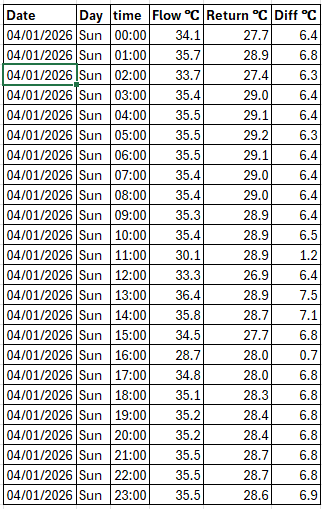
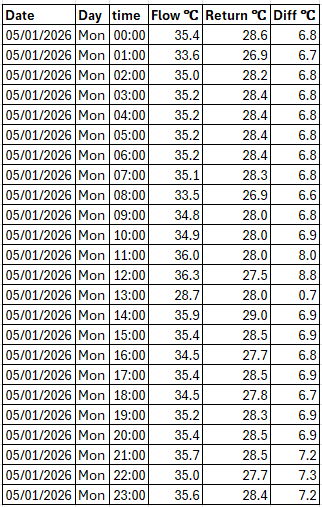
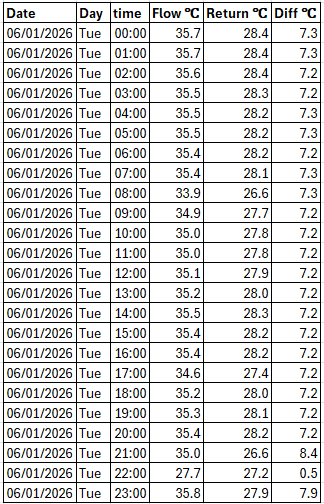
Sorry my error it was Jan when we had 3 days where OAT temp ranged from -6.3 to 2.5 Deg C In the 72 hour period the boiler was running for 68 hours (1.5 hrs was HW) and total number of cycles was 19 (average cycles per day is normally 20 to 24 Hourly flow and return temps for that period are below I hadn't noticed till I looked at the data today but the DT at the boiler ranged from 6.3 to 8.8 (I'm going to assume that the heat loss at colder temps was driving this) Avg DT since 01 Nov 2025 to 31 March 26 was 6.1 Deg C
-
The boiler has no sensor on the return to measure temp - only sensors are in the HEX and after it Don't get me wrong here I've no complaints about the boilers ability to run stable flow temps comparable with a heat pump - ie sub 30 deg C - it's just the modulation spikes where I can't understand the reason that drives me slightly crazy...... I'm not going to say on a public forum what my next action will be but with a spare MBU and some very very techie friends/work colleagues who do this stuff for a living you can guess My bet is the program/boiler logic is very much IFTTT based and I reckon there is a line of code that is squiffy - 99% of users running more conventional flow temps or not monitoring the boiler in the same level of detail would never see the issue - I'm the 1% that does see it and it annoys me because whenever it does it the boiler plumes and I know that's heat/energy leaving the house having not been passed into the water circuit
-
I think that the start up and shut down signal temps are different as OAT changes. From collected data anyway (and it's remarkably repeatable - those aren't just one occasion but the average of multiple occasions) Yes the boiler FT does run at the target temp until it no longer can due to influence from the return temp creeping up The boiler ran for nearly 10 hrs sold when we had minus temps here in Feb
-
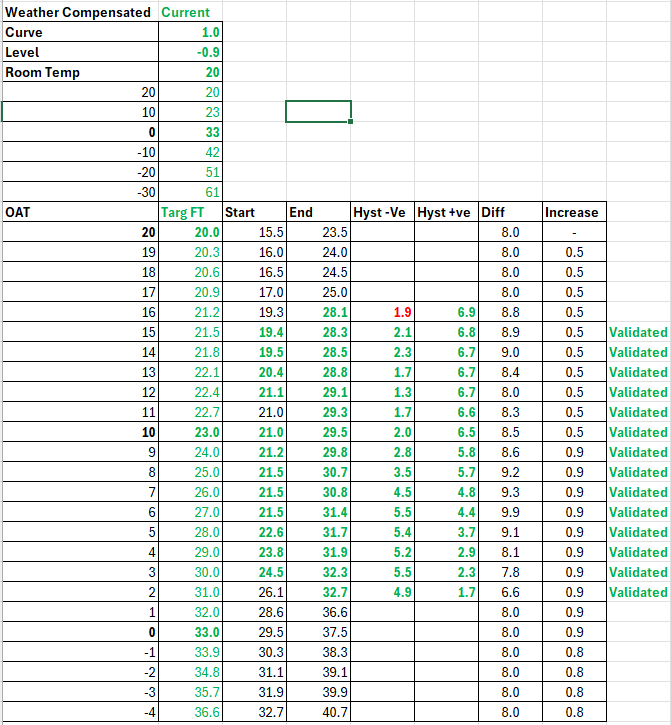
Yep it does all that (unless range rated in which case it can only fire at maximum range rated setting) NB only applies once out of the initial fire up and ramp down No anticycle that I am aware of - my monitoring indicates that the boiler re-fires based on flow temp being target - X Degs (It does vary depending on target Flow temp) - I'll post a table at the end Very familiar with all the above - Had a glow worm before that did the same thing (although that had anticycle paramerters that could be tweaked) The viessmann doesn't have that flexibility - very few parameters that you can play with Basically "Viessmann technical" are saying the behaviour is normal for a heat only boiler where the boiler has no control of the pump. Table of start temp and shut down temp based on WC settings
-
Maybe I'm not explaining myself very well DT between Flow and Return at the boiler is 5.9 Deg C Initially before the start the DT is 0 When the boiler fires up the DT is slightly larger as it throws 58% of max at the circuit Once it's modulated down to Min the DT stabilises and runs at 5.9 Deg C The house circuit is ~130 Litres in total and the flow thro the circuit is being pumped at 0.6 m3/Hr (10 Litres/Min) so if the rads can't get rid of all the heat then there will be some rise in the return temp. This causes the flow temp to increase because the boiler cannot modulate down any lower. During the cycle the DT remains at 5.9 Deg C until the temp limit is reached when the boiler shuts down The boiler doesn't measure the return temp - it measures just two things Flow temp (at the Hex and at the outlet - Why both I don't know but it does) and the temp of the Flue Gas
-

What numbers do I need to size a heat pump?
marshian replied to Selfbuildsarah's topic in New House & Self Build Design
Blimey that looks really good - looking forward to trying that out. PS in my day job I'm often testing functionality of new software -
I'm sure I've stated this before but the window where this happens is between 5 deg C OAT and 10 Deg C OAT when running on Weather comp I occasionally see it when there is a big swing in OAT outside that window but under normal circumstances below 5 Deg OAT and above 10 Deg C it's rock solid behave totally normally - Fire up - initial purge at 50% modulation, ramp down to min 10.6 - 10.8% and then steady state running until over temp by 5 Deg.
-
No facility to adjust the DT at the boiler - in steady state running it's 5.9 Deg C (Difference between flow and return) When I demonstrated that the boiler wasn't range rated the DT obviously widened because the return temp would not have changed whilst the flow temp ramped up The target temp I changed was the boiler target flow temp so it wouldn't have tripped out on the way up - on the way down it's a possibility hence why it was a short burst up and quick reduce back down - the return temp being stable soon dragged the flow temp down to close to target once the boiler had modulated back down I hope that makes sense
-
I tried that Weather compensation off, No Range Rating, Running a Fixed Target Flow Temp of 27 Deg C. 9.7 Deg Outside Air Temp 00:00:00 to 00:01:10 Start up and modulate down (missed initial start) Flow temp 29.1 00:01:10 to 00:03:33 Boiler modulated to min flow temp 29.1 00:03:34 Boiler ramps up to 24.8% flow temp increases to 32.1 00:05:44 Boiler starts to ramp down to 20.4% flow temp drops from 31.6 to 30.9 00:07:59 Modulation drops to 15.5% and flow temp drops to 30.4 00:08:41 Showing that the boiler has not been range rated by increasing the flow temp to 43 Deg C - Boiler ramps up rapidly to 44.2% 00:09:37 Reducing the flow temp back to 27 showing the boiler modulate down to 10.6% flow temp drops to 29.7 00:11:00 to 00:18:03 Boiler running at min modulation flow temps gradually rise from 29.7 to 31.2 Deg C 00:18:08 Settings review 00:18:33 Boiler ramps up to 15.5% flow temp rises to 31.7 00:19:39 Boiler flow temp risen to 32.7 00:20:30 Modulates down to 10.8% flow temp drops to 32.2 00:23:53 Flow temp 31.7 Modulation 10.8% 00:28:18 Boiler shuts down
-
It randomly modulates up mid cycle and if I'm lucky it ramps down again and continues the cycle - no apparent reason for the increase - return temps (not that the boiler measures them) stay stable but flow temps spike
-
PS I was supposed to sell it once the floor was finished but didn't - was thinking about doing a Buildhub loan on it as a way of giving back but no idea how to go about it.......
-
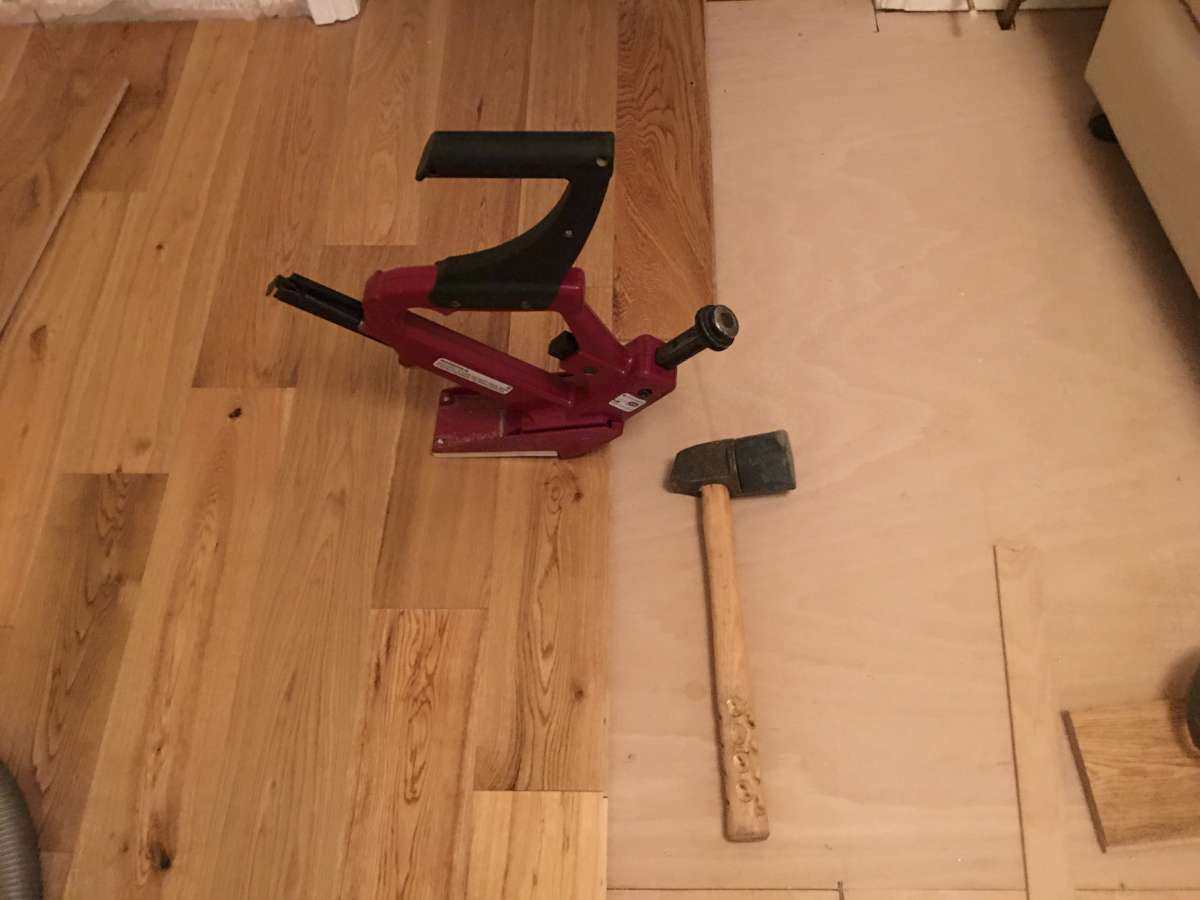
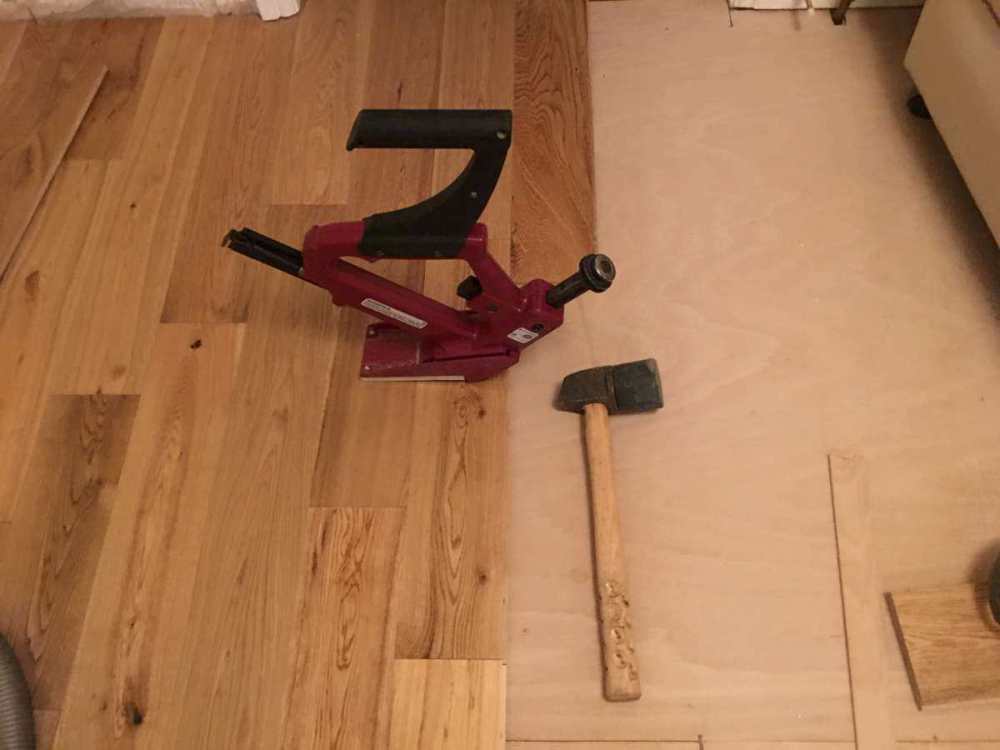
I bought a second hand portanailer - to do an oak floor........ I had to rebuild the bloody thing and replace some parts but once "serviced" it was brilliant to use and little or no effort with a perfect result on every nail (only time I had to drill and hand nail was for the last two rows)
-
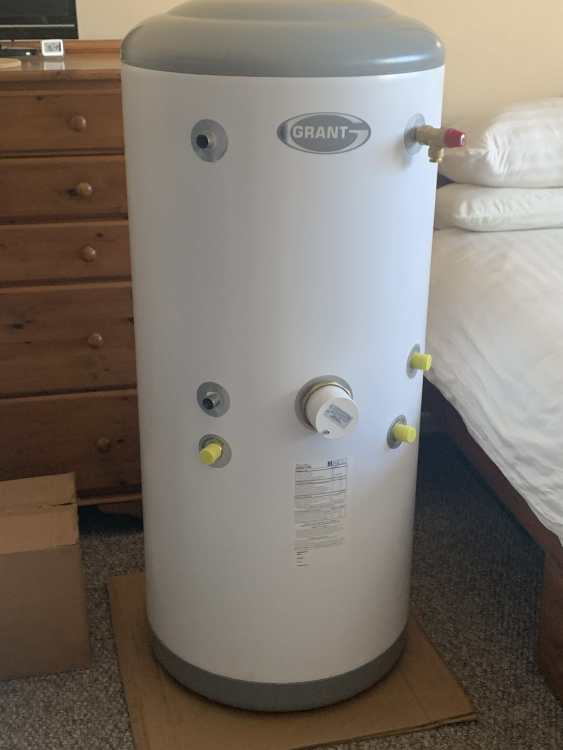
Next question because I’m confused cold water inlet is half way up the tank (drawing indicates it feeds the base of tank internally) - if I fit a drain point at the bottom of the leg that feeds the tank will it syphon the tank out if I ever have the need to drain down??
-
They've definitely done that round here - mains is rubbish even my pressure washer grumbles!! Std Joke If mains pressure was decent I'd dump pumps and go that way but the few houses locally that have dumped gravity fed and gone to combi fed by mains whinge frequently about dog shit poor showers - Mrs Alien would not be happy about that!!! It's best option right now 😉
-
Main drivers Poor Mains Pressure (it used to be way better but I think the local water company has turned the pressure down to the min it can get away with because of leaks) All the showers are currently pumped and are "Mrs Alien Nice" Frequent interruptions to supply (probably while they try to fix the leaks) means I'm unaffected due to CW tank in the loft High level of "sand" in the water which settles in the cold water tank and means my ceramic cartridge taps around the house are unaffected (I had to replace the cartridge on my kitchen tap after only 3 months - it's the only tap fed by mains cold so that gets a normal tap)
-
Actually on reflection I'm beginning to wonder if I need one at all Both shower pumps are at a level equal to the base of the tank but a good distance away The feed from the top of the tank would go directly to combined vertical HW feed and vent pipe so any air created at the top of the tank would have an easy exit and a short distance to travel to escape Both bathrooms have feeds to sink and toilet prior to the shower pumps so opportunity for air to rise there Previous pump (that failed) was in the airing cupboard about half way up the tank level Thoughts from @Nickfromwales or anyone who has fitted unvented cyl in a vented set up would be appreciated
-
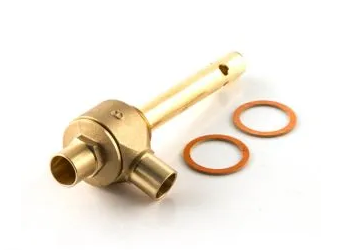
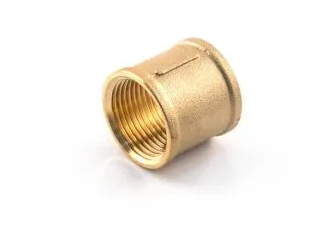
Hmm seems really damn tricky to find a suitable Surrey or York Flange with 22mm fittings and 3/4" BSP female connection to the tank..... Did find this Warix Flange 3/4" BSP Male connection to the tank and 22mm compression suitable outlet fittings I wondered if I can use this 3/4" BSP Threaded Socket To provide the required connection to both tank and Warix Flange Only downside I can see with the Warix Flange is the non aerated feed for HW comes from the vertical top connection and the bottom horizontal connection feeds the normal circuit (in my case that would effectively be connected to the cylinder vent pipe that finishes above my cold water store in the loft above the HW tank)
-
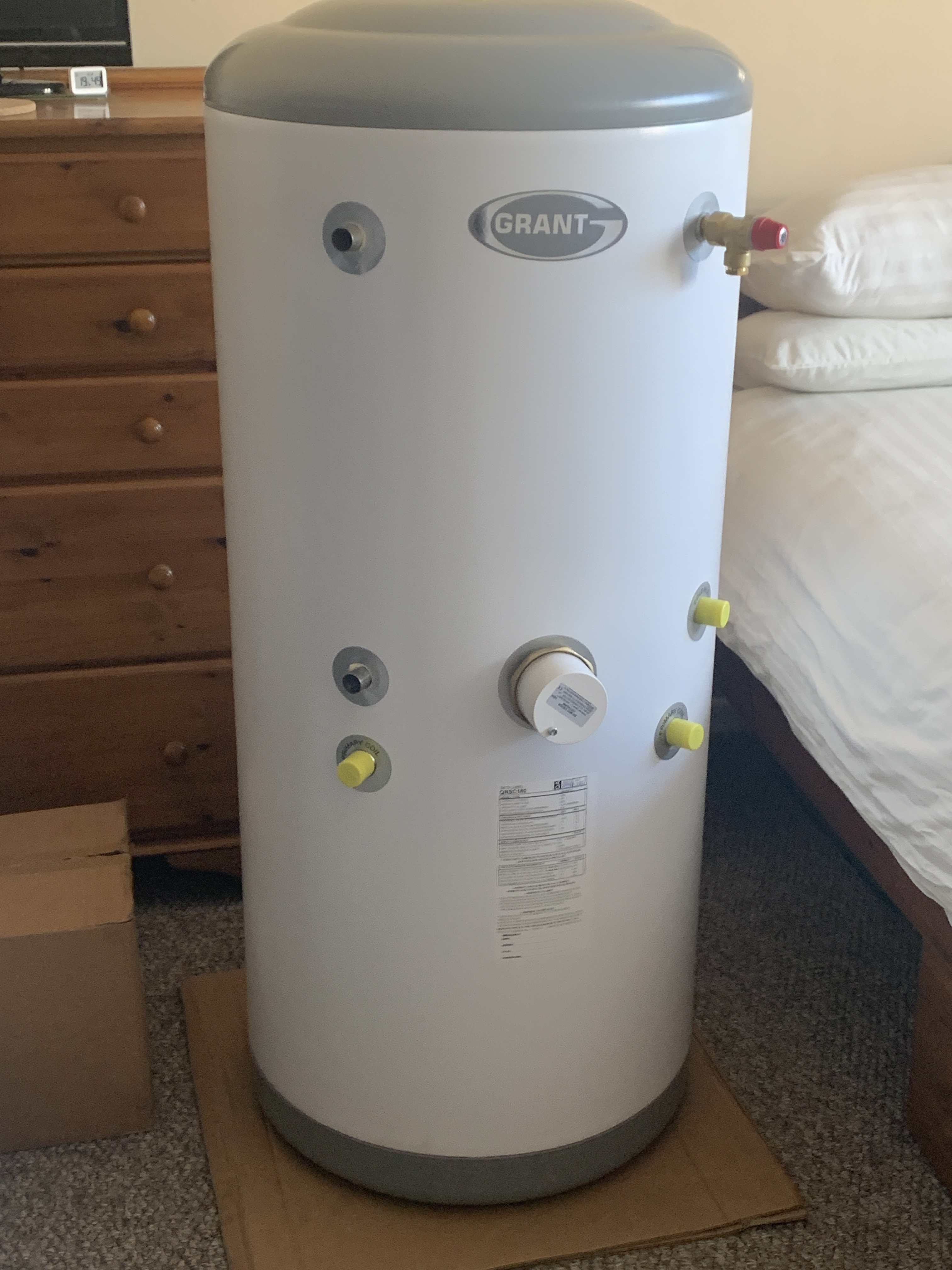
It's QRSC180 so older model (build date on it is 2025) In my research I did find out that the new QR2SC180 has a 3.2 m2 Coil surface area but even though my pockets aren't deep enough for that when I searched no-one had any stock.....
-
Ignoring a boiler that won't respect the range rating...... Finally got a HW Tank Brand new still in shipping packaging with installation kit for £625 Suitable for either ASHP or Fossil Fuel Boiler 180 Litres 2.4 m2 Coil Surface area (largest one that I could get without going pass 180 litres) It's a Grant and they seem to be happy for it to be used as vented I had to drive 400 miles to Wales and back to fetch as seller wouldn't ship but he was really good to deal with. Next job try and find a suitable surrey/York flange that will fit the 3/4" BSP Male outlet on the top of the tank - current Surrey flange in the existing tank is 1" BSP so I can't re-use that and it would probably be too big to go into the tank from memory. Both showers are pumped and before I fitted the surrey flange I trashed a couple of pumps in a short space of time due to air in HW supply.
-
Did you tile it? Modern house tiled to a price often the dot the adhesive in 4 spots - rather than butter up the whole tile