Mike
-
Posts
1484 -
Joined
-
Last visited
-
Days Won
8
Everything posted by Mike
-
Microcontroller based power switching revisited in 2024
Mike replied to TerryE's topic in Boffin's Corner
Sadly not - I know it exists, but no time to play as I still have a few months of the renovation to go. But that does look like an interesting use. ...and an useful proof of concept. I know the feeling. Before choosing to go this way, and before launching the renovation, I spent a good deal of time looking at various possibilities, product reviews and documentation for all the various components (including the Crydom SSRs you mention), until I decided that, after various iterations, this was the optimum solution for me. On the Shelly, the CE certification and being a European product is indeed a big plus, and should avoid awkward questions from the French installation inspectorate. At the moment I don't see any need to change the firmware - it's capabilities seem pretty comprehensive and are, so far as I can tell, well implemented. But knowing that at least a few people have installed Tasmota does provide a fall-back. I also like that the Shelly provides those different means of control. So, if the Pi fails while I'm on the other side of the world, it's easy for someone else to use the regular web-based interface - or even just the buttons - to ensure that there is adequate heating & hot water. Similarly, if / when I eventually sell the place, it's not essential that the buyer has a deep level of knowledge to operate the system safely and effectively, if not at optimum efficiency. 230 -v- 24V was an issue for me too and 24V AC did keep cropping up, rather than DC. I eventually decided that it was just going to be simpler to stick with regular kit that an electrician can readily understand and replace, so it was then easy to settle on 230V throughout. And, of course, that also works well with a standard consumer unit. But there are pros and cons for everything... -
Microcontroller based power switching revisited in 2024
Mike replied to TerryE's topic in Boffin's Corner
The Shelly Pro is also ESP32-based and, as recently reported here, can be flashed with Tasmota too. As per that thread, for the screen a separate UI required, and someone's built a basic one here. -
Microcontroller based power switching revisited in 2024
Mike replied to TerryE's topic in Boffin's Corner
I have a similar problem - switching 2 Willis heaters + pump + DHW (probably a SunAmp due to lack of space) - and I need to get it signed off in France by the independent electrical installation inspectorate (Consuel). It won't be up and running for a few months, but I have solution that should work, in theory. I'll be using a DIN-rail mounted Shelly Pro 4 PM in the consumer unit, providing 4 independently switched channels, one for each of the items above. Since the Shelly has limited load-switching capacity, it will switch 3 regular Legrand CX3 412558 silent contactors* in the consumer unit, with only the pump being directly controlled. In fact, as I'm limited to a 52A mains supply, there will be a Hager 60060 load-shedder between the Shelly and the contactors, monitoring the smart-meter and temporarily switching out the contactors when necessary. Provisional schema below. The Shelly can be operated in several ways (demo on YouTube), including manual buttons and via an app or web browser over Wifi, Blutooth or Ethernet. That includes the option of creating a weekly schedule so, with the addition of a thermostat, it would be possible to run everything in a similar way to a regular central heating controller, though I don't plan to do that. The Shelly also comes with an MQTT interface (documentation), so it can also be controlled using Node-Red / Home Assistant. Like you, I plan to run that on a Pi + SSD, with a PiJuice micro-USP with auto-reboot capability. From the software side this should give plenty of flexibility while, from the hardware angle, everything looks like it belongs in a regular consumer unit, so hopefully no sign-off problems. And, if the Pi fails (and while I wrestle the software into shape), the heating & water can still be operated via the Shelly. *25A resistive / 10A inductive, 230V power & control circuits. There's also a model with 24V AC control.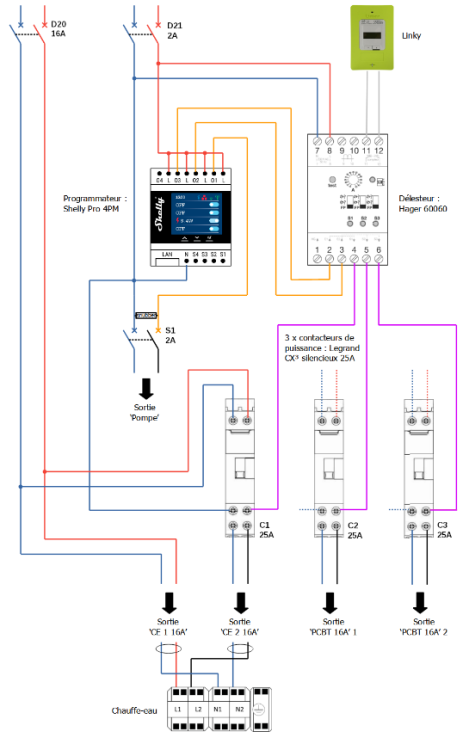
-
It would, but much better to use it for uses that are difficult to electrify - producing cement, iron, steel; HGVs, shipping, aircraft, etc. So perhaps creating something like the UK's planned industrial hydrogen / CCS clusters - e.g. https://eastcoastcluster.co.uk/ Yes - for example https://assets.publishing.service.gov.uk/media/624eca7fe90e0729f4400b99/atmospheric-implications-of-increased-hydrogen-use.pdf
-
Loopcad Vs CIBSE UFH outputs - Same parameters, one 50W/m2 one 70.3W/m2...
Mike replied to Ewan's topic in Underfloor Heating
I'd turn down the flow rate on everything instead. -
Distribution is indeed a problem. If it was to be used domestically the gas grid would need to be upgraded to cope with the additional pressures and gas-tightness required. Although it may have a niche role for some uses, the prospect of hydrogen in the home is at best wishful thinking by the fossil fuel industry, at worst a wilful distraction from electrification.
-
If you lay MR chipboard or similar over it that would work. For other insulations, check out LoftZone StoreFloor.
-
Clothes moths get their protein from animal fibres (keratin) not plant fibre (cellulose) so it's not a problem. Termites would be a bigger threat, but it's been tested against them (and clothes moths) to ISO 3998-1977 - https://cdn.chausson.fr/catalog-document/56ff46a2-72ab-4dcd-800c-7cba0040e887/certifications-813061.pdf and passed. Since France does have termites in some regions it's very likely that any problem would have become evident by now.
-
Nothing when used to insulate a sheep. But, for buildings: https://www.telegraph.co.uk/news/2017/09/01/grand-designs-dream-home-ruined-biblical-plague-moths/ https://victorianhouseproject.blogspot.com/2019/11/moths-problem-in-sheep-wool-insulation.html and other occasional similar reports dating back many years. Although there are anti-moth treatments used - Borax seems popular - I've not yet seen an academic paper confirming its efficacy. But if anyone can point me to one, I'd be interested.
-
That depends what you mean by 'better'. As above, the thermal conductivity of BioFib Trio (0.038 W/m.K) is is higher than PU foam (0.023–0.026 W/m.K) so it's less good at retaining heat. So, as Garald says, PU foam is useful in a tight space. It's also useful if you need load-bearing insulation. In other circumstances, a natural insulation (but not sheep's wool) may be better. For example, BioFib Trio contains 92% natural fibres - a blend of hemp, cotton & linseed fibre. Unlike PU foams, mineral wool & other similar products, many natural fibres - particularly hemp and linseed - are very good at moisture sorption and desorption - that is taking water vapour from the air into the fibre's cell walls, and releasing it again. There are several technical benefits to that, provided you have a construction that's vapour-open ('breathable') to take advantage of those properties: it reduces the risk of condensation improves thermal comfort by keeping the air within a comfortable relative humidity range for longer improves air quality by keeping the air within a healthy relative humidity range for longer (at <40% RH respiratory infections are more likely; at >60% bacteria and mould thrive) tends to reduce heating and cooling requirements (adsorption of moisture releases heat, desorption takes heat, though research into quantifying this in buildings is limited) There are also non-technical benefits - it uses renewable materials, has low carbon emissions, supports (potentially local) agriculture, and It's also a pleasant product to work with.
-
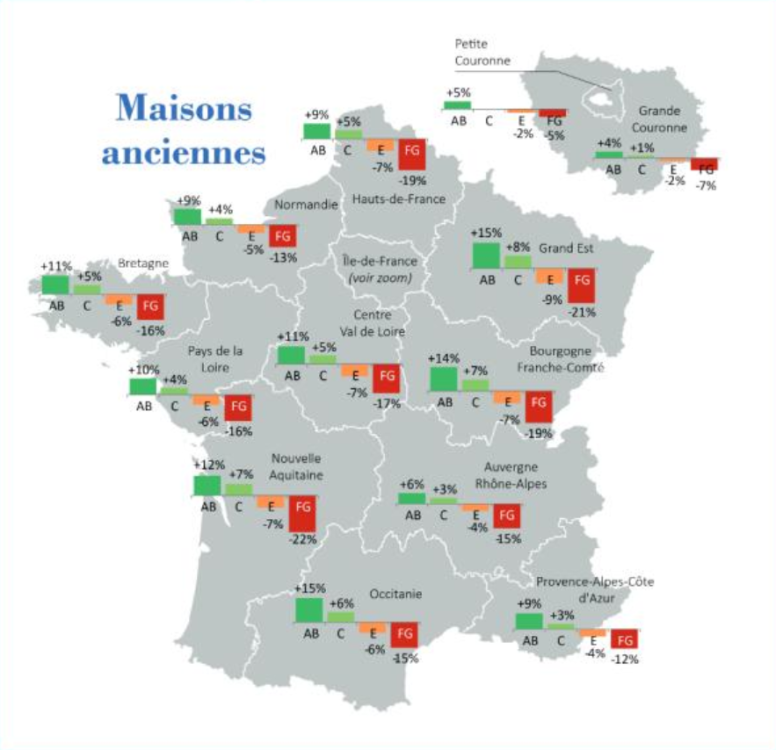
Just checked and the price variance in Paris is fairly modest compared to other regions. For those in the UK, where the EPC rating still seems to be a minor factor, here's a map from the Notaires de France showing the difference the rating made to 2022 sales prices in France: AFAIK it's fine behind any plasterboard, though I am using fireproof board throughout (GypsoLignum / GypsoOmnia) - for its other properties, rather than as a fire board.
-
However, in France, having a higher DPE increases the property value, so there may be a gain rather than a loss. I'm using the same - it seems good stuff.
-
If you use approved contractors, then it's worth knowing that there is potentially a lot of financial help for energy-related renovation in France - see https://www.maprimerenov.gouv.fr/ (in French, of course). Not much help if you're doing the work yourself though. Yes historic glass is certainly worth keeping if you can. Sounds like adding a secondary window (double fenêtre) might be worth considering, even if only in certain rooms.
-
If you're into DIY, then for 16m² it would be easy to buy the cedar and char it yourself with a hired gas torch.
-
I've not come across that. The closest would be Zellige ceramic tiles, which are close-butted but still grouted. Without grout they would soon become a cleaning problem.
-
Why not - what's the problem?
-
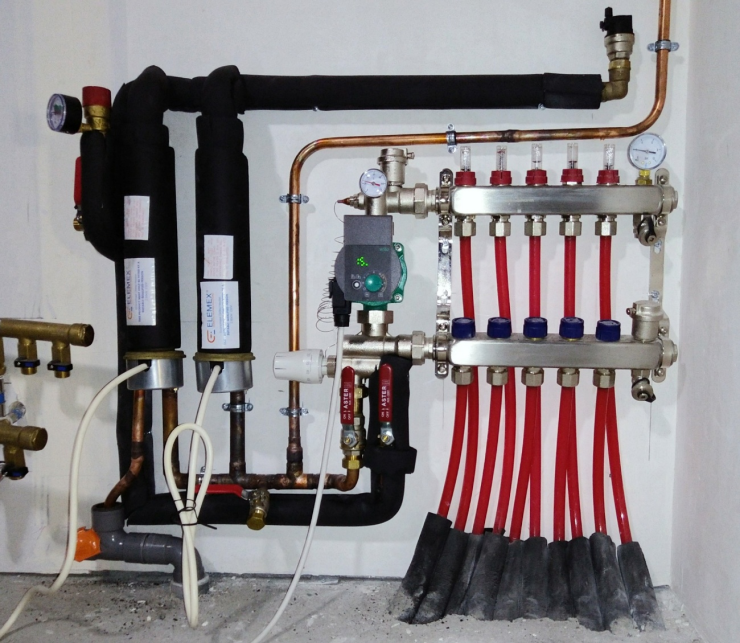
I've no questions, but with much thanks to those who documented their own Willis-based UFCH and in the hope that it may be of interest to someone else, here's a photo of my Willis heater UFCH which is now up and running on a temporary supply here in France. Sadly, due to French liability laws, I had to resist installing it myself and use a local plumber, in order to obtain a 10-year warranty. I'm not sure if it was the Willis heaters or the concept of 15mm pipe (unknown in France) that intrigued him most. The pipe disappearing top right heads to an expansion vessel. The insulation will be redone and completed more tidily once the room is finished. Once the electrical install is finished later this year, the heaters will be controlled primarily by Node Red running on a Raspberry Pi, via a Shelly Pro 4 PM which will also double-up as a backup controller in case the Pi goes down. The Shelly will in turn control the contactors that will switch the power, via a Hager 60060 load-shedder. The load-shedder will temporarily switch out the heating (and, if necessary, the hot water) when the total load approaches the 52A supply limit, which is likely when cooking.
-
No doubt poor installation can be a problem, particularly with DIYers, but it wasn't apparent in those I saw that had failed. They'd just split somewhere along their length. I imagine that each time the tap is turned off there's a shockwave that runs through the pipe which stresses it. Repeat enough and it may eventually burst. None that I'd buy.
-
Yes, pretty much. I did some work in a hotel once and there was at least one connector failing every month, sometimes every week, even more than one on the same day. I recommended replacing the lot, but the budget wouldn't stretch that far. Cheaper to repair the damage. Personally I no longer use or specify them, except the ones that are safely fitted inside a WC cistern. It's easy to avoid them - you can readily buy rigid copper tails to fit monobloc taps, and just use regular pipe connectors elsewhere. See also Faulty hoses dampening Australian households.
-
It may not help in your circumstances, but Passivhaus design is one way of overcoming this economic dilemma. That is, if you increase insulation, and all the other factors, 'enough' (to require no more than 15 kWh/m² of floor area per year for heating and cooling, as calculated using the Passivhaus Planning Package), then you won't need to pay for a traditional central heating system. And that saving then pays, in theory, for the extra insulation and other measures required to achieve the standard. In other words, there could be a world where you and your identical brother spend identical amounts on the build, but you save on your fuel bill each year and he doesn't.
-
Pitched Roof Thermal vs Acoustic insulation trade off
Mike replied to Nye's topic in Heat Insulation
The best way of preventing sound leaking through recessed ceiling lights is... not to have recessed ceiling lights. Do something more creative instead. The second best way is to create a sealed box from one or two plasterboard / plywood for them to sit in, or to use a substantial commercial hood. -
Pitched Roof Thermal vs Acoustic insulation trade off
Mike replied to Nye's topic in Heat Insulation
In terms of tools, I've used the BRE U-value calculator for many years, though it's not free. For sound transmission, AFMG SoundFlow may be helpful and is available on a free trial, though I've not used it. Of course if you have any windows facing the noise, they are likely to be the weak point. -
Tiles with epoxy grout. Although the technology and materials are vastly different now, multipanels still remind me of the tacky-looking plastic versions in that I encountered in the occasional old bathroom the 80s - so probably installed in the 60s or 70s.
-
Multi studio apartment heating/cooling solutions
Mike replied to LuisB's topic in Air Source Heat Pumps (ASHP)
Don't ignore it, check it out! Similar laws already apply here in France, and it wouldn't surprise me if Portugal has them too too - or plans to do so. -
What's more important for comfort U value or 'thermal mass'
Mike replied to Gone West's topic in Boffin's Corner
You would need to find out the fraction of moisture it can absorb According to a study of 3 hempcretes*, 'liquid transfer appears negligible for relative humidity lower than 80%', it has a moisture buffer value of 'excellent' or 'nearly excellent' on the Nordtest classification (from 1.94 to 2.15 g/(m2 %RH) depending on the composition), and high water vapour permeability. Which is pretty good. *Florence Collet, Julien Chamoin, Sylvie Prétot, Christophe Lanos. Comparison of the hygric behaviour of three hemp concretes. Energy and Buildings, 2013, 62, pp.294-303. 10.1016/j.enbuild.2013.03.010 hal-00810372.