


Bitpipe
-
Posts
4118 -
Joined
-
Last visited
-
Days Won
53
Everything posted by Bitpipe
-
This is a key point - aside from the wall system (inc. cladding / rain screen) everything else will be the same thereafter. Some advantage in TF if you want a complete shell (inc. internal framing) quickly and plan to PM trades after that, ICF offers itself to a degree of DIY and b&b has more widely available materials and labour.
-

Timber frame vs ICF vs Traditional masonry for a new build
Bitpipe replied to Indy's topic in General Construction Issues
It is a structural raft and forms the entirety of the foundation. There is additional thickness & strengthening around the perimeter and where the point loads of the structure above require it. The EPS acts as formwork and insulation, it is specced to take the load of both the slab and structure above without deformation. Additional benefit is that the UFH pipes are tied to the mesh and therefore the traditional 'on slab' insulation & screed is not required. Some have been able to power-float the slab post pour and use that as the finished surface. -
Bought one (£3500) , insurer went bust before completion but underwriter replaced the insurer. New Insurer lopped two years off the policy as we moved in 2016 but did not get completion cert until 2018. When we moved off self build (Ecology) to a High St provider, the surveyor said 'Do you have a warranty?' I replied 'Yes' but he never asked for details. Subsequent re-mortgages have not even asked. I would expect a sale to be more diligent but only 4 more years to go on that front. Tried to make a claim wrt a render issue last year and was turned down - they have many clauses that they can use - most noticeable is that any issue that 'arises' (their definition) in first two years is not covered. So spend as little as possible.
-
This is true if you're using standard methods (brick / block etc). If you go for a TF package they will quote from planning drawings and do their own detailed design. You still may need a few details for follow on trades.
-
Timber frame vs ICF vs Traditional masonry for a new build
Bitpipe replied to Indy's topic in General Construction Issues
Concrete goes on top - I was also worried they may blow or slide about and was considering pinning them to each other but they were 'king heavy and once down were going nowhere. Mine sat on 50mm of sand blinding the 150 compacted type 1 and the membrane sat on top of the EPS, dressed down at the sides. The concrete crew just built the slab on the top of all that. By luck, this EPS raft extended about 500mm beyond the edge of the slab without any trimming so there was a nice flat surface for the vertical EPS to sit on. Cutting the EPS 70 was horrible, I used a small chainsaw and the inside of the basement was like a giant snow globe. -
Also, you rarely charge from empty to full - recommended is to plug in at 20% and unplug at 80% - unless you have a long journey planned - my eTron settings default to this and you have to override to charge past 80%. The eTron is also limited to 11kW AC (and 155KW DC) so I can use faster chargers but obv. it's limited by the car. What's also interesting is that when you use a rapid or high power DC charger the speed ramps up as the battery warms so can take 15 -20 mins to hit the peak transfer.
-
Had a Pod Point 7Kw installed in Jan on outside of garage. Whole install was free - Audi promo (I have an eTron 55) - but still needed to do the paperwork for the £350 subsidy. My spark had ensured that there was a 40A fused spur to the garage and the Pod Point installer put another 40A breaker on the garage board and then put an isolator next to that to which the armoured cable running to the unit was connected. There is also a current sensing wire and clamp that runs between charger and distribution board. So I see no reason why you could not get it installed now and take advantage of the grant then disconnect and store during the build. Your electrician will be able to recommission it and re-use the supplied materials - I suppose the only variable is of the length of cable from distribution to charter changes significantly (i.e. gets longer). I used an external 13A for the first two months and while slow, it worked fine. Depends how much of a rush you're in to get the car charged - wall charger will be 3x faster (unless you're on 3 phase). For me, main benefit is being able to capitalise from the 4KW solar array on roof when sun is shining as the faster charge means I get more benefit before the sun goes down.
-
Timber frame vs ICF vs Traditional masonry for a new build
Bitpipe replied to Indy's topic in General Construction Issues
This is not flimsy packaging polystyrene https://www.specifiedby.com/styrene-packaging-insulation-ltd/stylite-eps-geofill-void-formers/geofill-compressive-strength-factsheet_4eeaa0ea.pdf We used 300mm EPS 200 blocks (1.2mx2,4m) for the slab which needed two people to place and were not going anywhere. Luckily we did not need to cut any as it was quite tough. The number relates to the compressive strength & the SE specced the grade. Was relieved as EPS 250 and EPS 300 were a lot more expensive. 200mm EPS 70 was used to clad the exterior basement walls, softer and easier to cut - as it sat under the cavity of the TF panels (to meet the insulation when pumped in) it did not need to be load bearing aside from resisting the basement backfill. -
Timber frame vs ICF vs Traditional masonry for a new build
Bitpipe replied to Indy's topic in General Construction Issues
We did not use MBC for foundation as like you we built a basement but same detail, we had a 200mm exterior basement wall that the soleplate and panels went on to and the structural gf was 18mm OSB web joists with a steel lattice to provide necessary point support for the frame above. -
Timber frame vs ICF vs Traditional masonry for a new build
Bitpipe replied to Indy's topic in General Construction Issues
The MBC passive slab detail is here - https://www.mbctimberframe.co.uk/passive-foundation/ They fix a timber soleplate to the perimeter of the concrete (DPM and airtightness fabric sandwiched below) and the frame panels attach to that. -
All professional services attract VAT, only possible exception are ground investigations that involve tools (so desk work and reports attract VAT, probes and excavation do not). That said I was charged full VAT by my GI company and was unable to get them to refund any after the fact.
-
We went gas as at build time since it was cheapest and it works fine for DHW and space heating (the latter requirement is minimal). However we could upgrade to ASHP in the future should the economics change, maybe think on that - a bit of tactical ducting and power planning at this stage would cost little and leave the option open for the future. We also have low power (150w) electric under tile heating in the bathrooms, mostly for comfort as tiles will always feel cold underfoot due to their higher thermal conductivity. Was inexpensive and contributes a bit to the heating requirement. Your lack of east glazing will help minimise morning solar gain but you need a strategy for the southern aspect - blinds (internal or external) etc
-
Welcome - knocked down detached -> detached so yours sounds like a first for BH! What energy standard is your new build to? That's what get's us all interested here We have lots to give but you get more when you give more !
-
So we don't have that system as we built a passive basement (no heating) and the UFH is under the suspended timber GF. We also use a gas boiler @jack is probably a better person to ask as he has an insulated GF slab with ASHP and does the cooling effect in summer. MVHR should be thought of as efficient ventilation, not a core way for heating or cooling the house, although in a highly insulated and airtight house it can make a difference - key issue is the volume of air moved over time. MVHR airflow is normally relatively low (30% of fan speed) , increasing to boost (50% of fan speed) when you're using a bathroom or cooking and want stronger extraction. Air is a poor carrier of heat (or coolth) so the small volumes of air moved around are fine for ventilation (reducing CO2 and moisture, smells etc, introducing fresh external air) but not super meaningful for moving heat around. MVHR is also usually restricted to the temp of the external air but you can add heating and cooling elements in the airflow. A split aircon will blast cold air out so is best considered a separate system.
-
Interesting, we had the opposite experience - I loved being on site every day (working day job from the caravan) as could keep an eye on things and trades were able to get hold of me (as PM) for any questions. The only mess ups happened during the odd times I was away from site for a few days or more. Easy to buzz round first thing and when they had all gone to tidy up etc.
-
How do we choose a structural engineer?
Bitpipe replied to CalvinHobbes's topic in General Structural Issues
My SE was recommended by the ICF contractor I was considering, ended up going shuttered concrete and TF instead. TF co (MBC) have their own guy but he is essentially independent and I know a few here have used him directly. http://www.tsd.ie/aboutus.html My SE came to site once but everything else was remote. Brief was basement design and services (drainage etc). https://www.buildcollective.co.uk -
Lots of discussions on space heating but you really need to consider overheating as thoroughly. Our passive standard house is in SE England and the single UFH zone on the GF comes on for maybe a handful of weeks each year. We have electric under tile heating in bathrooms (for comfort) and wet towel rads. No heating in basement and nothing aside from the afore mentioned bathrooms in first floor and rooms in roof. House is always comfortably warm in winter - frequently get a shock when we wander outside in a t-shirt. Everything that generates heat (people, appliances, pets, solar gain) will contribute to your requirement. MVHR will prevent internal heat being wasted via ventilation but is not an effective provider of heat per see as the air volume moved is quite low. Spring, summer & autumn are the challenge, once any unwanted heat gets in it is very hard to shift and low sun in spring and autumn can be very effective at heating the house unintentionally. Xmas day was warm this year, having guests and the ovens on made it necessary to open the sliders We face east (street) & west (garden) with gables to north & south (so minimal glazing there). We have external motorised Venetian style blinds to all east windows and recently added internal motorised blinds (from Ikea) to the big sliders on the west. West bedrooms have balconies so are a bit stepped in from evening sun and have normal curtains. All velux on east and south have external motorised shutters, west velux have internal blinds. Effective use of the blinds is key to keeping house comfortable in summer, we do stack ventilation in evening /overnight (opening atrium velux and opening & locking a slider a crack) which is very effective also. PHPP was done by a project manager early in project - as well as giving peace of mind wrt space heating it flagged the overheating risk. Some here have a passive GF slab (i.e. insulated underneath) with UFH pipes cast in and use their ASHP in cooling mode in summer, keeping slab just above dew point. I regret not putting in provision for split air con as with the roof PV would have been a free cooling solution for summer.
-
Exactly what @ProDave said - we got ours for a steal from a local caravan park that was offloading older models. They had a guy who did their moves and they installed it for us in garden. Then bought it back off us at the end of the build. We lived in it for 18 months, two kids and a cat. Was a bit chilly in winter, hot in summer but we saved a packet. So as well as dealers, find your nearest caravan parks and ask them if they have vans to get rid of or if they can recommend dealers or transporters.
-
We built a 120m2 basement in Berkshire clay/gravel/chalk. Ground conditions were good so no de-watering required, was able to just batter back sides of excavation. Went down 3.5m and ffl was about 750mm above that. We looked at Glatthar, friends of ours building in the water near the thames used them, very happy, but they are not cheap. You're paying for pre-cast concrete panels to be shipped from Germany to UK vs pouring them in situ using concrete from a plant a few miles away from you. We just used a local groundworker firm who did sub-surface structures like parking garages etc. They did shuttered concrete with a warrantied SIKA waterproofing system - we did not require external tanking or internal membrane. That whole package - demo & removal of existing, excavation & muck away, casting of basement, backfill and in ground services (fouls, rainwater, water & ducts for gas) came to £120k back in 2016. Glatthar wanted more than that just for the basement itself. A basement is just an underground concrete box at the end of the day, the SE will design it and any number of firms can construct it to the required standard. If you have good access and are not tunnelling under an existing building then that simplifies life. The dewatering will be expensive, as will the piling and shuttering though.
- 19 replies
-
- 1
-

-
- sheet piling
- ground investigation
- (and 13 more)
-
What makes a house look cheap? What makes it look fancy?
Bitpipe replied to puntloos's topic in New House & Self Build Design
We used a Sika product (comfort floor) and it's quite matt. TBH any shininess disappeared very quickly during use as surface buffed up (we occasionally see the difference when a rug is lifted). It is bullet proof, only ever had one tiny chip on the topcoat in the utility which was due to me being too vigorous moving the washing machine. Topcoat can be renewed if you want to change colour etc, it's very, very thin - the substrate itself is only 2-3mm deep. Stairs from here... (stock photo) https://max-stairs.co.uk/offer/93-2/ FSN doors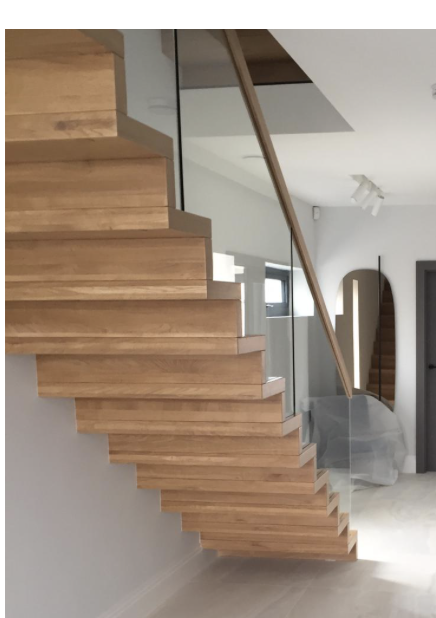

-
What makes a house look cheap? What makes it look fancy?
Bitpipe replied to puntloos's topic in New House & Self Build Design
Less is always more, especially where colour and finishes are involved. Muted tones with a single accent colour used throughout etc. Take a look at an Apple Store - plain white and wood - always looks high end provided the detail is spot on. However, it's your pad so do what you like and what makes you happy, but if you want to appeal to the masses at sale time then neutral is always best. Our most commented two finishes are 1) the resin floor which feels great underfoot and is a monolithic surface, no joints etc and 2) the stringless stairs which look just as good from underneath as they do from above. Rest of finish is pretty bog standard but we also used MK white sockets & switches everywhere (aside from brushed satin in kitchen on the glass splash back) as they are very well built but also are not that noticeable. -
Sounds like the tank is leased from Calor so can't be simply grubbed out and disposed of.
-
This was the main reason I went with cast in situ concrete (i.e. shuttering) for my basement vs ICF. Due to a low water table, SE signed off on a single waterproofing barrier, the concrete, so it needed to be executed perfectly. We have a warranty from Sika as the contractor used their system (admix, jointing strip & hole plugs) but the work needed regular inspection & sign off by the Sika rep. It does add significant labour cost and is not a DIY option but we were very happy with the result - the crew were rigorous with the pour and powering and we could see the quality when each panel was struck, no voids and no 'marshmallow' finish. I applied 200mm EPS 70 to the front face of the concrete using LE foam before backfill, the slab was cast on 300mm of EPS 200 so we had a contiguous insulation layer that the passive frame above could tie into. GRP light wells from MEA came with their own 200mm XPS insulation collar & adhesive and were quite easy to fit - just needed to cast a suitable aperture in the wall and pop a window in afterwards.
-
I might set up a Bat Survey company, take the fee and report back that 72% of the bats were against the development, 12% for and the rest were 'don't know'.
-
Always disappointed that these Bat Surveys never give us the unbiased opinions of the bats themselves.


