Rob99
-
Posts
330 -
Joined
-
Last visited
-
Days Won
1
Everything posted by Rob99
-
Couple of thoughts from me, some of which may have been covered by others. Use 4 of the 8 level blue terminal blocks for Tree (x2), +24v and GND. This gives you up to 30 connections per terminal block if you use both sides. Similar for DI connections from retractive switches, use an interconnected block for 24v out and one blue terminal block for every 8 DI incoming This should minimise the number of 8 way blocks you need. As I mentioned before I use the Wago double and triple height blocks. Triple height works for bringing in individual RCBO feeds, distributing live through the relays and then out to the circuits. Live is commoned across the relay side of the blocks and neutral is commoned across the outgoing circuits. You don't need earthed terminal blocks as your CPC from T&E would be connected to the common earth bars in the cabinet. Double height is generally used for non-mains relay connections or for distributing 24v to remote LED drivers. I sent you some info on panel design/wiring a few months back so hopefully that was useful or at least gave you some things to think about.
-
I use Wago 2002 series for all my panel builds, mainly double and triple height as below. https://www.wago.com/gb/rail-mount-terminal-blocks/double-deck-terminal-block/p/2002-2201 https://www.wago.com/gb/rail-mount-terminal-blocks/triple-deck-terminal-block/p/2002-3201
-
Bet they didn't complain though - kerching! It'll be interesting to see what they respond with. As far as I'm aware, regs or specific mandatory standards should not be used in planning guidance as that's a matter for the Building Regs and other statutory regs. Planning is, and always has been, a mainly subjective process. I'm going to do this too, any pointers on specific content so that it's noted as the same issue of concern? @JamesPa PM me if you'd prefer.
-
I suspect MCS won't be at all bothered about this as their gravy train now is very much the ASHP market. Speaking of which, how the f*** they managed to get their ASHP standard written into permitted development planning is beyond me!
-
The builder can't refund you the VAT as he is not able to zero rate the supply of the goods (if he did, that would be VAT fraud!) Remember VAT is never money your builder gets to keep, it goes to HMRC. It's a clever system to make all businesses unpaid tax collectors (bit like PAYE). The best you could do would be to ask him nicely if he will invoice you for the goods, or at least provide you with a VAT receipt in your name.
-
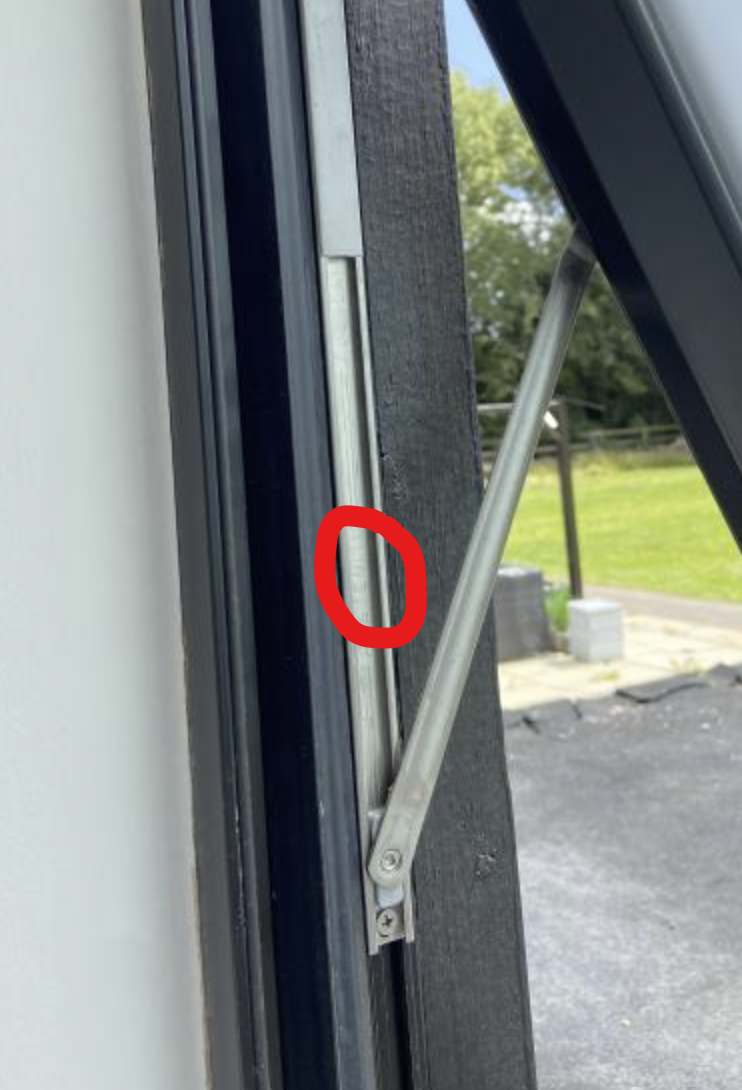
Just another thought, is there a manufacturers name anywhere on the hinge? Might narrow down an online search, or give you somebody to ask.
-
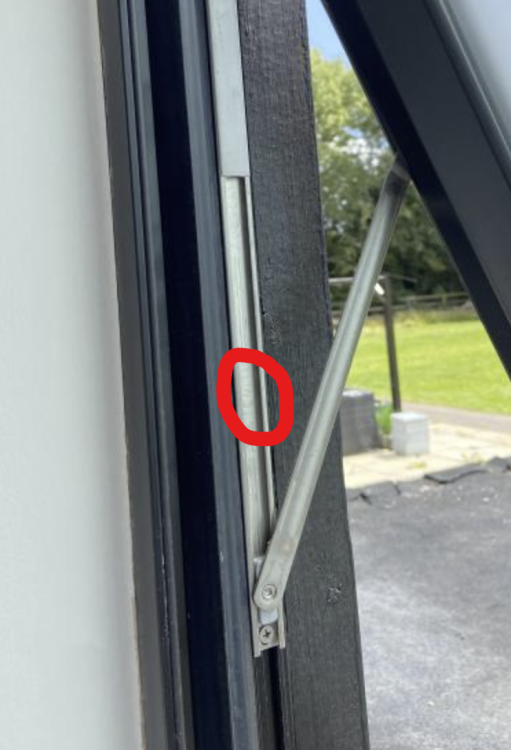
I don't think you need to remove the window, just drill a small hole in the slider and put a screw in it, see pic
-
Face mask advice/recommendation for loft insulation work
Rob99 replied to Rob99's topic in Lofts, Dormers & Loft Conversions
There's not a huge amount, around 40m2 of the old stuff, but it's moving all the other sh!te up there that'll take the time. That's interesting, I hadn't explored what to replace it with and haven't bought anything yet -
That seems a fairly simple plastic profile but if you can't find any then you could screw a small stop into the channel at whatever point you want the window to open to.
-
Face mask advice/recommendation for loft insulation work
Rob99 replied to Rob99's topic in Lofts, Dormers & Loft Conversions
Good shout, hadn't thought of disposable suit. Also means I can wear as few clothes as possible as I'm going to be sweaty mcsweaty face up there anyway! I did think about that, the JSP Force 10 one is full face but I wear glasses and even using safety goggles is a pain. I might still look at one though as I'll be in the loft quite some time over several days -
I'm going to be clearing out my loft soon, including pulling out the old flattened insulation and reinsulating with 300mm (100 between rafters/200 over the top) As I'm going to be spending quite a few hours each day up there over a few weeks I want a proper filter mask rather than the cheap disposable ones. I've been looking about and assume a FFP3 type would be best but not sure if I should get a face mask, half mask or full mask. I'm leaning towards a half mask (something like this ) but what have others used either as DIY or if you do this kind of thing for work. Any other thoughts? Cheers
-
Getting started on the PV G99 (and G100) minefield
Rob99 replied to dnb's topic in Photovoltaics (PV)
If you want to do the application yourself then UKPN have an online process called Smart Connect which you can sign up to as a homeowner. It does say on there that, provided you answer the questions and submit the correct information online then you should get an automatic approval for up to 5kW connection to the grid. In your case, as you already have a FIT export in place it's possible you won't get automatic approval but worth a try anyway. -
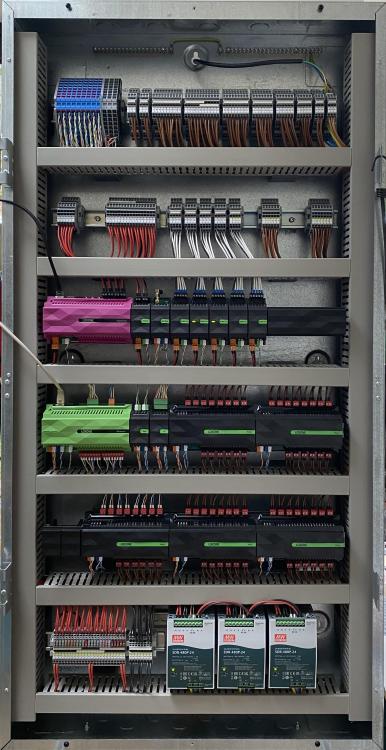
I use 1.5mm tri-rated for all cabinet wiring except signal wiring which would be cat6A. To me, mixing different sizes of tri-rated never made sense from a build perspective as I didn't want to have a scenario where internal circuit changes (and there usually are some no matter how well you plan) could be compromised by having the wrong size cable (sods law!) requiring significant rewiring. Use stranded tri-rated and bootlace ferrules on all terminations. Not sure of the need for gel crimps inside the cabinet, never needed them myself. Buy decent wire strippers and crimp tools. You'll be doing a hell of a lot of cable terminations and using the right tools is so much easier. Those blocks are only cat6A terminals. You will also need larger terminal blocks for all your other cabling both inside the cabinet and connections to external circuits. This is good advice and essential if you are to keep track of what you are doing. Planning the circuit wiring and cabinet layout/connections can be very time consuming but if done properly pays dividends when building your panel. This is a clients cabinet I built last year so you can get an idea of what is included.
-
I assume you/your installer have informed the local DNO and recieved confirmation back from them that they're OK with the grid connection? Otherwise you won't be able to get an Export MPAN and send anything back to the grid.
-
Gas boiler lobby obstructing heatpumps
Rob99 replied to Beelbeebub's topic in Air Source Heat Pumps (ASHP)
Everytime I read this it makes me so cross. You're absolutely right, any installation standards have no place in planning law. It's criminal that MCS have been allowed to write the permitted development planning rules. I think actually they might be the only non-governmental body to have been given the approval to do so. I can build a large extension as PD and the only people that care about HOW it's done (quite rightly) are Building Control. -
Gas boiler lobby obstructing heatpumps
Rob99 replied to Beelbeebub's topic in Air Source Heat Pumps (ASHP)
But you still don't have to store water at 65C. There's nothing in an existing set up that says you need to. -
Gas boiler lobby obstructing heatpumps
Rob99 replied to Beelbeebub's topic in Air Source Heat Pumps (ASHP)
I'm using the Loxone valves so only usable with Loxone but there are others out there. I know Mohlenhoff used to do them, controlled by a 0-10v control signal. -
Gas boiler lobby obstructing heatpumps
Rob99 replied to Beelbeebub's topic in Air Source Heat Pumps (ASHP)
I expect I'll be inundated with responses (or criticised for daring to say it) but here goes......... Why does anyone want stored hot water at 65/70 deg? You can't use it safely at that temperature. -
Gas boiler lobby obstructing heatpumps
Rob99 replied to Beelbeebub's topic in Air Source Heat Pumps (ASHP)
You can tick that box already........ There are proportional valve actuators already available, I'm using some with my Loxone system. They control the flow and slowly close off as the room is reaching set temperature to avoid overrun. -
Apologies for the late reply, been a busy few days!! Yes, a single t&e cable for each towel rail and UFH back to the cabinet. Generally in the UK everyone uses ring mains for socket outlet power circuits and radial circuits for others (e.g. oven, shower, lighting, immersion etc etc) Don't know how true this is but on an electrical course a few years back the trainer told us that ring mains are a peculiar british thing, having been conceived in the 1950's as a way to provide power outlets using less (and thinner) cable than radials as copper was in short supply. Before that all circuits were radial and I think pretty much we are one of the few, if not the only, country that does it this way.
-
30kW PV, All electric heating, is this mad?
Rob99 replied to DevonBarn's topic in Photovoltaics (PV)
I would definitely pursue having a 3 phase supply, even if it costs you a bit more, as it will future proof your supply. It's becoming the norm now to have 3 phase. -
I would recommend switching in the Loxone panel using a 16A relay with local isolation. When I build panels for some clients they run several towel rails and/or bathroom UFH circuits back to the panel in 1.5mm2 T&E as radial circuits. These are switched in the panel and fed from one or more RCBO's in the DB, depending on loads.
-
Quick question if I can - are optimisers worth it?
Rob99 replied to MrTWales's topic in Photovoltaics (PV)
So does seem like only the partially shaded panels are affected. Interesting that the landscape panel is doing better than the portrait one. Do you have shingle type panels? Do you have optimisers fitted? -
I'm switching to flexible octopus (basically their standard variable tariff) then having them fit my smart meter and then switching to Flux once my PV and battery system is in, although that could be several months away. 😞 I've got my referral code all sorted too 👍
-
Yep, I've already registered but was just waiting to confirm invertor before submitting. Interesting that UKPN approved 10kW on a single phase so there's hope for my 8kW (now I'm thinking maybe 10kW would be worth asking for 😂🤣