


sharpener
-
Posts
1492 -
Joined
-
Last visited
-
Days Won
1
Everything posted by sharpener
-
Mitsubishi settings for DHW and Home Heating
sharpener replied to roadrunnerAlgarve's topic in Air Source Heat Pumps (ASHP)
That sounds like the equivalent of the Honeywell BRD91. Shame, you might have been able to benefit from incorporating it. -
Well yes, there are still lots of machines on the market that use R32. But R290 gives you higher flow temperatures and higher CoP for any given temperature so it is the way to go. As the amounts of refrigerant are tiny (and you are allowed to have bottled or piped propane in the house for cooking) I think the dangers are exaggerated, but I can see that no-one would want to install in a non-compliant fashion. I think the caution stems from the fact that many German houses have cellars/basements where it could accumulate to dangerous levels.
-
Is there a no-frills R290 heat pump?
sharpener replied to sharpener's topic in Air Source Heat Pumps (ASHP)
Thanks for following that up! Performance looks useful too. Surprising there is no effective representation in the UK though. But after all the aggravation I think I will stick with Vaillant now they have agreed with my proposed scheme. -
Mitsubishi settings for DHW and Home Heating
sharpener replied to roadrunnerAlgarve's topic in Air Source Heat Pumps (ASHP)
Wouldn't have thought so. But did the Tado provide a "call for heat" signal to the boiler, and if so can you connect it to the HP so when all the rooms are up to temp it cuts out? I plan a similar set up with an existing Honeywell Evohome TRV network (with the necessary output) and Vaillant HP (with the necessary input) so I think it could be made to work. The TRVs will be set as overtemp limits as in practice I expect the WC will do the heavy lifting controlwise. -
This is the actual spec:
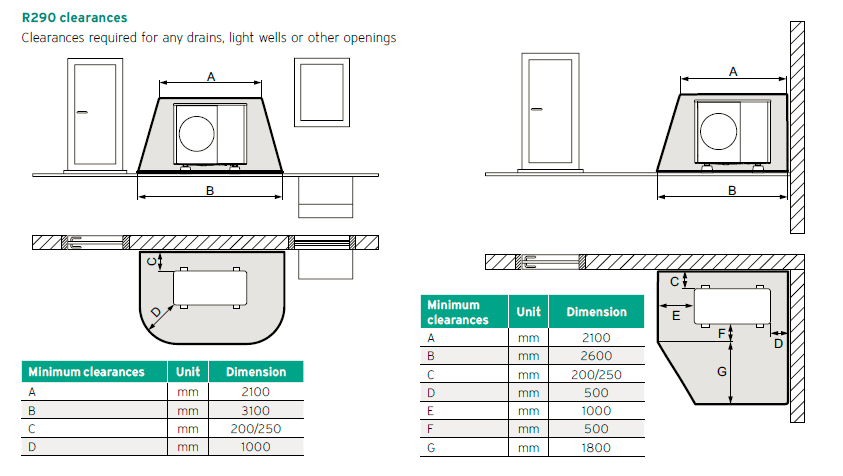
-
You don't need a registered electrician and you can get your LA Building Control to inspect your own DIY installation, which is what I did with my Victron storage system. IME they do not know a lot about electrics but in some places they contract it out to a third-party inspector who does. Put everything you can think of on the initial application so you can come back later when you add the EV charger, heat pump or w.h.y. without paying again. Get hold of a copy of the IEE Code of Practice for Electrical Storage Systems, it is incorporated into the Building Regs and there is a lot of stuff to comply with, including earthing which is a complicated subject on its own.
-
Arotherm Plus ASHP parallel heating?
sharpener replied to vlp2024's topic in Air Source Heat Pumps (ASHP)
Vaillant ppl told me two weeks ago that they want to see HW priority and do not support S-plan setups like this. Nevertheless I am hoping to fit a mid-position valve rather than a plain diverter so that by a simple wiring change it will be possible to experiment with heating the DHW and charging the thermal store at the same time, see this thread. But that is a special instance where both flows are required at the same temp. -
Do I need a HP specific cylinder?
sharpener replied to Beelbeebub's topic in Air Source Heat Pumps (ASHP)
Regarding fittiing a 12kW Arotherm plus to my existing 210l OSO cylinder, a fortnight ago two representatives from Vaillant came with the installer for a further site visit, and confirmed they will stand by their official schematic (which shows my proposed bronze secondary circulation pump to improve the heat transfer) on their usual warranty terms for the Vaillant-supplied parts. They are understandably not going to guarantee the performance of the existing HW cyl but informally it seems they believe it will work and are quite keen to have an interesting case study. I ran some further modelling with @JamesPa's spreadsheet and it would seem that even without the pump I can heat the HW to 51C with a flow temp of 70C before the HP cuts out. This gives me 5 deg margin for error as its abs max is 75C. Assuming the secondary circulating pump will then improve the heat transfer by 1.5x (borne out by a simple water bath experiment) then I can get HW at 52C from a flow temp of 65C which will give me more margin and a worthwhile improvement in CoP. The installer after some initial teeth-sucking now seems happy with this and is going to issue a revised quote with the extra parts. Separately the approved design includes a 210 l thermal store (to be charged at night rate and then used to heat the bedroom radiators after it has ended). All parties seem happy with that too and the quote from Newark for a customised vessel (which will also serve as a volumiser) is very reasonable. In the mean time I have managed to get DNO approval and PP so it looks like most of the hurdles have been overcome at long last. Thanks to all who have contributed along the way! -
Recommissioning/Certification of Solar Install
sharpener replied to James SHS's topic in Photovoltaics (PV)
Rather confirms my hunch, the MCS process is very flawed in its execution and it seems there is no effective monitoring or audit. -
EDDI exporting despite my SunAmp not being 'full'
sharpener replied to ToughButterCup's topic in Photovoltaics (PV)
If the Eddi is like the Zappi (also from myenergi) then you will be able to change the grid balance point in the direction of exporting less. But you might find you then start to import when you don't want to, it will never be perfect. My solar diverter is home-built but like @JohnMo's takes 100W export to turn it fully on. So you might not have much scope to reduce it further. It is something I was prepared to live with rather than spend time experimenting with the control loop, it has worked well for >10 yrs now. -
For a given mfr and construction (plain or convector) the water volume in rad is pretty much proportional to surface area (w x h x # of panels). Output is pretty much proportional to surface area too. For identical delta T you want flow rate to be proportional to heat output. Eliminate surface area from both sides and you get desired flow rate proportional to volume. This means equal time to displace the cold water with hot in each rad regardless of size/output. QED. Neat or what? For convector fins the output is roughly 50% more so the return pipe should start to flow hot in 2/3 the time of the plain ones.
-
Check that the TRVs are a reversible type, not all are. The sensor measures the air temperature and there is an argument that measuring it at 2 -3 ft above floor level is actually better. If the rads are all of the same pattern set the lockshield valves so it takes the same time for the hot water to reach the return pipe on each rad from a cold start. This works bc the volume of water is approx proportional to the output of the rad and so it makes the flow proportional to the output as well. Doing this you might get away with the wrong connections tho if the plumber will correct it for free you might as well get him back.
-
Recommissioning/Certification of Solar Install
sharpener replied to James SHS's topic in Photovoltaics (PV)
I have had PV from two different installers (2011 and 2022), and both have issued MCS certificates without any proper investigation of the roof loading issue though one did ask me for pictures of the inside of the roof as part of their virtual survey. But without a ruler in the pic they have no real idea of the scantlings. I don't think the previous owners gave me any paperwork from the re-roofing in 1995, and it's doubtful if BC would still have any records as it is now a joint enterprise with two other RDCs. I'm guessing from what I've read that most installations are similar, in which case Octopus are asking far more from non-MCS customers than they would get with an MCS cert. My second installer was adamant that I did not need a certificate at all as the panels are connected to the DC side so I withheld £500 which caused them to sharpen their pencils in a hurry. Apparently the MCS database needs an AC meter type and serial number so they used a random one out of their stores. Glad now I persisted as intend to export to Octopus. -
@MrTWales' bar chart is very characteristic and similar to what we have experienced over 12 years with our first 3.7 kW of panels, July and August have often been poor compared with May. Since last year we have a total of 6.9kW installed PV capacity plus 10.65kWh in Pylontech batteries and a 5kW Victron inverter/charger but are very far from self-sufficient in winter (except when we are away, when there is a standing house load of about 200W which is mostly MVHR on setback, and so the batteries will store about two days' worth). Analysing existing energy consumption figures is a must. Also a significant amount is used for cooking so much depends on whether you cook by electricity. We have an oil AGA running 24/7 in the winter which helps a lot, even so we needed to upgrade with a 3rd battery module charged on E7 to cope with winter evenings. Ppl who are wholly off-grid often have 20kW installed solar and 25kWh or more in battery storage, often thermal storage as well bc this is cheaper per kWh. Very expensive in terms of capital and hard to justify on purely economic grounds. Our more modest setup has a predicted payback of 6 yrs. You could achieve almost the same results for less with a cheap Chinese inverter but we wanted the Victron for its 2hrs of whole-house backup. I don't want to be disloyal here but this forum is more specialist and an afternoon's browsing there will give you a lot of interesting case studies of what ppl have done and what you can get away with!
-
They have been used for submarine propulsion for decades, though they have only been ordered a few at a time and been made in small numbers of any one design so no mass production as such. I think it is perfectly reasonable to think that in the long term making them in factory conditions should be cheaper and much more reliable that trying to weld the full thickness of a containment vessel in the middle of a muddy building site. The current PWR designs really stretch the limits of what can be achieved in terms of fabricating large pressure vessels and this has caused a lot of re-work and cost overruns. No, various methods of cooling the reactor have been proposed including gas, liquid metal, molten salts and water for transferring the heat to the turbines, but they still need cooling water as the ultimate heat sink as the thermal efficiency is ?50% at best so half the reactor output is rejected to the environment. Cooling towers could be used at inland sites, and air cooling is theoretically possible but I have not seen it proposed seriously. Though the original piles at Windscale were built just to produce weapons-grade plutonium so none of the heat was used and all 180MW of it was rejected up the massive 400 ft chimneys, one of which was heavily contaminated after it caught fire in 1957 (I have been up the other one!).
-
Mostly butane on small boats, but propane on canal boats etc. The principles are the same, if inside the hull the gas bottles have to be in a gas-tight locker which has a separate drain to the outside. Leak detectors are readily available in chandleries.
-
If not here then you might find answers by posting on the Facebook heating design group. There has been some recent discussion of Esbe mixing valves there (though I have not been following it!).
-
Sorry, I come late to this discussion as have been away. It's a tribute to the original engineering of the AGR stations that they have been able to have their life extended several times. Had we pressed on with them (or indeed continued with the PWR programme after Sizewell B was up and running as originally intended) we would now be in a much better supply position. But they are expensive, no denying it. I worked on secondment to the govt Nuclear Review in the 90s. It was totally rigged, the principal external consultancy in Oxford was deliberately chosen for their free market economy perspective. The report came out in favour of all the risk being borne by the private sector, which hasn't happened and was never going to. When it was published the civil servant in charge of the Review left to go and work for the said consultants. You couldn't make it up if you tried. As an aside I remember the research included the fact that the UK manufactured content of AGR stations was much higher and the import content was lower than the alternatives. However any project that involves careful engineering in mud and rain on windswept coastal sites is going to be difficult and expensive. IMHO the small modular reactor approach was always the way to go, though I have my doubts that the RR Nuclear approach is small enough or modular enough to realise the benefits. The compact PWRs that are fitted in submarines are a better illustration of what can be achieved.
-
I see Screwfix's latest mailshot is plugging "autobalancing" TRVs from Drayton (£34.99) and "self-balancing" TRVs from Danfoss (£24.99 inc lockshield). They seem to have some kind of mechanical pre-settable constant flow controller element https://www.free-instruction-manuals.com/pdf/pa_2912219.pdf. Anyone know how they work from a physics/engineering pov?
-
Ducted A2A and floor level vents
sharpener replied to Crofter's topic in Air Source Heat Pumps (ASHP)
Yes, I looked into adding heat from a HP to the existing MVHR system using basic "specific heat of air" calcs. But the air flow required was from memory about 5x what I have at present so clearly not a runner. (The electric inline heater in my Villavent central unit is only 2kW, but it is disabled anyway.) WRT your original query I have been thinking that the 110 x 50 or 204 x 60 rectangular PVC ducting you can get for tumble driers might have a role to play, though obvs you would need several outlets in a typical living room. -
There's no consistency to it. I don't think the issue is noise. You would think if there is a policy to discourage cooling on grounds of energy usage then it would be at national level. But my LPA have just granted permission for a 12kW Arotherm plus without any restrictions on cooling (or anything else). As sold by Vaillant in the UK they do not do it, however you can import a programming plug from Germany, reputedly for the best part of £200, but apparently the same resistor is sold as an accessory for their boilers at a more reasonable price. Or you can probably find one in the scrap bin for nothing if you know what you are doing.
-
@Bozza what did they say?
-
Arotherm Plus ASHP parallel heating?
sharpener replied to vlp2024's topic in Air Source Heat Pumps (ASHP)
You would need to replace the 3-port valve with two 2-port ones if you want them to be separately controllable, and change the wiring to the VR70 or VR71 wiring centre to suit. Perhaps setting the DHW as a dummy heating zone would be easier if you do not need features like anti-legionella. What does your installer say? Don't know though if Vaillant would support this, IIRC it is not on any of the standard Arotherm plus schematics. I am thinking of doing this for reasons connected with not changing my current inaccessible hw cylinder, and they are coming for a site vist so I should be able to tell you the outcome in a fortnight's time(!) -
Is there a no-frills R290 heat pump?
sharpener replied to sharpener's topic in Air Source Heat Pumps (ASHP)
They don't seem to have any representation in the UK atm https://kaisai.com/where-to-buy. -
Is there a no-frills R290 heat pump?
sharpener replied to sharpener's topic in Air Source Heat Pumps (ASHP)
Thanks for checking progress @MikeSharp01. It prompted me to check out Phnix Greentherm and agents KTS web site, still looks pretty rudimentary, has anyone used them?
