


sharpener
-
Posts
1492 -
Joined
-
Last visited
-
Days Won
1
Everything posted by sharpener
-
Help with air source heat pump
sharpener replied to thenight's topic in Air Source Heat Pumps (ASHP)
I know lots of electricians and a couple of plumbers who have experience in heating. How difficult is it to install them? Not difficult but needs familiarity with heat pumps. To get the grant your installer must be MCS registered (like allseasonenergy). To provide extended warranty the installer must be approved by the HP manufacturer. Will heat pumps work with my designer radiators? Possibly. As part of the quote process an MCS firm has to do a full room-by-room heat loss and emitter survey, this will determine whether rads need upgrading. House is already well insulated but do I need more? Possibly. You will need to have an Energy Performance Certificate which does not have recommendations for more cavity wall or loft insulation. This normally means you need 270mm already in the loft. I’ve briefly spoke with this company https://allseasonsenergy.co.uk/ who seem to know their stuff and have some cracking reviews. Anyone know them? No. They look similar to many other MCS registered firms. Their web site is quite impressive but that's the easy bit. Talking to several bidders (ideally local) will give you more of a feel. Also the energy firms like Octopus and Good Energy are entering the market now for simple straightforward installs. Whereabouts in the country are you? Can you give us an idea of the age and construction of the house and its floor area in sq m? -
Mitsubishi settings for DHW and Home Heating
sharpener replied to roadrunnerAlgarve's topic in Air Source Heat Pumps (ASHP)
You seem to want to run with the hare and hunt with the hounds on this one @Beelbeebub!!! I am sceptical too but I think this direction of travel is more or less inevitable. I fashioned my own internet controls in 2009 and my son has been using his Tado for many years now and moved house with it. I think you have to consider the fallback options available. If it optimises the HP settings in the light of its experience and after that makes only small adjustments, a temporary outage is not a big deal. And if all else fails £200 written off is not a big sum compared with the possible improvements in energy saving or comfort. -
Mitsubishi settings for DHW and Home Heating
sharpener replied to roadrunnerAlgarve's topic in Air Source Heat Pumps (ASHP)
Seems things are moving in the right direction. Went this morning to a seminar by Paul Williams of Homely https://www.homelyenergy.com/. Uses wireless temp sensor plus UV sensor and online weather data to optimise HP settings, with a 14 day initial learning period. Claim it currently interworks over ModBus with Samsung, Midea/Riello, LG, Ebac, Airwell, Clivet. User interface is a simple phone app with intentionally limited settings. Integration with Vaillant & Mitsi in development but needs them to produce proprietary interface boards. Integration with EV and PV also in the works. In comparison with normal weather compensation they claim 3% improvement in CoP and 6% energy saving. Cost ~£200 plus £25/yr optional subscription for smart service to accomodate variable electricity tariffs. -
Why is my flow fluctuating so much?
sharpener replied to Ambaz79's topic in Air Source Heat Pumps (ASHP)
Depending on how it is wired/timed this pump will be mixing the contents of the tank so will spoil any stratification. As @Gary68 says, your tank should be more than sufficient for two showers and a great deal else. -
Heat Pump Decisions - BUS or not.
sharpener replied to Pip895's topic in Air Source Heat Pumps (ASHP)
I am planning on a 12kW Vaillant Arotherm Plus. The quoted nominal flow rate is 2065 l/hr and the minimum is 995. The former is 34 l/min which according to this flow calculator is 1.0 m/s in a 28 mm Cu pipe which is about the max to avoid noise and erosion (opinions differ a bit). Vaillant do not make any specific recommendation about pipe sizes. 1 kW is 860 litre-degrees per hour (3600/specific heat of water). So to check the heat transfer capacity for 2065 l/hr at 5 deg delta T you divide 5 x 2065 by 860 which comes out at 12.005 kW. So yes it is possible, an 11kW unit with 28mm primaries will require a flow rate of only 11/12 as much for 5 deg i.e. 0.917 m/s which is fine and gives you a margin for using glycol. -
Outdoor unit in ventilated garage??
sharpener replied to Archer's topic in Air Source Heat Pumps (ASHP)
There was a recent thread which is highly relevant to all this, maybe @JamesPa can provide a link as it was his IIRC. -
Outdoor unit in ventilated garage??
sharpener replied to Archer's topic in Air Source Heat Pumps (ASHP)
Also consider access for servicing. A way to address both points is to set the unit back from the walls of the garage and then have a removable housing to cover the gap. I am thinking of 3/4 in chip board lined with 50mm fibreglass insulation which IME will absorb noise quite effectively. And having this inside the garage simplifies the task of keeping it dry. -
Mitsubishi settings for DHW and Home Heating
sharpener replied to roadrunnerAlgarve's topic in Air Source Heat Pumps (ASHP)
Depressing comment on the Heating Design FB group "I’ve given up fitting weather comp to my customers boilers, causes too many problems, people just cannot get their head round a simple thing of moving a dial to set it." Not sure which dial he means, my WC curve is set by a preset pot behind a dummy knob, not exactly a user adjustment! And several others saying e.g. ppl don't like it because the rads don't get hot and they cannot dry their smalls on them. WC never enabled on new build housing bc there are too many callbacks (I thought it was now mandatory). So not a specific problem with heat pumps, however WC clearly needs some kind of Auto-tune sw before it will achieve much greater market penetration. -
Outdoor unit in ventilated garage??
sharpener replied to Archer's topic in Air Source Heat Pumps (ASHP)
Methinks time for a visit to some of these reference sites and talk to the owners... -
Old joke. Two engineers in France: "It works just fine in practice" "Yes but will it work in theory?"
-
Not unique to heat pumps. I had to fit a relay to my Vokera boiler to inhibit the weather compensation when there is a call for the HW. A side benefit is that this gives fast warmup for the CH first thing in the morning. I might change the timings though as this takes it out of condensing mode which is not ideal. Really good explanation of the various 3 port valve wiring etc with animated diagrams here.
-
Presumably UKPN have put in two cables, supply heads and meters. In which case there is no way you can have any equipment which is connected to both supplies at once. So you are a bit stuck as to what you can do. Maybe have the HPs on one supply and the PV/batteries/EV on the other, then you could have different tariffs which are optimised for each use pattern.
-
Am surprised there is no night setback possible. Or a low-noise setting which would limit the heating available during night-time hours. Maybe you could make use of this to simulate two zones with different temp/time settings? You might need to use both outputs but connect them to the same actuator. With or without two relays.
-
The OP is charging the floor slab with the UFH during cheap rate and then switching to the rads to heat the bedrooms. There seems to be little point in having the water un-necessarily hot for the UFH (and then tempering it with a mixing valve!) when the rads are anyway not going to be on at the time in question. I think so, Vaillant Arotherm + certainly, don't know about the OP's Daikin. Presumably when zones are on together the one demanding the highest temp has priority, hence the need for the mechanical mixing valve. Or you can control zones separately with electronic mixing valves but AIUI the HP will still have the leaving temp of the highest circuit, and so involve an increase in entropy for the others hence less than ideal CoP. So turning off the UFH for an hour while you heat the bedrooms would give you a small improvement and you probably wouldn't notice the gap.
-
Assuming the flow temp is high enough for the rads you could maybe set the temp back during the UFH phase, to avoid the mixing valve having to temper it down again which will be costing you in terms of CoP. If the controls will allow it when using WC.
-
Mitsubishi settings for DHW and Home Heating
sharpener replied to roadrunnerAlgarve's topic in Air Source Heat Pumps (ASHP)
Is that the OAT reading? Have you got a proper OAT sensor fitted and is it working? You could check it with e.g. gentle application of a hair dryer. WC curve looks vaguely plausible but I would expect no heating at 16C not 35. -
Might also be a hangover from the age of non-inverter drives where the high electrical and mechanical stress of frequent direct-on-line motor starts will shorten the life of motor and compressor. Wouldn't think this a problem now. The above report's main conclusions (in 2012) were Both ASHPs and GSHPs should be designed for a minimum run time of circa six minutes, which will avoid the worst excesses of detrimental performance caused by short cycling...run times of ~ 8 minutes for the ASHP gave COP values close to catalogue steady state values. which is significantly shorter than the 15 mins often quoted. So perhaps this problem is less severe than many people seem to think?
-
Did you ever explore the possibility of splitting the rads from the UFH? I would have thought this could give a worthwhile improvement. You could then preheat the slab at night rate until say 0600 then switch to heating the rads to get the bedrooms warm. Maybe changing every 10 mins as @Beelbeebub suggests is a bit too frequent though, there will be a lot of water still at the higher temp pushed into the UFH at the changeovers which will reduce the savings. And it would maybe require an external controller.
-
Sorry, my mistake, I meant the demand inputs S6, S7, S8, can you confirm if these are contacts closed for heat or the opposite, it's not entirely clear from the wording The text for S6 says "DEM1 External heating switch-off for heating circuit 1" and the footnote says "Closing the "DEM" contact ends the heating demand for the relevant heating circuit" which is the opposite way round for the usual (S-plan) boiler controls. In my case S6 will be the radiator circuit, I will anyway have to add a relay to get a voltage-free contact, so that can be either way round. S7 will be the UFH, the signal from the manifold location will be the OR function of all the four thermostat call contacts which at present calls the boiler so I would need to invert the sense of that with another relay. S8 will be the call for the thermal store, that is an external timeswitch with changeover contacts so can be either at no penalty.
-
Sorry, my mistake, I meant the demand inputs S6, S7, S8, it's not entirely clear from the text if these are contacts and circuit closed for heat or the opposite.
-
Sorry, my mistake, I meant the demand inputs S6, S7, S8, it's not entirely clear from the text if these are contacts and circuit closed for heat or the opposite.
-
Sorry, my mistake, I meant the demand inputs S6, S7, S8, it's not entirely clear from the text if these are contacts and circuit closed for heat or the opposite.
-
For anyone else looking this is the best I have been able to find, in a 700/2 controller manual online. VR71 pinout.pdf Seems to have suffered a bit in translation, @Lofty718can you confirm that the demand inputs R6, R7, R8 are for external contacts that need to be closed for heat demand (as it would be for a conventional boiler)?
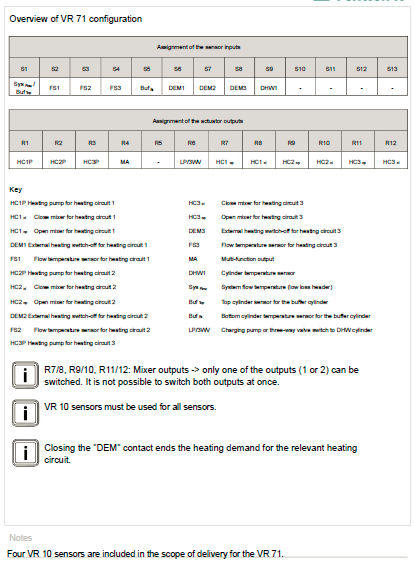
-
Have you found any decent documentation for the VR71 @Lofty718? By which I mean a description of what all the inputs and outputs are intended for and what the voltage levels are? Seems to be lacking, though I have reverse-engineered a version by looking at numerous schematics and Vaillant tell me my interpretation is correct as far as it goes. The SensoComfort simulator on the web is quite good. It is designed to be hierarchical in the following way (and commissioned in this order): So at the bottom level is the HP and its native controls, this should work to give DHW, and plain WC heating if the frost stat on landing is turned up so as to create the demand. Zones and thermal store do nothing in this mode. I will get the installer to achieve just this level of functionality to begin with. The thermal store comes next, the re-purposed external timer will control when it charges (e.g. 0500 - 0600 on Economy 7, and 1300 - 1600 from surplus PV or Octopus Cosy) and when it discharges (to feed bedroom radiators 0700 - 0830 and 2200 - 2330). Then we have the Honeywell zone control system. If any zone is calling for heat it will turn on the Honeywell boiler relay wired in parallel with the frost stat so calling the HP on its two-wire voltage free heating input. Other than that it is electrically separate. Lastly is the internet control box. By judicious use of the 4 normally closed and 4 normally open relays it will default to allowing all of the above to operate normally if it is powered down, is reset by a power outage, or fails. Two of its timers also do the night setback for the MVHR fan speed.
-
Yes, 100% I have spent quite a few hours working out if/how to integrate my proposed Vaillant Arotherm Plus with my existing controls. Fortunately its standard interface box has a voltage-free call for hot water and defaults to heating. With the extension box (VR71) it will accept v/f contacts for three further zones e.g. (i) radiator circuit (ii) underfloor heating (iii) thermal store. So the electrical interface is fairly straightforward, the wrinkle is optimising whether this box is placed near the existing controls, or near the pumps and valves which will be on the other side of the room. Fortunately there are 6 control cores to the hw tank location and another 6 to the remote underfloor manifold which should be sufficient, though both will need to be re-purposed somewhat. I have previously traced and documented all this when installing a wireless Honeywell Evohome zoning system, which I want to retain because of the usage patterns and shape of the house. So it is all basically do-able. Also I plan to re-use the current dual channel timeswitch to control the charging and discharging of the thermal store. On top of it all I have an 8-channel internet timer box which enables me to control the existing setup remotely. Still debating whether to keep this, it is long in the tooth but the installer has no experience of the Vaillant internet add-on beyond one webinar, and the app has not got a very good press on this Arotherm fb group. Maybe the answer is to keep it in service until the Vaillant product has bedded down and then add it to the system as a DIY enhancement. If all this were simply left to a good heating electrician I imagine the result would be ditching everything that exists, pulling lots of multicore through the house, and making do with what the native Vaillant control system is capable of. So far I have concentrated on getting an agreed pipework schematic, I sense there are further challenges to come!


