


sharpener
-
Posts
1492 -
Joined
-
Last visited
-
Days Won
1
Everything posted by sharpener
-
Disabling Weather Comp during mid winter?
sharpener replied to Andeh's topic in Air Source Heat Pumps (ASHP)
That's the catch, if you have a fixed (highish) flow temp from the HP and then temper it during the day you will not get the same CoP benefit as lowering the flow temp at source somehow during the daytime. For that reason I would guess that separate timed setpoints or conventional night setback setting would give better CoP. 0.5 is quite a big hit if you were to get that. If you mean the entire HP I wouldn't have thought so. Recovery from off would take a long time as many ppl have found. Maybe during the 1600 - 1900 peak would be viable for someone on Cosy (which you are not). Will be interested to learn what your conclusions are in practice for someone on E7. -
Disabling Weather Comp during mid winter?
sharpener replied to Andeh's topic in Air Source Heat Pumps (ASHP)
Yes, I am wondering whether plain old Economy 7 will be best for me for that reason. Will have to do some spreadsheet modelling. The 10kWh battery will bridge the gap for usual domestic loads but would not get a 12kW HP through to 0400. Planning to switch to Octopus to give me a choice of tariff when the HP is installed in the spring. -
Disabling Weather Comp during mid winter?
sharpener replied to Andeh's topic in Air Source Heat Pumps (ASHP)
https://octopus.energy/smart/cosy-octopus/ So peak is 160/60 = 2.67 x "cosy" rate.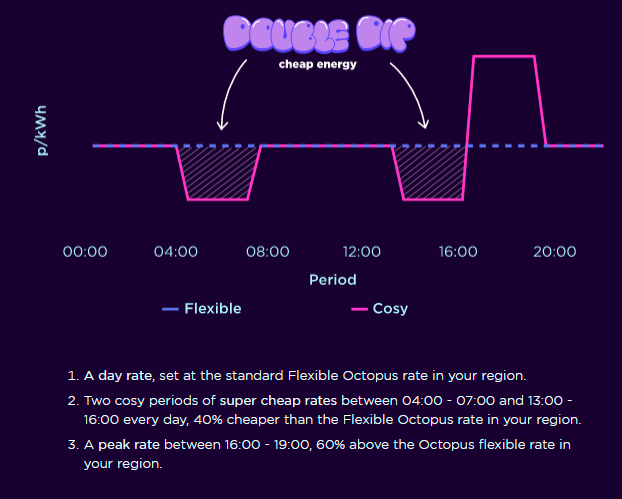
-
Disabling Weather Comp during mid winter?
sharpener replied to Andeh's topic in Air Source Heat Pumps (ASHP)
From reading yr post in the UFH thread it would seem you have a lot of setback, 3 deg would be more normal. Also many ppl increase the target by 1 or 1.5 deg during the cheap periods to provide a reserve of heat so the HP runs less in the peak. Whether you can do this with the setpoint or the WC will depend on how yr controls work. -
ASHP & UFH in these freezing temps
sharpener replied to ashthekid's topic in Air Source Heat Pumps (ASHP)
To expand on that a bit, the hot water will have priority and so the heating will go off while it is doing it. Hence to get the best efficiency you need to heat the hot water to the lowest acceptable temp and at times when the other demands on the hp are going to be minimal e.g. the last hours of the off-peak window. Heating needs to be on weather comp as others have said, not programmed to a fixed temp. Once you have got that right the HP will automatically run at the lowest temp that will meet the house heat demand and so with the highest possible CoP. -
Adding panels myself? (Inverter & cables already installed!)
sharpener replied to glock339's topic in Photovoltaics (PV)
Not in fact the OP but @saveasteading, from whom despite several responses we have not heard since Sunday. Well aware what he asked, but he suggested the figure of £15k, and I agree with you what he is asking for is way beyond the capabilities of even a large domestic installation and certainly not achievable for £15k. As you wrote earlier: Is the right answer. -
Reported in this link from Heat Pumps Today newsletter. Full report downloadable here. Well worth a read, IMHO contains many sound and practical recommendations for levelling the playing field (gas vs electricity and HPs vs boilers), simlifying PP and DNO approval, increasing/training the workforce, and international comparisons. @JamesPa and @Beelbeebub will be particularly interested I think as all readers of this forum.
- 1 reply
-
- 4
-

-

-
Adding panels myself? (Inverter & cables already installed!)
sharpener replied to glock339's topic in Photovoltaics (PV)
As upthread you might get 10kW pk installed power for your £15k budget. Facing SW you would need something like 75 sq m plan area of roof for that allowing something for margins, chimneys etc. -
ASHP & UFH in these freezing temps
sharpener replied to ashthekid's topic in Air Source Heat Pumps (ASHP)
Well what do you know! Every day a school day. 43C flow is quite high for UFH. Assuming you are running weather compensation turn the slope down by 0.1 per day until it gets too cold then back a bit. If not then switch it on. Well during the daytime a Willis heater will use peak rate electricity with a CoP of 1.0 which is less than ideal. If your tank has an immersion heater then it would be more economical to heat the DHW with it at night-time rate, freeing up some HP capacity if you need it. If not, can you fit one, might be cheaper and less disruptive than a Willis heater. So that is 42W per m^2 which is not very generous according to this cheat sheet and might not be enough in a cold snap, air changes per hour are crucial so stop up the draughts you mention in the OP! -
Adding panels myself? (Inverter & cables already installed!)
sharpener replied to glock339's topic in Photovoltaics (PV)
Were it facing due S that ought to buy you something north of 10kW peak. Have you got the roof area? How will you get that much past the DNO? Even with a big battery in addition I don't think it would begin to keep an ASHP going. I have got 7kW of PV and at this time of year it has been generating about 11 kWh per day. This is enough to fully charge my 10kWh of domestic storage but that only provides 400W averaged round the clock. So the EV has to charge from the mains and the HP will I think have to do the same. -
ASHP & UFH in these freezing temps
sharpener replied to ashthekid's topic in Air Source Heat Pumps (ASHP)
Yes but when does the HW go off? Until that time it will inhibit the operation of the UFH (unless the HW demand is satisfied first, by the tank being up to temperature). You say can you see the three-port valve at the point the circuits diverge and can you do anything that moves the valve actuator? Also in the pix above are the displayed values the setpoints or the actual temperatures? -
Clean Heat Market Mechanism to incentivise heat pumps
sharpener replied to LnP's topic in Air Source Heat Pumps (ASHP)
I think we are at cross purposes here @Beelbeebub. I was merely trying to say (i) we have two existing appliances which run without any electricity at all so it would be wise to keep them as an insurance against power outages and (ii) we would need to expand our battery setup by a lot (like double it in size for ~£3 or 4k which I do not plan to do) to provide a worthwhile backup for the new HP. (I have already upped it from 7 to 10.5kWh in the light of experience the first summer but we would have to re-locate it to add a fourth module on top). Yes the existing battery will run it at full o/p for maybe 3 hours but that presupposes it is full to begin with. By nightfall that will not be the case unless it has been a really good day for PV. I have yet to do the modelling to see whether Octopus Cosy or some other tariff will give the lowest cost, and investigate whether it makes sense to re-charge the battery at daytime rate to run the HP during the peak 1600-1900. Controlling the system to optimise all this may not be easy without some additional hardware as for that we would want the HP inside the inverter control loop but otherwise not. -
ASHP & UFH in these freezing temps
sharpener replied to ashthekid's topic in Air Source Heat Pumps (ASHP)
Sounds like your system is stuck in DHW mode, this will take priority over any heating. If there are backup heaters these should be fairly obvious both physically and from the setup screens. Suggest you set DHW to come on only 0500 to 0700 (or whatever suits your off-peak tariff) and see if things improve. If you need more HW than that provides, divide it up or find the lockout setting which should stop HW production after e.g. 30 or 60 mins to allow UFH to have its turn. Lots of help available here but need to post details of system, make and size of HP, size of HW tank, sq m of house, # of occupants etc -
Clean Heat Market Mechanism to incentivise heat pumps
sharpener replied to LnP's topic in Air Source Heat Pumps (ASHP)
Planning to keep our AGA and WBS for exactly this reason. Existing 10kWh of Pylontech will keep the oil boiler running for a bit but would last no time once 12kW Arotherm Plus is installed (hopefully spring 2024), so it will go on the grid side of the inverter metering. -
IIRC though I can't provide a reference it is better to have a 2-port buffer aka volumiser in the return to the HP so the stored heat is directly available for defrost. I don't think two cycles an hour (though not ideal) is much to worry about if you are achieving the target indoor temperatures.
-
Might not be trapped air. On my UFH the flow regulators are very susceptible to blocking with crud. Opening the regulator and closing all the others on the manifold usually shifts it. The bubbles might just be incidental. Do you have any filters, or air release valves?
-
Nor a storage heater I imagine.
-
Quite cunning but the drawback to all schemes involving mixing valves is that the HP has to run at the higher of the two temps, so you get the lower of the two possible CoPs all the time. Is there any possibility of a bit of time division multiplexing so you can run each zone on its own at the optimum flow temp, for part of the time at least? Similarly, I am about to re-do my (current, gas-fired) HW programming so it heats up while the CH is off and hence doesn't compromise the weather comp and the attendant condensing mode operation.
-
1 m planning requirement to be scrapped?
sharpener replied to sharpener's topic in Air Source Heat Pumps (ASHP)
Very likely it will be (at least using MCS methodology) because if near the boundary it's more likely to be screened from the neighbours' windows by the fence. This gives you an extra 5dB if partial or 10dB if complete screening to play with. -
Heat Pumps work when installed correctly...
sharpener replied to Marvin's topic in Air Source Heat Pumps (ASHP)
Think where we would be now if we had pressed on with the Sizewell B design and built a fleet of those as was the original intention. -
See this article in Telegraph
-
Help with air source heat pump
sharpener replied to thenight's topic in Air Source Heat Pumps (ASHP)
Not really a horror story. Mostly it's because elecricity is approx 3x as expensive as gas, but the CoP of an HP is also in the region of 3x so the cost relative to a gas boiler is down to small differences in the two and may be more or less. Hence the emphasis on running the HP from off-peak electricity as far as practicable. The amount of energy needed is beyond the scope of small domestic battery systems. The situation in Norway is rather different, they have a history of cheap hydroelectric power (dating from before their exploitation of oil and gas fields) so saving 2/3 of consumption by upgrading from resistive heating to heat pumps is a no-brainer. There is also much more use of MVHR which helps. -
Help with air source heat pump
sharpener replied to thenight's topic in Air Source Heat Pumps (ASHP)
Some of the claims in that link are pretty doubtful though. Afinia aluminium radiators are more efficient than traditional radiator materials, such as steel and cast iron Incredibly effective thermal conductors and with low energy consumption, Afinia radiators can help lower energy bills The range can deliver exceptional room comfort, heating up and cooling down very quickly which allows Afinia radiators to respond quickly to any changes in the temperature demand set by the thermostat Except for heat lost from the back via an external wall (which will not vary a great deal) all radiators are 100% efficient in terms of the heat getting from the pipework into the room. The radiators themselves do not and cannot have any intrinsic "energy consumption", low or otherwise. (Even with fan-assisted radiators the motor power ends up in the room.) Claims about warm-up time are I think illusory, the thermal mass of the metalwork is small compared with the water content and very small compared with the room itself. All the usual misleading advertising guff IMO. -
Heat Pumps work when installed correctly...
sharpener replied to Marvin's topic in Air Source Heat Pumps (ASHP)
Why? The property owner may see a big bill for lots of short-term disruption and a very long payback time. If the property is rented the owner and occupiers interests are not very well aligned. The landlord will have to increase the rent to get a return on the capital investment, it is easier just to invest in more property. An issue peculiar to the UK is the large proportion of Victorian housing with solid brick walls. Insulating these either inside or outside is costly, disruptive and/or unsightly. Space to fit HPs to terraced housing under current planning rules is often non-existent. Tragedy of the commons. Benefits in terms of CO2 reduction do not accrue to individual households. Legislation gets watered down/delayed by powerful new build industry. Enforcement of building regs is poor leading to e.g. weather compensation being fitted but not actually commissioned to avoid callbacks. Peoples' expectations need managing too. HPs will in most cases not reduce heating bills significantly so why would they embark on retrofitting them? Hence unless part of a larger refurbishment it is a hobby activity for those with lots of interest, time and spare capital. Education about all this from basic science and arithmetic upwards, at all levels from householders to Cabinet is what needs the massive "improvement". -
Help with air source heat pump
sharpener replied to thenight's topic in Air Source Heat Pumps (ASHP)
Can get quite cold there esp if up in the dales, the MCS design rules take account of predicted min temps and altitude. According to my go to cheat sheet yr house could need anything from 40 to 65 W/m^2, so a 5 to 8 kW unit. This means almost every manufacturer's single fan models so it will come within Permitted Development under the planning legislation. Also you need to verify your house power connection is adequate, but not likely to be a problem with this size of HP and age of property. Another consideration is choice of refrigerant, R290 will enable you to reach higher flow temps than R32 and if the rad sizes are marginal it might help, but the MCS (and hence BUS grant) rules don't really allow best advantage to be taken of this anyway. Try playing with this interactive toolkit.