


sharpener
-
Posts
1492 -
Joined
-
Last visited
-
Days Won
1
Everything posted by sharpener
-
Well IMHO the scenario where you allow the temp in the A (not set back) rooms to sag proves nothing. Sensible people will (for any specific room) already have chosen the lowest setpoint they are comfortable with, bearing in mind likely activity and clothing level. This by definition means they will detect sag and so not tolerate it. Certainly in the detached house example I would not be happy with a sag of 1.9K I would argue that the only rigorous comparison is where you have "stiff" temp control of the A rooms. Your model shows that in this scenario the "bad setback" highlighted by Heat Geek does in fact occur. The key point is the relationship between CoP and flow temp, you say "Raising the flow temperature reduces the CoP (coefficient of performance) of the heat pump (with data points from a real device) by a greater factor than the heat demand reduction caused by the TRVs, thus the electricity demand of the heat pump goes up while the two rooms are set back." I would be interested (since you do not say) what the "real device" was, whether it has R32 or R290 or some other refrigerant, and how sensitive the result is to choice of heat pump manufacturer, can you comment on this? That is all for yr steady-state analysis. With whole house night set back the likely potential savings are of the order of 8% as discussed a bit here. But as @JohnMo says, having to play catchup moves the HP onto an even worse point on its CoP diagram than required just to combat the "bad setback", this will be a bigger effect but as Michael Podesta has demonstated the overall result is, "Well, it depends, but it’s marginal, either way". The only getout I can see is to do it on cheap rate electricity and this will I hope give a net positive result as the savings are partly at normal rate but the boost phase will all be cheap.
-
Mini Store - Heat Geek / Newark Cylinders for ASHP
sharpener replied to Nick Laslett's topic in Air Source Heat Pumps (ASHP)
Do you have the TS already? If so you could perhaps find corrugated pipe which has more surface/unit length. If not then Newark are quite flexible in quoting specials to order, talk to Adam Blanchard. They might also do you a corrugated coil on its own. @JamesPa has a spreadsheet for performance vs coil size in DHW tanks, it should also work in reverse for HW coil in TS. -
Ah, so ideally you need rads which are big enough to cope also with the heat leaks to the setback rooms. Yes we are getting 6 rads changed for bigger ones, required uplift factor 1.9x. In one of the study/bedrooms this is not quite achievable bc of furniture but fitting foil and having it plumbed TBOE will help a bit. Your paper concludes Using common open-loop weather compensation (radiator flow temperature driven by external temperature only) eliminates the bad setback effect, and indeed saves a little extra energy. This is in return for a small sag in temperature for A rooms, though likely well within tolerable bounds. But this doesn't really eliminate the bad setback effect. If the "small sag in temperature" is "tolerable" then you could turn the setpoint/WC slope down by a corresponding amount all the time and make even greater savings! To respond to what @JohnMo has just posted, we have already got the wireless TRV setup so it is a question of optimising how to use it. I certainly wouldn't be fitting it from new when installing the heat pump. But it does allow flexible zoning by time and temperature and this will I think be useful. As a specific example I envisage using the UFH to heat the living room 18/24 to a setback temp of say 16C, there are also rads which will quickly bring it up to 20C at 1700 using off-peak heat from the thermal store. The ceiling is very leaky so this will provide the two bedrooms above with background heat as well. Only when they are in use for guests will they be heated to 18C, I cannot think that heating them all the time will save money. Verifying all this experimentally will be very complex when I also pose the question Will Octopus Cosy with its 3 periods at 10p/kWh be better than Octopus Intelligent Go with a single 6 hours at 7p plus whatever is achievable by gaming their algorithm by playing with the EV charging times?
-
Following this with interest. @DamonHD you mention radiator (over) sizing as a complicating factor but I did not see any conclusion about the magnitude or sign of this effect, can you enlarge on this point for me? I would love to see the work extended to the savings (or otherwise) of whole-house night setback. @JamesPa has done some modelling of this which IIRC showed real but modest savings from the heat losses being somewhat lower. Again there is a "bad setback" effect if the HP has to work hard to re-attain the daytime temps in a reasonable time. But I am guessing this may be reduced or eliminated if it happens only inside a cheap electricity window. We have a two storey long thin 180 sq m barn conversion with various unusual occupancy patterns. In particular the middle two bedrooms are used mainly as studies in the daytime, and the fourth only when we have guests. But the living room (which occupies half the ground floor) is only used in the evenings. There are Honeywell wireless TRVs on nearly all the radiators and I am considering how best to incorporate these into the control strategy for the 12kW HP which is shortly to be installed. Initial approach will be to simply use them for overheat prevention while I get the weather comp optimised first. After that it may depend on my patience for carrying out meaningful and detailed experiments!
-
I think diversity will become less applicable and this will give them tremendous problems in future with all sorts of heavy loads switching on at the start of the cheap periods. It is not like not using all four cooker rings at the same time, everyone is going to set their home battery, EV charger and HP to kick in at the same time. 10 mins (or even 30 mins) of programmable dither is not going to make much difference. In my case that will be 67 amps out of my permitted 80 all at once. The DNOs don't control which supply companies the punters are signed up to, so the small variations between them in the cheap period timings aren't going to help much either. I forsee OFGEM having to step in to enforce more variability in them. Silly, if they are nominally going to restrict you to 12kW then logic dictates that they should fit a 60 (or 50) amp company fuse.
-
Thanks. Was directed at @Dillsue in fact! By coincidence I remembered I had bookmarked this useful demand calculator also from SSEN https://www.ssen.co.uk/our-services/tools-and-maps/demand-calculator/. Allows you to test out what you might get away with before actually applying. Your 12kW sounds very restrictive. WPD have let me add a 12kW(t) HP and 7kW(e) EV charge point on my existing 80A supply, I was quite surprised. Couldn't easily upgrade to 100A as have 16 sq mm meter tails going by unknown route through a 500mm stone wall.
-
Sounds like we had a close shave then, original FIT system has 2 x 2kW Stecagrid inverters, fortunately the panels are 16 x 230 W so exactly 3.68kW, installed under G83/1 at the time (2011) IIRC. Blimey, what DNO was that? Am only 200m from the substation but am still expecting pushback if I try for more. Have now got a total of 6.9kW so ATM I have lot of curtailment in the summer, would like to do my bit (and get paid for it).
-
Making the most of excess solar with a 3-phase supply
sharpener replied to Tom's topic in Photovoltaics (PV)
Does this work when the car is fully charged? Doesn't Octopus need access to your car setup and so can tell? -
ASHP water leaving temperature control
sharpener replied to JohnMo's topic in Air Source Heat Pumps (ASHP)
Why is the edit window so short @jack? Comparable sites like the Arotherm plus FB page or https://camelot-forum.co.uk/ allow indefinite editing, and it does not seem to be abused in either case. -
No, reliability. This is just one of several recent posts on the Arotherm Plus forum about duff Honeywell valves falling apart https://www.facebook.com/share/p/nqxrMWsS4CE7Uio4/.
-
Honeywell diverters in particular have had all sorts of QA problems in recent years. Installers seem to recommend ESBE valves for anything over about 5 kW.
-
ASHP water leaving temperature control
sharpener replied to JohnMo's topic in Air Source Heat Pumps (ASHP)
I believe Vaillant Arotherm plus are similar, default also -60. Not sure about max, ?-120 DM. -
Further thoughts following a query I posted on the IET Consultants discussion group in an idle moment. I didn't get any more pointers on input filter design but though it worth a try. One reply suggested a power factor correction capacitor might help but I am doubtful. Another suggested a circuit to minimise the inrush current. But there is already a built-in soft-start facility in the VSD, what delay is it currently set to? Playing with this might buy you some more margin. Did you ever check that the motor is the 230V 3ph variant not the 400V? There is also a note in the manual about letting the motor run at full speed for at least 60 secs to calibrate the drive. If as I read elsethread you have an issue with acidic water then you might want to consider a plastic or stainless steel body for the pump not cast iron. There is a "polymer" version of the DAB pump, the JETCOM 62 but it doesn't seem to be readily available in the UK. So maybe s/s after all.
-
Pressure relief drain for heat pump heating circuit.
sharpener replied to sharpener's topic in General Plumbing
Thanks guys. Plumbers have in the past seemed quite happy to fit a Hepworth bladder trap onto my soil stack at first floor level for a boiler P & T relief. But it seems to require quite a head (>2m) to open it up, this caused the D2 drain line to back up to the tundish. So I relocated it to the bottom of the soil stack but it still does not drain freely. IIRC there are some combined tundish and waterless traps available now, perhaps this is the way to go. Ideally it would have an outlet for 22mm D2 not 32mm waste pipe, is there such a thing? -
I think if the appearance is going to be acceptable you will be OK, particularly if they are both based on the same resin polymers. Most of the covering power in a paint system is in the undercoat, it needs UV protection though which the varnish will provide. We had a continual problem with a damp stain bleeding through on a chimney breast. International Paints'(*) Stain Block was completely useless but two coats of Ronseal matt polyurethane fixed it and would take matt emulsion on top. * makers of the famed International Yacht Varnish which says on the tin "not suitable for exterior use".
-
A carvel-built wooden boat of that size would have thinner planking, but also internal frames of some kind to resist the external pressure (so the fastenings would not be under tension). Also dinghies have reinforcement round the "rim" by way of gunwales or decking, and are generally curved, both of which which prevent the sides from bowing in. So I think you are right, some structural calcs might be in order to see if lengthwise external ribs would be a good idea. If the sides bow out it will also tend to peel apart the corner joints over time. Not easy to tell but to me it doesn't look to be very generously proportioned for 2 x 75 kg people.
-
I have got express permission in an AONB as HP is too big for deemed PP. South Hams DC (Devon) have applied no conditions in their Decision Letter about noise or anything else. Their Planning Officer's report includes only the following about noise Environmental Health Section: We have considered the application and the proposed make and location of the heat pump. The pump is a low noise pump with sound pressure level at 3m being around 36-38dB. The nearest neighbouring residence is further away than this and there would be no direct line of sight with windows to a habitable room. Therefore we do not anticipate that there would be any unreasonable noise impact from this unit. The statements about the neighbouring house are not entirely accurate, but work in my favour. I said in my application the installation would comply with the noise requirements of MCS020, my calcs show on a strict interpretation this might require at least a partial screen. I do not know where they got the 36 - 38 dB from, the data sheet I sent with the application has these noise figures with a picture that only applies to the smallest sizes. For the 12kW model the correct figure at 3m would seem to be 42dB(A), and even at 5m (which is just meets) it is still 1 dB over the 37dB limit. However I am not complaining.
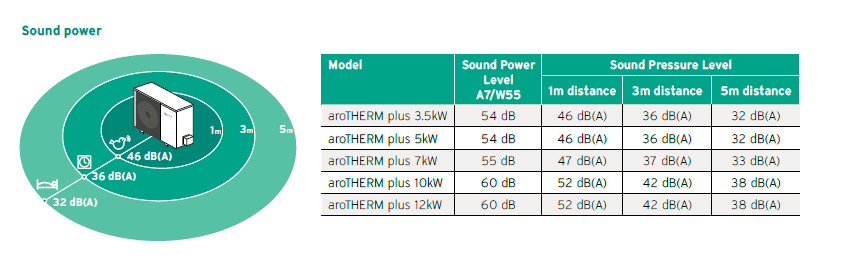
-
PVGIS is your friend.
-
An update before you are next on site @Hastings in case it affects your planning. There have been no further responses from the Victron forum so I have done a bit more thinking about possible harmonic filters to fix this. The VSD manufacturer does a 50A filter <EMC Filter INFILT-M501> but it is £235 plus shipping and VAT. And filters that are too big may not be effective IME. I have actually got some sample toroidal choke cores which might well serve as the basis for a series filter, but annoyingly I cannot find enough design information, there is some stuff on the web e.g. this article and this one but mostly intended for big industrial applications so I have no way of knowing what component values would be correct for a small VSD. So we are back to the thought of replacing the pump with a smaller, single phase one. The automatic Steelpumps X-AJE80B would be good, but any of the other three mentioned upthread would also do with a suitable pressure flow control. They all have a suction lift of at least 7m which should be enough even allowing for 1m head loss in the suction line. As I wrote previously so it all depends on whether you want to stick with Steelpumps, go for something that also has spare parts availability and the best suction lift (DAB), for the lowest power consumption but not repairable (ST) or for the really cheap and cheerful option (small Clarke). Given the price of the Steelpumps option and that the rest are quite close I think my favourite would be the DAB62 e.g. from here, I see they also stock the Clarke controller which I have found works fine. HTH. Do let us know how the existing pump performs on a mains 3-phase supply if you are able to test it.
-
How acid is your rainwater? Does it matter?
sharpener replied to sharpener's topic in Rainwater, Guttering & SuDS
Interesting, remind me what part of the country are you? I think if we could get a naturally occurring pH of 6.6 we would be very happy and wouldn't bother about it! Was it the testing lab who advised the Juraperle? Will a 10" filter housing be enough for your flow rate (have just reviewed my correspondence with Wrekin Water and they advised a min size 8 in dia 35 in high vessel for 10 lpm)? I have looked into these but I think they are more suited to regular use by the professionals. For best accuracy you need to keep the electrodes in a buffer solution when not in use and recalibrate them periodically. Universal indicator drops https://www.water-for-health.co.uk/ph-test-colour-reagent.html have a shelf life of 3 years so I ought to get some more now. And they are above all reliable and cheap! The colour chart is a bit off though, IIRC pH 7.5 is a pleasing teal colour which is not shown on the test card at all. BTW when are you going to be back on site and able to test yr pump again? -
Possibly. It is as ever a balance between capital cost, running cost and practicality. I decided to pay extra to increase the insulation on the tank itself from 50 to 75mm. The thermal store will be in a utility room so everything is inside the thermal envelope of the house anyway. The 22mm outlets will have heat traps, but for the 28mm primary connections it would serve no point anyway as there is flow all the time through the buffer section at the bottom of the tank. The tank will be at max temp for only a short time because we will use the heat again as soon as the Cosy cheap periods finish at 0700 and 1600. Octopus have just added an extra two hours from 2200 to 2400, which is welcome but has changed the planned usage pattern slightly e.g. we could charge it up for a third time and use it for background heat on the landings. The concept enables different flow temps for rads and UFH. In an ideal world I would add a further two-port valve so when the tank has got too cold for the rads we can use the residual heat in the UFH, but the design has been finalised with Vaillant now and there are no spare control outputs to do it.
-
All very true but the linear approximation is good enough for everyday calcs. The custom 270 litre tank I have got on order has a loss of 1.49 kWh per 24h which is small in comparison with the actual usage. This standing loss of about 60W is only 1% of the OP's proposed 5 kW HP output so can safely be ignored in the heating time calculation.
-
Don't think so. Quoted ratings of HPs are for thermal output not electrical input unless your Panasonic is different. Yes it will be a bit better in warm weather, but not by a factor of 3. But many ppl will reheat when it gets down to 40 as that is only slightly above body temp. So are not exercising it over the range 10 - 40C which accounts for 2/3 of the total stored heat input. Is O level physics. For comparison a 3kW immersion heater takes the best part of 3 hrs to heat the usual 210 l cyl from cold to 55C. Entirely consistent with the above.
-
5kWh is 4305 litre-degrees. So 5kW will heat a 300 litre cyl at 14.35 deg per hour. So about 3 hrs from stone cold. Reheat from tepid obviously quicker.
-
How acid is your rainwater? Does it matter?
sharpener replied to sharpener's topic in Rainwater, Guttering & SuDS
You may be right but even so it is a comparatively big and expensive extra vessel, according to the GAPS Water Treatment web site we would need the 13 x 54 inch size for 20 l/min. We have 5 micron and 1 micron filters upstream so the treated rainwater is in fact clearer than the mains water, which often throws deposits. The 1 micron one will soon need changing, we will replace the activated plant charcoal cartridge with one containing bone char which we have been told is better at reducing the iron content, another issue though no-one has any idea where it comes from as there is none in the system, it is all s/s, brass or plastic. Have just noticed this footnote on the GAPS site "*Note: If the inlet water contains iron or manganese it is recomended to use a backwashing unit instead to prevent media binding." Somewhere I also read that the backwash also serves to shake up the bed, wash out spent fines and expose fresh calcite surfaces to the incoming flow. The tank has a 4 in vertical inlet pipe going right to the bottom, the designers say this helps to aerate and stir the contents and prevent it becoming stagnant. So ATM we have been feeding Juraperle down this pipe, the thinking was the inflow would also spread the Juraperle about too. It seems to do that but still does not raise the pH by the expected amount so we continue with the bicarbonate which is pre-dissolved and fed down a small bore plastic pipe into the inlet.
