


sharpener
-
Posts
1492 -
Joined
-
Last visited
-
Days Won
1
Everything posted by sharpener
-
How acid is your rainwater? Does it matter?
sharpener replied to sharpener's topic in Rainwater, Guttering & SuDS
It's historical, the previous owners had installed it, with many deficiencies, sorting it out was quite a project but we anyway needed to get new surface water drains put in after the garage was flooded. In hindsight we should probably have binned it, though (after the cost of consumables) the savings on water and sewerage charges are £100s a year. UVC is stainless steel so that is not the problem. We do need to treat the water anyway to avoid it dissolving copper from the cold pipework. Then the hot pipework is OK provided we do not exceed 55C. Not bothered about legionella. Perhaps. Have spoken to them in the past. The standard size we would need for a whole-house supply is 4ft 6ins high by ?10 ins diameter which is too big to go in the existing kiosk in the garage with the 2 filters and pump in it. Would also need auto-backwash on a timer, with a drain connection as well. Something more like this perhaps? https://www.ebay.co.uk/itm/374794124532. Only 3 litres/min flow rate though. Contact time with Juraperle is the issue, hence the height of the whole-house system vessel you need. Its advantage is that being calcium carbonate based its action is self-limiting to ?ph 8.5 so does not continue to dissolve indefinitely. Magnesium-based pH correction media like Corrosex are much faster but have an end pH of 10.0 (drinking water limits are 6.5 to 9.0) so not advisable on their own. Mixtures of 90/10 or 75/25 are recommended as a compromise but if you are away the magnesium component continues to dissolve making the water too alkaline. We have not found a foolproof way round all this at a reasonable installed price despite consulting several different equipment suppliers and a water quality testing specialist. And the water treatment firm who supplied all the kit for a local vineyard and winery(!) They proposed a bag filter containing Juraperle placed in the tank inlet pipe, but after a very long wait the one they then supplied was too big to fit. -
How acid is your rainwater? Does it matter?
sharpener replied to sharpener's topic in Rainwater, Guttering & SuDS
Have been sold loose Juraperle in the past but not found a good way of dosing it. Cylinder sounds interesting, do you have a link? I have tried various things and recommend the liquid indicator drops, they give a much more positive pH indication than any strip. Have also used the 10-in-1 test kits from Simplex Health, they are quite sensitive tests for various metals and contaminants inc bacteria. But their pH strips are pretty useless. -
Here you go @SteamyTea
-
I have a 5000 litre underground rainwater tank which collects almost everything that comes off 200 sq m of slate roof in a village in Devon, which amounts to over 200 cu m per year. It goes through multiple stages of filtration and then a UV steriliser. So it is fit to drink, though in fact we have mains water piped to the cold taps for drinking. Everything else gets fed from the rainwater - loos, washing machine, dishwasher, hot water system. The water is noticeably acid and the stainless steel spring in the UVC pressure regulating valve has in the past completely disintegrated. The acidity is because of the CO2 that gets dissolved from the atmosphere as the rain falls through it. I have used the free Aqion s/w to investigate this (www.aqion.de) and it gives the equilibrium pH as 5.61. Testing the as-collected water with pH strips is not reliable (because of the low conductivity), but I have found the Universal Indicator drops available from Amazon give a clear indication with a resolution of 0.5 pH. Typically it is pH 6.0 or less. I have had conflicting advice about this and currently dose it with 100g of sodium bicarbonate per 1000 litres. Even so it doesn't get much above pH 7.0 (though aquion predicts 8.28). Does anyone else see this as a problem or do anything to treat their harvested water?
-
More than happy to try and help. So no separate BMS as for my LiFePO4 batteries. Otherwise your system is enticingly similar to mine as we also have a remote tank, and yr Easy Solar inverter section is electrically identical to my Multiplus II GX 5000. So I have just run through the possible settings in VE Direct but there is nothing obvious I can suggest. Re-building the rainwater system that was previously installed at our house has been a long and difficult journey involving 8 ins of floodwater in the garage, a burnt out control box, a blocked pilot jet in a solenoid valve, two replacement pumps out of which I have built one working one, a new underground tank and learning quite a lot about filtration, corrosion and water chemistry into the bargain. Post the results here when you are able to get back to the site for further tests!
-
OK @Hastings I think I have an answer for you but it is quite technical. The E-Power e-MM/MT Variable Speed Drive probably uses a simple bridge rectifier to provide an internal DC supply as per the description here. The rectifier will conduct over a very small angle near the top of the input sine waveform and this will result in it taking short duration heavy current pulses from the mains input. I suspect given its compact size and economical price this VSD does not incorporate the proper filtering on the input necessary to avoid this effect. These heavy current pulses are something the Victron Multi inverter probably does not like, and in consequence it may not be able to power the VSD properly especially at low battery SoC. I have posted a query about this on the Victron forum, however the replies so far are about using industrial VFDs on a Multi RS Solar (which is anyway a different type of inverter not using a toroidal mains transformer) so may not be applicable to your case. Are you able to take the pump/VSD combo to somewhere there is a grid supply to see if it then works? Did your supplier sell you them specifically for use with the Victron inverter? In which case did you get a guarantee that it will work OK? Long term I think you would be fine with Steelpumps' smallest jet pump with a simple pressure/flow switch, but ideally you would want to check with them that the long suction line is OK before committing. HTH
-
AIUI it is Octopus who have to apply to the DNO for the export MPAN see e.g. this thread, some hints there too. A smart meter can have more than one MPAN associated with it, if there is one etched on it I imagine it would be the import MPAN.
-
Yes but if the output is not reaching the target pressure presumably the VFD will increase the voltage/frequency in an attempt to achieve it, subject to the limits that have been set.
-
Fischer Aquaefficient heat battery vs cylinder
sharpener replied to anonymous's topic in Other Heating Systems
I can't believe the Advertising Standards Authority lets Fischer get away with their claims. Their whole setup stinks, especially directing their newspaper advertising at the elderly. Even if it were not a re-badged Sunamp I would not touch any of their products with the proverbial insulated bargepole. SA must be desperate indeed to get into bed with them. -
I was wondering about that, 52kW over 550 sq m is about 95 W/sq m, spot on for the HG Cheat Sheet We have a 192 sq m house with stone walls and slate roof that is only 62.5. With 3 floors you should have a better surface area to volume ratio so I think the difference will be in the loft insulation and draught-proofing, can you do anything to improve those factors, yr air changes/hr must be horrendous? 100A will get you 23 kW(e) so about 69kW thermal from a HP so it is technically doable but the complicated cascade sounds something of a technical challenge! UFH also not obligatory but you would need big rads instead to get a decent CoP. Not a problem with an oil boiler bc efficiency is not very dependent on flow temp. +1 for that as the solution.

-
What company will tell you what size pipes, ASHP?
sharpener replied to CalvinHobbes's topic in Air Source Heat Pumps (ASHP)
Was there any outcome to this @CalvinHobbes? -
Will have a similar issue as am planning to move to Octopus Cosy when the HP is installed. There is a school of thought which says that rather than prioritising battery charging from PV it is more cost-effective to export to the max at 15p on Octopus Outgoing and then charge the batts at 7.5p during the cheap periods if you have to. Sounds like what you are doing. The economics are also discussed by Michael Podesta here. The profit seems however to rely on the cost of increased use of the batteries being disregarded as it is already a sunk cost. I have 3.68kW of panels on an AC inverter and 3.24 on a DC MPPT, but max export is constrained by the DNO to 3.68kW. So when it is sunny it makes sense to delay charging the 10kWh of batts until the 3.68kW limit is being reached, this means the marginal cost of charging is then zero as generation would otherwise have to be curtailed. Problem is that if it then clouds over the batteries never get fully charged from the PV. However it still works out cheaper, as above. Victron Dynamic ESS is supposed to integrate all that with weather forecast and control all this automatically but still has various teething problems reported. Also it relies on integrating your usage over time so if you go away for a while does not work well. There is a ?Polish software package which is reputedly better and has a "holiday" mode, but more complicated to program, sorry can't find the link ATM.
-
Not that are specific to this situation. In the present situation it might struggle to start a 1200W pump on its own, but there is a soft-start VSD between the pump and the Victron setup anyway. If as the OP believes the battery/inverter is struggling I would expect to see a low battery or overload warning but he doesn't. If there was a loose connection somewhere that would probably throw an error too. @Hastings what Battery Management System do you have with your Rolls LA batteries? I am puzzled you say the pump crashes the system unless the batteries are fully charged, I would expect (i) the soft start provided by the VSD to obviate this problem and (ii) it would show up as a low battery error message. Are all the battery connections fully tightened? The Victron inverters have according to this video a 100% overload capability for 2 mins, they are widely used for off-grid pumps machinery etc and there have been a few queries on their forum about induction hobs and really large motors. The video also recommends allowing 100% margin for reactive loads with a PF 0.7 to 0.8, but that is less restrictive than the advice to allow for 6x startup current for a single-phase motor. As upthread I tried with the kettle etc already drawing 2.4kW and it will still start my 650W pump with the briefest of flicker. I looked to see if my bench grinder would be more of a test but it is only 260W and I do not have anything bigger. (The vacuum cleaner is 1200W but IIRC it is a series-wound AC/DC type motor so not yr typical induction motor like the pump. Ditto the lawn scarifier.)
-
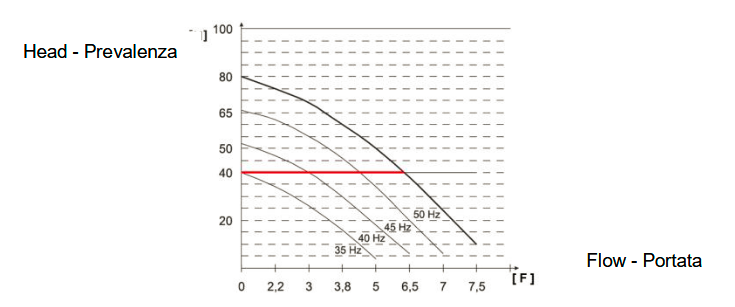
Here are a few further thoughts and possible lines of enquiry 1. Inverter drive - Compatibility with pump etc Has this combo been tested/approved by Steelpumps? What do there Technical Sales ppl say about it? Italian 3 phase is 230V phase to phase. UK 3-phase is 415V phase to phase. Steelpumps therefore make two different versions of the 3-phase models, have you got the right one for the VSD (I think -230 not -400), you didn't give the suffix? I see the inverter instructions say "For having correct behaviours it is essential to choose a pump with slope characteristic curve (see fig.), usually multiimpeller pumps; this kind of pump permits the Epower to pilots pump at variables speed. The head and capacity of the pump must correct for request of the plant." So if it has to be a convex characteristic and the pump has a straight line as upthread maybe the inverter s/w can't find a proper working point on the curve. N.b. this is not a multi-impeller/multistage pump. (The English "three-stage pump" on p.9 is a mistranslation of "pompa trifase"). The inverter drive has a lot of programmable functions. Maybe one of the limits (?voltage ?frequency ?pressure) is set inappropriately. There is a factory reset that can be applied to go back to the default settings, p.33 code 76. If you have to re-locate the/a pump to the tank site I would ditch the VSD, as the complication of needing the Long Connection Adapter if you do not also move the drive and also needing to run three phase cable is a PITA. 2. Choice of pump Looks OK and is suggested for this application. But the 1200W version would probably be too big for the Victron inverter if you did not have a soft start. Inductive loads such as motors are not in themselves a limitation, the inverter is specified for a power factor of 0.8 anyway. I would guess the 800W single phase version would be OK. Maybe you could keep the pump but replace the motor with the 800W single phase one? Should be capable of a reasonable suction lift, they don't show the figures but DAB and ST will do 9 and IIRC 7 m respectively. The effect from the graphs seems to be to restrict the max flow, but not to reduce the delivery pressure at lower flows. What do Steelpumps technical say about using it with such a long suction line? Is there a pinhole air leak in the suction line somewhere? If you leave it overnight is the foot valve or NRV sufficient to prevent any drop in level? As a sanity check this online calculator says 25m of 28mm plastic pipe will require 105mbar of head for a flow of 20 l/min. So will add 1.05m to the suction lift which is reasonable. Velocity of 0.8 m/s is also reasonable. For the fittings assume 1m extra length per elbow, but it will not make much difference. 3. Is the pump broken? As above I would query the reported 8 bar on test. It sounds as though the pump is faulty or is not getting enough power from the VSD for some reason. Does it sound as though it is operating at the right speed? Can you try connecting it directly to a 3-phase mains supply somewhere? N.b. do not do this if it is a 230V 3-phase motor (see above). Has one of the windings gone open circuit (you should read the same resistance between any two of the three terminals)? Have you monitored the terminal voltage and frequency when being driven by the VSD? Does it provide the same voltage to all three phases? You can read the frequency off the VSD display or infer it using a simple RC circuit and a voltmeter. 4. General thoughts VSDs are of most benefit where you have a pump that has to operate continuously but with varying loads/flow rate. I don't think the savings will be significant in yr domestic situation. The soft start is beneficial in cutting the initial power drain but the slow startup will mean without an accumulator there will be a corresponding delay in providing the flow compared with a simple pressure/flow switch (which seems to work well enough for me without crashing the battery inverter). HTH
-
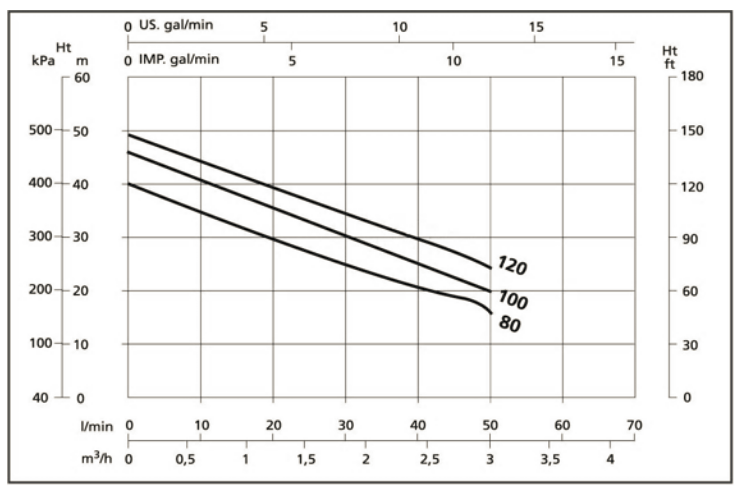
Meanwhile I see the Steelpumps X-JE120BT is in fact a jet pump from its shape and as mentioned in the text. Performance of the 800W version seems to be very similar to the DAB Jet 62 upthread. I would question the supplier having found @Hastings's 1200W one produces 8 bar on bench test though, because the mfrs data sheet shows it only going up to 5 bar when stalled (and that seems typical of the other jet pumps I have looked at):
-
Yes. I thought it would be useful to compare though. Failed to realise it was a 3-phase pump motor driven by 1 to 3 phase inverter drive. Am currently reading through the manual and have already come across a couple of mistranslations so could take a while! It's possible I suppose that the one inverter does not like feeding the other or vice versa.
-
Sounds really strange. What exact model/type/size of Steelpump is it? I see they have quite a range including jet pumps, new to me but look quite impressive. Then I can look at the data sheet for further inspiration. Pipework sounds OK to me, much of my suction pipe is 22mm Polypipe, again sufficiently rigid not to collapse. Did you check the voltage at the terminals when you were doing the test? Victron inverters are robust and well regarded, they put out a decent sine wave so I would be a bit surprised if that is the problem. Also you can set various alarms inc low battery and overload, and look at the history using VRM to investigate problems, does this reveal anything e.g. running the pump pulls the DC voltage down unexpectedly? If your pump has a VSD that would almost certainly act as a soft start lessening the impact on the inverter somewhat. How does it cope with other heavy loads e.g. cooker or fan heater? My pump in contrast is a simple capacitor-run type with direct-on-line starting so I am not surprised it makes the lights dip a bit but as the tests showed (I needed to check it anyway) it will start reliably off-grid without crashing. , Victron advice is not specific to pumps, applies to all motors, see for example this discussion, if you follow the link there is a video where at about 12'15" in Johannes Boonstra explains the limitations for starting motors. I keep an eye on this forum and there have been various queries about motor starting, I don't recall anything which might shed any further light on your problem but you could always post your own query there. I have got 3 x Pylontec 3.55 kWh Force-L2 modules giving me 10.65 kWh nom capacity. Two modules was defo too small so I added another after their first winter. They are a bit smarter looking for a domestic install than the usual 3000 series and the wiring is much neater but I managed to get them for about the same price. They are the same electrically, the only problem peculiar to all Pylontecs is they are only 15 cells and they will not supply full rated current when below about 20% SoC as the internal resistance means this takes the voltage below the Victron trip threshold. So I have written a NodeRed flow to taper off the max inverter power before this happens (see my post Pylontech batteries will not cook the breakfast).
-
Don't understand this. My Onsite Guide says it is appiicable for impedances outside the customer's installation of 0.35 ohms for TN-C-S, 0.8 ohms for T-N-S, 21 ohms excluding the customer's earth electrode for TT. IIRC these are the usual design assumptions for domestic wiring. So I don't see why an external earth impedance of 0.18 should be necessary for a generator putting out 5kW which is only about 1/4 of the max load of your typical house. Can someone explain what the DNO is trying to achieve here? What kind of faults do they envisage? Would converting the installation to TT help?
-
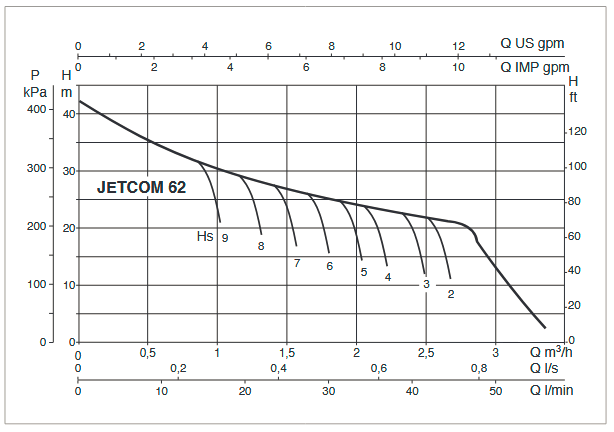
Maybe, I had thought it might be, certainly doesn't sound very nice. But there is no info on the data sheet about this, it is pretty sketchy. No signs of erosion though when I had it apart after several years' use to discover the cracked shroud. The info about the reduction in flow vs suction head copied above is actually taken from the data sheet for an earlier ST jet pump, now discontinued, but I imagine they are all pretty similar. That model was supposed to cope with a suction lift of 7m (presumably without cavitation), and at low flows the pressure drop we need to add to take a/c of flow resistance will not be much (certainly compared with 20m of underground delivery pipe). The DAB Jetcom 62 is a bit better and will cope with a 9m suction head but has a somewhat higher max power consumption, 850W. The small Clarke is 800W, so the ST Jet 55-45 at 650W is the best of the three if max power consumption is the chief criterion.
-
I suppose it would. We inherited a system without one and it has never bothered us, the pump is pretty noisy (?cavitation?) but is in the garage 20m away, I would not want it in the house without some kind of NR treatment. In the extreme case my grandfather ran the downhole well pump to fill it up the tank in the loft only once a day, as a child I was fascinated by the cat-and-mouse indicator under the eaves which showed the tank level. There was also an automatic level switch but he did not use it as he said the frequent starts brought up a lot of sand as well. We have rainwater so sand is not a problem but the pH is, have tried various things but never quite cracked it, will make sure to fill up the HP with mains water which is slightly alkaline. Vaillant recommend pH 8.2 min and I bet most installers never check this. I now see the OP has already done this test, with no resistance at all on the suction side it sounds to me like the pump is defo stuffed whatever the supplier says. And also too big for the inverter to handle. Truly the worst of all possible worlds ((c) Voltaire).
-
Thanks for adding that. Do you actually need an accumulator with your pump @JohnMo?, mine works OK with just the Clarke pressure/flow switch (which looks to be a copy of the original Stuart Turner one I think made in Italy), threshold 1.5 bar, not adjustable but works fine for us (assuming the pump does not have a cracked housing as upthread!). So can be used up to 15m delivery head which is a 3-storey house. Have just done some tests starting the pump when off-grid. We have a Victron Multiplus II GX 5000 with 10.65 kWh of Pylontechs, currently at 34% SoC after cooking breakfast. Pump is a ST Jet 55-45 rated at 55 l/min at open outlet and 4.3 bar closed. Curve is a straight line with a slight upwards kink so goes through (35 l/min, 2.2bar). Nominal power quoted as 370W, maximum 650. If I were buying new I would either go for the cheapo Clarke equivalent or the branded DAB as per link above. Base house load is 350W Pump adds another 550W. Off-grid there is a brief dip on the lights when it starts but nothing serious. I tested it also with the kettle boiling so a standing load of 2408W, the flicker is no worse when the pump starts. It then draws 2957W total so again about 550W for the pump which is well within the advice Victron give on motor sizes. I would have run a test with a longer suction line but I do not have enough spare suction hose for this to be meaningful. You do have proper spiral reinforced or rigid suction pipework don't you @Hastings? Any ordinary flexible hose at any point on the suction side will collapse under vacuum and seriously restrict the flow.
-
Having re-read the entire thread there were some points I had not taken in. You are completely off-grid You do not have electricity out to the tank location ATM You already have a VSD pump but it does not work properly. Your existing pump sounds as though it ought to do the job but I am not sure about the long suction line, if it is/can be used as a submersible then it is probably designed for flooded suction side rather than having a significant suction lift. I would not have thought the bends etc would stop it developing enough pressure head though it might reduce the delivery flow. I have got at least 10m of suction line as well as a foot valve with integral strainer, several elbows and another fine mesh strainer before the pump. If you need to run a cable out to the tank you could try it with an extension lead first. Have you tried the existing pump as a submersible to see if it works any better in this mode? I am not off-grid so there is mains backup available to help with motor starts but I don't think it makes any use of it. Can't be completely sure as the Victron current graphs don't have the time resolution. Occasionally they catch the starting current of the freezer which produces a really big spike. If I remember I will test it tmrw without grid power. IIRC Victron recommend an inverter 5x the nominal motor power for single-phase motos (and 3x for three-phase which are easier to start as upthread). Hence the 5kVA (which is only rated for 4kW continuously) is not really big enough for a 1200W 1-ph motor. So the solution to this is probably a smaller pump, hence my suggestion of the small jet pump which IME is adequate for a similar house. They will handle a suction lift of 7m though the performance graphs show a significant drop-off in flow rate (from 40 to 20 l/min at 3 bar delivery pressure) but still enough for you. Depending on the relationship with your supplier he might lend or hire you the pump he thinks more suitable. Fitting a second pump to help the first sounds like a cop-out to me and no advantage. It also occurs to me a standard centrifugal pump might be more suitable in your situation with significant resistance on the suction side, but I don't know enough about their characteristics to be confident. Maybe find a supplier (?Anglia Pumps?) who stock them all and so are in a better position to give dispassionate advice. Yes, that should do it. If it does not have an integrated control (haven't seen any reply from @JohnMo) then with the Clarke control unit in the house feeding the pump circuit. But it would still mean a cable to the tank location, which you might be able to avoid with a jet or centrifugal.
-
Nothing like that in Devon I have used the same application to install a battery storage system, they were then willing to amend it to include an EV charging point and a second time to add a heat pump. So good value for my £215!

-
Edit to add: I have no direct experience but would have thought the Clarke control box should work equally well on a submersible pump. If it has enough head to supply your house it should reach the required cutoff pressure which is IIRC 1.5 bar. You could install it anywhere in the delivery line e.g. where it comes into the house, much more compact than a pressure vessel. I notice also that Clarke do jet pumps as well, the bigger of the two looks identical with the larger Stuart Turner one.
-
What is your control strategy/mechanism for the submersible? The focus on energy consumption and VSDs makes me think you will be running it all the time! (Submersibles often come with float switches but that is for use as a sump pump not a water supply.) The pressure control unit on the jet pump (see this link) has both pressure and flow switches in it. It starts the pump on the pressure drop when you open a tap and it continues to run while there is a flow rate of > ?0.5 l/min. When you turn the tap off the system pressure rises until the pressure switch stops the pump. The non-return valve in the control unit then maintains the pressure in the pipe until the next time. There is a 10 sec max no flow run-on period to prevent dry running. The user experience is like having mains supply. I chose the smaller of the two sizes of ST jet pump bc I was a bit worried about starting current causing the lights to flicker but it isn't in fact a problem. This pump is nevertheless powerful enough to allow two showers simultaneously. I have since installed a battery system with a 4.4kW Victron inverter and it copes fine with the starting current. With a pressure/flow control switch as above you would not need any kind of pressure vessel so it will save you the expense and space. If you can install the pump near the tank it would be advantageous because it is better to have a short suction line and long delivery line that v-v but if not it may still work.
