


sharpener
-
Posts
1492 -
Joined
-
Last visited
-
Days Won
1
Everything posted by sharpener
-
Mini Store - Heat Geek / Newark Cylinders for ASHP
sharpener replied to Nick Laslett's topic in Air Source Heat Pumps (ASHP)
Yes, it's a mystery to me. And the Newark/HG tie up for the super expensive massive coil tank too, AFAICS does not make much economic sense, see e.g. this article. I would have just brought the single most useful install-in-kitchen-cupboard size to the market first. The wide range just confuses the choice even further IMO. Also they have had nearly 6 months since Adam's first video to sort all this out, yet I cannot find the new cyls on the Newark web site as yet. Perhaps the formal product launch is set for the Installer Show which is yet to happen? Hard to justify but I might go again this year (and can get there and back on one EV charge). I expect the OEM community will be onto this soon (see above link). Will know a bit more myself once I can do the "is it worth adding a bronze pump to stir the tank" experiment (although that is the other way round it might tell us something). -
ASHP in cooling mode, warned off the idea
sharpener replied to Post and beam's topic in Air Source Heat Pumps (ASHP)
Here you go, link was posted recently on Arotherm plus FB page https://www.theheatxchange.co.uk/vaillant-plug-coding-vai0020266328. -
Pressure relief drain for heat pump heating circuit.
sharpener replied to sharpener's topic in General Plumbing
Well the G3 requirements for an unvented cylinder which is what you may be thinking of don't actually require that, any discharge must be visible either at the tundish or at an outside discharge point. What we are talking about here is different, it is a discharge from a pressurised heating circuit which cannot exceed 75C, bc that is the absolute max of the heat pump as it has no auxiliary heating, and will in operation be limited to 55C bc that will give us an adequate hw temperature of 50C. -
We need to install a pressure relief drain for a new heat pump heating circuit. Previously there was an oil boiler, we have just realised that the previous owners never had anything connected to the pressure relief valve so for 25 yrs it was potentially venting into the utility room! The boiler does have a condensate drain plumbed to what looks like 19mm overflow pipework that goes into a 50mm waste stack in a narrow void next to a cupboard. This combines two sink wastes and looks like it is done in solvent-welded plastic. So given that the HP will be run at a max of 55C is it acceptable to terminate the pressure relief line to the existing arrangement?
-
We have a similar setup, with a 5 cu m rainwater tank just below ground level, with a Stuart Turner jet pump and pressure-sensitive control switch, conceptually the setup works fine for a two-story house even with a longish suction line. The response to a tap being turned on is pretty instantaneous as I think the elasticity of 25+ m of 20mm underground delivery pipe provides something of a buffer. It only runs when water is being drawn off so its consumption is not a problem even when we are running off our battery after dark. The pump stopped achieving adequate pressure and after fruitlessly replacing the controller with one from Clark it took a lot of further effort to discover the reason was a hairline crack in the plastic impeller shroud which was I think causing a sufficient internal leak to negate the jet pump action. This was the second time it had failed, previously I had had to replace it because of a leaking shaft gland but at least I had enough bits left to make one working pump again. They are only warranted for 1 year and no spares are available, Stuart Turner buy them in from the Far East and regard them as non-repairable (and their customer service was rubbish) so if it fails again I will replace it with a similar jet pump from DAB as it has a 2-yr warranty and you can get spares for it. So I would think this DAB pump would suit your application pretty well, and installed above ground is more accessible than a submersible.
-
Came across this thread by accident but here goes... So as you have a pressurised primary side, unless the pressure has dropped to zero the volume will have been made up by the expansion vessel and you will not have got any air in. Then the only thing you need to do is open the "1 in Vent" at the top and see if water comes out. If yes all good, if no then open the valves on the filling loop until air stops coming out of the vent, close it, wait for system pressure to reach your chosen target, close filling valves. If you have any automatic bleed valves open those too, any air may have accumulated at their locations. Depending on the type of drain valve the design may not have a seal on the stem anyway. Where simply tightening it further does not work it might be worth backing it off slightly so it leaks a bit then re-tightening, might get it to seal better.
-
Mini Store - Heat Geek / Newark Cylinders for ASHP
sharpener replied to Nick Laslett's topic in Air Source Heat Pumps (ASHP)
Yes, ideally. My concern would be that with say a 5kW hp that gives a flow through the tank of 15l/min, and this may actually be faster than you want, as in 10 mins you are turning over the entire contents of a small tank. Moving the thermocline downwards by adding less hot water at the top is not going to help the dhw ft. Time for one of your spreadsheet models @JamesPa? (They don't seem either to claim any of the features you sometimes see aimed at preserving stratification, such as baffle plates or curved or tangential-flow inlet pipes.) At best it would be the same but for the reasons we have been discussing I think it will be more difficult to achieve than in a well-stratified conventional cylinder. -
Change Timing of Legionella Cycle
sharpener replied to Grannysan's topic in Air Source Heat Pumps (ASHP)
Installation instructions are here, I can't find any mention of legionella settings. Found a more comprehensive manual here, periodical disinfection of HW tank settings are described on p 141. HTH -
Mini Store - Heat Geek / Newark Cylinders for ASHP
sharpener replied to Nick Laslett's topic in Air Source Heat Pumps (ASHP)
A further thought about the flow regime in the tank (assuming normal vertical mounting). The concept relies on the coil surface area being big enough to transfer the heat to the flowing DHW at a fast enough rate (50kW is mentioned at one point). This will rapidly cool the body of water in the tank in the immediate vicinity of the coil. So if this cooler water stays put it will soon reduce the effectiveness of the heat transfer, if it mixes it will reduce the effectiveness in a different way, if it falls to the bottom of the tank it will displace the warmer water towards the top which is the desirable outcome. But after the 3 mins has elapsed the HP will start up so we do not need to worry about natural convection any more. With a flow rate of ~3 l/min per kW of output it will push re-heated water into the top of the tank and move it downwards. This will improve the heat transfer and is OK if the HP can reheat the water fast enough. But if the heat being abstracted is greater, then the return temp to the HP will steadily fall so the flow temp will fall too. Then the water surrounding the top of the coil will not be hot enough to give the desired output temp. So I am not sure how this concept will perform against the normal DHW cyl where stratification is quite good and the water for your shower stays very hot until quite suddenly it isn't. The video picks a scenario where the HP meets the entire heat requirement which does not place any real demand on the store at all. In real life I forsee a steady decline in flow temp from quite early on - so in practice you will need to heat the water to well above the shower temp you want and the efficiency gains will then not be achieved. -
Mini Store - Heat Geek / Newark Cylinders for ASHP
sharpener replied to Nick Laslett's topic in Air Source Heat Pumps (ASHP)
No, I don't think it makes any difference which "kind" of hot water you are storing, 1 kWh is still 860 litre-degrees. We have had many debates on here in the past about optimising various combinations of storage, heat input and auxiliary electric heating whether in the same vessel or as @Beelbeebub suggests upthread in cascade, and have yet to unearth the silver bullet. I am sceptical that this will address the 80% of the market they claim, bc with smaller properties that lack the space for a cyl you also (should) get smaller HPs being fitted, and Adam is already stretching the claimed performance by using figures for a quite large HP at an unseasonably warm OAT. Also having a largish store of hot water is a good way of time-shifting your usage. If E7 elec only costs 1/3 as much the savings in CoP are overshadowed by having to heat it at the time of use, not many ppl shower between midnight and 0700. -
Mini Store - Heat Geek / Newark Cylinders for ASHP
sharpener replied to Nick Laslett's topic in Air Source Heat Pumps (ASHP)
I agree with yr analysis upthread @JamesPa. Because heat transfer is reciprocal I don't think there is anything to choose conceptually between doing the heat transfer on the way in and storing it as potable HW, or storing it as primary flow and doing it on the way out. The latter requires a bigger coil, much bigger if they are to be believed, so uses more copper. The concept has been quite well packaged with the reversible design and unversal wall bracket/cradle. I was surprised at the number of size variants but they are all part of Newark's existing range so they will have all the tooling apart from a stock of the lurid paint colour. As you and others have said, the main advantage to what they have done is dodge the G3 requirements, which I agree is worthwhile in itself though doesn't affect me personally. -
Mini Store - Heat Geek / Newark Cylinders for ASHP
sharpener replied to Nick Laslett's topic in Air Source Heat Pumps (ASHP)
I think it is a good technical advance - but there are some optimistic assumptions being made in the video. Adam refers several times to the "11kW" output of the HP. This is attainable by the 7kW Arotherm plus at his test OAT of 7C (but he was lucky to see that at 0730 on 30th Jan!). So with this HP at that OAT you can indeed achieve indefinite shower duration. Less generously specified HPs and/or ones appropriate to smaller houses would not achieve anything like the running times he quotes at winter temps of zero or below, and I think it is notable that he concludes (? to avoid disappointment) by recommending aerator shower heads, which will significantly reduce hw demand with little reduction in the showering experience. Having just stayed for three nights in a hotel with unnecessarily extravagant fittings in the bathroom (twin sinks with no plug at all, massive bath, massive rain head for the shower, optional hand set but no way of diverting all the flow to it etc etc) I think we have a very long way to go in educating ppl to lower their expectations about water usage, hot or cold. It is already a severe constraint on housing development in some parts of the UK. -
Hot water cylinder as buffer tank
sharpener replied to Little Clanger's topic in Central Heating (Radiators)
I would have thought TRVs would succeed in metering the flow to control the room temp just as effectively at lower cost and less to go wrong. What the OP is planning is analogous to my scheme for running rads off a thermal store charged at off-peak times, so I will know more when my HP is installed. Has just been put back by another three weeks though and I won't really know until winter anyway. -
Here are the actual figures. Installer's Heat Engineer emitter schedule has 1172W for the 600 x 1400 with MWT of 47.5C. I don't know what conditions the s/w assumes, maybe TBSE if that is in the BS/EN. Under the same conditions the 600 x 1200 will be approx 6/7 of that so 1005W. But I can plumb this one as TBOE so it wiil be 1.05 x as much, 1055W, and recouping some of the loss from the smaller length, I will put this to the installer as it will look better in the room. Useful discussion as I realise another bedroom also has a TRV which will be easier to get at if TBOE and as a bonus 9.4% more output over BOE (so my 10% upthread was very nearly right!). Thanks both, invaluable input once again.
-
That is my preferred option, in either case the flow will go into the top to avoid having the TRV at low level obstructed by furniture. System will have a powerful pump (in Vaillant 12kW HP) but I am still concerned about the flow reaching the far end. However the installer is keen to fit the very largest possible rad. Does anyone know the performance penalty for the usual BBOE connection compared with TBOE for which the charts are given? 10% springs to mind but I have no idea of the basis for it. OTOH this link states BS EN442 requires rads to be tested using TBSE. It allegedly gives 2% more output compared to BBOE. Not what I thought but if true it will in fact be slightly better. Maybe @JohnMo will know, as with many other things?
-
Hot water cylinder as buffer tank
sharpener replied to Little Clanger's topic in Central Heating (Radiators)
1 kWh is 860 litre-degrees. So for a 250 l tank you need 3.44 C change in temp to store/release 1 kWh of heat. So for 12kWh you need a delta T of 41.3 C. Hence as others have said if you heat the tank to 70C it will put out 12kWh in falling to 30C approx. But if your radiatiors are sized to output the 2kW at 70 deg they will emit virtually no heat at all at 30. If they are sized for the low end you will need TRVs (or some more sophisticated controls) to prevent the rads from overheating the rooms when the tank is at max temp. But if you are heating them intermittently they will require less heat once they are up to temp initially so you might get away with rads sized for some intermediate temp. -
Is this a sensible way of connecting a radiator? We have a restricted space which will just take a 1400 wide rad provided both the valves are at the same end and the other end has blanking plugs. Is this reasonable or will it result in such poor water distribution that we would be better off having a 1200 with TBOE connections? Rads in either case will be 600 mm high K2. I am mindful that radiator performance figures are usually quoted for Top Bottom Opposite End which of course hardly anyone does in practice. So I wonder if TBSE is any worse than having both connections at the bottom which is a common practice.
-
Don't the MCS have a list, after all the installers are required to put the type and serial nos of yr panels on the certificate? What about the body (forget the name) that has the register of all UK type-approved heat pumps?
-
If he cannot provide this kind of info because he no longer has access to his own records I would have thought this was a prima facie breach of the MCS membership conditions. Under them he is supposed to give you a clear explanation of how all the controls work and provide you with proper documentation. And from the load of bobbins you report him saying he certainly does not deserve to be registered as a Heat Geek either. So IMO you have good grounds for complaint to both organisations.
-
I put smoke alarm in roof void linked to main house alarm system with remote phone dialling etc as an obvious one. Cables are sized for voltage drop so they are oversized for the current they carry.
-
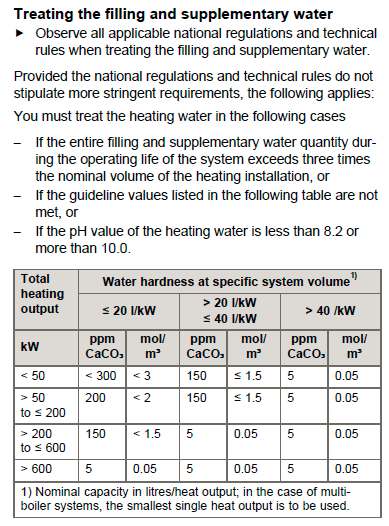
Personally, having experience of both very hard and very soft water supplies I would only want softened water in the shower; the loos, dishwasher and washing m/c do not really need it. AFAIK ion-exchange softeners still work by replacing the calcium (and magnesium) ions with sodium, which will increase your blood pressure if you drink a lot of it. The kind which allegedly use magnets etc to change the structure of the molecules in the water are unlikely to do this. Polyphosphates are widely used by water authorities, orginally to prevent lead being leached out of lead pipes. I was told they do this even where the hard water means it doesn't actually happen anyway. But it does cause an annoying scum to form on tea and coffee. I wonder if ion exchange softening also changes the pH of the water or is otherwise bad for heat pumps? Naturally soft water is often quite acid. Harvested rain water is AFAIR pH 5.3 bc of CO2 dissolved from the atmosphere, I have some trouble neutralising the acidity and won't be using it to fill my heating system. SWW use sodium hydroxide to raise the pH so that introduces some sodium too. Vaillant have some quite detailed specifications in their HP installation instructions (though the footnotes refer to boilers where scaling is much more of a problem), I wonder how many installers follow them? pH 8.2 is quite alkaline (the lower limit for potable water in the UK is 6.5), you would need to add >100g of sodium bicarbonate per cu m to achieve that.
-
Sounds as though they are basically OK then. For comparison my Longi LR5-54HPB-405M installed 2022 are 1134 x 1722 mm (1.95 sq m) and rated 36.95 o/c V 13.74 s/c A at STC, product 504W. So 20% reduction on this gives the 405W rated output. And 0.68V per cell. O/c voltage does not vary much with brightness so yours clearly have more, smaller cells than my 54, calc suggests 68 so maybe 66 or 72 (IIRC standard sizes) but you can I imagine count them fairly easily! As they are about 2.5% bigger overall than the Longi something in the region 400 - 450W seems very plausible.
-
They look to be a reseller in Lebanon advertsing Longi and Trina panels (both of which are available in the UK). Seems improbable it is them. A quick search doesn't throw up any more likely leads. At 1 x 2 m that is pretty big for a domestic installation, did they fall off the back of a delivery to a solar farm? What do you know of their history?
-
Combi boiler filling loop placement and other peripherals
sharpener replied to Del-inquent's topic in Other Heating Systems
When we moved in there was a Fortic combined HW and header tank in a cupboard in the bedroom (with a noisy pump), cos it was directly above the Baxi Bermuda gas fire/back boiler and had gravity circulation. Fortunately there was room for a UVC in the bathroom when we had it all re-plumbed. Fire went as spares to a friend, quiet replacement pump is going to be part of HP system in our present house, old pump has replaced an even noisier one on the UFH. As my grandfather would say "nothing wasted where they keep pigs..." -
Combi boiler filling loop placement and other peripherals
sharpener replied to Del-inquent's topic in Other Heating Systems
Expense. Complication. OP has a small property and is desperately short of space.

