


MikeSharp01
-
Posts
5693 -
Joined
-
Last visited
-
Days Won
16
Everything posted by MikeSharp01
-
Doesn't sound very usual to me - you must have been very bad surely this cannot be a consequence of a plumbing problem. I have a suspicion that there is more to learn here.
-
 Sorry Jeremy didn't mean to give you work to do - will be interesting none the less
 -
Yes - I hope mine lasts more than that though, but I suspect that is just another of the variables - you factor in 60 years at the outset to figure out how much energy you are, or think you are, going to need. I was wondering about those that have already been built. EG does @JSHarris's pad do it as is (his SAP is 107 I think although SAP does not really tell you much about energy production as you get points for all kinds of things which, on the face of it, don't count in the energy equation) or would you need need much more generation. I guess you can factor in COP benefits from ASHP's etc as well which might help. Either way you have the, on the face of it, nightmare of working out how much energy was used to create the materials, build the building, run it in energy terms (100 of the 107, simplistically I guess). Throws down a challenge though don't it?
-
Just been reading the latest Passive House magazine (sad I know) but came across the new 'Powerhouse' standard that has been suggested in Norway. In this standard you first have to build a passive standard building and then ensure that it, or systems associated with it, can generate enough renewable energy over the building's lifetime to: (Wait for it) pay back the energy used in manufacturing all the materials. pay back all the energy used in its construction. cover all the energy use of operating the building. cover all the energy used for maintaining and renovating the building - including materials used. pay back the energy used in demolishing the building. So you need a SAP value of more than 100 (if you believe in the SAP values anyway) and then you need to work out / find all those energy consumption values. Wonder how much energy it takes to make 1 meter of 15mm plastic water pipe! So if you have a SAP of 110 I wonder how long the average buildings life has to be? Somebody somewhere seems to get it - the Norwegians, but I cannot see any of our major builders doing it or self builders for that matter. There won't be a collective opinion on this but it would be interesting to hear the thoughts from the forum. Anybody worked it out for their build?
-
Insect Screen Corroding
MikeSharp01 replied to Gone West's topic in Mechanical Ventilation with Heat Recovery (MVHR)
You are a long way from the sea so it's probably not salt corrosion, lets hope @JSHarris has some chemical theory as pretty much everything corrodes given the right atmosphere, might it be something the local farmer puts in the air as you are a bit exposed there - sadly the best solution might be, I hesitate to say it, plastic sorry. -
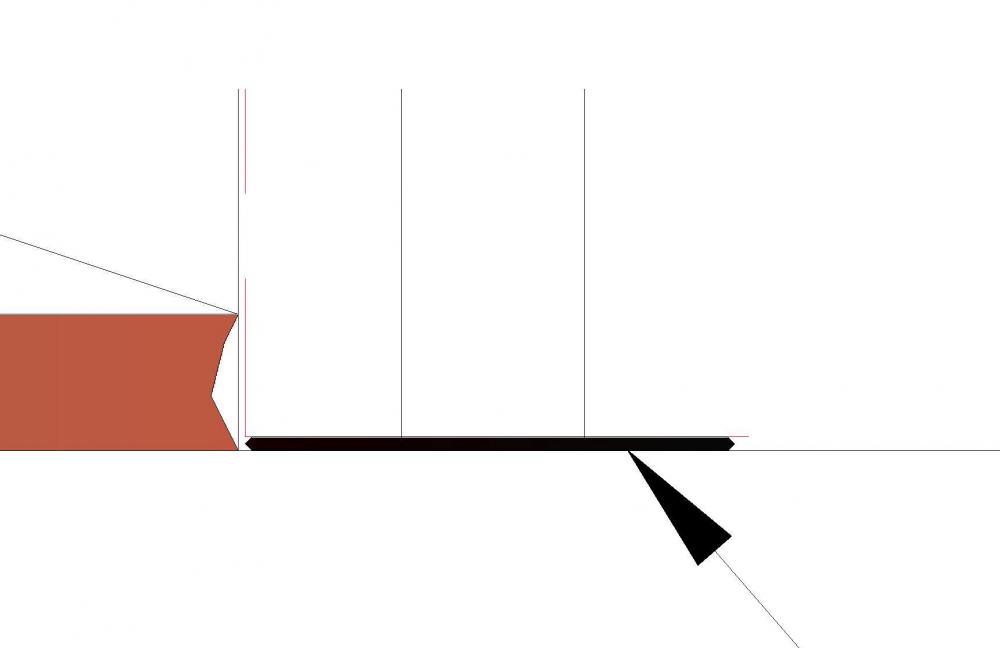
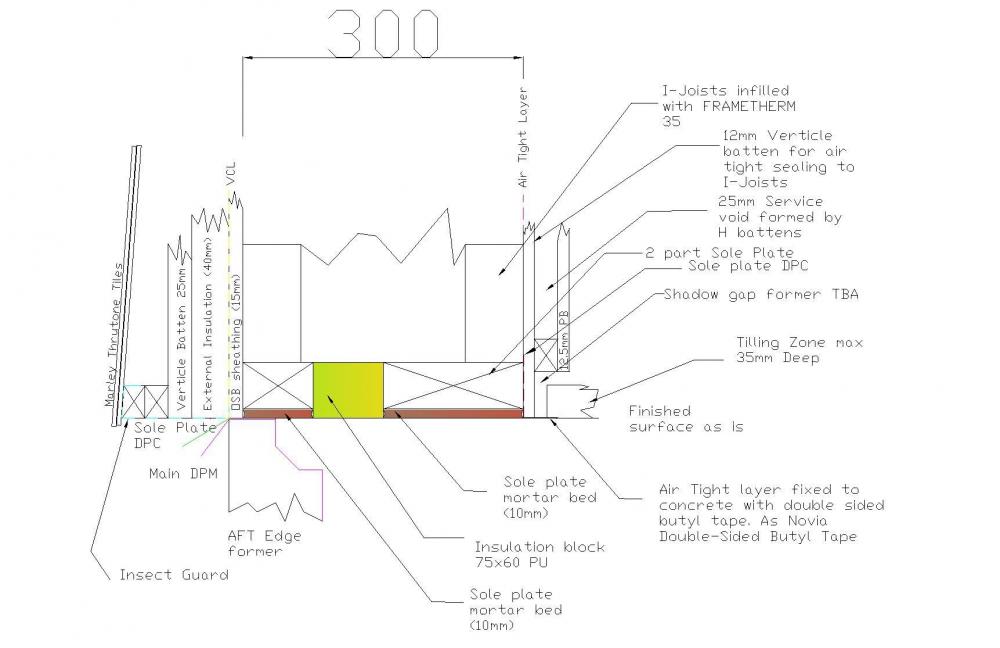
Sorry yes @Mr Punter the VCL should read breather membrane I keep mixing those up. On the air tight membrane and the double sided tape - the air tight membrane is sealed to the concrete slab with the double sided butyl as in: I could use packers and a mortar gun to load up the mortar - I guess you do that before you actually start loading it with studs. The DPC is directly on the concrete and laps over the main DPM coming up the side of the polystyrene former and over the top, then the Mortar and then the sole plate timbers, putting mortar below the DPC feels like a potential damp path. I was wondering if I should bitumen down the DPC to ensure the join between the DPM and the sole plate DPC is sound.
-
Many of you will recall our hickup around the concrete polishing of our new slab. ( ) Well after much thinking and soul searching we have chosen to look at tiling our floor. That means a slight change to the sole plate detail and I thought I would run it past the forum and see if it stacks up OK. The SE has OKed the split format as shown below but I have some concerns. They are: How to tidy up the two DPC / DPM tails that hand over the outer edge. Does taking the sole plate DPC up the out side of the inner sole plate make for a robust detail. How thin can a tile adhesive layer normally be so we can work out the final height based on the choosing a tile of a given thickness. Any thoughts greatly appreciated.
-
You may have seem pictures of the 'incident' in Hertfordshire today https://www.bbc.co.uk/news/uk-england-beds-bucks-herts-45167570 Very bad news but a great way to see how a new house is built. I spent a few amusing minutes looking for evidence of the insulation. What do you make of it?
-
Yes I think so, we are still working out our next step and all the above experiments might form part of it. I am meeting a concrete grinder on site Monday so I hope to have a full prognosis and all the options thought through quickly after that.
-
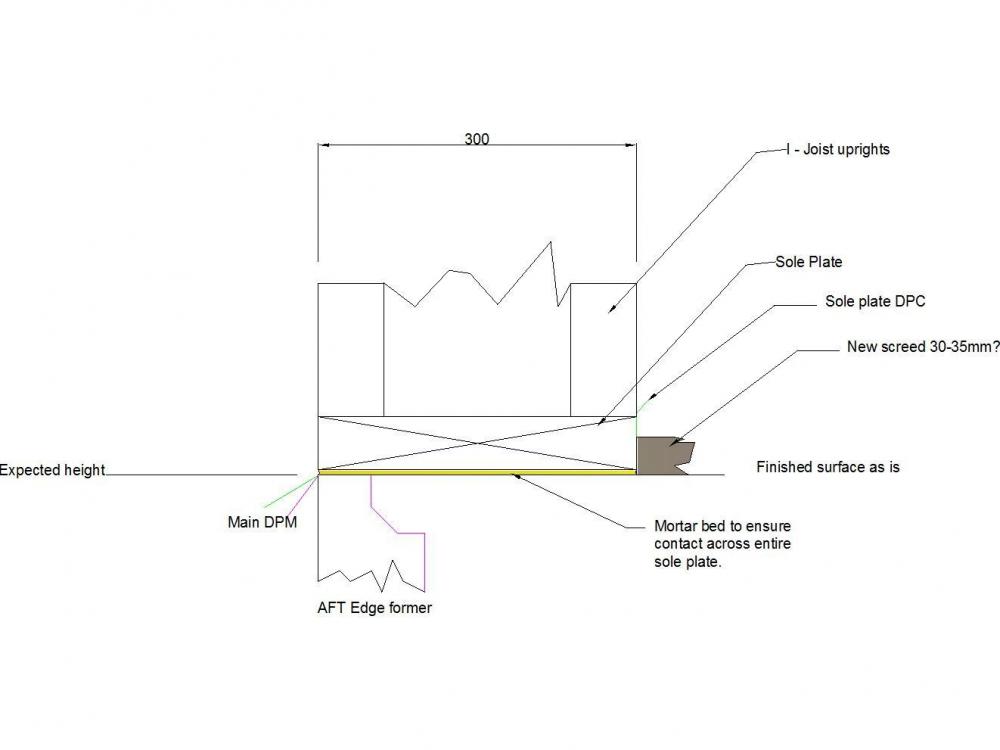
Ok so I am getting there with potential solutions but I want to press on so I thought I would move ahead allowing for all permutations when fitting the sole plate. The cost of the finish won't change much once the sole plate is down as long as I leave the internal walls out for now. SO I need to get a sole plate detail that ensures we can either go down (easy) or up with a screed. Its all about making sure the DPC comes out above the screed - so here is my thinking which would allow up to 60mm of screed assuming the mortar bed, which sits on the DPC, is about 10mm: Is this a runner, any thoughts?
-
Any chance of a pic @jack to show Jackie and see what she thinks. Mike
-
That is an option but the power floating did remove the fat in places so we will have to go down a good way. I am not sure how far you can go down with diamond polishing. I think my plan at the moment is to scabble it down to an even surface, IE remove the powet float finish, and then see where we are. Jackie is not keen on the terrazzo look and I think that is where we would need to go with it.
-
We poured our slab on Thursday but despite our best efforts we had a couple of problems and as a result our plans have changed. The polish we achieved was not good enough across the whole house and we don't want / can't have level changes between spaces, we knew the risks, so we now need a screed that can look like a polished floor and be less than 35mm thick if a topping is required or 50mm if it's a finished surface. Any ideas on thin (ish) screeds / polished concrete like screeds? I guess I will have to scabble the surface to ensure any render takes which is a pain but at least we are out of the ground.
-
Thanks all. @PeterW I can make a continuous loop so I may do that and then pressurise it a bit. Thanks @TerryE we have the UFH pipes tied to the lower mesh and pressure testing yesterday @ 7 bar went OK once we found that the pressure tester had a slight leak, one, one more loop to test today - concrete pour is tomorrow so no great exposure for the pipes.
-
All sounds great but a couple of things I am still not clear about. Presumably I do not need to keep rhe pipes under pressure during the pour they are only 70mm down on the slab. Secondly I will be pressurising each loop separately as we cannot leave the tails sticking out during the pour. I can leave the water in but not pressurused.
-
Seems to be a lot out there on this but thought I thought I would ask here and see if I can approach a definitive answer. 5 bar / 6 bar and for how long. I will test our UFH pipe work tomorrow and so need a test pressure and duration. Don't say 5 bar for ever! Our pipework says it's good for 10 bar but I doubt a circulating pump will manage much more that a couple of bar worst case. I guess the test is to look for leaks and stretch / expand l the pipe.
-
Looks very interesting - why don't you ask then for a proposal against a draft spec. Are you going for a full passive level build?
-
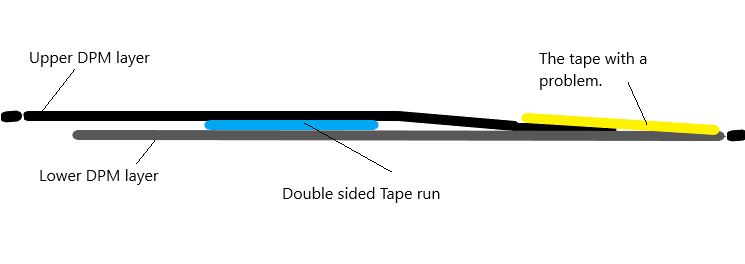
I have asked the BCO what thy want me to do. Here is a better sketch: of what I am doing - just like the Visqueen Video
-
Yes - so I understand, the weight of the concrete will crush the overlap, in my case further pressing down on the double sided tape in between the sheets as well. Hope the BCO see's it your way.
-
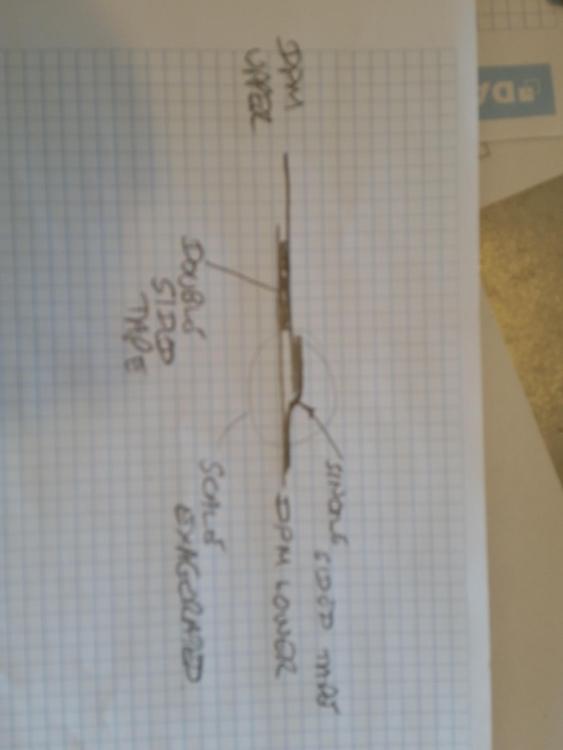
Yes I have that, well the visqueen equivalent, between the two sheets all along the joins and the tape that is failing just along the flapping edge as it were. Here is a quick sketch.
-
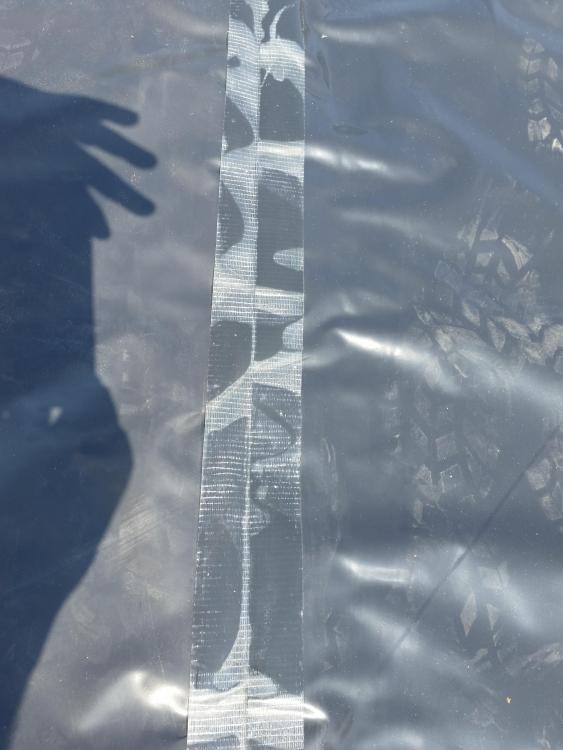
Just wandered out onto site and spotted a problem with the DPM seams. They each have two tapes making the seal one double sided a bit back from the edge and the other single sided along the edge. The single sided is showing signs of lifting (see pic) in patches. Both tapes were rolled / rollered on as per the Visqueen video (all tapes are Visqueen). I wonder how important the single sided run is, is it just protecting the double sided inner row? Do I need to take it up and do it again?
-
Sounds like a special floor so unless you realy understand the dynamic and static loads the floor, and any structures stood on it or close to the beams, will impose the £200 sounds like your best option - done and dusted!
-
Anyone know of someone with a CNC router?
MikeSharp01 replied to Jeremy Harris's topic in General Self Build & DIY Discussion
Looks great @JSHarris they are great machines aren't they. -
That paper was 18 months ago - do you see any evidence of it going further - rather it is going back to green as a result of digital mould, or any other evidence of this being taken forward energetically by our political class. Nope - thought not.
-
Hi Cazza - Welcome to THE forum fellow Kent type. We live in West Kent, know Sevenoaks planning very well and are building in Whitstable so know Canterbury planning quite well now as well. Look forward to hearing more about it and helping if I can. Costs can be anything you like realy but you probably need 250k for 130m2 as a starting point doing the finishing work yourself, more if turnkey or less if doing much of the work ++ if you have exoensive taste in fittings. Don't tell the architect that budget go in much lower to constrain their fee expectations. The big unknowns are getting out of the ground and if the old house had any asbestos.





