Iceverge
-
Posts
4383 -
Joined
-
Last visited
-
Days Won
31
Everything posted by Iceverge
-
A good vapour membrane stapled and pinched between SC battons and Rafters would be quite capable. I reckon if you were careful you could lie on it yourself! We have 400mm Above ours and it's fine. They regularly use netting in the US which looks infinitely more flimsy. I think @Nickfromwales has some cellulose contacts from memory.
-
 I've been thinking about this. Continuing my never ending love hate affair with concrete. Why not do an insulated raft foundation but instead of a concrete slab you have a "timber slab". A lattice frame of say 140*45mm placed inside an EPS tray. If constructed properly it should have all the mechanical properties of a concrete slab. With the insulation outboard it would be able to breathe inwards and not decay. Dried sand inside the frame and topped with OSB. Build your timber frame up from there.
 -
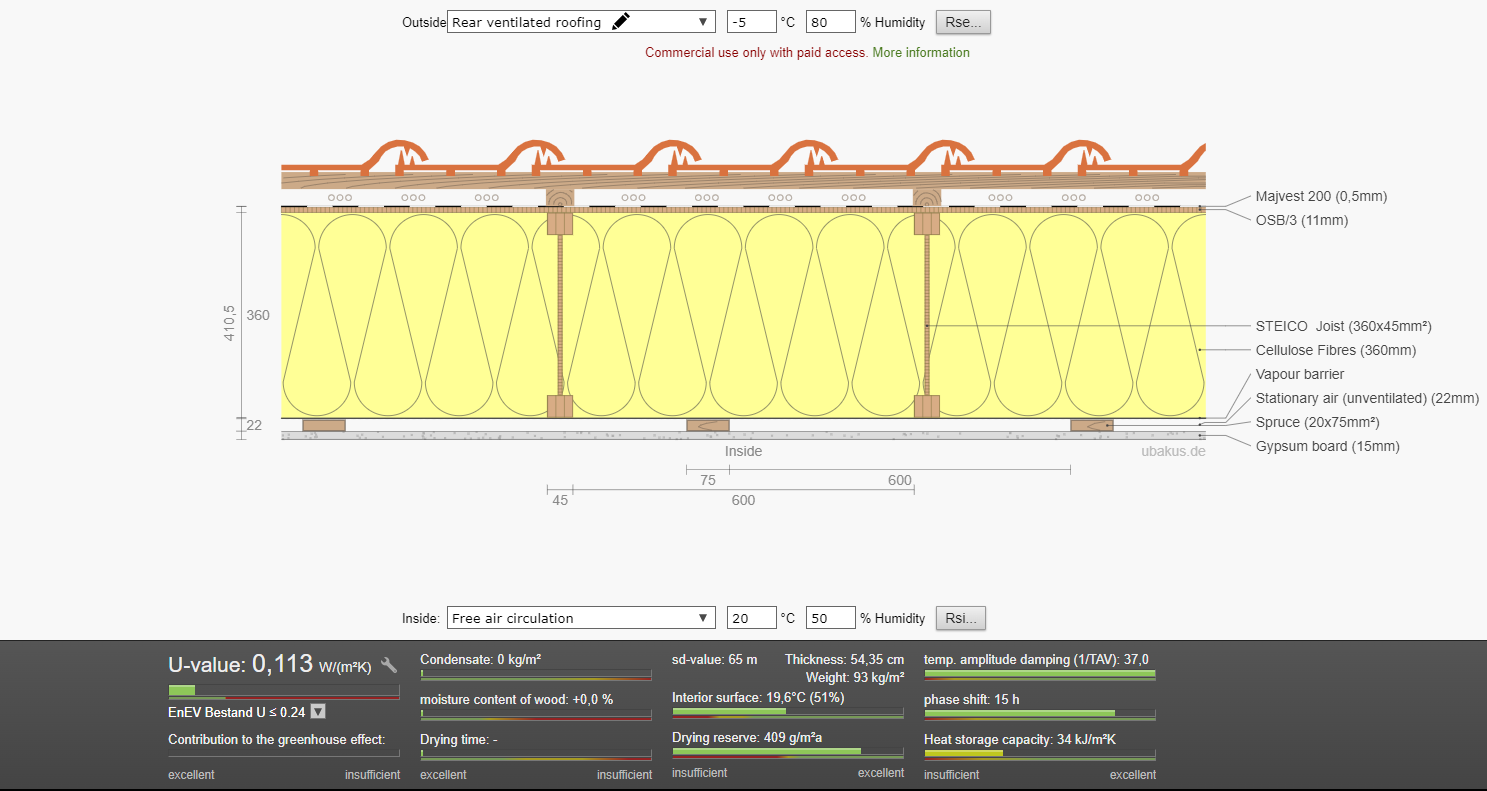
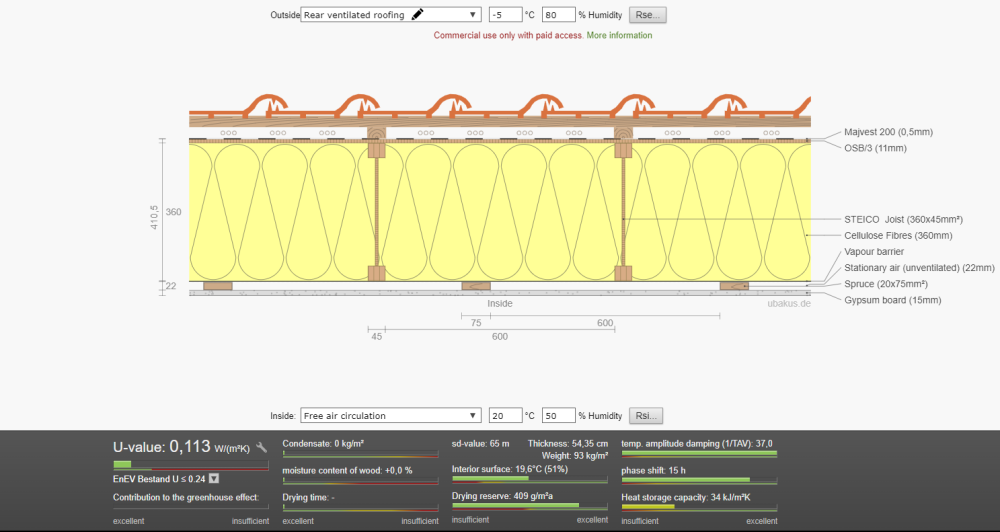
I joists + Dense Pack Cellulose Cellulose is about €100/m3 inc VAT installed near me. If there's something better for heat protection/ cost/ sound protection / airtightness/ VOC's/ carbon/ mess/ ease of install I'm yet to hear about it.
-
Use your concrete slab ( thicker the better) as a heat battery. Our 300L UVC is in effect a 14kWh battery. Again the bigger the better.
-
Cold bridging at cavity reveals and floor slab detail
Iceverge replied to ruggers's topic in Brick & Block
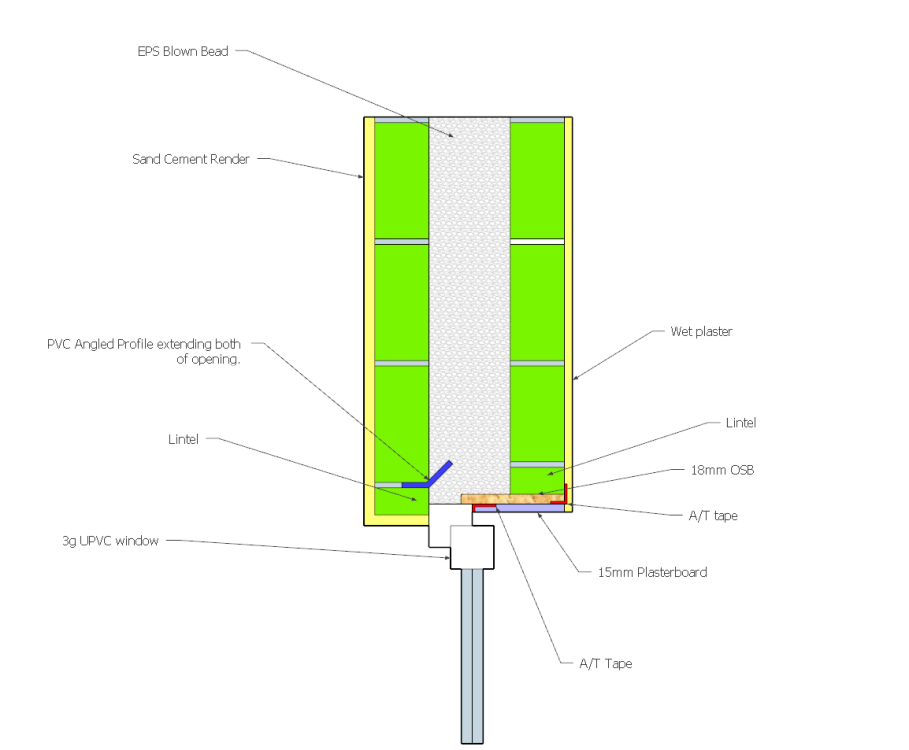
+1 to avoiding cavity closers. OSB window boxs here. Easy to tape to the windows and fix plasterboard and window sills to. Very robust during the building process. EPS bonded beads filled all the areas behind 100%. -
I think you need to get another BC. What's your detail for the threshold at the rear like?
-
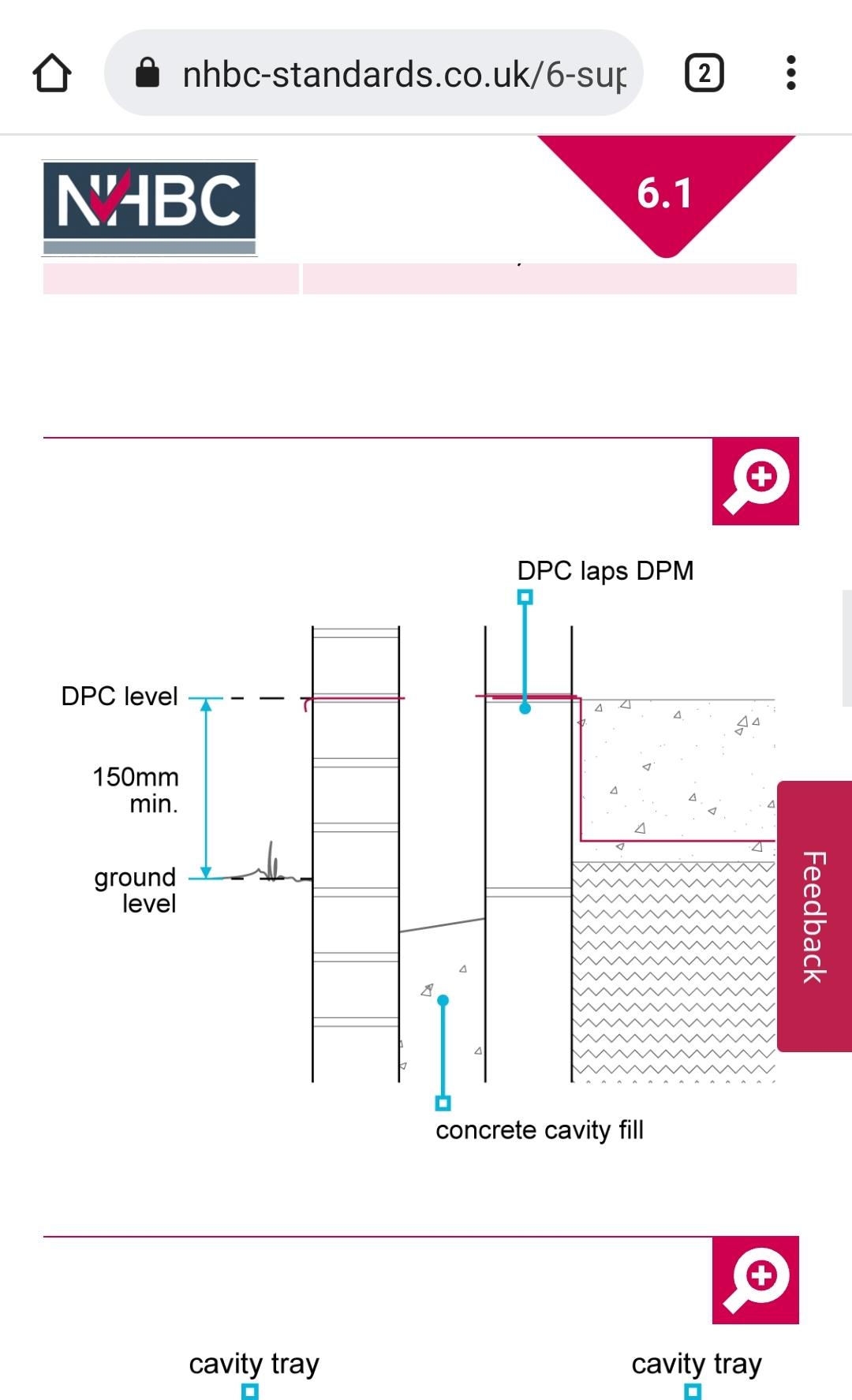
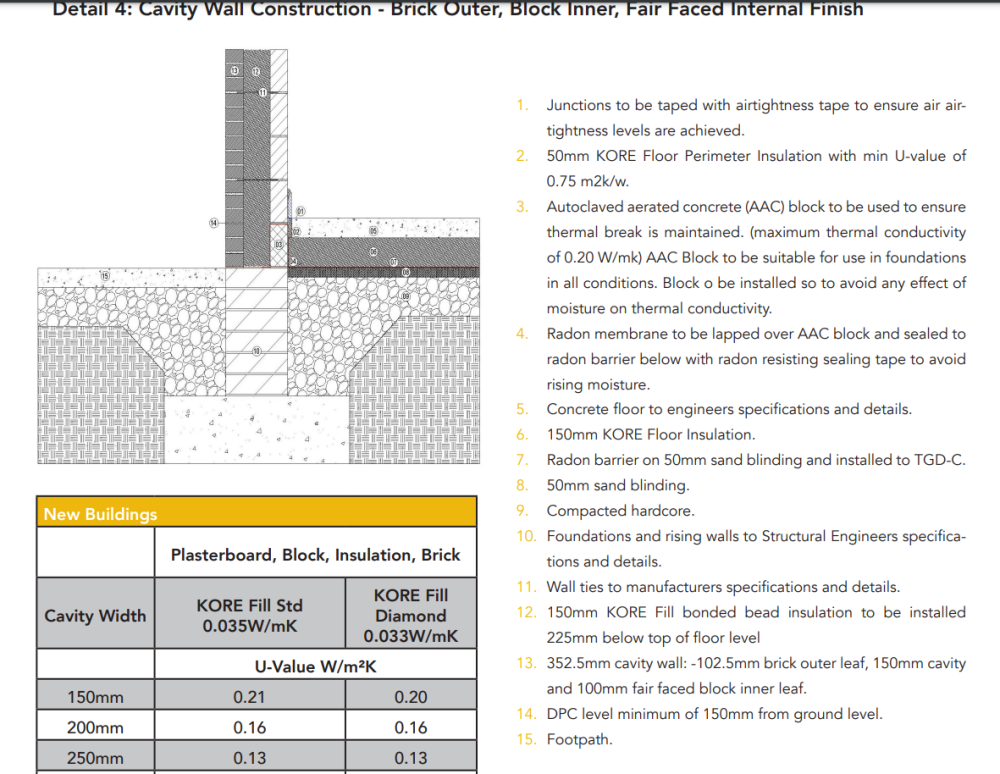
I cannot see what that cavity tray achieves. Kore don't have it in their MI's https://www.kore-system.com/wp-content/uploads/2018/12/KORE_Fill_Cavity_Wall_Design_Guide_2018.pdf So much of building is based on " cause we always do it that way," with almost zero interrogation of why something is done. You need to achieve 2 things here. 1.Prevent any drips of moisture that may may be blown through the outer leaf (driven rain) or condense on the inner surface of the outer leaf from running down the wall and making their way in the tops of windows doors etc. The cavity tray needing to extend all the way across the cavity is nonsense in my opinion as by stating that, you've admitted than moisture will be against the outer face of the inner leaf and the battle is well and truly lost. In fact if I was to build a cavity wall house again ( unlikely! ) I would use angled PVC profiles as "drip catchers" rather than DPC plastic as cavity trays. They're always full of holes post build and often hold many KGs of mortar droppings often leading to moisture crossing the cavity. The underside is rarely correctly insulated giving rise to cold surfaces inside the house and more condensation. More negative than positive. Issue 2. You need to prevent ground moisture getting inside your floor. Imagine submersing your house to floor level in a huge tub of water. The DPM needs to prevent water getting in. A continuous DPM up the outer face of the inner leaf as shown (should not be breached by Cavity ties) achieves this. I would be very slow to put any DPM vertically on the outer leaf as it will prevent any moisture that gets into the cavity from draining to the outside. I would always include a French drain always if I had the opportunity. Lower than the bottom of the insulation and free draining to a lower plain. In effect it uses gravity as a DPM. Very reliable.
-
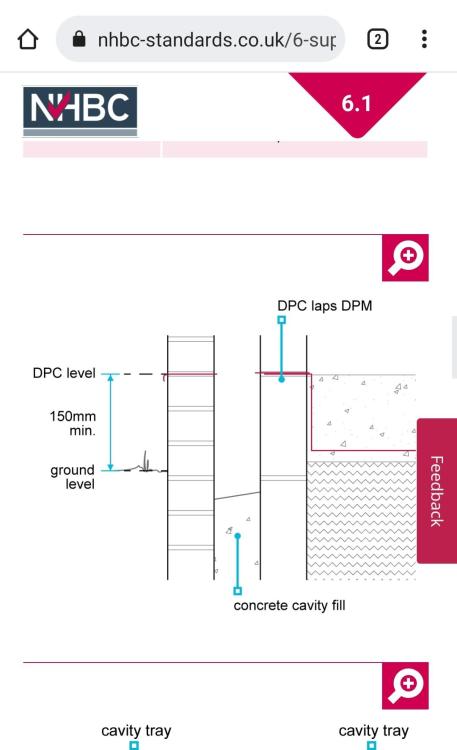
What reference is your BC working to? A quick Google found this image on the NHBC website showing a non continious cavity tray.
-
Oh dear. Well 2 things. First we've had some pretty savage driving rain but no issues without cavity trays. Second, there's always a solution. Can you provide a cross section diagram and a picture of the buildup as it currently stands?
-
New build floorplans - opinions welcome
Iceverge replied to Indy's topic in New House & Self Build Design
Buyers choice. We have 2700mm throughout. I like it. Do you need the space! Lofts often become dumping grounds for stuff that belongs in a skip in my experience. -
New build floorplans - opinions welcome
Iceverge replied to Indy's topic in New House & Self Build Design
Keep it for storage I would say. You could raise the first floor ceiling to something like 2700mm or even a vaulted ceiling for some extra wow factor. -
No. There is some very marginal improvements in emissivity (shining out of heat from a surface) and as a radiant barrier (heat protect) in the right circumstances but largely they're nonsense when it comes to insulation. If I could I would use organic material in a pitched roof, (cellulose, hemp, woodfiber etc). Much better heat protection and less issues with thermal bypass when using pumped insulation. Also more vapour safe and better in a fire. In the case of your mate what U-value does he need? What stage are you at in your build? There's some nice examples of good pitched roofs here. @ProDave is one.
-
Having insulated the living daylights out of some 26mm pipes in the hope that it would preserve some heat in the pipes I would say it's of limited value in a radial system. ( Hot circulation loops might be different) Even with 2 layers of pipe insulation well taped at all joints ( it looked like an elephants leg) the water cooled very quickly, about 20 mins. Insulation only slows the heat loss it doesn't stop it. so unless you use your taps super frequently i wouldn't bother insulating outside the plant room. Running 10mm and 15mm Hep20 to reduce the volume of the dead leg worked a treat to have hot water quickly.
-
Well done for coming back for more! I would nab 300mm extra depth from somewhere for the study to allow it become a double bedroom if required. There is a step in the external wall between the kitchen and the living room, I cant see why. I would get rid. If you want to create a visual division here just use a downpipe, speaking of which I would draw the rest of them in now. It doesn't look like they've been considered yet.
-
Reducing accidents for elderly
Iceverge replied to CalvinHobbes's topic in General Self Build & DIY Discussion
A good idea from a fire safety perspective, a thumb turn internally would have been best in that case. Double handrails on the stairs buy people a couple of more years upstairs. -
Congrats and welcome. Plenty of ways to build with straw. If you can afford it don't be put off. https://passivehouseplus.ie/magazine/new-build/deep-green-passive-house-defies-all-weather https://passivehouseplus.ie/magazine/new-build/timber-straw-passive-house-is-a-world-first https://passivehouseplus.ie/magazine/new-build/norfolk-straw-bale-cottage-aims-for-passive This phrase has been much abused by various peddlers of gimmicks unfortunately. If you can separate it into quantifiable embodied carbon in the building and carbon use in occupation you're onto a winner. Good luck!
-
Airpaths, Low mass roof build-up. No decoupling.
-
Any hints and tips regarding new sedum roof for garage
Iceverge replied to Modernista's topic in Garages & Workshops
Are you planning on using the roof as part of your garden? Any pictures would help -
I can't see the original photo. Might you be able to repost please? Can you just omit the vents at the doorway? Are there enough elsewhere to suffice?
-
Revised timber frame details with stone cill
Iceverge replied to maxdavie's topic in New House & Self Build Design
There no time in life one is really truly safe from a wet bed, the variations of fluid of course may vary. -
Revised timber frame details with stone cill
Iceverge replied to maxdavie's topic in New House & Self Build Design
Are technical details at a domestic scale not within an architects remit? -
Revised timber frame details with stone cill
Iceverge replied to maxdavie's topic in New House & Self Build Design
I would argue that utility and economy trump aesthetics for longevity. Stålekleivloftet storehouse in Norway, about 900 years old, in an area that gets about a meter of rainfall per year. A narrow pallet of proven materials, utmost respect for the weather, especially the rain, it keeps most of the water off and the rest can dry quickly. Plain shape and form, accurately constructed. Not burdensome to construct or maintain. I reckon it'll see 1000 years.
-
Revised timber frame details with stone cill
Iceverge replied to maxdavie's topic in New House & Self Build Design
Hi @maxdavie, Nice looking artistic render. Keep the questions coming. If we never explored different ways of doing things we'd never learn. I have a couple of queries about the section provided. 1.What supports the external block and stone sill? 2.I think the cladding could get very grubby/decay being in the rain splash zone, although the aesthetic is nice. 3.Again with the DG unit, water pooling may cause a decay/ingress issue.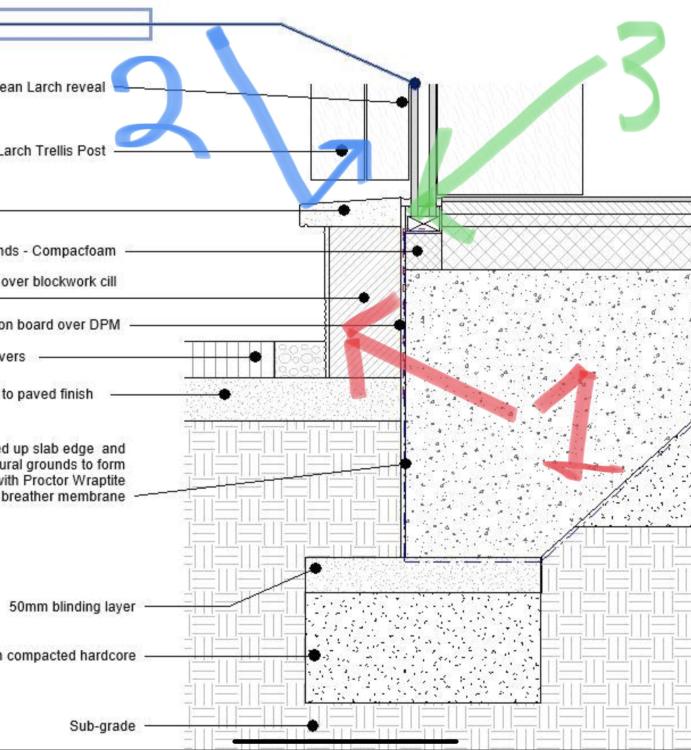
-
First year Heating Energy Use in Passive(I hope) House
Iceverge replied to Iceverge's topic in Boffin's Corner
@rh2205do you intermittently heat your house or 24/7? -
First year Heating Energy Use in Passive(I hope) House
Iceverge replied to Iceverge's topic in Boffin's Corner
@rh2205Wow, you seem to have had a very good result despite everyones best efforts! Well done. One really needs to grab these things by the scruff of the neck it seems. Is the house detached? what approximate m2 is it? Would you describe the location as sheltered. I think this can make all the difference.