Jeremy Harris
-
Posts
26430 -
Joined
-
Last visited
-
Days Won
360
Everything posted by Jeremy Harris
-
Pretty much a spot on assessment, in everyday terms, IMHO. Adding material that has lots of heat capacity, be it specific heat capacity or volumetric heat capacity that's used to define it, may or may not have an impact on the thermal inertia of the building. As an example, lets roughly compare two types of floor construction, a beam and block floor, with insulation above the concrete, and a passive concrete slab floor, with insulation beneath the concrete. The concrete in the beams and blocks will have a significant heat capacity, so will be able to store a fair amount of heat for a given absolute temperature. However, because the insulation layer will be above this concrete, the rate at which heat can flow into, or out of this concrete to the inside of the house, so changing the amount of heat stored in the underlying concrete, will be small, so that heat capacity will have very little effect on stabilising the temperature of the house. On the other hand, a passive concrete slab, which may well have a very similar amount of concrete as a beam and block floor, and so much the same heat capacity, will behave very differently. The concrete has a reasonably high thermal conductivity, so will be able to absorb heat from the house, and emit heat back into the house, as the house temperature varies. The rate of heat transfer will be fairly rapid, so such a concrete floor will be a useful aid to helping to stabilise the temperature in the house, and increase its thermal inertia. Both these houses will have roughly the same mass of concrete in the floor, so both will have roughly the same floor heat capacity, but in one that heat capacity will be useful in helping to increase thermal inertia inside the house, in the other it will have little effect.
-
Even the person who, reputedly, first coined a definition for the key attributes of an architect (literally "chief carpenter") included strength as the first attribute, which implies that architects, at least around 40 BC, must have had an understanding of the strength of materials. It is not possible to understand strength without having some form of system of measurement units, as otherwise the term has no real meaning. Strength can only be understood if there are recognised and widely understood units for mass, distance and force (including gravitational force). Without an understand of those units, and in particular the way forces interact with material properties, it would not be possible to build reliable structures. Some of that understanding may well have been either innate or empirical in ancient times; some may be empirical even now (we just "know" that a single skin brick wall, for example, will stay up as long as it remains below a certain height). If you can put forward some evidence that shows that defined units are not needed, or even not relevant, when describing something that can be felt or experienced, then I think it might help to bridge what seems to be a bit of a gap in understanding. From my perspective, as a former scientist, I start from the position that if something physical cannot be measured and defined then it probably doesn't exist. I can't find any meaningful unit of measurement for "thermal mass" anywhere, just unclear and non-specific rearrangements of units of heat capacity, with no mention (as far as I can find) of thermal conductivity/thermal resistance.
-
I suspect that the biggest cause may be just loads of moisture being introduced into the building after it's sealed up. The amount of water that was literally running down the inside of the windows after our house had been plastered was staggering, and the timber must have absorbed a lot of that. When it dried out it then shrank back a bit, causing shrinkage cracks that I had to go around and fill. The movement stopped after about 6 months or so, as the humidity level in the timber stabilised, I suspect.
-
I'd argue that trade has always depended on units. Goods have always been measured in some way when offered for sale, and we have records of those units going back to pre-Roman times here in what is now the UK. The unit of wine volume for example, seems to have been a standardised amphora. Without measurement units, how did the ancient Britons ensure that their chariot wheels fitted the axles, or that the wheels were even the same diameter? The units may have been crude, and poorly defined, but even the Old Testament uses defined units to describe physical properties, for example, “And this is how you shall make it: The length of the ark shall be three hundred cubits, its width fifty cubits, and its height thirty cubits.” (Genesis 6:15) How did the ancient architects of the pyramids of Giza mark out and build them so relatively precisely, if they didn't have defined units?
-
Thermal inertia is pretty much the same thing as the thermal time constant, in practical terms. Worth noting that the heat capacity of a material (either volumetric or specific) isn't a reliable indicator as to how well it may help stabilise temperature. Thermal conductivity (for internal materials) or thermal resistance (for materials within the fabric) is at least as important, as we need to get the heat into, or out of, the material within a useful period of time. Having a high specific heat capacity isn't any use if it takes a very long time for heat to flow into, or out of, the material. This has nothing at all to do with any personality disorder, it is just simple science. If we were sloppy about units, and the ways in which those units are defined, then we would not even be able to trade with each other, let alone design and build structures. Humankind has spent millennia defining, and refining, units and their definitions; they are key to everything we do. When we get unit definitions wrong it often has serious consequences (for example, the Gimli Glider, where confusion between two units of mass led to an airliner full of people running out of fuel in mid-air).
-
Titles of units are critical, and not to be taken lightly. It's why we have strict rules on unit definitions in every measurement system used around the globe. The SI system even has clear rules on how unit definitions, and their modifiers, should be spelt, for the sole purpose of reducing the chance of confusion or misunderstanding. The unit titles you've quoted do not define "thermal mass", and make no reference to mass at all in their referenced units, so the use of the term mass is highly misleading. Like it or not, people regularly confuse mass with weight, probably because we buy stuff in units of mass, but use weighing devices to measure them. Weighing devices don't, of course, measure mass, they measure force, it just so happens that it's convenient (at least for those of us living close to the mean radius of the Earth) to use the gravitational force exerted by a mass as an analogy for mass. This does mean that, when weighing devices are used as an estimate of the mass of goods, people living closer to the mean radius of the Earth get less goods for their money than those living further from the mean radius of the Earth. If there was a shop on the ISS, then scales would be a meaningless way of estimating mass, as they would read zero, no matter how much mass was placed on them. This is probably a pretty good way as any of demonstrating why precise terminology is essential when referring to anything that can be measured. The most useful practical measure for the thermal comfort level of a building is probably the thermal time constant, how quickly or slowly it responds to a step change in outside temperature. I think this may well be what many think of when the term "thermal mass" is used.
-
 I doubt it will make much difference, TBH. If you want it to work a little better, and have slightly lower flow resistance, add a short length of pipe to the elbow, projecting up the duct a bit. If you look at the flow resistance caused by a typical extract grille it's probably a lot higher than this thing.
 -
That's just a measure of heat energy per unit area, and has nothing to do with mass, assuming that what you really mean is kJ/m²·K (i.e. kilojoules/square metre · kelvin) kJ/K (not Kj/K, that has different meaning) is just a measure of energy per unit temperature, i.e. heat capacity, as kilojoules per kelvin. Again there is no unit for mass, or volume expressed here, so how can it relate specifically to mass? Decrement delay is clearly a measurable effect, that's clear. The cause and influencing factors that impact on the measured decrement delay is also clear, it is a fairly complex function of the thermal resistance of the fabric elements, the heat capacity of the fabric elements, the ∆T across each fabric element, and the rate of change of temperature across them, with respect to time. Architecture seems to have chosen to misuse the language of science, so misleadingly refers to heat capacity as "thermal mass", in whole building terms. "Thermal mass" is just a pseudo scientific term, that seems to have crept into common usage within architectural circles, but that does not make it in any way correct, from a scientific perspective. The very fact that there are no units of either mass or volume used to define it, is a clear indication that it is a mythical property. How is it possible to examine the elements of the fabric of a building, and calculate the physical properties of thermal mass, to determine how any particular building may behave, when the supposed measurement makes no reference to mass (or volume, if preferred)? Heat capacity can be defined for the elements of the fabric of a building, or anything else, by relating heat capacity, J/K, to either volume or mass. The former gives the volumetric heat capacity of a material, the latter the specific heat capacity of it. For completeness we can also define material heat capacity as the molar heat capacity, although that has little use in building science. If we wish to determine the thermal time constant of a building, which is probably the physical property that comes closest to how many people view this topic (i.e. how quickly, or slowly, does the temperature inside the building increase or decrease with a step change in outside surface temperature) then we can use the following measurable and easily defined parameters: Either the specific heat capacity (if we know the mass of each fabric element), or more usefully the volumetric heat capacity (as we will have the dimensions, and hence volume, from the drawings), for each material used. The thermal resistance of the materials that make up the external structure. The thermal resistance of the junctions between those materials that make up the external structure. The length of the heat flow path through each material (may be multidimensional) The magnitude of the temperature differential between the external surface and the internal space within the building. The rate of change of temperature on the external face of the structure. The volume of the building The total heat capacity of the materials that make up the internal structure. The thermal conductivity of those materials, which determines the rate at which they release heat into the air in the building, or absorb heat from it.
-
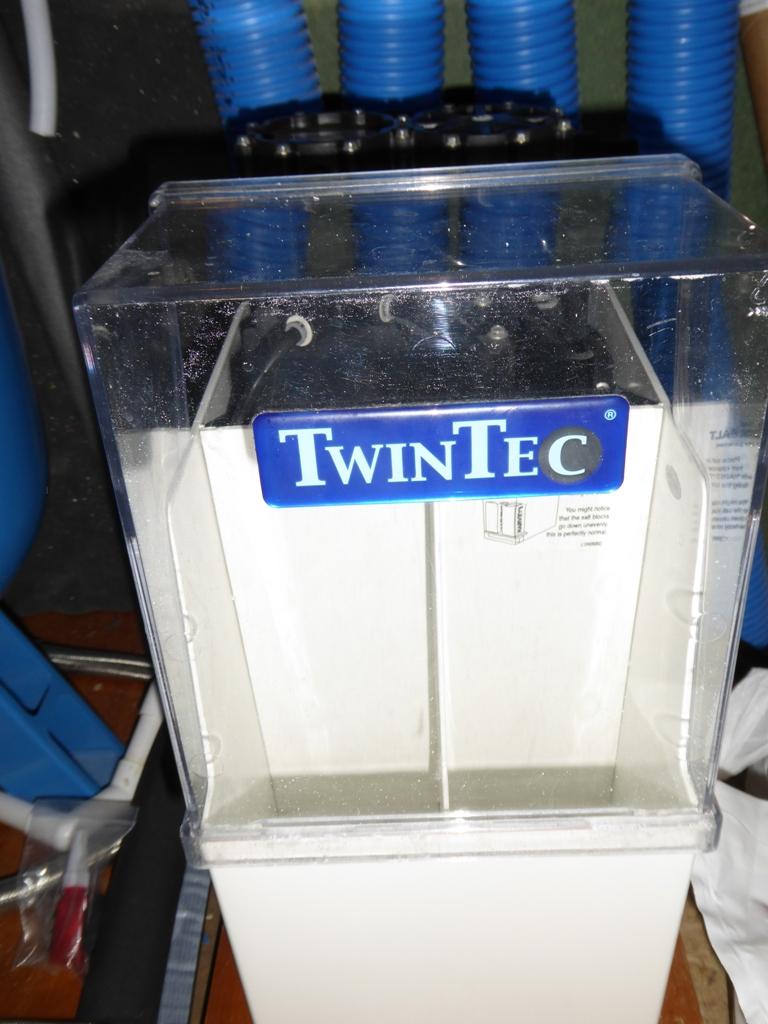
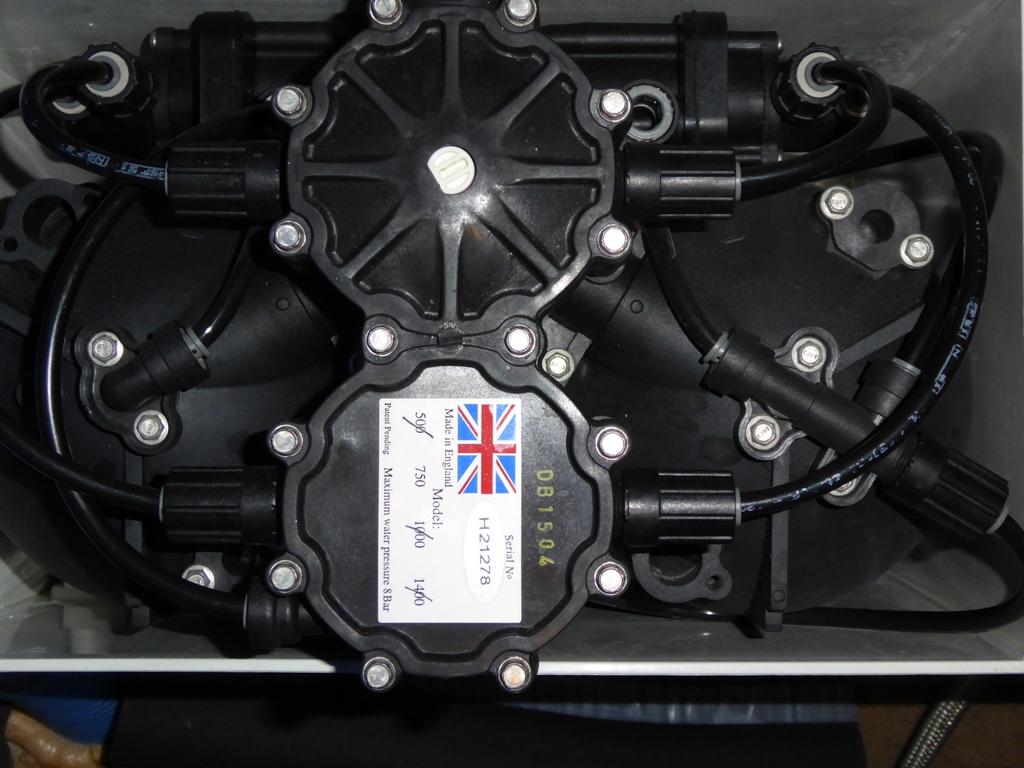
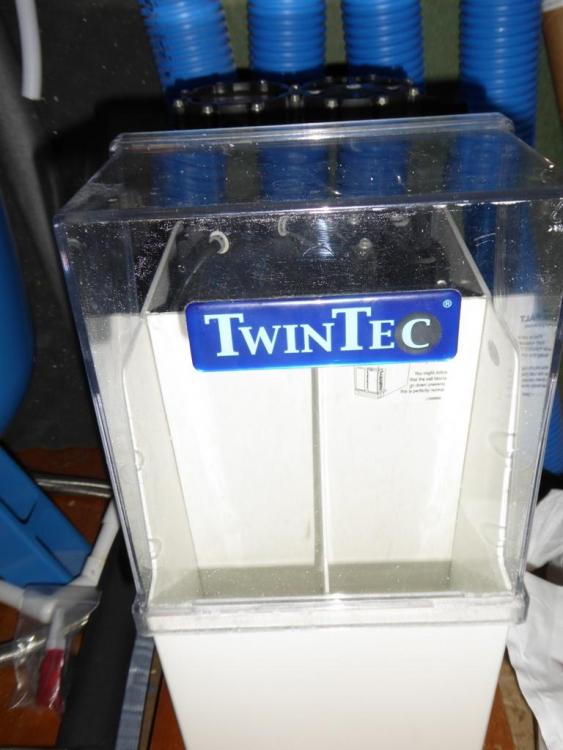
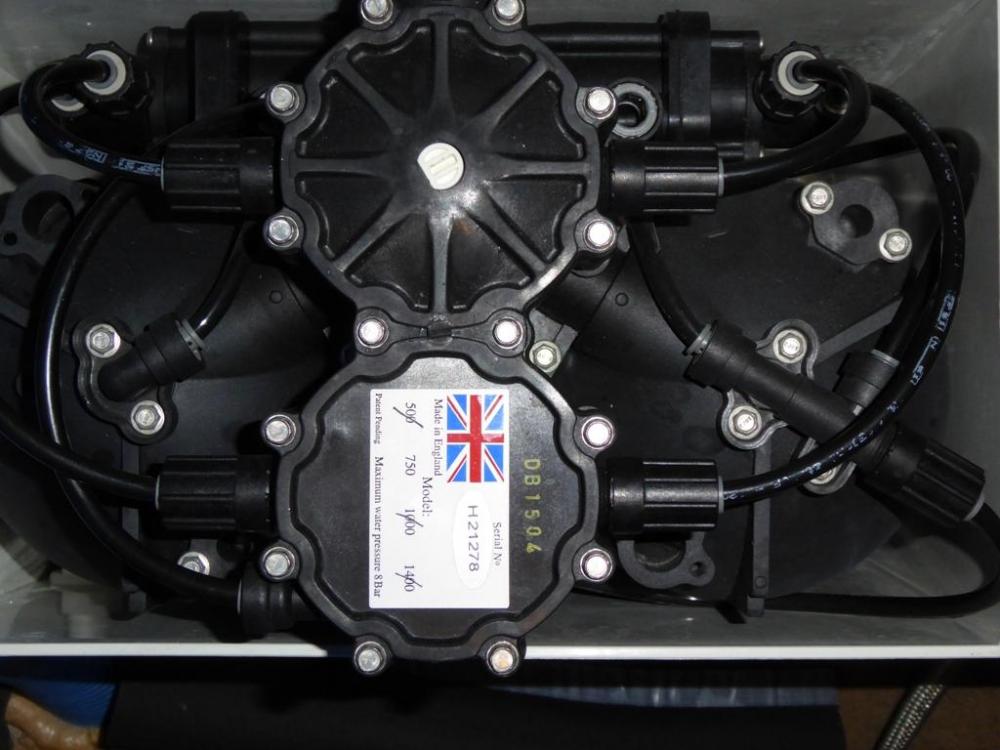
That's true, it is the volume between regenerations, but it can only be set by changing the water metering assembly, something that I've tried (out of curiosity) and found to be very challenging, as all the gears fall out when you lift the cover off! Here's a photo of the front of our spare TwinTec (with the top lid off): And here's a photo of the top of the water meter assembly, with the label showing that this unit is preset at the factory to regenerate every 750 litres (looks like there are four different water meter gearbox options):
-
Same here, the stuff came in an artic curtainsider, looks to be the standard way the stuff is delivered, perhaps.
-
Interestingly, the spare one I took apart has a Twintec label on the case, but a standard Harvey unit inside. Where is the adjustment for hardness, out of interest? Maybe there is more than one type of water metering unit fitted to these units.
-
Out of interest, what units do you use to measure "thermal mass", to enable one form of construction to be assessed against another as having more, or less, of it?
-
External Wood Cladding - What to use
Jeremy Harris replied to colin7777's topic in Building Materials
For environmental reasons I deliberately chose locally grown larch, and we have no regrets. We wanted a "rustic" look (a planning requirement - it was that or mega expensive local stone cladding) and the availability of very good value, locally grown, wide board (between 250mm and 300mm board width) larch at a very affordable price was the clincher. We paid far more for labour to cut and fix the cladding than we did for the timber. The local sawmill (at Ansty, 3 miles away: http://ridleysawmill.co.uk/ ) had a source of locally grown larch (from Fonthill estate, about 3 miles from their sawmill) and they took us to go and see the trees before they were felled, so we could choose the trees and see them marked with our name. We've had a bit of movement, and have needed to replace few fastenings, but movement has been less than we'd have had from oak, which was the only other option open to us (planners again). The sawmill have used a lot of this locally grown larch for years, and took us to see some of their customers. The oldest structure we saw was a ~60 year old bus shelter, clad in their larch, that still looked fine, it had just silvered to a lovely colour (IMHO). In my view, if this local larch can last at least 60 years with no treatment, then it's good enough for me, as I won't be around in 60 years... -
There's only one way to remove limescale from water, which is to remove the calcium and magnesium ions from the water, so that calcium and magnesium carbonates cannot form. There are two ways to do this, using an ion exchange resin, which swaps the calcium ions for sodium ions, or use reverse osmosis. The latter isn't well suited to volume water supplies, so that really leaves ion exchange. There are a multitude of different ion exchange systems around, that differ mainly in terms of physical size, whether they uses electricity or not to control the valves and regeneration process and the type of salt they use. The smaller units that don't need electricity are the Kinetico and the Harvey (both of which licence their technology to other companies). We have a Harvey and have found it to be reliable and effective, and it's supposed to have some advantages in its water metering system over the Kinetico, but I believe these are probably a bit marginal. Both are compact units that can fit (just) in a kitchen cabinet if need be, although we have ours in the services room. There are lots of other devices that claim to reduce the impact of limescale, using magnets, special catalytic elements, etc, but these don't actually remove anything. There is some limited evidence that they may slightly change the nature of the carbonates that precipitate out, making them less prone to sticking to stuff, but my own preference is to just remove the limescale completely. Some of the water conditioning devices that are marketed are simply snake oil, and use pseudo science to make them sound as if they are doing something magical. Finally there are phosphate dosing hard water treatment systems. These can work very well to stop limescale sticking to things, as although they don't remove it, they do reduce the impact it has on things like washing machines and dishwashers. They have the advantage of being cheaper to buy then something like the Harvey or Kinetico units, but they do need topping up with phosphate balls, that can be more expensive than salt.
-
For the record, I've not been upset at all. Hopefully we can all express a view here without causing offence; we may not necessarily all agree all of the time, but then life would be pretty dull if we all did.
-
DIY Arduino based solar PV dump controller
Jeremy Harris replied to ProDave's topic in Photovoltaics (PV)
I had major problems with interference on the 433 MHz band when I originally fitted the HomeEasy/Byron wireless light switches. They used simple ASK receivers/transmitters that were extremely prone to interference. Any transmission near 433 MHz would just block the receiver and stop them working. The problem was fixed by changing to the Quinetic wireless switches, which use FSK on the same 433 MHz band. These are immune from interference it seems, and just work very reliably. The same goes for the 433 MHz data transmissions from both the treatment plant monitor and my energy metering system. These use FSK, with the small HC-11 modules, and are also completely immune from blocking, it seems. In our case the interference seems to come from a wireless weather station that a neighbour has. This seems to transmit data pretty continuously, using ASK, and tends to swamp any nearby ASK receiver operating in that band. -
There is no way to adjust a Harvey for different water hardness once it is in-situ. The water meter inside the top cover is set during manufacture for a particular hardness range and this cannot be changed. I've had our spare one apart, and all there is in the water meter is an impeller plus a lot of gears, nothing in there is adjustable. I would guess that Harvey have a range of different gears they can install during manufacture in order to change the preset hardness, as the top cover is labelled with the hardness range that the unit is set for.
-
Yes, I think so, although there's no indication inside the car when they come on, so I'm not sure whether they stay on when the car has stopped or not.
-
UFH on the first floor of a Timber Frame
Jeremy Harris replied to puntloos's topic in Underfloor Heating
We have no heating at all upstairs, other than heated towel rails in the bathrooms (our house is also an MBC build). As risk mitigation I included switched fused outlets in the bedrooms, so that I could add small electric panel heaters to the walls if needed. We have found that we just don't need any heat in the bedrooms at all, only cooling. We like the bedrooms to be no warmer than about 19°C to 20°C, and even in really cold weather they don't drop below about 19°C. The only thing I wish I'd done differently is to fit UFH in the bathrooms, as the travertine floors do feel a little bit chilly at times. I don't think I'd have bothered to fit wet UFH in them though, as for just taking the chill off morning and evening electric UFH switched by the same time switch that controls the towel rails would be fine. I doubt it needs more than a few tens of watts to take the chill off those floors. -
The brakes still come on sometimes, it's just that there's no need to press the brake pedal, as lifting off the accelerator either uses regenerative braking, or applies the brakes, as needed. I'm not sure how it decides whether to apply the brakes or use regen, probably a mixture of speed and how far my foot has lifted off the accelerator pedal. The braking effect if you lift your foot right off the accelerator is pretty strong, and took some getting used to at first. I'd guess that the brake wear will be much like that on the Prius, very low. The Prius I did the most mileage in had around 60% brake pad wear after about 65,000 miles, so I'd guess it would do around 100,000 miles before the brakes needed attention. The i3 is probably much the same, I think.
-
I had to drive a different car yesterday. Nearly caused an accident in traffic, as I lifted off the accelerator, expecting the car to do as mine does and just come to a stop, only to find it didn't, and I needed to find the brake pedal. What surprised me is that in the space of around 9 months or so I've become so used to one pedal driving that I just didn't think I needed to press the brake pedal to stop.
-
There's some photos of our passive insulated slab going down here (they are all much of a muchness in the way they are laid): http://www.mayfly.eu/2013/10/part-sixteen-fun-and-games-in-the-mud/
-
The problem is that someone, years ago, thought that mass was what stabilised temperature in a building, most probably because massive stone buildings tend to maintain a fairly stable temperature. Mass isn't the thing that's making the temperature stable, though, decrement delay is. There's a useful description of decrement delay here: http://www.greenspec.co.uk/building-design/decrement-delay/ In relation to this thread, it's fairly easy to build a timber frame house with a long decrement delay. One way is the way we've chosen to do it, which is to use fairly thick walls and roof, filled with blown cellulose. Blown cellulose is much the same as timber in terms of its heat capacity for a given mass, and it holds a lot more heat per unit mass than concrete, brick or stone. It is also a reasonably good insulator, much better than concrete, brick or stone, so it works well at slowing down the rate at which heat flows through it, in either direction. This slowing down is what increases the decrement delay and also increases the thermal time constant of the house, so it takes a long time for the house to cool down or heat up when conditions change.
-
DIY Arduino based solar PV dump controller
Jeremy Harris replied to ProDave's topic in Photovoltaics (PV)
The HC-11 modules provide a 433 MHz, encoded, control link. The documentation on them is crap, and most of the time people use them as half duplex serial links, but there is an option to just have the receive end turn something on or off on receipt of a command (I've not tried it though). There's a not very good data sheet on them here: https://www.elecrow.com/download/HC-11.pdf They are pretty cheap from ebay: https://www.ebay.co.uk/itm/1pcs-HC-11-433MHz-CC1101-RF-wireless-Transceiver-RS232-TTL-the-official-agency/191864666716?hash=item2cac067a5c:g:QWUAAOSwKfVXKx9y The "con" terminal can be used to both send and receive a simple switch command, but first the modules needs to be programmed by connecting it to a serial terminal and setting the channel, baud rate and code. Once set the modules store the programming in non-volatile memory. It should be possible to drive a transistor and relay from the output, or it should also be able to directly drive an SSR, which might be simpler. I have a bunch of HC-11s here, so if I get some spare time I might play around with the simple switch control setup, as I've only used them for transmitting serial data. -
We did all ours in situ with no issues. The Osmo oil is fairly thick stuff, so it doesn't tend to drip. We just slid old newspapers under each door, just in case.