Jeremy Harris
-
Posts
26430 -
Joined
-
Last visited
-
Days Won
360
Everything posted by Jeremy Harris
-
Be interesting to see if you can get close to £2k for a single house installation. My experience of looking around and getting quotes suggested that a one-off installation was going to cost a lot more than that. Also worth looking at mitigating the fire risk in other ways, so that sprinklers aren't needed everywhere. The most common causes of fire (leaving aside smoking) are in the kitchen (cooking, faulty appliances etc) followed by small electrical appliances (notably dodgy chargers left unattended). We don't have a tumble dryer, but if we had then I'd have considered that a significant risk. We have a policy of only charging phones etc in the kitchen, with the USB chargers built in to an outlet there, partly because that eliminates the possibility of dodgy chargers causing a fire, partly because the kitchen has fire resistant work surfaces. If we'd fitted the mist sprinkler system it would have only been in the kitchen, as for us that was where there was far and away the highest probability of any fire starting.
-
The vertical distance in metres from the turbine outlet to the surface of the water in the top reservoir that's feeding it.
-
Exactly the issue we ran into. The fire officer recommended that we fit sprinklers in the planning consultation (pretty sure they all do this with every application in England, anyway), which is why I looked into it. The volume of water we'd need to store to be able to run conventional sprinklers was far too large, hence the reason I looked at the mist systems, as they need a lot less water (but cost a lot more). In the end I just looked at some statistics, and compared the risk of death from fire with the risk of death from other things we do all the time. Once I realised that we were about 95 times more likely to be killed whilst driving than we were from a house fire I concluded that investing that much money to mitigate a pretty small risk wasn't justified. I did fit a decent fire alarm system, though, as the data shows that good fire alarms can massively reduce the risk of death from fire, the data suggests that alarms are significantly more effective at preventing deaths from fire than sprinklers. Probably worth noting that anyone building in Wales has to fit sprinklers, I think, as I believe they are mandatory there now.
-
 I agree with the above, and would add that putting 40mm of PIR or similar on the inside may also make it easier to fix the VCL and tape it all up, plus it will decrease the overall internal vapour permeability, so looks to be a pretty good option all around, especially if you can arrange it so that there is minimal impact on internal space. You can probably get away with slimming down the service void a bit, as most stuff will fit into a 25mm void OK. We have a 50mm service void and all it does is waste a bit of internal space, IMHO, as the biggest thing running down it are runs of 15mm pipe. Perhaps consider this build up, from the inside to outside: 12.5mm Plasterboard 25mm service void. Air tight barrier. 40mm Kingspan K12 300mm I Joists filled with DRITHERM .032 insulation 12mm OSB (4) Tyvek UV breather membrane 25mm Vertical battens (Ventilated) 25mm Horizontal battens (Ventilated) Marley Internit Thrutone cement tiles. This would definitely be OK, as the vapour permeability gradient is all going the right way, i.e. least vapour permeable on the inside, most vapour permeable material on the outside.
 -
MBC timber frame and cedar cladding closing the gap
Jeremy Harris replied to lizzie's topic in General Joinery
There are also wider trims available that may be closer to the ones I used: https://www.selcobw.com/products/plastics-drainage/pvc-fascia-cladding/trims-corners/300-x-60mm-black-pvcu-fascia-in-line-joiner https://www.selcobw.com/products/plastics-drainage/pvc-fascia-cladding/trims-corners/300mm-x-60mm-black-pvcu-external-fascia-corner-joint I can't remember who I bought them from, but have a feeling that I had them added to the fascias, soffits etc that were supplied and fitted by the roofing contractor, so they all matched. -
Yes, I shouldn't have suggested Betz, as Betz set the limit specifically for air, but there is equally a limit for any other incompressible fluid flowing through a turbine. Has to be, as the limiting case for 100% efficiency implies zero outflow, and that clearly cannot ever be achieved with a real system. The fact that there will always be energy in the outflow water means that mechanical efficiency can never be 100%, without accounting for electrical efficiency. Any home-brew micro hydro system is likely to be significantly less efficient than a large scale system, too, partly because the losses don't scale linearly with size, I suspect.
-
MBC timber frame and cedar cladding closing the gap
Jeremy Harris replied to lizzie's topic in General Joinery
There are trims to cover the joints and corners: https://www.eurocell.co.uk/fascia-boards/replacement-fascia-18mm/flat-joint-trim-in-white https://www.eurocell.co.uk/fascia-boards/replacement-fascia-18mm/capping-board-corner-trim-in-anthracite-grey These are just cut to length and glued in place (on one side only, to allow for thermal expansion/contraction). -
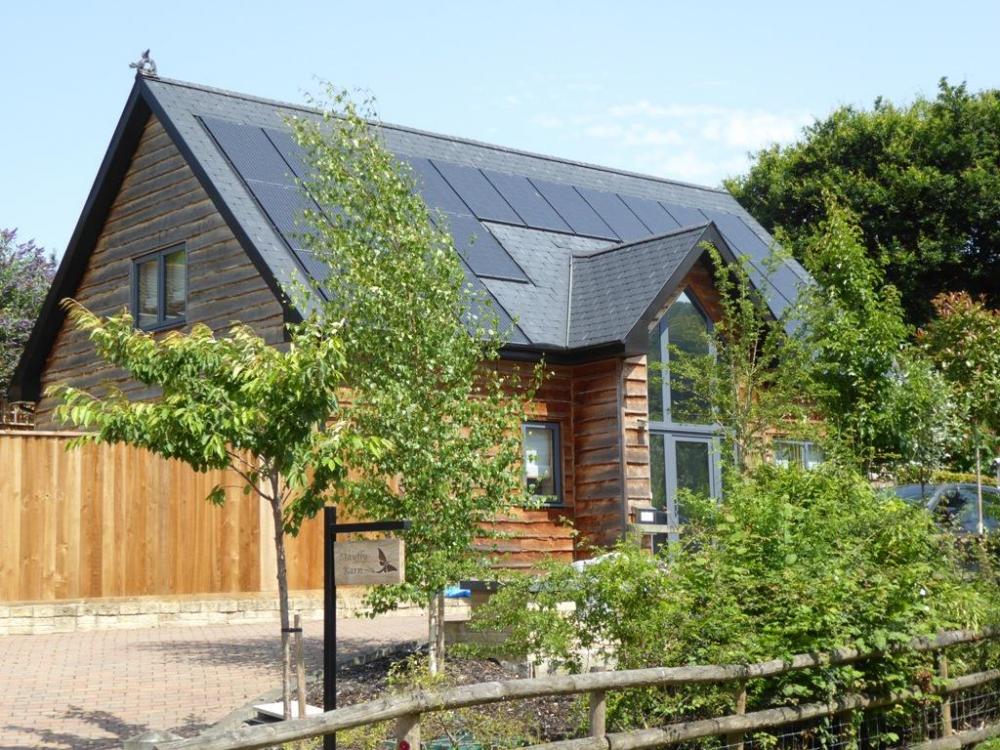
Our panels are proud of the slates by a fair bit, but it doesn't really stand out when looking from the ground. At a guess I'd say the panels may be around 30mm to 40mm higher than the slates:
-
Worth looking at Paul Camelli's blog: https://lifeattheendoftheroad.wordpress.com He has a small hydro system, that generates a few hundred watts. He laid a few hundred metres of pipe from a small loch down to his turbine house and spent a fair bit of time getting the system running OK, but as he's off grid it's a very useful way to help keep his batteries topped up.
-
Our 6 kW inverter doesn't have any cooling fans, just a big heatsink on the front. It makes a very slight hum when operating near full power, but you need to be close to it to hear this, and most of the time it's completely silent.
-
Air is also incompressible at sub-sonic velocities, so both air and water behave in a similar way as far as turbines are concerned (apart from the differences in density and viscosity). The logical test is to consider the limiting case for a turbine that extracts 100% of the potential energy from the flow. The implication of this is that there is zero outflow from the turbine, as the turbine would be absorbing all the flow without it ending up anywhere. Clearly this cannot happen (you can't just magic away a mass of anything, at least not under practical, earth-condition, conditions), so therefore efficiency can never reach 100% and there must be some finite limit. Betz defined this for air (not water) but the same principle of their being a finite limit applies to any machine operating in a fluid flow.
-
As @SteamyTea has mentioned, the potential power is easy to work out. To that basic equation you need to factor in the Betz limit and efficiency, so in reality you would be lucky to get more than about 30% to 40% of the potential power from the water flow for a practical low head turbine, I think.
-
Yes, that's what we found. We were looking at fitting them in the kitchen, but the basic cost was around £4.5k for just that room, plus another ~£3k in providing a guaranteed water supply (because we have a borehole). I looked at the real fire risk, rang around for insurance quotes, and decided not to bother. One major influence on that decision (apart from the cost) was that there was zero loading on the house insurance for it being of non-standard timber frame construction. I reckon the insurance companies are probably pretty good at assessing risk, and if they felt that our house was a higher fire risk because of its construction they would have loaded the premium to reflect that. They actually reduced the premium over that we were paying for our old, smaller, block and brick bungalow. When I queried this they explained that the premium for a bungalow was loaded over that for a two storey house. The fire statistics do show a higher incidence of fatal fires in bungalows, but I suspect that's more to do with elderly single occupancy than the type of house.
-
If looking at sprinklers (which are a very good idea, IMHO, but also expensive) then I'd look at the water mist ones. Not only do these suppress fire more quickly than conventional sprinklers, but they also use far less water. Using less water has two benefits, it means that getting an adequate water supply to them is a lot easier (it can be a challenge getting adequate water supplies to conventional sprinklers) and there is a great deal less water damage if they operate. Water damage is often more severe than fire damage in many house fires, so anything that reduces this has to be a good thing. Looking at the statistics, 75% of household fires are put out without the attendance of the fire and rescue service. The fire and rescue service attended 29,570 fires in England in the year 2018/19, from a housing stock in England of around 19.811 million, so the number of households that the fire and rescue service attend each year is about 1 in 670. Out of those fires where the fire and rescue service attended, the average area of fire damage was 18.3m², so roughly one room about 4.5m x 4m. There were 196 fatalities from house fires in 2018/19 in England. Breaking those down by dwelling type, far and away the highest number of fatalities is in single occupancy dwellings (people living alone in either a house or bungalow, excluding flats), 136 out of a total of 196, excluding those living in purpose built flats. The number of fatalities from fires in multiple occupancy dwellings, not-purpose built flats or HMOs, (so normal households) was just 19. From the data it seems that far and away the highest risk group are those living alone, either in houses, bungalows or maisonettes (not purpose built flats). The fatal fire risk for those living in households of more than one in England seems to be about 0.0000959%
-
Good question. I guess it depends on whether a cherry picker would be considered as being a safe way of working on a roof. It could be that access for a cherry picker might be difficult in some cases. I wonder how far a cherry picker can reach out laterally?
-
Yes, that certainly messed up both my model and PHPP a bit. The data I used for the local climate was taken from the Met Office dataset, which for here is reasonably OK, as we have a monitoring station fairly close by, at Fontmell Magna, and I used their data initially, then modified it by increasing the mean temperatures a bit to reflect the impact of our microclimate a bit better.
-
MBC timber frame and cedar cladding closing the gap
Jeremy Harris replied to lizzie's topic in General Joinery
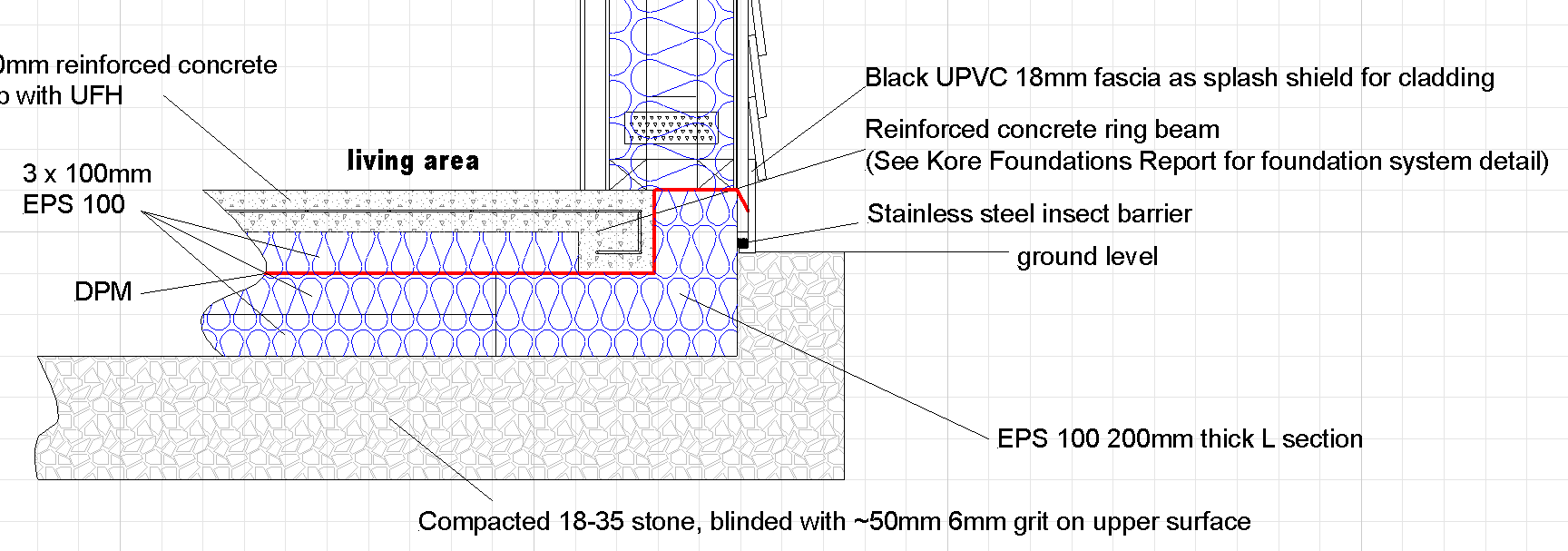
It's just a re-purposed black uPVC fascia board, the type that has a return at the lower edge. We used this return to cap off the end of the battens, with the small ventilation gap filled with stainless steel commercial pan scourers as an insect barrier. I can't recall exactly which fascia we used, but it was one like these: https://www.eurocell.co.uk/fascia-boards/replacement-fascia-18mm This sketch drawing shows how it was fitted at the base of the cladding: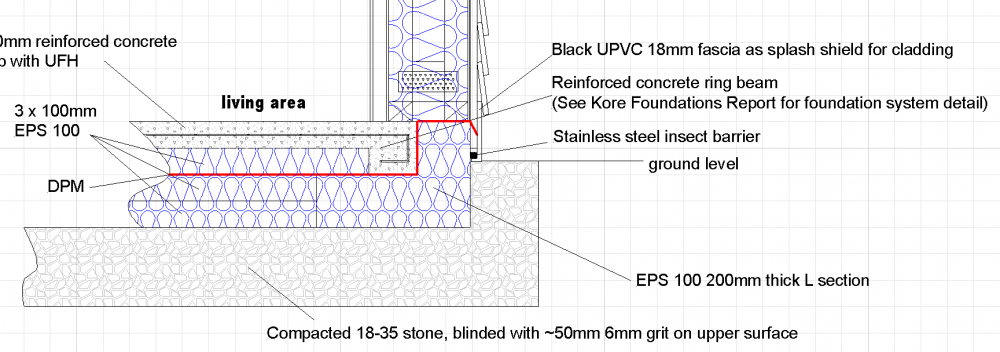
-
I read that earlier, sheer good fortune that no one was hurt. I read something a while ago (may have been from BRE) that assessed fire risk with building height, and concluded that the risk increased fairly dramatically with timber structures over a couple of storeys high. I'll have a dig around and see if I can find it, as off the top of my head I can't remember why they reached that conclusion.
-
They do, but if they are fitted under roof-mounted panels, then that's a scaffold hire job to replace one if it fails, so quite costly. I could change our inverter in under an hour, with no need for any access equipment, just a matter of unplugging the connectors and lifting it off the mounting bracket that it hooks on to.
-
One thing that does seem noticeable is that the fairly crude model that SAP uses (accepting that modelling thermal performance is not the primary purpose of SAP) is often pretty inaccurate. For our house SAP significantly overestimates the heating requirement (by a factor of about 2), overestimates the hot water requirement (by about 30%) and massively underestimates the overheating risk (by a factor of about 4). PHPP is pretty damned close, the only significant error is the predicted overheating risk, but a large part of that turned out to be the temperature value that PHPP defaults to as the threshold for overheating, which was a bit higher than I think it should be (but we don't like the house to be much warmer than about 23°C). IIRC, PHPP default to 25°C as the overheating threshold.
-
Registration of a replacement roof window?
Jeremy Harris replied to vivienz's topic in Windows & Glazing
FWIW, when we sold our old house we were asked for evidence that the replacement doors and windows, fitted around 15 years earlier, had building regs approval. I'd kept the FENSA chit in the house file, so was able to send a copy of it to satisfy the solicitor. -
Be interesting to see if it is valid for a range of different house types. Be a lot simpler than some of the behemoth models around, like PHPP, if it is.
-
So, are you in agreement that the definitions that you've previously given for "thermal mass" are either just the standard definition for non-dimensional heat capacity, sensible heat per kelvin, or an alternative definition expressing heat capacity as sensible heat per unit area?
-
That's a partial quote, taken out of context. This is the complete quote, as the context is important, particularly the last phrase:
-
Can anyone turn a pdf into a CAD for me?
Jeremy Harris replied to Powerjen's topic in Surveyors & Architects
This has been my experience of converting .pdf to .dwg or .dxf formats. Objects end up broken, there are no layers, and there are lots of scaling and positional errors. I recently spent a few hours tidying up and rationalising a fairly simple set of drawings that had been converted from .pdf to .dxf, but for anything other than a fairly simple outline drawing I'm inclined to think that just doing a new drawing from a print out of the .pdf, with reference to some known dimensions, would be quicker and easier.