Jeremy Harris
-
Posts
26430 -
Joined
-
Last visited
-
Days Won
360
Everything posted by Jeremy Harris
-
In my experience, the flow restriction from the filter housing, even the standard small 10" one, is very low, 99.99% of the restriction comes from the filter cartridge. The refillable inserts that fit the 10" filters also have a very low flow restriction when empty, and I'd guess that the restriction around the polyphosphate pellets will be pretty small, as they are fairly large, with big gaps around them. I'd be inclined to get a standard 10" housing, one with 3/4" BSPF fittings and a clear lower part, plus a clear, refillable media cartridge, and see how it goes. I doubt you'll notice any pressure drop through this. I think you may have to rig up a bypass, anyway, to be able to get the dosing right. I don't think you want all the water to flow through the polyphosphate beads, just enough to get the right dose. A simple bypass across the filter, with a ball valve, would probably be enough to adjust things, but you might also need another valve to restrict the flow through the cartridge a bit. I believe that the clever stuff in the Combimate is mainly the bypass arrangement that gets the dosing right, so I would expect a home brew system to need a bit of trial and error to get set up.
-
As an aside, Tesla have done another update, which has actually made the voice commands work reasonably well. Some are a wee bit American, though. For example, the voice command "my butt is cold" turns on the driver's side seat heater...
-
AFAIK, yes, as they have no clutch or gear lever.
-
It seemed to be a bit of both, I think. Suppliers here were charging a premium price for panels, so much so that when I bought some for my boat years ago it was very much cheaper to import them from China directly. I think the increased level of competition in the UK, that was a direct consequence of the boom in panel sales, helped to reduce the price of panels here a fair bit.
-
In my view, the FiT largely succeeded in what it set out to do, which was kick start the adoption of microgeneration at the domestic level. It provided just the incentive needed to create a boom in microgeneration system take up, which then resulted in a marked reduction in the price of panels, inverters etc. Certainly the FiT, and in particular the MCS, was/is very badly managed, and like pretty much all government subsidy schemes it was many of the MCS accredited companies that cashed in, rather than consumers, although it's clear that, with FiT in particular, consumers have actually seen a worthwhile benefit from a government subsidy. Many government subsidy schemes don't end up providing a subsidy for the people they are aimed at all, good examples being insulation schemes, where the cost to the customer is much the same whether there's a grant or not - the grant just gets taken as extra profit by some installers. The same applies to OLEV grant funded car charge point installations, the electricians installing those are currently getting around £600 to £800 per day, or their bosses are (nice work if you can get it!). Certainly FiT was unsustainable, but I don't think it was ever meant to be sustained, it was really an incentive scheme, to bring about a step change in thinking, and arguably it has contributed a great deal to that. The main problem with FiT was that it was incompetently managed. The rates should have been reduced gradually, as the level of take up increased, rather than the government waiting until they saw there was a major problem and just shutting the system down almost overnight. This isn't unusual in government, though. They see a political benefit to be had from promoting and implementing an idea, then lose interest and forget about it until it causes a near-crisis.
-

Solar DHW with UniQ and PV Diversion
Jeremy Harris replied to DamonHD's topic in Boilers & Hot Water Tanks
Potentially yes, but the amount used is extremely low, these things take a handful of polyphosphate beads once a year, so it's not like chucking tonnes of phosphate-containing detergents down the drain. Also, because the water is dosed with phosphate, you can probably reduce the amount of detergent used and reduce the amount of soap used, as well as reduce the amount of stuff like toilet cleaner used, so the chances are that there's little, if any, net worsening of the potential phosphate pollution problem. -
Solar DHW with UniQ and PV Diversion
Jeremy Harris replied to DamonHD's topic in Boilers & Hot Water Tanks
The cheapest option is probably to look at phosphate dosing, if all you wish to do is protect the heat exchanger in the Sunamp from scale build up. This works well, and is cheaper than ion exchange softening. @richi here seems happy with the Combimate, but there are other options, and in terms of performance all the phosphate dosing units are much of a muchness. -
MVHR is Largely Bogus
Jeremy Harris replied to DavidHughes's topic in Mechanical Ventilation with Heat Recovery (MVHR)
Should have used the tongue firmly in cheek smiley, methinks... -
Solar DHW with UniQ and PV Diversion
Jeremy Harris replied to DamonHD's topic in Boilers & Hot Water Tanks
It's yet another, expensive, magical, electric field/magnetic field, device that supposedly does the impossible, and remove calcium ions from water passing through the pipe that runs through its centre. There's zero evidence that any of these magnetic/electric widgets actually do anything to permanently change the composition of the water flowing through them, but there is a fair bit of anecdotal evidence that they tend to reduce the tendency for calcium carbonate to form scale on hot surfaces, and instead precipitate out as fine particles. No one seems sure how this works, if the effect is real, or how long any changes made may last. Does the device provide scale protection? I'd have to say that it might, or it might not. There are many cheaper ways of doing this, though, as the idea has been around for decades. -
The Honda E has the same layout as the i3, the pedals look just like those on an automatic car. Unlike a friends 1930's era Rover that I drove to a show for him years ago. That had the accelerator pedal in the middle and the brake pedal on the right. Took some getting used to, but luckily there were three of us driving his cars in convoy to a show, so we kept the speed down.
-
So do I, but then it seems that a lot of car advertising can be a bit confusing, like the Toyota/Lexus "self-charging" nonsense. The one-pedal-driving thing is not often that well described by any of the manufacturers, but feels just like driving a car that has lots of engine braking, enough to bring the car to a halt in the case of some implementations of it. My last Prius would use regenerative braking down to 5mph, then expect you to use the brakes. The BMW i3 would use the brakes a bit, without you touching the brake pedal, at low speeds, with the accelerator lifted. The Model 3 seems to do the same, but goes one stage further and applies the brakes hard as soon as the car has stopped, rather like putting the handbrake on. I'm not sure what Honda have done with their implementation of one-pedal-driving, but would guess that it's may be similar to that in the Tesla, now (Tesla only recently added the full one-pedal-driving feature, as an over-the-air update to the software). It doesn't seem to, but the lights are pretty good even when dipped, so it's not much of an issue. It seems that the lights on cars generally have improved a lot in recent years. My 2013 Prius had LED headlights, that were bright enough, but had an unpleasant blue tinge. The i3 had better LED headlights, probably about the same as the Prius in terms of brightness, but a more even colour, and without the very sharp edge cut-off. The Tesla seems to have LED lights that are better still, slightly brighter in the area where you need it, without the very sharp edge cut-off of the Prius lights. My only criticism of them would be that they seem to be set a little bit high when dipped.
-
One advantage of the autopilot sensors is that the forward looking radar will usually "see" things a fair bit before the driver does. I suspect that auto dip is just using the same autopilot sensing systems as used to detect and classify other vehicles, cyclists, pedestrians, road markings etc. It has a big advantage over us mere humans, in that it can "see" stuff that we can't, plus it looks all around the car all the time, so knows how close the car is to the edge of the road, how close it is to the centre white line, etc, as well as detecting things way off in the distance. This is an old video, showing how the sensing systems inside the car "see" things (this isn't displayed to the driver). Things have markedly improved in the past year, since this video was released, but it does give an idea as to what is being detected and classified by the car all the time. The impressive thing is just how many features the car simultaneously manages to detect and track:
-
There are no internal door handles. There are very carefully disguised buttons at the very top of the door pull, that when pressed unlatch the doors. Likewise there are no door handles that protrude outside the car, and no locks. As you walk up to the car it either senses your 'phone or an optional keyless entry remote, so that when you depress one end of the flush door handle the car unlocks and the door unlatches electrically. To start the car you just press the brake pedal, and select forward or reverse with the steering column lever. There is no handbrake - that's done automatically when needed. In practice, pretty much all the stuff you need to do when driving can be done from the steering wheel. The right steering column lever controls forward, park and reverse, plus it activates cruise control and autopilot. Cruise and autopilot speed can be adjusted using the right scroll wheel on the steering wheel. The left column stalk controls the indicators and manual dip switch (although that's not needed, as the auto dip works fine). This stick also has a button to activate the wipers, if the auto wiper function doesn't detect light rain, plus the screen washers. The left steering wheel scroll wheel controls the volume of the audio, and also has options to select mode, station, track or whatever by clicking it left or right, or muting the audio by pushing the scroll wheel in. The right scroll wheel also activates voice recognition when pressed, so to open the glovebox (there's no catch for that either) you just press the right scroll wheel and say "open glovebox". About the only thing I use the touch screen for when actually driving is adjusting the temperature, and this is no harder than doing the same with a switch.
-
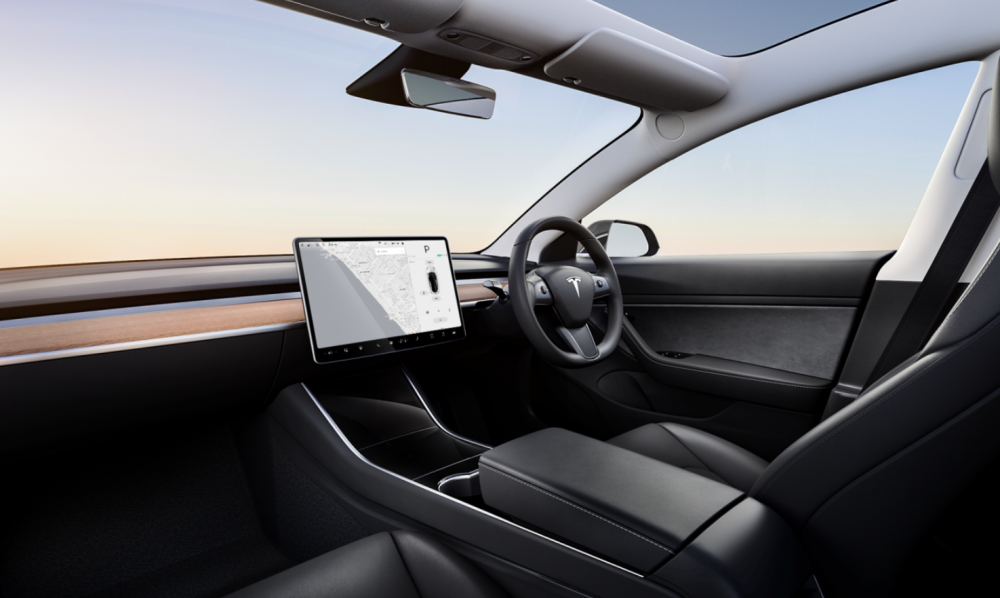
The dash in my Tesla has a strip of oak running across from one side to the other (not my car, but a photo of exactly the same spec as mine, from Tesla):
-
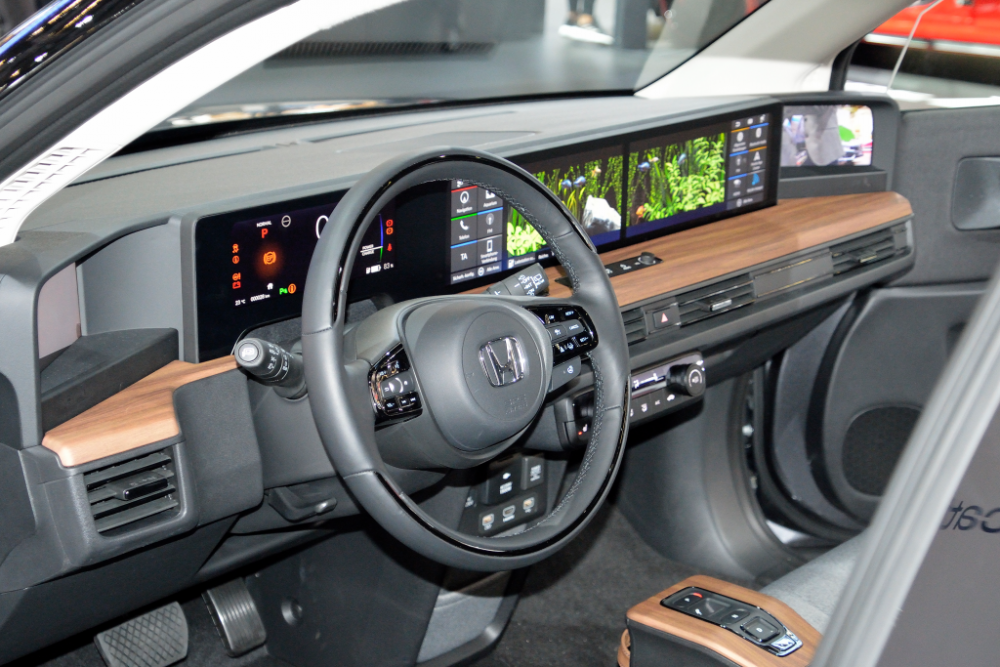
Yes it does. Even on the Tesla pressing the brake pedal disengages both autopilot and cruise control (if either are activated). Single pedal driving usually refers to the way the car can be driven most of the time without needing to touch the brake pedal. Both the BMW i3 and the Tesla can do this (although Tesla were a bit late in getting it to work well). I'm not aware of any EV that doesn't have a working brake pedal. The newly released Honda E has a brake pedal, as can be seen in this photo: I suspect that, like almost all EVs it can still be driven in "single pedal" mode most of the time, with the brake pedal really just being there for emergency use. I found one-pedal driving a bit strange at first, but after a year or so of driving like this I wouldn't be without it. I can turn it off if I wanted to, and even make the car behave like an automatic, and creep with my foot off the brake, but I much prefer driving in one-pedal mode, with automatic brake application when the car stops. The latter is incredibly useful, for everything from hill starts to coming down our drive to the lane. Just lift off the accelerator and the car just comes to a stop, no jerkiness, just rolls gently to a halt and applies the brakes to hold the car stationary.
-
I could if I had a 1/2" female to 3/4" female square adapter, but all I seem to have is a collection of various 1/2", 3/4", 3/8" and 1/4" square adapters, none of which will fit to together easily to allow me to connect the thing to my 3/4" drive torque wrench. The only hex threaded pillars I have are M6, so 10mm AF, and I could possibly try an arrangement of adapters and sockets to get this to work, but it would mean using a 3/8" drive 10mm socket that's seen better days, and which probably wouldn't be up to taking the full torque of this thing. Somewhere I'm sure I have another set of 1/2" sockets, but I'm damned if I know where they are. I seem to be struggling to find loads of stuff since we moved - something that's getting to be extremely annoying. My workshop at the old house may have been a tip, but it was my tip, and I knew pretty much where everything was...
-
Looks absolutely identical to mine, so my guess is that it does also have the 1/4" hex socket in the end.
-
The Great Thermal Mass Myth................
Jeremy Harris replied to Jeremy Harris's topic in Boffin's Corner
Any normal MVHR will pretty much always cool the house, except when the air outside is hot. It just cools the house a lot less than conventional ventilation in cold weather. It doesn't heat the house, or move heat around to any significant degree[1], as it always delivers fresh air that is cooler than the air in the house (has to, as the efficiency is rarely greater than about 85% to 90%). [1] The exception is active MVHR, that includes either heating, or an air-to-air heat pump to deliver both heating and cooling, but these tend to be expensive compared to normal, passive, MVHR. -
How much is too much insulation? Water UFH
Jeremy Harris replied to Bikerz's topic in Heat Insulation
No reason not to fill under block and beam with an insulation material that is unaffected by moisture, AFAICS. Materials like bonded EPS beads blown into the cavity, or leca beads poured in, would be OK. -
Hybrids are exempt from emissions testing. There is a way to force hybrids into emissions test mode, via CAN bus commands sent via the OBDII port, but MOT testers aren't permitted to do this. Brake light testing is OK, as the brake lights also work when the brake pedal is pressed, as well as when regenerative braking is slowing the car.
-
The snag is that ANR on this sort of scale is very, very expensive. It can be done, but it needs a lot of power, weatherproof speakers etc, and a passive solution will almost certainly be cheaper and easier to implement. ANR also only tends to work over a very small area, so works brilliantly in headphones, sort of OK inside a small, enclosed area (like inside an aircraft cockpit, for example) but really doesn't work at all well in the open air. The fan room looks to have lots of hard surfaces, crinkly tin etc, so adding sound absorbent panelling would probably make a significant difference. If the sound can be absorbed at source, in that room, then that seems to be far and away the best way of dealing with it. Clearly some sound absorbent panel solutions aren't going to be an option, because of the possible fire risk, but there are fire resistant acoustic panel materials that may well work OK. I once spent a day at Bicester, at the Challenger tank engine test facility, and the engine test cells there were lined with rigid board full of small holes. The noise inside the test cell with that big V12 diesel running at full chat was deafening, yet in the control area outside it was barely audible. Might be worth looking at how engine test cells are built and then seeing if a similar box of rigid acoustic board could be built around the drier, allowing enough room for access. If it would be possible to build a concrete block wall around the drier, with the inside lined with acoustic board, then this might well be even better. My guess is that 99% of the noise will be coming from the tips of the fan blades, plus a bit coming from the air flow itself. I doubt the motor contributes much to the overall noise, TBH.
-
The brake lights are controlled by car deceleration, so seem to come on at a set deceleration rate. In the i3 I never knew when this was, as there was no indication inside the car that the brake lights were coming on, the only clue was to look in the mirror at night and see if you could spot their reflection. The Tesla has an image of your car (right down to the correct colour, wheel type etc for your actual car) to the right of the screen, and this shows both the front and rear lights, and shows pools of light cast by the headlights on the virtual road around the image. When the brake lights activate, they show in this image of the car. In typical Tesla fashion, they also use the weather data for your location to make sure that the reflections shown in the virtual car glass roof and screens are right, so there will be clouds moving over it on cloudy days, an apparent reflection of the sun on sunny days, and stars showing on a clear night...
-
The Great Thermal Mass Myth................
Jeremy Harris replied to Jeremy Harris's topic in Boffin's Corner
The simple answer is to just design the house to give you the specific temperature you want in the bedrooms and the specific temperature you want in the living areas in the house, if these are different. Ours does this; like you, we don't like warm bedrooms at all. We have no heating at all in the bedrooms, and they typically sit at around 18 to 19°C for most of the year, whilst the rooms downstairs sit at around 21.5° to 22°C. I increased the fresh air flow rate from the MVHR to the bedrooms to ensure that they stay a bit cooler than the rest of the house, and increased the thickness of the acoustic insulation in the ground floor ceiling (acoustic insulation also works well as thermal insulation). This works very well for almost all of the year, except in very hot weather, where after a few days of high outside temperatures the bedrooms do get up to an uncomfortable level (for us) of maybe 22°C or more. I fixed this last summer by adding a small air conditioning unit upstairs, that is very effective at lowering the bedroom temperature in very hot weather. It doesn't get used a lot, but we feel it's worth it. Had we been staying in our old house I'd have done the same, as that used to overheat badly in hot weather, and my fix there was to use a portable air con unit. OK, but noisy, and because the house thermal time constant was short, it needed to be on all the time in hot weather. The air con we have now only needs to be on for a few hours during the day and the long thermal time constant means the bedroom stays cool overnight and well into the next morning with it turned off.- 122 replies
-
- 2
-

-
- thermal mass
- heat capacity
- (and 4 more)
-
All a question of who you choose to trust, really. I tend to view 99% of everything reported/reviewed on any form of mainstream media as being suspect at best, completely unreliable at worst. The car review business tends to be a bit biased towards performance and petrolheads, with very few motoring journalists being prepared to suggest that anything that doesn't make a lot of noise and need special skills to drive are worth buying. Which just proves that he didn't bother to try it for long enough to see just how easy it is to use. The control areas on the screen are larger than typical switches etc on a conventional dash, plus they are very easy to see and well illuminated, so less distracting. Anyway, it's unusual to have to use the touch screen, as there aren't many controls there that are needed when driving. The scroll wheels/buttons on the steering wheel, plus the stalk controls, do pretty much everything needed whilst actually driving. Even tyres for my old Prius were around £150 each, so not much cheaper than the ~£180 for a tyre for the Model 3. BTW, you can add a bit to the price for a Tesla. The cheapest Model 3, the SR+ is around £41k on the road, the LR AWD is about £10k more and the Performance is maybe another £6k on top of that.
-
I'll admit to being very sceptical about the whole AP/FSD thing before I tried it. It's clear that FSD is a long way off, but the basic AP functionality is very good indeed on some roads. Driving along the very busy A303/A30 AP worked flawlessly. Where it falls over is at junctions, and particularly roundabouts, where, at least at the moment, it's better to take over control manually. The biggest single benefit is the very much enhanced situational awareness, as the car's cameras and sensors are looking all around the car all the time. After a while, it becomes second nature to just glance at the right hand side of the car's screen to get a really good picture of traffic all around, especially useful for spotting the nutters who choose to "undertake" at speed when in congested road conditions.