


Jeremy Harris
-
Posts
26430 -
Joined
-
Last visited
-
Days Won
360
Everything posted by Jeremy Harris
-
It's a bit like carrying a tool kit around in the back of your car***, isn't it? As soon as you do, the thing magically becomes 100% reliable............... ***relates to cars of a certain vintage where you did have a reasonable chance of fixing them on the side of the road............
-

Tiling behind Wall mounted toilets
Jeremy Harris replied to JanetE's topic in Bathrooms, Ensuites & Wetrooms
Chance would be a fine thing! I took the time to space all our socket/switch boxes on ply spacers (where they were on the service space walls) so that they projected out far enough for the plasterers to just put a sheet of plasterboard in the right place, give it a bang and leave an impression in the board for them to neatly make the cut out. I spent ages going around making good every box before second fix, using those plastic inserts that you just stick in the boxes and then use filler to get a neat and sealed hole (these things: http://s243691647.websitehome.co.uk/plasterguards ), as all the holes were just sort of hacked out................ -
I've been dithering about this for a couple of years, as at our old house we get at least a dozen power cuts a year, but we have a gas fire in the living room, a gas cooker and I've made up a few battery-powered LED lights that I keep charged up specially for power cuts, so we can manage fine for a time. So far the new house has only had two or three power cuts a year, but it's all-electric, so we lose everything when the power goes off. The water supply should be OK for a day or two, because we have two 300 litre and one 100 litre accumulators, but we lose the UV disinfection system. We also lose the sewage treatment plant, and it's a pumped system, so we only have a day or so before the level rises too high. The problem is deciding what to run off a generator, or even whether to go for a battery and inverter system. Financially, a battery system doesn't stack up, even though we could use it to save using grid power a fair bit of the time, a bit like a Powerwall, but there's more to it than saving money. How much is being able to run the house fairly normally during a power cut worth? I've come around the view that the cheapest, DIY, battery system I can come up with is probably the optimum solution, something that I can start with a modest investment, then scale up in the light of experience.
-
We fitted MK Logik everywhere, chosen after looking at quite a load of rubbish stuff. According to the grapevine, MK outsourced manufacture some years ago and quality went downhill, but all the stuff we bought was clearly marked "Made in the UK". The very worst stuff seems to be the Chinese stuff, sold under various brand names in the big DIY sheds. I'm particularly averse to the crap Screwfix sell under the Lap brand name, and suspect it's made somewhere where quality control is near non-existent. Overall, I'm pretty happy with the MK stuff, my only gripe was with the price of the big box for the combination plate; that was a totally silly price for what it is.
-
That's exactly my view, and the reason I've fitted CCTV with recorders (two, in separate locations, just to reduce the chance they will nick both of them). Outside security lights are restricted here, as the AONB is trying to get "Dark Skies" accredited or whatever, which means that the village really is pitch black on dark nights. I can't even manage the few hundred yards to the village hall, I've found, as even the edge of the lane (and more importantly the stream) is impossible for me to make out on a dark night. I tried it once, and ended up walking along, bent double and using the light from my phone screen to try and make out the edge of the lane. I carry a small torch around all the time now. The darkness does mean that we are, in some ways, more susceptible to being burgled, I suppose, but the counter to that is that any burglar would need to use a torch (or night vision goggles!) and would probably get noticed. Also, the IR illuminators on the CCTV cameras give off a faint visible red glow, so they can be seen in the dark and may help to dissuade anyone from trying to get in, or at least get them to look elsewhere (I think we're the only house nearby that has an obvious CCTV installation).
-
I think it all comes down to making your house slightly harder to get into than those around you, in the end, as I doubt you can stop a really determined scrote from gaining access. It also depends on whether it looks as if you have anything worth nicking, too, as I'm sure these scrotes are pretty adept at picking places that look as if they might have readily saleable stuff and that are going to be quick to get in and out of. I changed the Eurolocks in our old house just because the ones in the doors were really rubbish, and very easily snapped, but also because both our front and back door are hidden from view from anyone in the street, or even any neighbours, so a scrote could take ten or twenty minutes breaking in with little fear of being seen. Our new house is far more visible, and in all probability changing the lock barrels probably wasn't worth the cost, but it keeps the insurance company happy!
-
The problem is that, in this case, the quoted MTBF seems to defy the known characteristics of a pretty well-modelled component, that's my concern. Few suppliers of consumer-grade components like this will offer more than around 100,000 to 150,000 hours MTBF, and that's over a restricted temperature range and takes no account of the cumulative effects of having multiple components in a bit of equipment. MTBFs can be misleading, too, as it depends how they've been calculated. I have a suspicion that, in this case, the well-known failures of the Enecsys microinverters may possibly have coloured the way Enphase have chosen to market their product! Reliability is quoted in terms of a statistical probability of failure, usually cumulative, and is always given under a specified set of operating conditions (not a range of them). When you have components that have a non-linear reliability, or life, with a variation in one, or more, operating conditions, then you can quote an MTBF for the "best" operating conditions, yet be sure that it will be a fraction of that for the "worst" operating conditions. Service life will generally be quoted as a number of years, but that does not mean that components won't fail within that period of time. If you keep a bit of equipment at a constant cool temperature it's service life will pretty much always be extended, often dramatically. It's one reason that places like data centres often feel a bit chilly if you're walking around inside one, as they provide masses of cooling both to remove all the heat the things generate and to improve equipment reliability. PV inverters are basically just switched mode converters, that use commutation and filter capacitors under conditions that are pretty near identical to things like data centre power supplies, fixed telecoms power supplies, brushless motor power supplies etc, in terms of switching frequency, ripple current etc. They are also essentially a consumer-grade device, they have to be in order to be cost-effective in a competitive market. A consequence of this is that they use consumer-grade components, rather than high-reliability "aerospace" or "military" grade components. There are some "ultra long life" electrolytic capacitors around, some with a predicted life of > 20 years, but they are expensive, and that long life is at the expense of a reduced ripple current rating and a relatively high ESR (the equivalent series resistance of the capacitor) both parameters that are critical to performance in a switched mode inverter, converter, power supply, or whatever. The effect of heat and ripple current on the life of electrolytic capacitors is well-modelled, and so the operators of equipment that needs to be very reliable (something like mobile phone mast power supplies, or data centre power supplies) will have routine replacement as a part of the maintenance regime to maintain the required reliability. One of the biggest drivers in that part of their maintenance regime will be the capacitors in the supplies, as they are the single most failure-prone component in this type of system (I have the figures somewhere, but off the top of my head I seem to remember that capacitors are around 5 or 6 times more likely to fail than switching semiconductors). Emerson have written a paper that gives a reasonably clear explanation as to why it can be challenging to determine how long capacitors will last in switched mode supplies: http://www.repeater-builder.com/tech-info/pdfs/replacing-capacitors-from-emerson-corp.pdf which is worth a read. It deals with high-reliability components, rather than consumer-grade components found in domestic equipment, but the principles are pretty much the same. EDITED TO ADD: I've just pulled off the Enphase (USA) research papers they use to justify the expected life and read them right through. All I can say is that there is one hell of a lot of optimism in there! They are using capacitors with a service life of 10,000 hours at the rated temperature, then arguing that because they have many smaller capacitors in parallel the service life, and reliability, increases. I'm no expert on the statistics of failure, but I'm not convinced by the logic of their argument. Happy to be put right by one of our resident statisticians, though! The other point in the research from 2008 is that if the capacitors degrade and lose capacitance, as they will, the inverters will continue to work at a lower efficiency, but don't, technically, "fail". It seems they have achieved this by the method I suggested they may have used, they've over-rated the switching devices so they can cope with the reduced capacity and increased peak switching current. It seems similar to the warranty on the Nissan Leaf battery, which says that (I think, need to check) that the battery capacity is allowed to drop by 20% and the battery is still considered to be serviceable and not elegible for replacement under warranty. Finally, the capacitors they are using are exactly the same as the ones I'm using in my BLDC controllers, Nichicon low ESR ones, and the research papers were written to help obtain venture capital. For those interested, the two papers I can find on this are here: https://enphase.com/sites/default/files/EnphaseElectrolyticCapacitorLife.pdf and here: https://enphase.com/wp-uploads/enphase.com/2011/03/Electrolytic_Capacitor_Expert_Report.pdf Neither seems to have been peer reviewed as far as I can find out. The question of whether any supplier will be around in 25 years time is a very, very good one. How many hardware technology companies stay around in their original form for more than 10 years? It's one reason I steered clear of the mobile 'phone app controlled home automation stuff, as I suspect some of it has a life of less than 10 years, if only because the hardware and software on mobile phones is likely to change dramatically over that time and render older applications unworkable, much as has happened with PCs and tablets. I have a perfectly good scanner that became unusable because Microsoft chose to change the way device drivers work from with the shift from XP to Win 7; when my wife upgraded iOS on her iPad the data link hardware (that was only around 4 months old) stopped working. As a final point, I'm far from anti-microinverters, and if you're going for a microinverter system there is no doubt in my mind that the Enphase ones are the most reliable on the market, as borne out by their low failure rate over the past 8 years.
-
Contracts - which one and what to add?
Jeremy Harris replied to Triassic's topic in Project & Site Management
For our ground works contract, all I did was agree in writing the specification, which included my site and services drawings, a QS costings and quantities table, the structural engineers drawings and specifications and the topographic survey (to calculate volumes) and agree a written schedule of works, broken down into stages, with a payment for each completed stage. I also included a few clauses to cover things like responsibilities, site security, a requirement for the contractor to give me a copy of his insurance and highways approval etc, just so we knew exactly who was responsible for what. This went into some detail, as it included things like the provision of toilet and hand washing facilities, secure site storage (I had none), the limitations of our self-build insurance with regard to anything stolen from the site etc. We only had one change, and that was to the invert depth and gradient of a drain, suggested by the contractor and with no cost impact (confirmed in writing). All told it was quite time-consuming to draw up, and I think I probably went into too much detail, but it did give me a bit of peace of mind! The house contract was a lot simpler. It was a pretty standard form of contract, with much the same as above but with the drawings etc referenced, and only small copies included in the annex to the contract itself. If I get time, I could have a go at editing out the stuff that's commercial and personally sensitive and seeing if what's left looks reasonable for a boiler-plate template for the house foundations and build. -
All I can say is that I've designed and built a few three phase brushless motor controllers over the years (hobby use, and a BLDC controller/inverter uses the same power component topology as a PV inverter, except it's three phase) and it's always the commutation capacitors that are the toughest parts to source and the cause of pretty much all switching device failures. The very best low ESR, high ripple current, 105 deg rated electrolytic capacitors I can buy have a 10 year nominal life, with no warranty over a year. The manufacturers do publish data on life versus temperature and it's highly non-linear, with relatively small decreases in temperature having a disproportionately large increase in expected life, but none give any data out beyond 15 years, which makes me think that Enphase are winging it a bit with their 25 year warranty. It may well be that they've over-specced the ratings of the switching devices so that they can handle the increased stress as the commutation capacitors degrade and fail, but efficiency will drop a fair bit and the failure point then moves from the capacitors to the switching devices. I know that this is the approach some Chinese brushless motor controller designs use, they just massively over-rate the switching devices and fit cheap and nasty capacitors that will undoubtedly degrade pretty quickly. It's not an approach that is practical with big inverters, though, as they are already using banks of switching devices to get the required power handling, and increasing the number of paralleled devices brings with it another set of reliability issues.
-
It's sadly not that easy. Normal (rather than non-grid tie) inverters measure the impedance of the supply, so know when they are connected to the mains (very low impedance) and when they are only connected to something like another inverter or generator. There are ways around this, and companies like SMA make special inverters that can be run in "island" mode, without a grid tie. The Sunny Boy is one of those often used to do just this, but from what I can gather it isn't the easiest thing to set up. There are details here: http://www.sma-uk.com/residential-systems/solar-system-off-grid.html
-
Absolutely. A smaller inverter needs smaller capacitors but in terms of ripple current, the percentage relative to the size stays the same, so the stress is the same.
-
Worst case for an inverter is probably similar to that for a switched mode power supply (similar topology internally) and that's part load, rather than full load. However, temperature plays an absolutely massive part in determining capacitor life, so if running at full load heats up the enclosure and the capacitors, then it may well over-ride the impact of the higher ripple current at part load. Keeping an inverter as cool as possible is a pretty much guaranteed way to maximise its life, because the most common failure more is capacitor degradation followed quickly by switching semiconductor failure (usually IGBTs, but some use arrays of HV MOSFETS still, I think). The semiconductor failure is due to the commutating capacitors not shuttling enough current, because their capacity has reduced and ESR has increased from ageing. FWIW, it's the same failure mode and cause as electric car drive electronics. It's interesting to see the lengths that EV manufacturers go to in order to cool the inverters - mine has it's own liquid cooling system, complete with a separate radiator and circulating pump, just to cool the inverters, nothing more.
-
I agree, in my case it was not knowing about the tool, and discovering the hard way that the sharp edge of a freshly cut UFH pipe tears the O rings! The O rings are pretty thin, IIRC around 1mm to 1.5mm ring thickness, so easy to damage. Luckily I had a couple of boxes of assorted O rings to hand, with some the right size to replace the damaged ones. I had a lathe centre to hand and found it did a perfect job of just putting a very tiny flare inside the pipe. I think I'd have just bought the proper tool had I known in advance about the potential to damage the seals.
-
I had a challenge finding really long Eurolock barrels for our doors, as it seems the main market is for standard width uPVC doors and the like, rather than massive passive house standard doors. IIRC, there were only a couple of companies that offered high security barrels at the length needed. I have a feeling our barrels were around 130mm overall, something like 60/70, which doesn't seem that common.
-
I've seen the Enphase warranty, but I believe it's limited to replacing the faulty inverter, and doesn't include additional costs, like scaffolding etc that would be needed to get at a pitched roof-mounted array. It could easily cost a few hundred pounds just to get a single microinverter replaced under warranty I suspect, which may skew the economics. The very best high ripple current, low ESR, 105 deg C rated, electrolytic capacitors aren't going to have any form of warranty beyond a few years, especially when operated at the sort of ripple current that an inverter chucks through them, so I'm inclined to the view that Enphase are being a bit optimistic and taking a risk. The minimum start-up voltage is installation dependent on a non-microinverter set up, but not installation dependent on a micro-inverter system. Taking our case as an example, we have two strings feeding a single inverter, that has two MPPT front ends. One string is 12 panels, the other is 13 panels. The inverter startup threshold voltage is way off the bottom of the useful power curve from the panels, so microinverters would just be a slightly increased loss on our system (there is a fixed loss element that means that 25 microinverters would have a greater loss than our single inverter). Then again, we have no shading at all, so all 25 panels deliver pretty much the same DC voltage at any time.
-
I think it very much depends on the way the future looks, in terms of prices of materials and labour (we're now back in an inflation period) and how much the main contractor wants the work, as the latter will determine how much profit he/she is prepared to lose in order to get the job. I've found some of the sub-contractors I've employed have been open to a bit of negotiation, some none at all, so I don't think you can put a hard figure on what you might be able to reduce a quote by. Also bear in mind that if you drive the price down too hard, then corners will be cut, often in areas you may not be able to see. It's very common to see poorly fitted insulation in new builds, for example, as it takes time to fit insulation properly, so that it actually works. A walk around any big development will show badly fitted and missing insulation, and although you may not be able to see this in the finished build it could have a big impact on both the performance and longevity of the structure of the house.
-
I did carefully check the spec of our doors and windows before buying. The glazing is fitted internally, against a rubber seal on the outer alloy frame, so there's no way the glazing units can be removed. Coupled with multipoint latches that makes all the windows pretty secure, as it's damned hard to cut holes in, or break, thick, 3G glazing. The doors have the same glazing method, and my main concern there was the locks, as Eurolocks are notorious weak points, with a number of very serious design failings, well known to the criminal fraternity. Although the lock barrels supplied were approved as being secure, I took one out to check and wasn't that happy with it. It was an anti-bump, anti-snap, design, but the barrel didn't have protection from the cam coming out once the anti-snap sections had been broken off. The locks I fitted weren't cheap, but they have an extremely hard, non-removable, cam, with a hardened face that's exposed if a scrote does get as far as snapping the outer sections off, meaning the lock still can't be turned. When I was looking around there were only two or three makes of lock that were as secure, and which carried the BS logo with the three diamonds above it, so it's worth checking. Even quite expensive door and window suppliers seem to not fit really good Eurolock barrels, and these are really the major weak point that needs to be addressed. If in doubt, just search YouTube for lock snapping or bumping videos - it's scary as to how incredibly quickly a scrote can gain entry this way.
-
I'd agree with this. Years ago we were badly let down by a lawyer who failed to properly word a clause in a purchase contract, and failed to discover that the house we were buying had an outstanding planning condition that not only hadn't been discharged, but which was at the enforcement stage. I tried to complain, first to the lawyer, with no luck, (although the senior partner admitted liability to me and apologised) and then to the Law Society of Scotland. The latter refused to accept a complaint from a client, saying that they existed to protect the interests of their members.................... I've recited here before that an NHBC warranty isn't worth the paper it's written on, and again is no indication at all that a builder who offers NHBC is in any way competent to build a house.
-
I'm not at all sure there's any evidence to support the first two statements, I'm afraid. The limiting component in pretty much any inverter, of any size, is the life of the capacitors. They have a tough time, handling high ripple currents and are seriously degraded by heat. The capacitors in a microinverter mounted under a panel are going to run massively hotter than those in an inverter mounted in a cool location, so are, in my view, more likely to fail early. They have a limited life even when run cool; perhaps 8 to 12 years would be typical. Replacing a single inverter mounted away from the panels is relatively quick and easy, how easy will it be to replace under-panel mounted microinverters? The second point is only true if there is shading affecting the array, where microinverters offer a good solution to allowing the whole array to continue to deliver a good output even when some panels are shaded. If there's no shading then microinverters are not better (in fact may be slightly worse because of slightly increased fixed losses) then a single inverter in terms of efficiency. The last point is very valid, and is the only real reason for considering microinverters. Edited to add: Just realised that in your drawing there are more points of failure than in a single 48V charge system, so it would be less reliable. If any one MPPT DC-DC controller goes down then the whole battery array fails. If any one battery doesn't get charged, then during discharge the battery array will go out of balance and you may well reverse charge the flat battery if you run things down low enough.
-
If you have an old lathe centre knocking around, then I found that warming that up and pushing the cone into the end of the UFH pipe flared the end just enough to slide over the O rings on the fitting without snagging. If you don't flare the cut ends of the pipe slightly you risk damaging the very thin O rings. Ask me how I know this........................
-
Opinions on induction hobs
Jeremy Harris replied to vivienz's topic in Kitchen & Household Appliances
Both our hot and cold water come from the same pipe, in effect, and both are potable as there's no cold water tank or hot water tank for any bugs to grow in. The design of our Itho three way mixer means that water at around 105 deg C flows through a silicone pipe that runs up the centre of the mixer outlet, so very effectively kills any bugs in the thing. We went for the stainless version, with a pressurised under-plinth heater (hence the higher than 100 deg C output) and it really is brilliant. Itho do a mixer kit that means you can do away with the hot water feed and get the hot water via a TMV from the boiling water tank and cold feed, but we didn't find out about this until after we'd bought ours. I think the combined three way units look a bit neater than the stand-alone boiling water taps, and I wasn't exactly taken with the aesthetics of the Qooker, which is why we went for the Itho. This is what ours looks like; the normal hot and cold mixer is on the right, the boiling water knob is circular, with the locking button, on the left: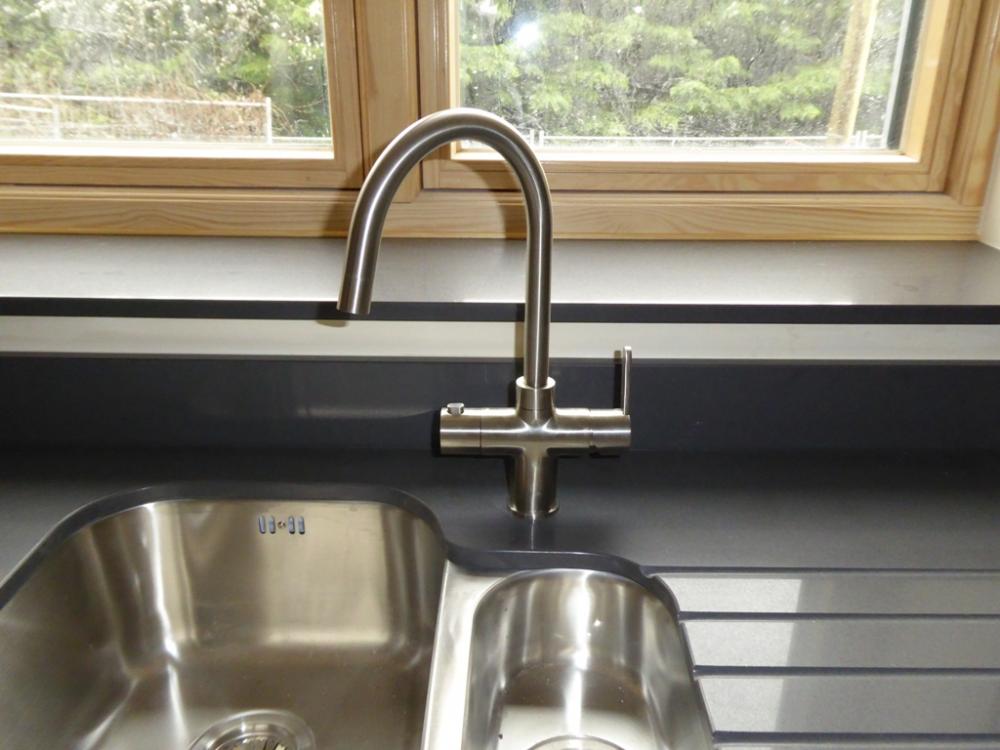
-
Opinions on induction hobs
Jeremy Harris replied to vivienz's topic in Kitchen & Household Appliances
Interesting. My other half has been on about putting a compost bin near the back door, but I've been resisting it because of the possibility of smells. Running at that sort of temperature would mean no odour, I suspect. Looks easy enough to make one, too, with some welded up PVC sheet for the lining, some insulation board around the outside and then some timber cladding to match the house (and I still have some larch boards left over). I think I'll do some digging around to see if there are any DIY designs around, as it can't be that hard a thing to knock up. -
Yes, those big fans are quiet, I found. Ours was a bit of a bodge job, as the shower was under a flat roof extension, so it was really awkward fitting the damned grill and ducting in, as I had to alternately do it from reaching as far as I could from the loft side, through a small hole where the eaves were before the flat roof was added, then reach through the hole in the ceiling above the shower. It works very well, but really only thanks to the power of the fan (I think I used the Manrose centrifugal one) as the ducting is simply horrible, but it was the only way I could get an extract from above the shower around and out through the soffit on the non-flat roof bit adjacent to the bathroom extension. The bottom line is it works OK, in fact better than it should, and I managed to fix the fan to a rafter above the insulation, to get the right sort of gradients on the lengths of duct either side, so they can't collect condensation. It was one of the "do up to sell" things I've done when tarting up the bathroom, and I didn't do as good a job as I should have, but frankly, after an hour or two struggling to get the ducting around obstructions and through 300mm of fibreglass I'd run out of patience a bit....................
-
Indeed they were! IIRC they also often had a white printed plastic label on them, stating they were the property of such-and-such an Electricity Board, too.
-
Opinions on induction hobs
Jeremy Harris replied to vivienz's topic in Kitchen & Household Appliances
We have a three way boiling tap, and it is pretty hard to accidentally scald yourself. The boiling tap handle is locked, with a spring loaded push button to unlock it, plus the handle itself is spring loaded to close when you let go of it.

