Jeremy Harris
-
Posts
26430 -
Joined
-
Last visited
-
Days Won
360
Everything posted by Jeremy Harris
-
But this is exactly how HS&E law applied before this, all CDM2015 has done is spell out something for domestic clients that has always applied. The facts are that this very, very rarely ever becomes a real issue for self-builders. What's extremely annoying is that unwitting self-builders seem to be getting fleeced by people who have set up businesses to make money from the change in legislation, and that annoys me a great deal.
-
Thanks, it's exactly as I thought, then. So, self-builders should carry on as they've always done, follow the "domestic client" rules, as described above in this post: Flap over, no need for self-builders to shell out yet more cash, we carry on exactly as we have before this came along......................
-
I'm not sure. Rain X might work, but it needs buffing off, and access to do that would be difficult, and would need scaffolding. I think that the best bet will be to give them a regular clean, to prevent the build up of algae. It's probably something that grows over the winter, so a yearly clean, at the right time of the year, may do the trick.
-
OK, I'll bite. What part of the "domestic client" bit have I, supposedly, misunderstood? I've read and re-read it, and it seems blindingly clear to me that self-builders are "domestic clients", and as such the contractors we contract with take responsibility for their own HS&E, and we are, as we've always been, are just clients.
-
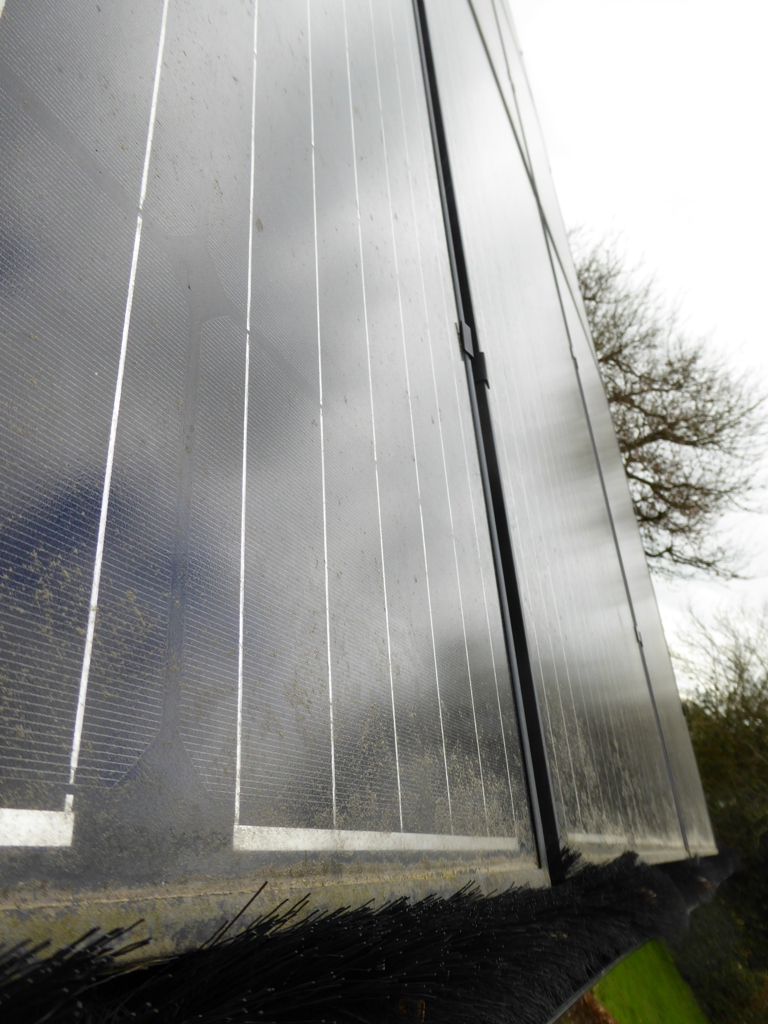
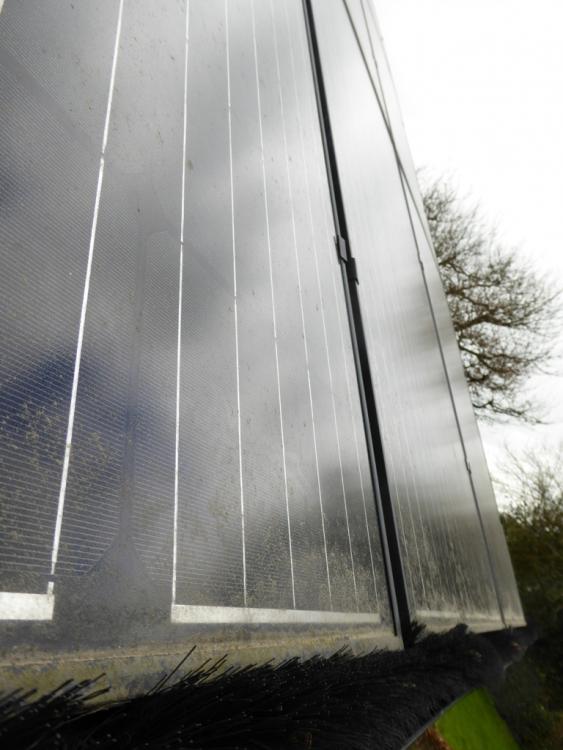
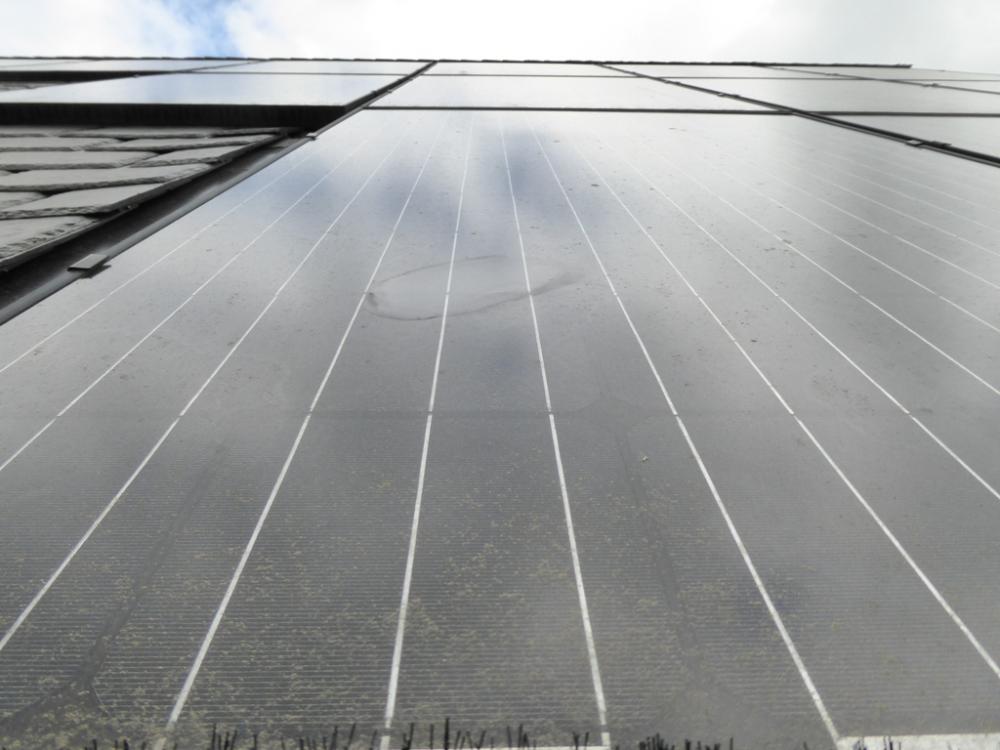
I managed to get up a ladder this afternoon to try and get a photo that shows the (now dead) algae and dirt: The stuff wipes off easily, I rubbed my hand over part of it and it cleaned up OK, so I think a water fed pole with a brush on the end will do the job OK. Looking at the muck closely confirms that it is an algal growth of some kind. My guess is that it's got a good foothold because the panels are faced with non-reflective glass (which was a planning requirement). The whole surface of every panel is affected, although the lower 1/4 of the bottom panels is the worst bit. Here's another photo looking up at the panels, with the bit I rubbed with my hand visible:
-
I think it's the damned "experts" trying to create a market for their new-found "services", together with some pretty poor reporting, that doesn't view things from a self-build perspective at all. I got so bloody-minded about all the people with their hands out for a slice of our build budget that I very deliberately chose to do everything myself, from designing the house, through gaining planning permission, doing the flood risk assessment, fending off the unwarranted requests for ecology and environmental studies, through to doing the energy assessment. I got caught out by the latter, as I did all the work, only to find that the damned government have created a monopoly, where only registered assessors can file the report. I ended up paying an assessor, not to do an assessment, but just to file my paperwork - barking mad and extremely annoying!
-
In practical terms, for the average self-builder who's employing contractors, what's really changed? There's some fancy bullshit, invented to create jobs for yet more consultants, but the reality seems to be that none of the responsibilities have changed at all, they've just added some fancy titles to things that have always needed to have been done (from a purely self-build perspective). Self-builders get hit by people trying to fleece them for everything from ecological and environmental studies, through archaeological and flood risk assessments, not to mention having to pay to have someone file in a damned energy assessment. Now it seems as if yet another scheme has been dreamt up to relieve self-builders of funds............ Having read this lot of bumf from cover to cover, I really don't think anything has fundamentally changed. As a self-builder, your actual responsibilities remain as they have always been, in that you're responsible for ensuring that your site is secure, that appropriate HS&E signage is in place, that your contractors are briefed as to where responsibilities lie and that you have insurance to cover the risks you don't feel comfortable with taking. You should also check your contractors insurance - all ours happily provided me with copies. For our build, I wrote into the contract for our ground works contractor that they had complete responsibility for the site for the duration of the contract. This included site security as well as the HS&E stuff. On completion of the ground works I took back responsibility for the site, put in place insurance and placed a contract for the foundation and house shell construction. Again, the contract was clear, in that the contractor had responsibility for HS&E, but in this case I retained responsibility for site security, signage etc (only because by then the site could be made secure safely by hand). For all the fitting out works each and every contractor was responsible for their own HS&E. I firmly believe that for the majority of self-builds, CDM2015 has no impact, unless we're daft enough to get scared into paying someone to do something we can do ourselves with no more effort than has always been the case. Self-builders are almost always going to be "domestic clients", in CDM-speak, which means that the responsibility falls where it's always been in these circumstances, the contractor.
-
I found that the FFX ones worked fine in both a Paslode and Hitachi first fix nailer. It's where I bought all ours.
-
Welcome. Finding a plot can certainly be a big challenge, especially if you're constrained to a particular area. It took us about three years to find our plot, plus several hundred miles clocked up driving around looking.
-

mvhr replacement filters
Jeremy Harris replied to ragg987's topic in Mechanical Ventilation with Heat Recovery (MVHR)
I found the same thing, that Genvex filters were a silly price. I had a batch made by these people: http://jasun.co.uk/ . They were around 1/4 of the cost of the Genvex ones, but look identical. I just emailed them the sizes and types I wanted and they made up five of each for less than £100. I find that the filters can be cleaned with a vacuum cleaner at least once, sometimes twice, before they need replacing, so five sets of filters should last at least five years. -
The lower panels seem to have a covering of muck that extends up over around a quarter of the panel area, and my panels have no significant inactive area around the sides, the crystalline elements are right up to around 20mm of the frame. This system used to limit all the time in bright sun, usually at an indicated power of around 6.1 kW (I have 6.25 kWp of panels and a nominal 6 kW inverter). I've yet to see them exceed 5.5 kW this year, which is noticeably lower than in past years, and something that was very noticeable last weekend, when we had clear skies with little or no cloud cover. I had a good look this afternoon and will get a ladder up there tomorrow and take some photos, and try to clean the lower parts of the panels that I can reach. They do look very mucky, and if I had to guess I'd say that algae are the primary cause, providing a sort of rough layer that has attracted more dirt and that seems to have resisted being cleaned by rain. The fascias look to be covered in the same stuff, as do the slates on the roof. On the positive side, it's probably indicative of good air quality, I suppose.
-
I had thought of just trying to clean them with a pressure washer. I have a small one, although I've not used it for years, I might dig it out and see if it will spray up high enough. Looking at the panels this afternoon, the sun seems to have killed off the algae and now the bottom of the panels looks like it has a layer of dirt, worse on the lower edge of the lower panels than the ones near the ridge, for some reason. This does mean that I could probably get away with just cleaning the lower panels.
-
The snag is that there is visible algal growth on our panels, plus I'm sure the peak output has dropped. I'll try and remember to bring a camera over tomorrow and take some photos of the green stuff on the panels. Last weekend we should have seen a peak of well over 6 kW, based on the peak output we've seen before in bright sunshine, yet the maximum was only around 5.5 kW. We haven't hit the inverter limit once yet, and I'd have expected the inverter to be limiting for a couple of hours either side of midday last weekend.
-
It might be, but it would be pretty difficult to treat them now they are up, as I seem to remember that Rain-X needs to be buffed off when dry (may have changed, the last time I used it was to treat my aircraft windscreen).
-
For us, £100 is around 600 kWh just in FIT payments, plus the increase cost from additional imported electricity. We get around £1000 - £1100 per year from FIT plus export payments, and probably save another £200 (probably a fair bit more) from not importing, so a cleaning system at £100 could pay for itself in a year fairly easily, as I think the reduction in peak power we're seeing at the moment is around 10%. I've not seen generation over 5.5 kW in peaks, whereas I was seeing well over 6 kW, so it looks like we could have lost around 10% already.
-
I did manage to fit panels to all the walls of our old bathroom on my own, but it is not easy to fit full 8 x 4 panels on your own, because of the way the click-fit joints go together. In the new house I only fitted panels around the shower, bath and behind washbasins, and it was a fair bit easier (only two whole 8 x 4 sheets, the rest were smaller). If working on your own the job can be made a bit easier by waiting for half an hour or so for the solvent grab adhesive, used to fix the panel, to go off, before fitting the next panel. It's also important to dry fit all the panels first, as the adhesive does harden pretty fast, so you have very little working time after applying it. The final point is that the lower edge seal strip that's often supplied with these panels (any brand) is useless. It's the weakest point of the whole system, and I had to retrofit a PVC trim around the shower bath in the old house, just to overcome the design failings in the special seal strip. For the new house I fitted the panels with a gap of around 4 to 5mm under each panel (I temporarily held them above the shower tray and bath with strips of thin ply). The gap was filled with neutral cure silicone, and then covered with a small PVC moulding, fixed in place with clear neutral cure silicone. This not only makes for a better seal at the base, but it covers up the sealant, so eliminating another area that can go mouldy.
-
Thanks for this. Our water is quite hard at the outside taps, so I've been looking at the systems used to supply deionised water for these things. It looks easy to put together a system that doesn't cost a massive amount, using components that are very similar to our water filtration system. The flow rate needed seems to be around 2 litres/minute, which would only need a pretty small DI vessel, and if only used two or three times a year the resin would last many years before needing to be replaced. I have a spare vessel head and riser, albeit a long riser that would need to be cut down, so for around £100 I could buy a pressure vessel and enough resin to refill it three times, probably around 20 or more years worth for our application.
-
I used AB Products Multipanel ( https://www.abbuildingproducts.co.uk/multipanel-c-5055.php), a bit more robust than the Mermaid ones, as they use a plywood core, rather than MDF. I can vouch for the fact that they look good for years, as I used them around 8 years ago to refit the bathroom in our old house, and they look as good now as they did when I fitted them. Very easy to keep clean, and no grout to get mouldy. I was so impressed with them that I've used the same stuff in the bathrooms at the new house.
-
@Ferdinand, Many thanks for the comprehensive reply. I will do a bit of hunting around. I'm not sure whether to just buy a pole or whether to find a window cleaner with one, as I can clean all the windows OK by hand, so it would only get used for cleaning the PV panels maybe once a year. @Declan52, Thanks for the info, our ridge is around 7m high, with a 45 deg pitch, so, allowing for the angle a 10m "working height" pole should just about do it from ground level.
-
It seems to have only started this winter, so a bit over two years. I'm not sure what's changed, but I've noticed more green algae growing on other surfaces recently, too. Our roof faces South, with a pitch of 45 deg, and I'd hoped that they would stay cleaner than they have.
-
Any idea how high a pole can go, @Declan52? Our panels are tucked behind a gable, that may make getting at the top ones in the centre a bit difficult.
-
We had a similar weekend, probably the best we've had for this time of year. Our peak output seems to be down a bit, though, and when I looked at the panels they do seem a bit dirty. Not sure of the best way to clean 40+m² of in-roof panels, I'd rather hoped that they would self-clean from the rain, but it looks almost as if they have started to attract green algae or lichen. Maybe a pole window cleaning rig would work, I need to have a hunt around to see if anyone else has come up with a good way of cleaning them.
-
I can't remember who it was, TBH, as it was around 6 months ago. I just did a search for the blade size, hole diameter and number of teeth and came across two different Makita part numbers for what looked to be the same blade, with two different prices. This was for the 18V cordless circular saw. I bought one of each, only to find that they were identical, apart from the price and the side that had the printing on. Edited to add: Just found both blades, sadly no indication of the supplier. However, the part numbers are B-09248 for the one that's the "right" way around, and B-09232 for the one that's the "wrong" way around. Both fit the saw perfectly, as long as you remember to fit the "wrong" one with the printed side facing inwards.
-
I bought a couple of fine tooth Makita TCT circular saw blades recently for around 2/3rds the usual price. They were the wrong part number for my saw, but the right diameter and hole size, they were cheap because they were the "wrong hand". It seems that Makita make the same blade with two different part numbers, one has the printing on one side, the other has the printing on the other side. They both fit and work equally well, it's just that you can't read the printing if you fit the wrong-handed one. I'm guessing that this isn't that widely known, hence the price difference.
-
GSHP Under A Passive House
Jeremy Harris replied to Onoff's topic in Ground Source Heat Pumps (GSHP)
Brilliant photos, Ian, convinced me even more that I must go there. The last trip wasn't much fun, as it was a bad weather diversion, that stopped us getting back to St Mawgan. The USN made us welcome, even to the tune of lending us money (none of us had our wallets with us.........). It was memorable mainly for the phone call home, to say that I wouldn't be back that night. On being asked where I was I said NAS Keflavik, which prompted the question "Where's that?". At that point the USN chopped the phone call!