Jeremy Harris
-
Posts
26430 -
Joined
-
Last visited
-
Days Won
360
Everything posted by Jeremy Harris
-
I can understand the advantages of nitrogen, aircraft tyres are filled with nitrogen for similar reasons, plus others related to reduced rubber degradation from oxidation. I'm not convinced it's worth the hassle for an accumulator, though. There seems to be very little air in an empty, but pre-charged, vessel, as the bladder seems to completely compress in on itself. On ours there is what looks like a small grill behind the base fitting that I think is there to help stop part of the bladder blowing down the connection pipe when the vessel is empty. Air does seem to dissolve very easily in water under pressure, too, so I doubt there is any free air space in the bladder when it's filled with water. I've never needed to bleed ours, and when I fitted a pressure gauge to the top port on one of them, no air came out when I undid the screw, so I'm guessing any air just gets dissolved into the water. Before bladder-type accumulators came along, borehole supplies used to use a sealed water tank with an air space at the top. These are still in common use in the USA. They work by having a non-return valve on the inlet to the pressure tank, with a snifter valve in the inlet pipe, that opens when the system is static, draining down the inlet pipe and letting it fill with air. When the pump comes on, the snifter valve closes and a slug of air is pumped into the pressure tank, to top up the air space. In the air space there is a float valve that operates an air release, to maintain the air space at a set height. Some still prefer these systems over a bladder type accumulator, as they tend to oxygenate the water and remove dissolved iron and hydrogen sulphide. There are many tales on the US well forum of people who have changed from an old air space pressure tank to a new bladder type accumulator and then found their water quality has degraded. We did have a problem with dissolved water in our system, with the water coming out of the taps looking a bit milky. This upset the ultrasonic flow measurement sensor inside the Sunamp PV, so I fitted a special vent to remove the microbubbles, a Spirovent. This works very well.
-
That's good news. Having a mole turn a valve off has to be a first, though!
-

Insulation, Heating, time constants etc. Am I expecting too much?
Jeremy Harris replied to ProDave's topic in Boffin's Corner
FWIW, I agree with pretty much all of the above. Our house warmed up fairly quickly after it was sealed up and insulated, but only because we had at least two people working indoors all the time, plus two 400 W halogen work lights. By the time we got to plastering, the structure was already pretty warm, and the plasterers had a problem with the halogen lights giving off too much heat and overheating the house (they were working in shorts and tee shirts in February). We then had a very high humidity inside the house, and had to bring in a dehumidifier to run overnight, and keep the windows open during the day (the latter was far more effective. The house then cooled down again, but within a couple of weeks of the windows being closed it was back up to temperature again, but that was mainly because we had two or three of us working in the house, decorating, fitting the internal joinery, laying the flooring, fitting the kitchen and doing second fix electrics and plumbing. By then we were into early summer. -
Drayton programmer service interval reset tool?
Jeremy Harris replied to Jeremy Harris's topic in Other Heating Systems
Sorry, missed this earlier. According to the info I've been able to glean, the Drayton resetting tool uses a one-way infra red data link, like a TV remote control. It is said to be resistant to cloning by Drayton, which suggests that it may use a rolling code, rather like car locking systems. I'll stick the old one on ebay, with a warning that it needs resetting, as I may get some of the money back. It cost me about £40 a year ago, and I've just bought a "new, old stock" version of the same controller that doesn't have the service interval "feature" for the princely sum of £17.90, including postage. Even if I only get a tenner from ebay for the old one the difference will be cheaper than the postage in trying to borrow the special tool from anyone that has it. -
I agree, a CU swap has to be the cheapest fix. Here an electrician is on around £160 to £180 a day, but even if you have to pay £200 a day in Bristol it can't be more than a couple of hundred pounds or so to do the whole job, including the new CU with the right RCDs, stickers etc. It's an easy job, too, as that 100mA DP RCD makes isolating the incomer to do the work dead easy, no need to call upon Amelie and faff around with the company fuse, especially as that new'ish meter isn't one of the ones with an isolator switch built in. The only question mark is the condition of the existing wiring, but I'd have thought that if it was iffy that would have been picked up during the inspection.
-
Drayton programmer service interval reset tool?
Jeremy Harris replied to Jeremy Harris's topic in Other Heating Systems
I suspect this could be made to work, with a lot of work, as it's a one-way transmission. It might use a rolling code, though. Given the need for security, and the fact that rolling code chips are dirt cheap and readily available, I strongly suspect this is what the unit uses. There is a reference I've read from Drayton that says that the reset tool cannot be cloned, so that does imply some level of protection. I've ordered an old stock, pre-service interval bricking, version now, anyway, as for the sake of £20 it's not worth arguing about. It is a useful lesson for anyone else looking to buy a programmer, though. Check very carefully that it hasn't been hobbled by the manufacturer before you buy it! -
Drayton programmer service interval reset tool?
Jeremy Harris replied to Jeremy Harris's topic in Other Heating Systems
I'll give it another try tomorrow, but I suspect that he'll just repeat back to me that the instructions state that it should be installed by a certified person and that Drayton have told them that a certified person should have the special tool. I've found a couple of old stock LP111 units, that look the same, but aren't hobbled with this service interval "feature", so for the sake of £20 or so I'll just bin this rubbish and fit another one; it's not worth the hassle of arguing about. I'm still as angry as hell about it though, especially as there is no specific mention that the damned thing will stop working after a year unless a Drayton certified person resets it. Sadly not, as the reset tool seems to use IR, rather than RF. That seems clear from the reset instructions, that say that the reset unit has to be pointed at the front of the timer to change the settings in memory. -
Drayton programmer service interval reset tool?
Jeremy Harris replied to Jeremy Harris's topic in Other Heating Systems
No, the instructions don't state that it should only be used with a gas appliance, in fact they say that it can be used to control any heating system that has a low current (less than 3A @ 230 VAC) control circuit, or a no-volt switch control circuit. The advertise the service interval feature, but nowhere in the installation instructions does it mention that this is turned on by default when you buy the thing. When I bought this, I specifically asked the chap in the electrical factor for the most basic single channel version, and that I wanted to just switch the control circuit on an ASHP system. I did specifically ask for a Drayton, but only because SWMBO is used to using the other Drayton we have (which looks very similar, but has a thermostat and doesn't have this service interval "feature"). It does look as if it is a nanny state dictat, as when I spoke to Drayton earlier they told me they had introduced this feature to allow landlords to comply with some regulations regarding mandatory servicing of gas appliances. Presumably Danfoss have done the much the same. That link is the one in my first post, which explains the process, but without the special £125 reset tool the timer just resets to the off state, with the service due message. The tool is needed to make the reset process permanent. I guess this is to stop the unscrupulous from just turning off the alarm and cut-off to avoid servicing a gas appliance. I'll do some digging around with hacks, as it seems clear that the reset tool is just an IR remote type device. If I can find the codes and protocol that need to be sent, then programming a microcontroller to just send that code should be easy. The hard part will be finding the protocol and code used! -
Rendering and airtightness
Jeremy Harris replied to ToughButterCup's topic in Plastering & Rendering
Parging with a wet sand/cement mix (lots of cement) is a standard detail. For big areas use a soft broom. It works well, and has been used for years to seal up leaky brick/blockwork. A web search on "parge coat" will reveal more than you ever wanted to know about it................... -
Drayton programmer service interval reset tool?
Jeremy Harris replied to Jeremy Harris's topic in Other Heating Systems
That's tempting! However, it seems a bit unfair on Screwfix, as the problem lies with Drayton being draconian is trying to force the use of their own certified installers. If it was a complex bit of kit with integral safety issues that required regular servicing I could, perhaps, understand it, but it's a cheap single channel time switch. -
Drayton programmer service interval reset tool?
Jeremy Harris replied to Jeremy Harris's topic in Other Heating Systems
I agree with the damned thing not being fit for purpose when used to control anything other than a gas appliance that requires a mandatory annual service and safety check, but Drayton are adamant that as the instructions make it clear that only a properly certified installer should fit one of the things, and as any properly certified installer will have the expensive reset tool, they are acting responsibly by sending out units set by default to stop working after 12 months, unless reset by a certified heating engineer with the tool. Similarly, the supplier is adamant that they have checked with Drayton, and that the unit is working properly, and as designed, so it's not a warranty issue. -
We have three vertical pressure vessel/accumulators on out borehole supply, so they are carrying potable water. The advice I've had is that vertically mounted ones last longer than horizontal ones, due to less friction from the bladder on the side of the vessel, and that the bladders fail from friction and folding fatigue, rather than oxidation, so filling with dry nitrogen, rather than air, may not make any difference. Spare bladders are fairly expensive, and I wasn't sure of the wisdom of keeping some, as it is probably quicker to just buy a replacement accumulator and swap it out, then look at replacing the bladder in the old one. I've also heard (from one of the US well web forums) that there's no point in replacing the bladder, as the chances are that the liner will be worn and have rough spots, so may cause early failure of any replacement. Apparently, most of these things have a polythene sleeve inside that is there to reduce the friction between the bladder and the vessel inner surface, and this can wear and cannot be easily replaced.
-
Drayton programmer service interval reset tool?
Jeremy Harris replied to Jeremy Harris's topic in Other Heating Systems
I bought it a year ago. I've rung the supplier ( the local electrical place in town) and they say this is not a warranty issue, as it only concerns an installer setting and that anyway they don't stock the reset tool................... Apparently it they are all sold like this by default, now, in order to comply with some legislation that applies to rented properties, or that's what Drayton (now Invensys) say. They do it this way because only their authorised installers should fit these things (even though they are openly on sale all over the place) and their authorised installers have the £125 special IR remote control gizmo needed to reset the thing. -
I've just run into a problem, which, to be frank, has me steaming mad with Drayton controls for being more like Apple than Apple are. I had been using a standard immersion heater type time switch to turn our heating system on and off each day. This worked fine (in fact I've just had to re-install it due to Drayton's stupidity) but it wasn't as intuitive to set and adjust as a normal heating controller. All I need is a single channel time switch, with programmable days and times, nothing famcy. All it does is switch a single low current control circuit on or off, but it does need to be something that my other half can use easily. As we have a Drayton programmable thermostat controlling the combi in the old house, and as SWMBO can work that just fine, I decided that if I fitted the simplest timer that Drayton make, that works in much the same way as the programmable thermostat she's used to, then life would be easy. Alas, all was not so simple. I fitted the thing about a year ago, and it has worked fine, until now. It seems that the idiots at Drayton now send these things out with a gas boiler service interval timer pre-enabled. This means that after a year the bloody thing starts flashing "SEr dUE" on the display, and sounding an alarm. 30 days later the bloody thing just stops working, until it's reset using a special tool from Drayton, that they will only sell to a properly certified heating engineer, plus the tool costs £50!!! More than the damned time switch. I've got hold of the installers instructions, and it seems that there is a process for disabling the service interval timer in these things, by holding down the "-" button for 8 seconds, when a service mode menu comes up, which allows the service interval feature and the audible alarm to be disabled. This is fine, you can disable these in this menu, but unless you then hold the super-duper, expensive, service resetting tool up against the front of the unit when the "Con" message comes up (for "confirm") then the unit stays dead; the service menu changes don't get saved. Right now I have a programmer for our ASHP that is just junk, unless I can get hold of the special tool. Sadly I don't know any heating engineers, and the ones I've rung around want more than the cost of the tool to come around and do 30 seconds work resetting the thing. So, my options are: 1. Ask kindly on here to see if anyone has the special Drayton tool (it's described in this document: http://www.draytoncontrols.co.uk/sites/default/files/LPsi Reset (I. Guide).pdf ) and if so would they mind lending it to me for a day so I can turn this "feature" permanently off. 2. Bin the year old controller and buy another one that doesn't have this feature programmed in default by the factory. FWIW, I can understand why this feature could be very useful for gas appliances fitted in rented properties, where it would force the landlord to do the required annual gas boiler servicing. I can understand why it's useful for anyone who needs a reminder to get a gas appliance serviced. What annoys the living daylights out of me is that Drayton pre-programme these things into this mode, so anyone with electric heating or who doesn't need the servicing or alarm nanny has a major inconvenience. What's more, they don't make it clear when you buy one that this stupid feature is enabled by default, and to disable it will more than double the cost of the unit............... Screwfix sell the reset unit, for £125, I've just discovered ( http://www.screwfix.com/p/drayton-lpsi-reset-unit/6292r ), but as I only paid around £30 (IIRC) for the new programmer, I'm buggered if I'm going to pay £125 for something I'll use once, just to make the damned programme do what it is supposed to do.
-
The supply is TN-C-S according to the report, and from the photo that earth block seems to connect to the incoming combined N/PE. I suspect it may have been TT at one time, though, hence the 100mA RCD feeding the CU. Looks like there have been piecemeal changes to parts of the installation over the years. The tails look older than the meter, for example, and the earth block next to the incomer looks new'ish, too, which suggests that the 100mA RCD is a hang over from a previous arrangement, which would support the idea that it was once TT.
-
The main problem with burying plasterboard is that the gypsum will breakdown into sulphides, and particularly hydrogen sulphide, (the "rotten eggs" gas) when other organic materials in the soil are present. H2S is detectable at very low concentrations, well below the level where it becomes toxic, but it is a nuisance, and is one reason that plasterboard is recycled rather than sent for landfill. Having a buried pile of plasterboard in the garden, or under the house, that releases H2S for many years could make your house a pretty unpleasant place to live.
-
It may well be that whatever fault caused the unit to need re-gassing is still present, or it could be that the unit has just been incorrectly filled, perhaps with too much, or too little, refrigerant, and is consequently tripping because it's under/over pressure. It could be that the sensor is faulty, but given the history of the unit having been run very hard, with settings that will have caused the 4 way valve to operate frequently and the compressor to run for long periods of time, I suspect that there's something else going on. The same (or extremely similar) compressor and primary circuit is used in a range of Carrier air conditioning units, so a good air con engineer, who's familiar with Carrier equipment (most should be, they are a pretty big company; Willis Carrier was the inventor of air conditioning) might well be able to get to the bottom of the fault. Best to tell whoever you can find that although the unit is badged Kingspan, it is really a Carrier 30 AWH series: http://www.carrieraircon.co.uk/product/30awh-004-015-aquasnap-plus-heat-pumps-4-15kw/
-
It's best kept out of the ground, because of some of the reactions that gypsum can create with other substances in the ground, but would be OK as dry fill somewhere where it can't cause a problem.
-
It's been done, well, almost! I saw one house design, in Germany I think, that had a helical staircase running up the centre of the house. The core of this was a massive cylindrical water tank - I can't remember the volume but it was many thousands of litres. It was insulated, to allow it to remain much warmer than the house, and used as a massive storage heater for low grade heat, effectively working as an absolutely massive buffer tank to run an UFH system, IIRC. I can't recall the performance, but seem to recall that the tank could heat the house for a couple of months or so without having any energy input to it.
-
Assuming that the legacy CU is still serviceable, and Dave has confirmed what I understood, that an older installation has "grandfathered rights", so doesn't need to be brought up to the current standard unless it's defective in some other way, then just changing to RCBOs is an option, plus adding some stickers on the cover (you can put the stickers on yourself, AFAIK, all you need are the hazard ones, the colour code warning one and the "this unit has an RCD, test periodically" ones. If you have smoke/fire alarms then the circuits they are connected to need a sticker to show this (not sure if it's in the current regs or not, but I did it anyway, as the stickers came free with the alarms). However, as Nick says, it could well be just as cheap and quick to change the CU over for a new 17th Ed one. They aren't massively expensive, and it's not usually a big job if the rest of the wiring is in reasonable condition. A new 13 way metal CU, complete, is under £70 (just a random one taken from this link - not a recommendation: https://www.tlc-direct.co.uk/Products/BGDP18613.html ), and even if you had to pay for a whole day's time from the electrician the whole bill shouldn't be more than about £250 (I paid our electrician a day rate of around £160/day, IIRC). The CU should come with stickers, but if not, you can buy them pretty cheaply: https://www.tlc-direct.co.uk/Main_Index/Necessities_Index/A_Warning_Labels_All/index.html
-
It's one reason I opted to use 100mm bore duct as the flow straightener and measurement section for the unit I made up, with adapters at the end that fits to the terminal of increased diameter. Because a hot wire anemometer doesn't interfere with the flow very much, I calculated the cross sectional area at the measurement point, assuming that the tip of the hot wire probe was in the centre of the measurement duct. In practice, the small reduction in cross sectional area caused by the probe is pretty small, but I felt that if I was trying to make accurate measurements I should allow for it, as it clearly does reduce the cross section at that point, and so, from Bernoulli, it must increase the local velocity at that point for any given flow rate.
-
If you can borrow a Command Unit, then you can hook it up with four core cable to the external unit and get a lot more information as to what is going on. The snag is that the Command Unit is quite expensive, and often wasn't supplied as standard with some systems. Attached is a copy of the Carrier Command unit manual that give some insight as to both the diagnostic information available and, more importantly, the system settings. It is the latter that are usually the cause of poor performance, by default Kingspan (and others that badged these same units) didn't seem to re-programme them for UK conditions very well, if at all. Without the Command Unit the unit cannot be reprogrammed, AFAIK. Carrier Controller Installation Manual - 33awcs1.pdf
-
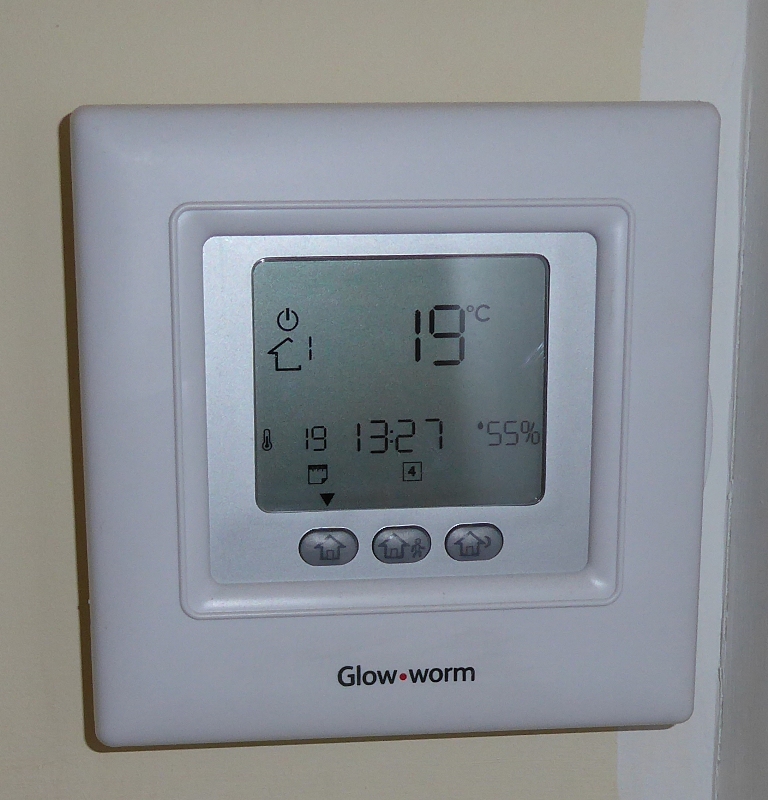
Do you have the Command Unit fitted? If so, you can enter diagnostic mode and look at the parameters and fault codes on the screen, rather than on the flashing fault LED, which makes things a LOT easier. The Carrier Command Unit look exactly like this (but with a Kingspan logo on bottom of the front cover, rather than the Glow worm logo on this one): Do you have the external LED diagnostic extension box fitted, or are you looking at the LEDs on the internal board? If the latter, then pages 22, 23 and 24 of this manual (which may be the same as you already have) might help: Kingspan_Aeromax_plus_Installation.pdf

-
FWIW, I found a load of left-over hazard stickers in the skip after the PV installer had been - he'd just used some from a sheet and binned the rest, and the left overs were more than enough for me to stick on the cover of anything that needed it.. There's no good reason why you can't just go around sticking the appropriate warning stickers on where they are missing. You can get them from any electrical stockist, or probably even ebay. I see he failed the CU for being combustible. Do the regs now require older plastic CUs to be changed on inspection to comply with current regs? I thought there was a "grandfather" provision, that allowed a pre-existing, signed off, installation to retain things like cable with the old colours (with the appropriate sticker), plastic CU's etc? If this is the case then I will need to get our CU changed, as it is plastic and was installed before the regs changed.
-
Plasterboard has a higher mass heat capacity than concrete, so if it's located where that might be useful, say in terms of increasing decrement delay, then it would be useful. In fact, if you want to improve the heat capacity of the internal structure of the house, double boarding a timber frame with plasterboard will probably do a better job than having block walls. Only around the first 100mm, if that, of external wall thickness has any appreciable effect, usually, in terms of storing useful heat over the range that may help keep the house internal temperature stable. The higher the heat capacity of the inner layer the better, and plasterboard has a mass heat capacity that is around 23% higher than concrete. It's one of the points that illustrates how daft the false notion of "thermal mass" is. The implication with this unmeasurable property is that mass = heat capacity, which is nonsense. 1kg of brick has a heat capacity of around 840 J.kg.K 1kg of concrete has a heat capacity of around 880 J.kg.K 1kg of gypsum plasterboard has a heat capacity of around 1090 J.kg.K 1kg of wood (or compressed wood fibre) has a heat capacity of around 1200 to 2900 J.kg.K 1kg of water has a heat capacity of around 4181 J.kg.K In the above list, the higher then number, the greater the amount of heat the material will store for a given temperature change. In other words, if you want to store heat in a building in order to help stabilise its internal temperature, by increasing the mass of the building, then you're better off using something other than brick of concrete, as on a heat stored per unit mass basis brick or concrete is far from being very useful, lightweight concrete even less so.
- 22 replies
-
- 3
-

-
- plasterboard
- waste
- (and 1 more)