Jeremy Harris
-
Posts
26430 -
Joined
-
Last visited
-
Days Won
360
Everything posted by Jeremy Harris
-
Good question, as it depends on the battery chemistry, at least as far as usable capacity required. I've started measuring the average current each device draws, to get a better feel for it, as before I just went for over-kill on the basis that 100Ah sealed gel lead acid batteries were cheap and dead easy to rig up. So far, I've found that the switch draws around 450 mA at start up (on 5 V) and idles at about 120 mA. I need to run some traffic through all the ports to try and get a feel for the average current, but would guess that something like 300 mA might be about right. The modem draws about 600 mA at start up from 12 V, but this drops back to a pretty steady 330 mA when it's running and doesn't seem to change with the amount of traffic it's handling to any appreciable degree. I'm struggling to get a measurement from the router at the moment - for some reason I'm getting wildly variable readings from one switch on to the next, plus there is a lot of variation as it does things like poll the 5 GHz band every few seconds and does some sort of regular internal cycle where the current goes up and down a lot. Best guess is that it's somewhere around 500 to 600 mA at 12V, with a peak at around 850 mA. Using those figures, and assuming I'd like 24 hours of back up operating time, and using a figure of 85% for the switched mode regulator efficiency (I reckon I can do a lot better than that with synchronous rectification, though, probably around 92 to 94% with luck), then it looks like I need around 340 Wh or so of usable capacity. If I was to use a 5S LiFePO4 cell arrangement then that would give me a voltage range of between about 17.75V fully charged (assuming that I only charge the cells to 3.55 V to extend their life) to 16 V at discharge cut-off (again, assuming I want to cut off at 3.2 V per cell to extend life). It looks like a pack with a nominal capacity of around 30 Ah would give me a bit of headroom and still allow the cells to operate within a limited SoC range to extend their life. The question now is whether I can find 15 good cells in my collection of 10 Ah Headway LiFePO4s. I know I had a couple of hundred of them originally in my motorcycle pack, and that only around 20 failed, but they have been sat lying around for a time, so I need to cycle test any that look good to see how they hold up.
-
I found the paperwork for the batteries I bought years ago, and as far as I can tell they are very similar to the Sonnenschein A400FT A412/120 FT batteries, but with a custom blade connector at one end at the front. My guess is that they were specially designed to just have some sort of quick-fit connector in the rack they were originally installed in. Looking at the prices of new gel batteries, I'm going to have a serious rethink about my standby system. Originally it was just a way to keep the internet connection and house wifi running during a power cut (we get loads of power cuts here, for some reason) and it does that job just fine, but because the ex-UPS batteries were cheap, I just used them, with some voltage regulators to supply the required DC to the modem, router, switch etc. I didn't bother optimising anything, as I had loads of spare battery capacity, so there are separate regulators for every device, including a boost-buck regulator to give a steady 12 V to the modem, irrespective of the battery voltage. The system is pretty simple. The battery runs the voltage regulators 24/7, and then run the bits of kit with the right regulated DC voltage. A small switched mode power supply is set to 13.5V and that float charges the battery all the time the mains is on. If the mains fails, all that happens is that the battery stops getting charged. As a safety device, I added a small extra circuit, with a latching relay, that draws less than 1 mA, and monitors the battery voltage. As soon as the battery discharges down to 11.5 V the latching relay disconnects the battery from everything. There's a reset button to bring the system back on line if this ever happens (it never has). The system is a bit wasteful of energy, both because of the poor Peukert number for the lead acid battery, but also because the voltage regulators and charger aren't optimised at all. If I'm faced with having to spend lots of money (over £200) on a replacement battery that's as good as the one I have now, then I may as well look at switching to a different system, using longer life LiFePO4 cells, perhaps. I happen to have a few dozen old 10 Ah LiFePO4 cells spare, that aren't in the best of health, but are good enough to build a proof of concept system. I could change the battery voltage so that I can use efficient synchronous rectification buck regulator for both the 12 V and 5 V supplies, and I could improve the charging and battery management system to reduce losses a fair bit. Using LiFePO4 cells also means I could get away with a smaller capacity pack, as the usable capacity would be a fair bit higher than for the sealed lead acid battery. It's more work, but I think it should be possible to make a decent backup system for around the same cost as a replacement battery, and that would probably have a longer life. I just need to sort and capacity test my big box of Headway LiFePO4 cells to see how many of them are any good..............
-
I can try and take a photo next week, I'm not sitting near them at the moment. The shape and size doesn't matter, though, as I have them sat on the floor so they could be any shape really. Be a tough job to get inside them, I think. They have cases that look as if they are made to be chucked around by gorillas. Not sure they've dried out, as they've been on a constant 13.5 V charge all the time I've been using them, and when called upon to run the router. modem etc in a power cut I doubt the peak discharge exceeds 3A, and is probably around half that most of the time. There's a low voltage cut-out that's set for 11.5 V at the moment, that turns the load off if the battery gets below that voltage, so they haven't been over-discharged ever, either. I suspect they are just at the end of their life, as they are around 12 years old, and probably had a design life originally of around 5 years or so. The real issue here seems to be that, as @Onoff mentioned, the law has changed and everyone is now required to keep accurate records of disposal, which really stops batteries being sold off second hand to ordinary people. I can understand why the law was introduced, but it's a bit of a sledgehammer to crack a nut, especially as it seems to have stopped people like me getting an extra few years life out of these things.
-
That explains why there seem to be no ads for these second hand batteries any more. Back when I bought the last two, there were loads of places selling ex-data centre UPS batteries, but now they've all seemingly gone. IIRC, I got the original tip off about this ebay seller from one of the renewable energy forums, can't recall which one, that had a link to the advert. A fair few there were using them to build cheap off-grid solutions. I might try that. This place was North of Basingstoke by a fair bit, somewhere around Hook, I think. However, if the regs no prohibit the sale of second hand batteries then it may well be that I have to look at forking out for new ones. The annoying thing is that I doubt the new ones would last much longer in this application.
-
Good tip, thanks. The ones I bought originally, around 8 or 9 years ago, came from a seller on ebay, one of those 99p ads that's really just an advertising poster. As the place was only half an hour or so's drive away I went up to see him, armed with a meter and load tester, and was pleasantly surprised to find that all the batteries he had looked and seemed to perform like new, even though they had date codes showing they were around three years old. The only problem I had with them was trying to find the proper connector to fit them - they had a two blade connector arrangement on one end, that must have been designed to allow quick replacement. I ended up making my own connectors for them, with Anderson plugs on the end of short flying leads. I have a feeling that this bloke had a contract for replacing batteries in some pretty big data centres, as his warehouse was stuffed to the ceiling with pallet loads of batteries, most the same size and type (around 100 Ah, sized to fit a 19" rack). I've hunted all over the place and can't find anyone selling off these old batteries any more. May be the high price of scrap lead has made it more economical to just scrap them rather than try and sell them second hand.
-
Thanks, I had thought about forklift batteries, but I'd have to keep them outside somewhere, as they aren't sealed. The big advantage of the old data centre backup batteries is that they are sealed gel AGM ones, so are safe to keep indoors, and are certified as such, as they are used inside data centres. The ones I have are around a standard 19" rack internal width and depth, and about 5U high at a guess when laid on their side, and I think they were originally fitted into a big, modular, UPS system, to provide the short duration power needed before the data centre generators came up on line during a power cut. The great thing about them is that data centres used to routinely replace these batteries every three years, just to be on the safe side, yet they were barely used, perhaps a few test cycles and maybe one or two genuine outage cycles, so they were really almost like new. I wish I could remember the place I got them from, as he literally had dozens of pallets loaded up with the things, and was selling them for around £50 each.
-
A few years ago, I bought a couple of 100Ah 12V sealed lead acid batteries from a dealer somewhere not fr off the M3, North of Basingstoke. He had hundreds of the things, removed from data centre UPS systems I now need another couple of these, as the last two were great, and still had loads of life left in them, I've been using them for around 8 or9 years and they were 3 years old when I bought them, and they are only just beginning to show signs of losing a bit of capacity. I use these as a back up supply to keep our network and internet connection up and running during power cuts, and could really do with a couple more of these batteries. The snag is that I didn't keep a record of the place I bought them all I can remember was that they took cash and were a big warehouse place, filled with pallet loads of sealed batteries. I will need to pick them up, as they are heavy, around 60 to 80kg apiece if they are like the ones I have, They are the sort of size that looks like it'll was designed to fit laying on their side in a rack system, but any gel type sealed battery at a bargain price would do. I only draw around 3A max off these batteries when they are in use and they sit on trickle charge at around 13.5V most of the time. Does anyone have any clues as to where I might find somewhere within reasonable driving distance from here that flogs off old data centre backup batteries, please?
-

Systemair VSR 500
Jeremy Harris replied to Stones's topic in Mechanical Ventilation with Heat Recovery (MVHR)
What's odd there is that the house is at 21 deg C, yet the extract temp is 11 deg C, which suggests that the extract temp sensor is downstream from the heat exchanger. The really odd temperature is that supply air temperature to the house, I would have expected it to be a lot warmer, unless the air flow rate is way too high. Has the unit been set up and balanced properly? Is it possible that there is far too much air coming in through the fresh air side and that it dropping the temperature? -
Electrical socket converter question
Jeremy Harris replied to Mikey_1980's topic in Electrics - Kitchen & Bathroom
Very true - forgot that possibility! Still need to know if this is really a spur off the ring final or a separate spur taken off somewhere else, or a part of the ring final, though. I'm not wholly comfortable giving blind suggestions without knowing where that single gang socket is currently fed from, as it may well have been added at some time when the dishwasher was fitted, and I've seen all sorts of wonderful jobs like that, including a spur fed directly from the non-switched side of a 45 A cooker switch............... -
Electrical socket converter question
Jeremy Harris replied to Mikey_1980's topic in Electrics - Kitchen & Bathroom
So, is it a spur or is in part of the ring final? Easy way to check is whether or not there are two cables going in to it, if there are then it's part of the ring final, if they aren't then it's already a spur and you ideally need to find where that spur is fed from. -
Electrical socket converter question
Jeremy Harris replied to Mikey_1980's topic in Electrics - Kitchen & Bathroom
Have you got a single or double gang box in the wall, and is it currently wired to a ring final? What you've linked to is a conversion outlet, that fits a single gang box. Your best bet would be to fit a second single gang box alongside and use that to connect up the FCU. A word of caution, how many spurs do you already have on that ring final? -
Systemair VSR 500
Jeremy Harris replied to Stones's topic in Mechanical Ventilation with Heat Recovery (MVHR)
+1 to the above. I've read that manual from cover to cover and being in summer bypass mode, for whatever reason, seems the most likely explanation for what's going on. Second most likely explanation is that the sensors are not giving the true temperatures at the various locations, and that the displayed temperatures aren't the actual temperatures, although I think that's a bit of a long shot. -
What about an off-the-shelf solution, like setting up an Own Cloud server? https://owncloud.com/security/
-
1/2 W should be fine, that's about the power of a normal torch, if you want a rough indicator. I think that drive lights need to be quite dim, just bright enough to show where the edges are and not much more. If they are too bright I think they could be a distraction.
-
It was in a big ball, around 20ft across, just as they had hoiked it out of the building! They left it lying on site and I just asked what they were going to do with it and was told that one of the labourers was going to have the job of cutting it into short lengths and filling skips with it. I asked if I could pull a few lengths out and the guy just said to "fill yer boots". It was all very long lengths, too, as it had just been laid in massive floor trays and never connected to anything, as the error was found during first fix. I think a fair few others helped themselves to a few hundred metres of the stuff, too, as every little bit taken meant less hassle for the main contractor. At the time we hadn't even found a building plot, and I was still working, so the loose coils of the stuff sat in my garage for a few years.
-
DIY Heat Exchanger
Jeremy Harris replied to Onoff's topic in Mechanical Ventilation with Heat Recovery (MVHR)
Heat pipes could work. Find a working fluid with a very low boiling point. You ideally want something where the boiling point can be adjusted (using pressure) to be around 20 degC. Methylene chloride might work, it boils at around 40 deg C at normal atmospheric pressure, but that can easily be lowered by reducing the pressure in the tubes. You might well find that ordinary heat pipes work well enough, and you may not need a lot of them, as even small ones have the capacity to shift a fair bit of heat. Maybe find a few broken evacuated glass solar tubes and repurpose the heat pipes. Add a lot of fin area to either side and it may work. Worth an experiment, I'd have thought. -
The alternative may be to fit a very small pressure vessel close to the valve, to absorb the shock as it finally snaps shut, or simpler still the bodge that I fitted to our old washing machine outlet, a tee connected to a 500mm long blanked off flexi hose. The dead end of the flexi, right next to the washing machine connection, stopped the pipes in the loft going bang every time the washing machine valve closed.
-
DIY Heat Exchanger
Jeremy Harris replied to Onoff's topic in Mechanical Ventilation with Heat Recovery (MVHR)
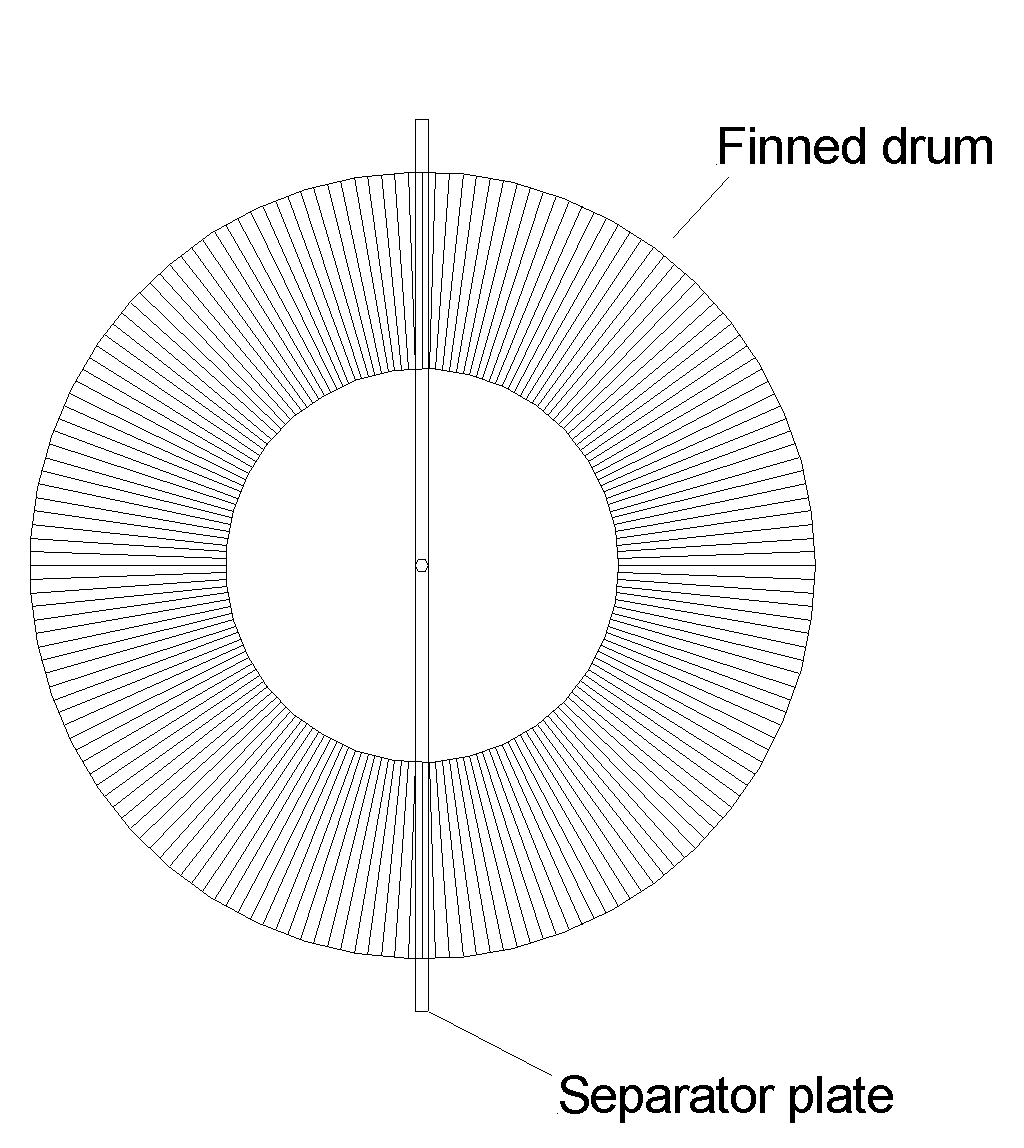
The ones we had on the roof our the new lab building had drums a bit like this inside (a very quick and dirty sketch): The drum rotates very slowly, with warm, extracted, air passing through one side of the separator plate and warming up the aluminium fins. When these rotated around to the fresh air input side, they gave up their heat to the incoming fresh air. There are two basic topologies, the radial design like this, which is easier to seal, or a design made from a stack of thin discs, with seals between each disc. I've seen both and from a DIY perspective I doubt there's much to choose between either. You can make the disc type physically smaller to get the same heat exchange capacity, as you don't need such a big hub, and you may well be able to find a company that will cut out discs with central holes pretty cheaply. Something like thin brush seals would work between the discs; the friction losses would be small because of the low speed. You may even get away with just thin barriers not actually touching the discs and relying on the low pressure differential to adequately seal. The key is to adjust the speed so that just as the drum rotates past the separator plate (and not before) the fin/disc is as close as possible to the temperature of the extracted air, that then ensures that the unit operates at the best possible efficiency. This has to be balanced with the airflow to ensure that just as the fresh air side fin/disc crosses the separator plate it has given up as much heat as it can, i.e. there's a very small Δt between the air going to the rooms and the fin/disc temperature at that point.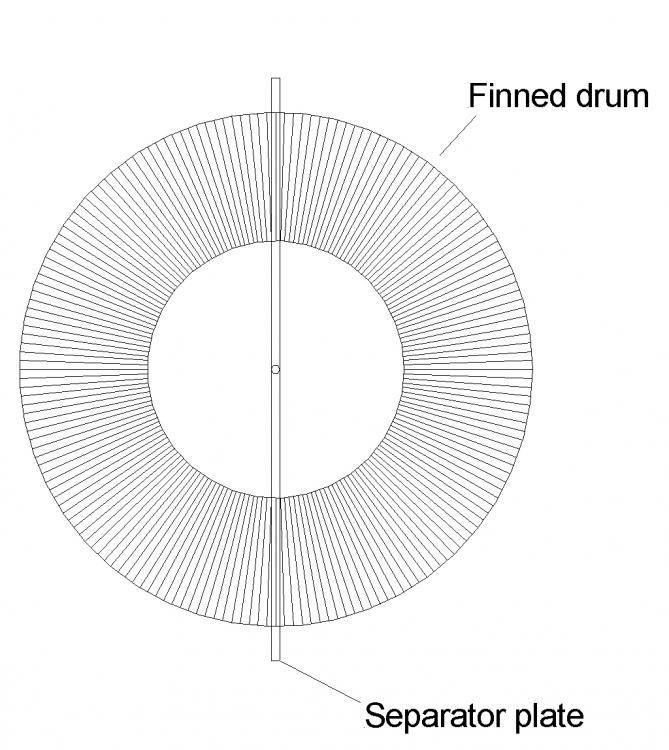
-
DIY Heat Exchanger
Jeremy Harris replied to Onoff's topic in Mechanical Ventilation with Heat Recovery (MVHR)
Yes, the thermal conductivity of the plates has almost no effect when compared to the thermal conductivity of the air flowing over them. What's more important is slowing the air right down as it passes over the plates, which means having lots of overall flow area and very small gaps between the plates. Ideally the air gaps should be no bigger than double the plate thickness, as that ensures that the air thermal conductivity is the limiting factor, not the thermal conductivity of the plate material. Practically it's hard to get gaps this thin though. The main problem with the Coroplast and drinking straw versions is that they double the thickness of the plates and introduce a thermal barrier at the junctions. The simplest way to make a decent home made heat exchanger might well be to make a rotating drum one. The efficiency would be high and you can compensate for any dodgy tolerances on plate spacing by just adjusting the drum speed. With a bit of cunning and some sensors you can automatically adjust the drum speed and fan speeds to keep the thing running in the sweet spot. I think I'd find a rotating drum heat exchanger a fair bit easier to make than a counter flow one. -
TBH, the only advantage of Cat 6 in a house is that it's a lot easier to pull through Posijoists, I can't see any other advantage. I was given a few km of the stuff, that had been laid in error in a new build (they had laid ordinary Cat 6, rather than the low smoke a fume stuff) which was the only reason I used it. It is a lot stiffer than Cat 5, because of the separator that runs down the centre, and doesn't tend to get itself into loops when pulled as cat 5 cable does. For that reason alone I think it's probably worth the extra cost.
-
One option might be to fit an adjustable pressure bypass across the unused ports on the manifold. I have one fitted across our ASHP flow and return and with a bit of tweaking they can be set to just open when the pressure increases above the set limit. With luck it could be an easy fix.
-
Officially they don't programme the cooling function, but it is inherently there, as the heat pump uses it every time it defrosts. Our Glowworm (a re-badged Carrier) doesn't officially have a cooling mode, but the reality is that it does, just like they all do, and it's not hard to programme it to get it working. All that's needed with the Daikin is to reprogramme it to enable the cooling function, probably ten minutes of work for someone that knows the intricacies of setting one up.
-
I'm certain that the two main problems with kitchens are deliveries and fitting. Do the fitting yourself and you will almost certainly end up with a much better job than any kitchen fitter will do, but it may well take you a lot longer. Our joiner was hanging doors whilst I was fitting the kitchen and was chuckling about me taking two weeks to fit a kitchen they would have done in a day and a half. Deliveries can be a nightmare from anyone, in my experience. Sometimes you get a really good delivery firm, often you get a mediocre one. Our kitchen delivery driver was hopeless, he smashed up the newly laid drive after being told that there was no way he could reverse up it, as his tail hoist bar would bottom out and rip up the pavers (it did). He flung open the doors and one hit the fascia of the gable roof, putting a big dent in it. And then we found that around 20% of our (solid oak) kitchen parts were unwrapped and rolling loose around the floor of the truck................. We had the drive and house repaired at their expense and had lost of replacement parts supplied for all the damaged ones. Then, when I came to fit the kitchen I found they had supplied a 600mm unit when we needed a 500mm unit, so they had to come and replace that too. Had the despatch checking, packaging and delivery been done properly we'd have had no complaints and they would have made a profit on the sale. Given we billed them well over £2k for damage they caused to the drive and house and that they had to re-supply lots of parts, I'm sure they ended up losing money on the job.
-
I hid our big media plate behind the TV stand, so all the cables are out of sight. It does have the advantage that all the cables to the TV, audio system, speakers, Freesat box etc are all hidden and out of view, as I fitted four speakers into the walls around the room and wired them back to that plate.
-
The Daikin hybrid does offer cooling as well as heating, and from what I've heard, it works very well indeed. Not cheap though, and perhaps better suited to those with LPG, because it massively reduces the gas usage.