


Jeremy Harris
-
Posts
26430 -
Joined
-
Last visited
-
Days Won
360
Everything posted by Jeremy Harris
-

calculating heat required to heat a room, for idiots
Jeremy Harris replied to Lin's topic in Boffin's Corner
It's a spreadsheet that should run on any spreadsheet software, it certainly works fine on Excel and Libre Office Calc, under Mac OS, Windows or Linux with Excel or Libre Office installed. I'm not an iPad person, but there are spreadsheet apps for the iPad. Sadly I've no idea how compatible any of them are with Excel or Libre Office Calc. You may be able to get Excel for the iPad, I think. -
calculating heat required to heat a room, for idiots
Jeremy Harris replied to Lin's topic in Boffin's Corner
Yes. some of the more common standard keyboard symbols for mathematical operations (because keyboards don't have all the mathematical symbols we often need), are: Addition + Subtraction - Division / Multiplication * or . (I tend to use . some use *) Raising to a power, say taking the square of a number ^2 (or ^5 for raising by the power of five). This forum is handy in that it also allows superscript text for powers, like 42 for four squared, or 16 (4*4) There are quite a few other common keyboard abbreviations, but we could probably do with putting together a glossary. -
Do you need a big retaining wall, or can you terrace that bank instead? Terracing, with walls not exceeding 1.2m, significantly reduces the work needed, and below 1.2m a retaining wall can be a standard design, reducing costs still further.
-
System design - mains and well combination.
Jeremy Harris replied to albert's topic in General Plumbing
More than welcome to show you around. We're about halfway between Shaftesbury and Salisbury, about a mile off the A30, at the far end of a village called Fovant. If you PM me I can send you directions and let you know when I'm around. -
System design - mains and well combination.
Jeremy Harris replied to albert's topic in General Plumbing
That's more good news, as the head loss will be trivial. There are some cheap and reasonably good Polish made pumps available. Cheap enough that you can buy 6 of them for the price of something like a Grundfos, or even the slightly cheaper Lowara. As replacing a pump that's only going to be a few metres down is easy, it gets to be a bit of a pain when you're hauling a pump string up from around 40 metres or so down.................... The cheap Polish pumps are like this one, the UK importer, Dambat, only seems to sell them on ebay, but I've bought a fair bit from this company and found their stuff to be OK for the price: http://www.ebay.co.uk/itm/IBO-3-5-SCR-1-8-50-Borehole-Deep-Well-Submersible-Water-Pump-LONG-LIVE-CABLE/172348620898?hash=item2820c74062:g:qDsAAOSwOyJX4RPY -
Same for us. The wall ended up costing well over £30k, by the time it was rendered our side with a stone wall added on top for the neighbour, with a fence above that. The SE cost was pretty trivial in the overall scheme of things!
-
System design - mains and well combination.
Jeremy Harris replied to albert's topic in General Plumbing
Yes, it's trial and error, but dead easy to do. You have a bypass pipe around the vessel filled with limestone chippings that has a valve in it. You measure the pH at the output, and if it's too low you close the bypass valve a bit. If it's too high you open the bypass valve a bit. Within half an hour you should have it set about right, and it will stay more or less the same until the chippings are almost dissolved, when adding fresh chippings will bring it back to the set value again, with no need to touch the bypass valve setting. -
System design - mains and well combination.
Jeremy Harris replied to albert's topic in General Plumbing
Remember there's no water bills for a well system, too, as that's a substantial annual saving. Our well costs around 1/3rd of the cost of water supplied from the local water company, in terms of running costs plus a bit put away to cover replacement parts. Overall I think we save a few hundred pounds a year by being on a borehole, but that's with me having down all the work to put the kit together. Your figure sounds in the right ball park, assuming your pump is already up to the job. Any idea what the pump is and what the resting water level (RWL) is in the well? With the latter info plus the physical height from the ground surface to the house I can have stab at working out the total head losses, and so the pressure you'll get at the house on the top floor. -
Floor bounce - PosiJoist Floor Vibration checks
Jeremy Harris replied to readiescards's topic in Floor Structures
It's the type of hangar and the way they are used that's key. Follow the standard detail in the Posijoist technical paper and hangars work fine; fail to follow it and they may not. There's also a relationship between the depth of the Posijoist (in this case 254mm) and the spacing. Use deeper joists and you can space them wider for the same floor stiffness. Finally, adding proper strongbacks across the joists at the appropriate spacing stiffens things up a lot too, by tying each joist to it's neighbour and helping to distribute applied loads over a greater area. -
System design - mains and well combination.
Jeremy Harris replied to albert's topic in General Plumbing
pH of 5.6 is pretty low, which is why there is so much dissolved manganese in the water, but at least your pipes are never going to fur up with water that acidic! You can correct the pH cheaply, just an empty pressure vessel like this: http://gapswater.co.uk/acatalog/PWG-composite-vessel-complete-with-head--riser-and-screens--3-4--BSPF-ports-5629.html#SID=489 filled with some cheap calcium carbonate (limestone) chippings. Basically, the taller the vessel the longer the chippings last (they last a few years usually) and the wider the vessel the greater the effect it has on increasing the pH. My inclination would be to not try and increase the pH too high, no higher than around 6.5, and to do the pH adjustment after the manganese removal. The really good news is that the small Aquamandix system mentioned before will very significantly reduce your manganese level with a pH that low. If you don't have a pH meter, I could lend you mine, and also lend you a water conductivity meter as well. I have a dissolved solids meter for measuring total hardness, but with a pH that low there won't be any dissolved solids in the water, I suspect! Sounds like nice water for making tea......... -
Good plan to use a structural engineer, but shop around for quotes. We had quotes from over £4000 to £300 for our retaining wall design by a structural engineer. Needless to say we used the chap that was £300! If you want some idea of the design work that went into our retaining wall, these blog posts illustrate the size and complexity of it. In total we removed around 900 tonnes of earth............ http://www.mayfly.eu/2013/07/part-six-there-we-were-digging-this-hole/ http://www.mayfly.eu/2013/07/part-seven-pouring-concrete/ http://www.mayfly.eu/2013/07/part-eight-the-wall/ and these are the drawings and calcs we got from our structural engineer: 20717.pdf 20130228093748130.pdf
-
Welcome. We also had to build a big retaining wall behind our build, so I went through a fair few options, including gabions. The key questions are: how much of the sloping land behind where the wall will go is going to remain yours? and will there ever be anything close to (within about 5m or so) of the top of the retaining wall that might increase the imposed vertical loads behind it (things like a path, driveway, outbuilding etc)? The reason the first is key is because public liability kicks in if that sloping land behind will be owned by someone else, and that makes a significant difference to both the approach taken and the cost, given that the retained ground is higher than 1.2m. The second question just relates to the loads that are imposed on the wall, and impacts the forces the wall has to withstand, so affects the structural calculations a fair bit. If you are retaining ownership of the sloping land behind, then gabions or permacrib are both good options, probably the cheapest way to build the wall with the least amount of machinery. They are not space-efficient, though, as a gabion or permacrib retaining wall that's a couple of metre high will be well over 1m, thick at the base, and will take up a lot of space, as it has to slope back with a slight batter angle in order to resist the overturning forces. Somewhere I have a spreadsheet I used for doing all the calculations for gabions, to the current Eurocode, that might help, but before going any further knowing who that land belongs to and what other loads there may be imposed is needed. There are also shaped interlocking dry block systems around, Stepoc is one and there are probably a handful of others. They are all gravity retaining walls, like gabions, and usually the manufacturers have standard designs, although you do need to know the bearing stress of the soil, plus a few other characteristics before any design can be done that needs to be signed off officially (for example, for house insurance).
-
Planning permission refused - options
Jeremy Harris replied to oldkettle's topic in Planning Permission
I'm pretty sure that there is software around now that will allow several photos to be stitched together, to make a panoramic view, like Streetview, but from eye level. making up one or two of these, and then doing as @PeterStarck has done and photo shopping in the proposed development, would seem a pretty good way to have a go at making something to show the planners what it will look like. If it's as benign-looking as Peter's photos, then that should go some way to addressing the planners concerns. I remain convinced that sometimes they just want something on file to tick a box, or for future reference in the event of a complaint. -
System design - mains and well combination.
Jeremy Harris replied to albert's topic in General Plumbing
Thanks, I'm trying to work out the simplest system to reduce the manganese level in your water, that won't cost and arm and a leg and which can be easily DIY installed. If you already have a well pump, then I'm assuming this is a downhole submersible pump that can deliver a fairly high pressure, is that the case? Assuming it is, then the pump will be controlled by a pressure switch usually, although as you are using a storage cistern at the moment you may have the pump running with float switch control. It's possible to have both, if you still want to use the open storage cistern for irrigation etc. There is one very good supplier of US made well water treatment kit here in the UK that I've found, and with whom I've had very good service. There are other companies around, but frankly none that I approached came close to being as competent or keenly priced as GAPS Water in Rochdale (http://gapswater.co.uk/ ) They sell the Aquamandix aerated manganese sand filter system that we have, and which works well, but there are some potential gotchas in both selecting the model needed. The smallest model will deliver 600 litres per hour, and although that would seem to mean it only delivers 10 litres per minute, that isn't the case at all, because of the pressure vessel. The problem I found is that if you go for a bigger model you need a lot more backwash flow to clean the filter, and that then pushes up the size of everything. I made the mistake of buying too big a unit, which is how I found this out! I'll do a drawing later, but given your marginally high manganese level, with no other notable contaminants to take up oxygenation capacity, I would opt for their smallest Aquamandix unit, with the air draw kit (which is £27 extra and will be needed as manganese oxidises more slowly than iron). This is the unit and it comes complete with media, timer, etc: http://gapswater.co.uk/acatalog/Aquamandix---sand-mix-Simplex-system-with-Autotrol-Logix-263-740-digital-TIME-controller-2968.html#SID=241 You have two choices as to where to fit this unit. If your pump can deliver at least 1100 litres per hour (just over 18 litres/minute) at around 2 bar or more, for at least 8 minutes, then fit it immediately after the pump, and before the pressure vessel. A single 300 litre pressure vessel should be OK, but if building a shed for this stuff then leave room to add a second one if you later find you need it (it's easy to add a second one later). A 300 litre vessel will usually be around the biggest that will fit through a standard door opening, which is part of the reason for suggesting this size. It also gives you around 150 litres of high pressure water available even with the pump off, which is a pretty sizeable buffer. If your pump cannot manage 18 litres per minute at a couple of bar, at the point where you want to build the pump house (taking account of head loss) then we can have a re-think, as the second option is a bit more complex (and is what I have had to do). -
System design - mains and well combination.
Jeremy Harris replied to albert's topic in General Plumbing
One more question, what do you think your water demand is likely to be? The size (and cost) of the treatment system is disproportionately affected by this, as high demand systems need bigger pumps, bigger pressure vessels, bigger treatment systems and filters etc, and doubling the demand can easily quadruple the cost. For example, how many showers a day, or baths, as that's probably where most water goes? -
Good news, and nice to hear that "switch loop" is getting to be used more, as I've always felt it made more sense. Like ring finals, I have a feeling that "loop in", where all the common neutrals are in the light fitting or a nearby junction box, was just a way of minimising the amount of cable, during the period when there was a shortage of copper wire, or it was expensive.
-
I was editing the post above as you were typing - I think they should work OK if there is a neutral in the box. We need to know which way the lighting circuit has been wired. If it's wired as "switch loop" then this should be easy, if wired as "loop in" then it won't.
-
That works the "wrong" way around though, the indicator is on when the light is off and the indicator is off when the light has been left on. Edited to add: However, if the wiring is such that there is a neutral available in the back box, then I am pretty sure you could wire these across the neutral and switched line, rather than across the switch, to get the light to work the right way.
-
The problem is that all the indicator switches that have this capability need a neutral, and unless your lighting circuit has been wired so the neutral is commoned in the back box (ours is, I think it makes the most sense) then there's no way to power a light with the switch on without running an extra neutral to the switch point. In terms of what's available, then there's no technical reason why a normal indicating DP switch can't be used, but you are pretty restricted in terms of design. First thing to do is check whether there is a neutral in the box behind the switch. Turn off the power, check that the circuit really is dead, then unscrew the light switch and pull it far enough away so that you can see the wiring. Either sketch what you see or post a photo and one of us will be able to have a good go at guessing whether you have the neutrals commoned at the switch or up at the light fitting. Doing it at the light fitting has been the "traditional" way for a long time, but isn't my favourite method, as there often isn't much room in the fitting, whereas there usually is in the back box of the switch. It's also easier to make multiple connections standing on the floor than it is up a set of steps!
-
System design - mains and well combination.
Jeremy Harris replied to albert's topic in General Plumbing
First off, there is no requirement for any official testing of a private water supply at all, as long as the supply is only to your own home. If you start supplying others then there is a requirement for a LA test, at a cost of around £125. I had an LA test just to keep building control happy, and as reassurance that what I'd made was working OK. I have our system set up in a separate shed at the rear of the house, mainly because of the space taken up by the pressure vessel etc. Cost depends on what you already have, as the most expensive thing is often the pump (over £600 for a decent one). I'll put together a drawing for a basic system to remove manganese by oxidation later - I need to just re-do one of my drawings to suit what you need. Removal of manganese by oxidation only works if the water pH is low enough, so if you have very hard water it won't work well. Ideally the pH needs to be close to 7 for it to work perfectly, although oxidation will continue to remove manganese to some extent right up to a pH above 8. -
Possibly, if you can get hold of the kit. The bit of kit is pretty simple and is the same as used for blowing in bonded EPS bead wall insulation. It's a big hopper full of loose EPS beands (bean bag size) that has a blower that squirts them down a pipe with about a 20mm bore (that's a guess from looking at one). There's also a tank of diluted PVA, and a pump that squirts that via a smaller pipe to the metal nozzle at the end. The PVA coats the beads as they are blown in, so a few hours later, when the PVA has dried, the whole lots becomes a solid mass of EPS. EPS beads are cheap, as is blown-in bonded bead wall insulation, so I reckon the best way to tackle it would be to have some injection point holes drilled (these seem to be around 16 to 20mm diameter, AFAICS) spaced over the floor, then just get the beads injected to fill the cavity. Bonded EPS beads are vapour permeable, so there shouldn't be any problem with water build up if there are still some vapour permeable external vents (perhaps a bit of vapour permeable membrane behind normal under-floor vents).
-
Planning permission refused - options
Jeremy Harris replied to oldkettle's topic in Planning Permission
All I did was to provide two line drawings and a photo of our house model to address the "street scene" points that had been raised. Here are links to the drawings, first the two drawings that compare the previously approved planning application for our site with our proposal, as a front elevation view, as a neighbour had previously raised an objection (not to our application, but previous ones) about any first floor gable end window overlooking their garden. This also showed the apparent reduced "mass" of our proposal (even though the house in our proposal was around 30% bigger internally!): 7 - Elevation Comparison - Revision 1.pdf Window sight line.pdf Next they wanted to see how our proposal looked in section, relative to the house behind and further up the hill (I think this is a part of the problem some people have in being able to understand 3D from a 2D plan): 5 - Site Section.pdf Also, because they had previously been an issue with earlier, refused, applications over the area of the plot that the house occupied, and as I wanted to build a bigger house, but with a smaller footprint, I did this comparison drawing: 6 - Site Plan Comparison.pdf Finally, because it was clear from earlier correspondence that some of the consultees just couldn't read a drawing, I made a scale model, to show how the proposed house would be set deep down into the plot: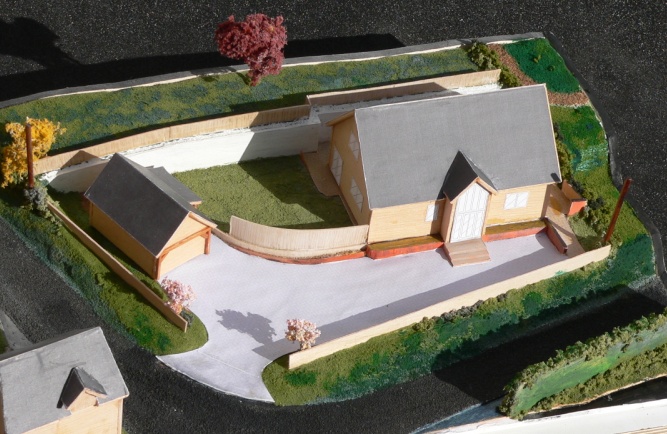
-
Planning permission refused - options
Jeremy Harris replied to oldkettle's topic in Planning Permission
Perhaps a series of photos, taken from different angles, from ground eye level, with a wide angle lens, and then make a photo shopped version to try and show the impact of your proposal. I suspect you won't see much at all in the proposal version, but that's what you need, really. The planner wants something on his file that shows there is no significant impact on the street scene, I suspect, so that box can be ticked! -
Yes, you're right, the outer member of the twin stud doesn't take any significant vertical loads and yes you can fit counter battens to it, then cement board to those and use brick slips. Some here have done just that. You then have a thermal bridge free outer skin that rests on the EPS upstand and looks like a brick wall.
-
Brickwork damp patch after prolonged heavy rain
Jeremy Harris replied to readiescards's topic in General Construction Issues
If the dummy pots are filling with water, then how about drilling drain holes in them right at the base, so the water can drain out over the flashing?

