Jeremy Harris
-
Posts
26430 -
Joined
-
Last visited
-
Days Won
360
Everything posted by Jeremy Harris
-

How much of a difference does 3g make over 2g?
Jeremy Harris replied to Juj's topic in Windows & Glazing
Worth remembering that the subjective effective of 3G in cold weather is that it is a great deal more effective than the best 2G. The reason is that 3G can have two internal facing low e coated panes, whereas 2G can only have one. The effect of this is to pretty much half the long wavelength IR heat loss through the windows, and although this doesn't make a massive difference to the overall thermal performance, it does make a massive subjective difference if you stand or sit next to any glazing on a cold day. Our bodies sense comfort by lots of ways, but one is the rate of radiated heat loss. When next to a 2G window more heat from our bodies will radiate out and it will feel cooler than it really is. The IR loss through double low e 3G is so small that I can't tell if I'm in front of the glazing or not, as such a large amount of body radiated heat is reflected back. -
House Cooling ideas
Jeremy Harris replied to mike2016's topic in Energy Efficient & Sustainable Design Concepts
Our old house is pretty hot - mid-20's indoors and only really getting cooled at all for the first couple of hours around now, when we can have all the doors and windows open and let in some of the outside air that's around 18 deg C. It's block and brick, with solid concrete floors, 60mm bonded bead EPS in the walls and 250mm of rockwool in the loft. The major problem is that it has loads of glass that isn't shaded, and although the glazing is reasonably good uPVC DG, there is a terrific amount of solar gain, so all the curtains have to remain closed to even try to keep it down to the mid-20;s. The new house is fine. It sits at around 22 to 22.5 deg C inside all the time, but over the past couple of weeks the cooling system has usually had to kick in by around 3pm, although I've noticed that the cooling usually switches off by around 5pm. I just have the floor cooling running at the moment, as an experiment to see how much warmer the upstairs gets. Hard to be definitive, but I'd say upstairs may be around half to 1 deg warmer than downstairs. I've just bought a duct cooling element, a water one, and as I was planning to relocate the MVHR intake to a lower position and position it next to the back door, but still at the rear of the house, with an added "bug filter" that can be more easily cleaned than the internal filter, I've decided to fit the duct cooler into the filter box I was making. I'll fit a motorised valve to it and connect it directly to the ASHP, which is just a metre or so away, so that the duct cooler is only turned on when the ASHP is in cooling mode (easy to do as there are programmable relays in the ASHP, so I can programme one to come on when the ASHP is in cooling mode). A few rough sums show that this should cool the MVHR intake air down to around 13 to 14 deg C, and as the MVHR will be on full bypass in this how weather, that means that it will be blowing cool air around the house whenever the cooling system is running. At the trickle ventilation rate the MVHR changes all the air in the house in a bit over two hours, so with the long decrement delay of the house and the effect of the slab cooling, I reckon the slight temperature increase we're seeing by mid-afternoon should be levelled out. I may drop the cooling thermostat threshold by half a degree; it's currently set to come on at 22.5 deg C. If it comes on at 22 deg C then I think the house would probably level out at between 21.5 and 22 deg C in hot weather like this. One other point, the heat reflective film on the glazing is extremely effective. Yesterday afternoon I was helping the fencing chap and coming in and out of the front door. The outer door hand was almost too hot to touch, but the glass inside the house was barely warmer than the air temperature inside. -
The tale of the sale of our old house
Jeremy Harris replied to Jeremy Harris's topic in General Self Build & DIY Discussion
Sounds a damned good compromise to me. I think we may have been lucky, in that our PB contact used to be a local estate agent, and seems pretty switched on. We know the price is low, but frankly that was our choice in order to try and facilitate a quick sale. We don't need to make any more than the minimum asking price to put us back in our planned financial position, and would rather trade speed of sale for a bit of additional profit - we're both heartily sick and tired of our old house, especially in this hot weather where it's a bloody nightmare. I've been at the new house all day, which sits at it's normal 22 deg C, only to come home to a house that's close to 30 deg C, and shows no signs of cooling down much overnight. Boy am I thankful for having got to grips with the concept of decrement delay! -
The tale of the sale of our old house
Jeremy Harris replied to Jeremy Harris's topic in General Self Build & DIY Discussion
I think you're right, but my wife is being exceptionally pessimistic and is convinced they are all tyre kickers! My view is that people only usually bother to view a property if they've already done a "drive by" and checked the local area out (certainly that's what we've always done in the past when looking for a house, and we've moved lots of times over the years). Out of those that have made appointments to view, three have no property to sell, so are probably cash buyers, and three have properties that are sold subject to contract. The remaining three have either properties on the market or not yet marketed, so don't sound like very realistic prospects at this stage. Interestingly 8 out of the nine are women, coming on their own to view. Not sure how relevant that is, or what it suggests, but it seems a bit curious. Whenever we've made appointments to view we've done so jointly; I don't think there's been a single occasion when only one of us has viewed a property. With six people viewing tomorrow, I think I'm in for a pretty busy day... -
Variable Solar Storage with Batteries
Jeremy Harris replied to MikeGrahamT21's topic in Energy Storage
Shouldn't matter. If the idea is to use your battery storage to reduce grid import, then I can't see why it matters if the battery provides a boost during the day, when it might otherwise be charging. Depends on battery capacity and charging capacity, but taking the 9.6 kWh Sofar system as an example, that can only discharge at a maximum of 3 kW, so the odd kW or so for short periods during the day when the PV isn't quite generating enough to run all the house demand shouldn't really have much impact, and the battery may well charge up again within the next half hour, anyway. The standby power situation changes this a bit, and ideally the system needs to be clever enough to only allow daytime power top up (to avoid import) to a set battery state of charge, leaving a reserve for backup power purposes. I had looked at getting a generator for the power cut problem, but ideally I'd like something like the old Lister autostart, that fired up when the grid goes down. Generators like that tend to be a bit pricey, especially if you need to be able to deal with relatively high peak loads. Factoring the cost/convenience of a battery/inverter system versus a generator backup system isn't that straightforward, either, as any generator would need to be run periodically, serviced, have fuel changes etc, all of which make it less attractive from an operating viewpoint. -
I had a mix of receipts with the plot address and our old house address and it didn't cause any problems. I think some of the ones addressed to the plot had two different addresses, too, because initially we used the planning permission address, then changed it as that was the wrong post code for the plot (the original planning permission related to the person that originally owned the plot). I didn't get any questions about addresses from HMRC at all, and I'm pretty sure that some of the receipts may not have had any address on at all.
-
The tale of the sale of our old house
Jeremy Harris replied to Jeremy Harris's topic in General Self Build & DIY Discussion
Thanks for all the useful tips and info, I think I'm going to do this, as we've just had yet another viewing appointment for tomorrow (that makes 6 that are coming tomorrow, 2 on Wednesday and one on Friday). The latest one is "house sold subject to contract" too, so that gives us half a dozen pretty good prospects. We've already made the advert "offers in excess of" the listed price, which will fit well with a sealed bid system, I think. I'll double check that we can sort everything our side out in time, but I'm pretty confident that I've already got most of the key info sorted and available. I'm still slightly stunned at the pace with which things seem to be happening. When I clicked the "submit" button to make the advert go live about this time yesterday, I didn't expect to have so many viewings booked in the first 24 hours. -
The tale of the sale of our old house
Jeremy Harris replied to Jeremy Harris's topic in General Self Build & DIY Discussion
The thought has occurred to me, as this is a method sometimes used in Scotland and seems to work well. If we get several people this week who I judge to be serious buyers (always the hard part) then I think instead of negotiating I'll just ask for sealed bids by, say, next week. Not sure how to organise this, though. In Scotland the sealed bids are handled by the agent/lawyer, with the seller choosing to accept the bid (not necessarily the highest one, either). I can't see a problem in running a sealed bid system myself - I'm quite prepared to just make my viewing diary public, with the names of the viewers blurred out, as evidence that there is a great deal of serious interest (the viewing diary shows the status of each viewer, in terms of being a cash buyer, sold subject to contract, house on the market, or house not yet on the market). -
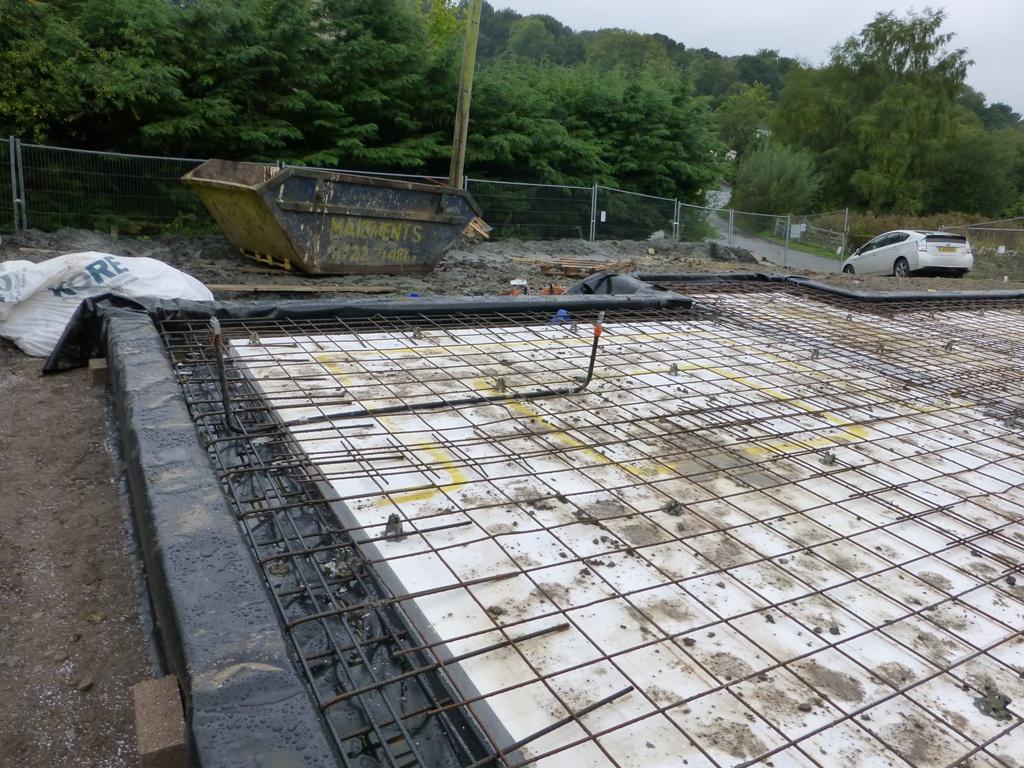
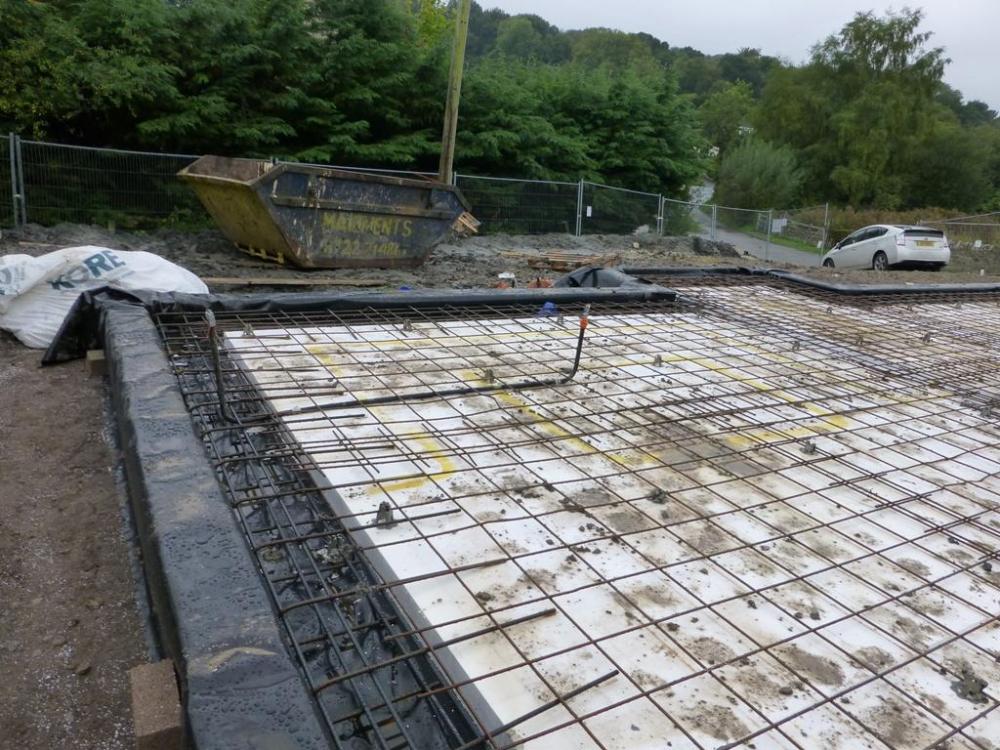
IIRC, our ring beam had four rebars that were around 10mm to 12mm dia running around it, all set inside the 200mm x 200mm ring beam section. These were tied to the fabric running across the centre of the slab with loads of 10mm to 12mm diameter bent bars, as in the photo below (not all the steels are tied in yet in this photo - there's loads more wire tying to be done before the pour):
-
The tale of the sale of our old house
Jeremy Harris replied to Jeremy Harris's topic in General Self Build & DIY Discussion
And another one has just come in for a viewing on Wednesday, whose house is sold subject to contract... In effect it looks like we're going to have most viewings tomorrow and Wednesday, with most being cash buyers or house sold subject to contract. That'll probably work a bit like an open house, I think, except I be repeating myself a lot. We have no viewings booked after Friday (so far) so if we get a reasonable offer out of the fairly big group looking at the house over the next couple of days then we'll push hard to try and seal a deal as quickly as we can. One advantage of the appointment diary system is that buyers can tell when appointment slots are taken - we've just had one switch an appointment from Wednesday to tomorrow, taking advantage of the one remaining appointment slot tomorrow, and I suspect that may well be because they've seen the level of interest. Clearly we've priced the house to sell, and that's probably making a fair difference, but as long as we get a quick sale and enough money back to top up our depleted savings pot then that's we really want anyway. -
The tale of the sale of our old house
Jeremy Harris replied to Jeremy Harris's topic in General Self Build & DIY Discussion
This is getting silly. In the last fifteen minutes I've got four more viewing requests. Looks like all I'm going to be doing this week is showing people around the house... -
The tale of the sale of our old house
Jeremy Harris replied to Jeremy Harris's topic in General Self Build & DIY Discussion
Thanks for all the tips, they are much appreciated. I think I have all bases covered, and have copies of every document regarding the house that I think might be needed by any prospective buyer (Land Registry Title Plan, warranties, gas safety inspection, etc, plus I can get an EICR done very quickly if needed) and of the three bookings for viewings we have taken so far, one has a house already sold subject to contract, one has a house on the market but not yet sold and one is a cash buyer (I suspect a landlord - there is a high demand for rented property in our local area). With regard to our local area we have a distorted market. The Army are moving many hundreds, perhaps thousands, of soldiers here; all those brought back from BAOR, plus those relocated to Andover, which is now HQ Land Command (20 mins away), my former employer (1 mile up the road from our old house) is in the process of relocating a few hundred staff from Kent to Porton Down, and generally the market here is quite buoyant. Staff being relocated (including some military personnel that own their own homes) will be on a relocation package that means they have no chain and are cash buyers, which may be good news. Fingers crossed to see what will happen... -
The tale of the sale of our old house
Jeremy Harris replied to Jeremy Harris's topic in General Self Build & DIY Discussion
Thanks, seems to be working. Third viewing just booked and the advert only went live around midday today. FWIW, Purple Bricks give you a pretty good breakdown of stats from Zoopla, Purple Bricks and RightMove. They give you the number of unique page views from each of the three sites, the number of individuals who have looked at/downloaded the online brochure (so one layer deeper than just a page view) and the number of emailed individuals to whom the details have been sent because they match the house types/area/price range they are looking at. The control panel allows me to change the order of photos any time I like, so I may well try switching them around every week or so. So far, all three viewings have come via RightMove and RightMove is also far and away the most popular site. The least popular at the moment seems to be Zoopla. -
The tale of the sale of our old house
Jeremy Harris replied to Jeremy Harris's topic in General Self Build & DIY Discussion
The snag may be that when people view they may realise that the photos are slightly optimistic! -
The tale of the sale of our old house
Jeremy Harris replied to Jeremy Harris's topic in General Self Build & DIY Discussion
That's a bit of a difference from our experience. Our chap turned up with a Nikon D7500 plus tripod and fill-in flash. He seems to have used the 18mm lens for all the indoor shots and I really can't fault them, they are a heck of a lot better than anything I could have shot with my Panasonic DMC-TZ70. Bearing in mind that our old house is pretty dire, here's a link to the advert on RightMove: https://www.rightmove.co.uk/property-for-sale/property-66568030.html I'm happy with it. We've had 43 advert views as of ten minutes ago and have two viewings booked this week, one a cash buyer, the other sold subject to contract. I'm under no illusions that this is very early days, and things could turn sour, but so far I have to say I'm pretty damned impressed. I suspect that a lot depends on the local agent that handles your initial data gathering and puts the ad together, but you do have the option via the control panel to take your own photos and edit any of the advert text. The principle seems to be that they put you in control, but give you advice when requested, and for me that seems an ideal approach, but I accept that it won't suit everyone -
The tale of the sale of our old house
Jeremy Harris replied to Jeremy Harris's topic in General Self Build & DIY Discussion
One advantage of the way Purple Bricks (and I suspect the other on-line agencies) work is that they put the seller in the driving seat for these decisions. My intention is to evaluate how realistic a prospect any buyer is myself, as I want to be able to decide whether to take a risk on someone who hasn't yet marketed their house myself, rather than have them filtered out automatically by the agent. All that the online agencies do is give the seller all the information they have about any prospective buyer, and leave it up to the seller to make the decision. They do provide a lot of help and advice, but ultimately it's only the seller who drives the control panel and makes the decisions. There are, in my view, advantages in being put in the driving seat, and not having an agent acting as a buffer, but there's also the slight downside of needing to do more work. As a seller you can choose to pay a bit more and have the online agency manage the whole sale process for you if you wish, including running viewings, but as I have time on my hands I didn't see the point in paying for something I could do pretty easily. -
The tale of the sale of our old house
Jeremy Harris replied to Jeremy Harris's topic in General Self Build & DIY Discussion
OK, time for another update on progress. We had reasons for holding off on getting the photos taken for the sale advert (like me panicking to get the drive refurbished, clearing out junk, making things look half way presentable, etc) and that happened to coincide with our Purple Bricks chap having a few days off, so the timing, from our point of view, worked perfectly. We had the joke EPC done, the floor plan done and then yesterday morning the Purple Bricks chap came around to take some photos and double check the descriptions etc. Given how much of a mess things were in the photos haven't come out too badly (I just love the magic "Estate Agent" camera that makes rooms look massive...). So, around lunchtime today we received the advert details for approval, with the option for us to edit any of the text, add some of our own photos if we wished, etc. As it happens all looked fine to me, no exaggeration, just accurate descriptive text, so I clicked the "submit" button on our Purple Bricks control panel page. Within seconds the advert was up on Purple Bricks, Zoopla and RightMove. Within the first hour of the advert going live the control panel was telling me that our ad had been viewed 20 times. Three hours after the ad going live we had our first viewing request, for Tuesday lunchtime (they wanted to view tomorrow, but I'm getting some fencing put up at the new place), from a potential cash buyer (no mortgage required). The info that you are fed from the Purple Bricks system is pretty useful, as it tells you a fair bit about the identity and buying status of the potential purchaser, so you can, if you wish, choose to filter out people you think may be time wasters, or that haven't yet put their own house on the market, so are a long way away from being in a position to make an offer. Whilst typing this another viewing request email has just arrived, so it looks as if I may have to do another update later. My initial view is that this method of selling a house is a heck of a lot easier than using a conventional estate agent, with the proviso that you need some time to get to grips with the way the online booking and availability system works (I've already made an error by not having filled in our viewing availability diary - I hadn't realised how important that is to the way the system works. I'll try and keep this thread updated with progress, in the hope that it might shed some light on how selling via an online agency works that might be helpful for others. -
Variable Solar Storage with Batteries
Jeremy Harris replied to MikeGrahamT21's topic in Energy Storage
For info, the Sofar systems I've been looking at, that use the Pylontech battery packs, have a maximum output to the house (or the emergency backup outlet) of 3 kW, so they should easily integrate into any normal house CU, much like a PV system. In many ways you can look at an AC coupled battery system like this as just an extension of your PV system, that happens to be able to "generate" up to 3 kW at night, as well as during the day. The battery system can also add power during the day when the PV is generating, if the household load exceeds the PV output and the battery has enough charge. This means that if, say, your PV was generating 1 kW and you wanted to run the washing machine, that draws 2 kW at peaks, then whenever the washing machine needed more than the 1 kW from the PV system the battery would kick in to deliver the additional power, rather than let you use power from the grid. -
Ours has two cross beams that are under two load-bearing internal walls, and those cross beams are the same spec as the ring beam, 200mm x 200mm. There are some photos of our slab being built in this blog entry: Slab being built and poured If you look closely you can see the two additional cross beams; one has a dog leg in it. They support the walls either side of our hall, which goes right up to the big gluelam ridge beam around 6.5m above. Those two internal walls help support the first floor as well as the centre part of the ridge beam (our roof uses ridge-hung rafters, so most of the roof loads are taken by the ridge beam)
-
Our slab has 300mm of EPS under most of it, a 400mm high x 200mm wide upstand around the edges and the edge ring beam is 200mm x 200mm. The slab is 100mm thick across most of the area. There's a layer of steel fabric in the centre of the 100mm deep section and four tied rebars running around the 200mm x 200mm outer edge ring beam. Soil max allowable bearing load is way over 100 kN/m², so didn't I bother measuring it accurately (simple 2 x 2 test with a lump hammer confirmed it was way over 100 kN/m²). House actual bearing load on the soil beneath, allowing for 45 deg outward load spreading from 150mm deep packed crushed stone bedding, works out to be just over 4 kN/m². In other words, the reserve between the minimum possible allowable soil bearing load of 100 kN/m² and the actual house and foundation applied bearing load is a factor of around 25, which is extremely conservative, even for the typical ranges of reserve normally allowed in civil engineering. I'd question why you have such a massively thick slab. 250mm seem way OTT for the non-bearing load area to be. Our reinforced 100mm thick slab is plenty thick enough, with it's 200mm x 200mm reinforced ring beam. Here's a sketch showing a section through our house and slab (it's one drawn up as a part of my building regs submission): Structure - Detail for BC.pdf
-
Ventilation Rates Issue
Jeremy Harris replied to worldwidewebs's topic in Mechanical Ventilation with Heat Recovery (MVHR)
I did self-certify, this is the report I submitted to building control, who happily accepted it, even though it doesn't follow the guidance (I only found the guidance after I'd sent them this) Mechanical Ventilation and Heat Recovery system Test Report.pdf I'd increase the inlet vents, and if this doesn't do it, increase the inlet fan speed, but try the vents first, as that's the lowest energy loss option. -
Ventilation Rates Issue
Jeremy Harris replied to worldwidewebs's topic in Mechanical Ventilation with Heat Recovery (MVHR)
TBH, the building regs background ventilation rate is, IMHO, way too high. I run ours a lot lower and we find that the air quality is very good indeed. I have a suspicion that they set the 0.3 l/s per m2 figure following some advice with regard to venting volatile organics from the house furnishings, and I think someone made an error somewhere. I'd try to get the intake/exhaust rates a bit closer, just for better heat exchanger efficiency, then fudge the data to satisfy building control. I strongly suspect that you wouldn't be the first to do this... -
I'm near-100% certain that the fill valve you need is the Siamp 95L, shouldn't matter if it's the all-plastic one or the one with the brass insert. I'm also pretty certain that the AG1378 flush valve is the right one, but I'm not at all convinced that the AG1378 inlet valve is the right one at all - I've been caught out with the float catching on something internally by fitting a similar, but not quite the same, fill valve before now (I think twice, as I'm sure there are two new ones that don't fit anything we have up in the loft)
-
I have to say that's been my standard approach ever since cisterns switched to using plastic fill valves. Back in the days of brass ball cocks I'd have happily just replaced a washer, knowing that nothing else was likely to go wrong for years, but these sliding float plastic fill valves seem so damned flimsy that I'd not trust another part to fail not long after repairing one. As an aside, if you want an absolutely bomb proof, super reliable, tank or cistern float valve, and aren't particularly constrained for space (although these things are tiny) then I can recommend these: Abertax valve which are available from BES They are brilliant, as they operate magnetically and have no external float to catch on anything. The only downside is that the fill level cannot be adjusted, it's fixed by the installation height of the valve. Ideal for hard to get at F&E tanks, though. Internally they work just like a servo assisted solenoid valve, with the magnet in the float operating the servo diaphragm through the plastic wall of the housing,.
-
It seems clear that there just isn't any sort of coherent quality process within the domestic construction sector. During the week I spent at Nissan, it became clear that right down to their Tier 3 suppliers Nissan imposed their own quality process, and made every supplier responsible for adhering to it. The result was that every part that arrived on the line was not only manufactured and checked to Nissan's own standards, but the contracts with the suppliers made them liable for any costs Nissan incurred as a consequence of any quality failing. Hence the line stop costs being charged to the supplier whose component had been shown to cause the problem that stopped the line. The discipline applied to quality had to be seen to be believed, right down to every single person in every team actively monitoring and visually reporting on boards adjacent to their workstation every single issue, no matter how minor. AFAICS, there is just no real accountability for quality in the domestic construction industry. It's just accepted that there will be snags, that stuff won't be built as designed, and that there will be a lot of remedial work at the end of every build. The concept of "build it once, build it right" just doesn't apply to house construction as far as I can see, plus there seems little willingness to apply any form of total quality approach. I don't think this has anything at all to do with consumers, as over the past few years, with the growing influence of social media, we have seen more and more cases raised to the level of the mainstream media where big developers have built really bad houses, with dozens, if not hundreds, of failings. Despite this they don't seem to be getting any better - it seems that the industry as a whole just isn't positively reacting to the problem. The contrast with commercial construction seems marked. As a part of my last job I programme managed a £96M new lab and office construction project, to house 900 scientists and support staff and provide 42 new laboratories. The quality regime of the main contractor (Sir Robert McAlpine) was very like that I'd seen at Nissan. Quality was "built-in" at every stage, from design through to ensuring that absolutely everything that arrived on site was exactly to spec. If the same approach was applied to building houses then I'm certain that the majority of the problems we regularly hear about just would never arise. FWIW, SRM were working to a "cost plus incentive fee" contract, with a 50/50 split on any cost savings made during the build between the customer and the main contractor, so they had a strong incentive to reduce costs wherever they could. They saved over £4m, IIRC, by the end of the contract, and that's after some quality upgrades were made during construction, like opting to use Corian for all the toilet work surfaces, switching to Dyson Airblade driers and upgrading the wooden flooring in the common areas. We even upgraded all the hundreds of office chairs to Herman Miller ones at around £800 each, out of the contract savings.