Jeremy Harris
-
Posts
26430 -
Joined
-
Last visited
-
Days Won
360
Everything posted by Jeremy Harris
-
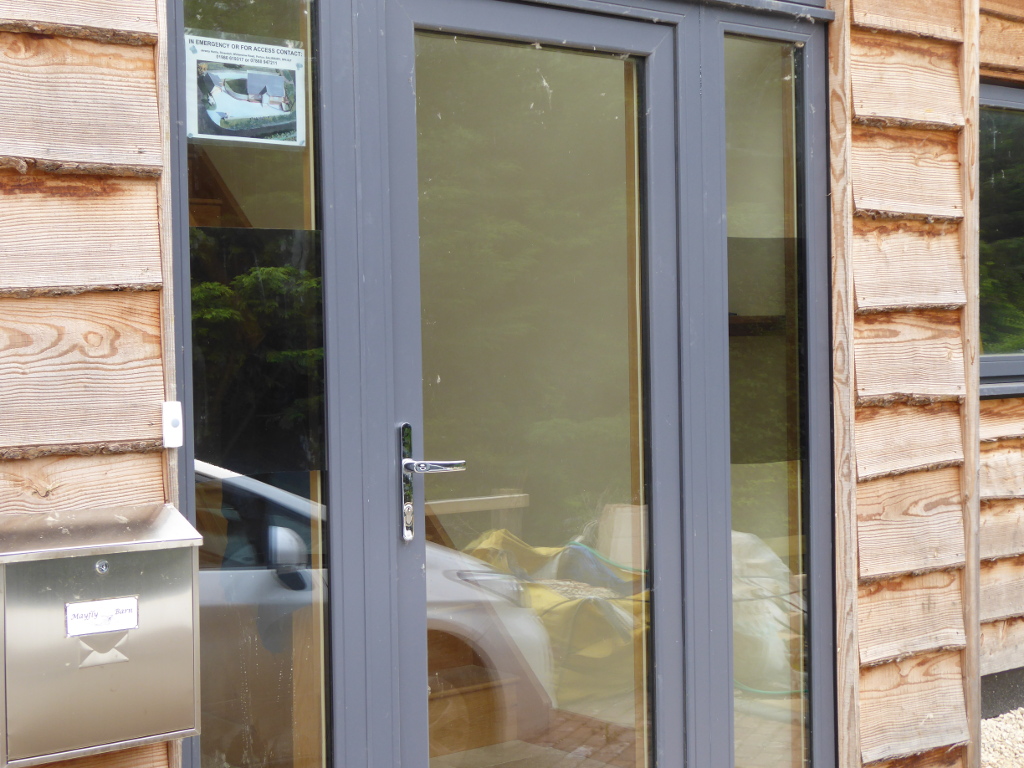
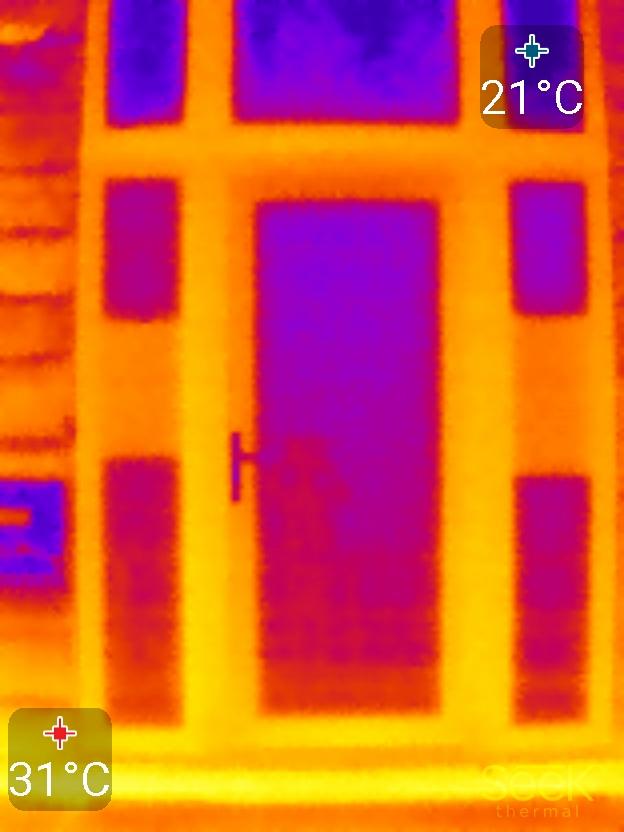
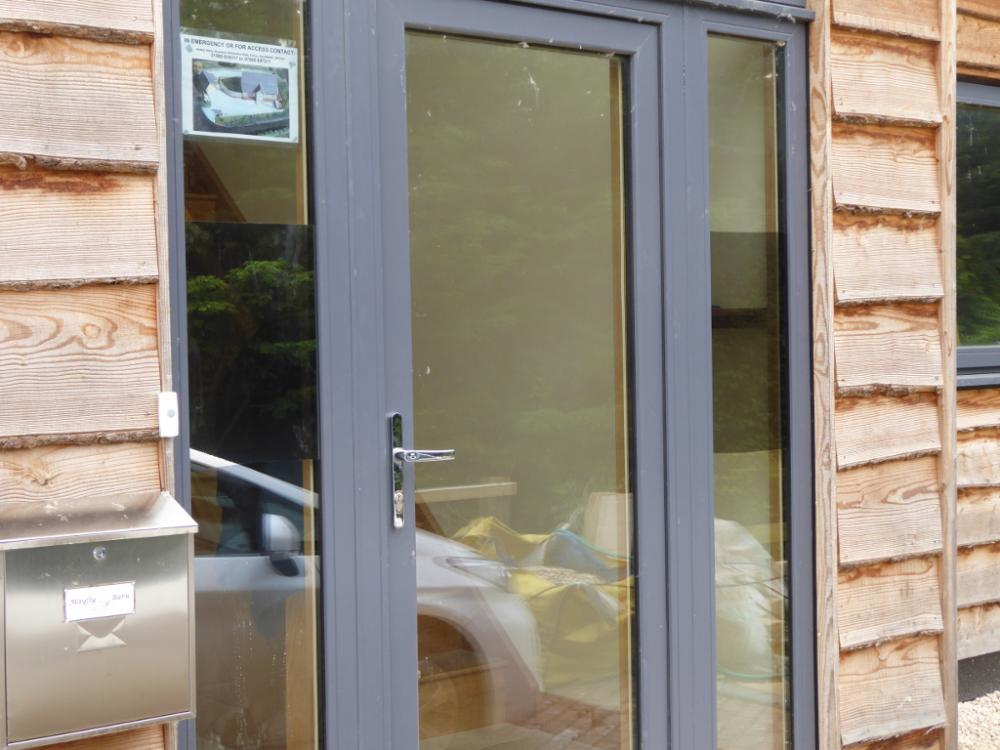
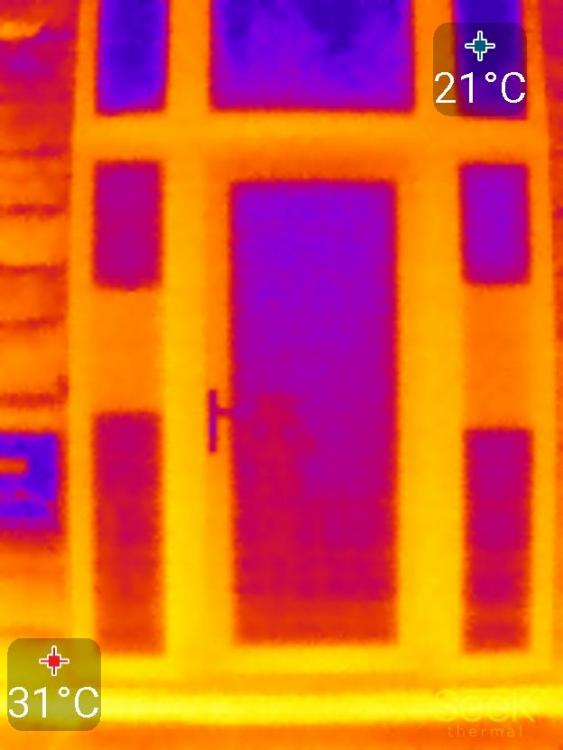
I've been looking around at the absorption spectra of glass, and it seems to vary a great deal. Quite a lot of "normal" glass seems to roll off quite sharply above about 3µ wavelength, from what I've been quickly been able to find out. Emissivity is the other interesting point. I took some thermal images using my relatively cheap thermal imaging camera, which is calibrated for a "standard" emissivity of around 0.9, I believe. When we were looking at external IR reflective film, I had two samples stuck to our south-facing glazing, and then tried to take photos and thermal images of them for comparison, during bright, sunny, weather: This is an external view of the front glazing, with a patch of the darker shade of 3M IR reflective film on the left and the lighter IR reflective film on the right (the film patches are stuck to the side panes, either side of the door and just above the level of the door handle). It seems that the camera can read right through the triple glazing to record a reasonably accurate house internal temperature of 21 deg C (the house stays at 21 deg C pretty much all year around), which is curious. The hottest point it found looks to be close to the dark grey alloy external glazing frame cladding (the "cool" object to the left is a shiny stainless steel mailbox, with a low emissivity), which is what I'd expect, as the sun has definitely warmed up the alloy frame. This external view had to be taken at an angle, because the reflections from a head-on shot were dominated by me holding the camera! However, it seems that the patches of reflective film are significantly more reflective at even optical wavelengths than the glazing alone. The best illustration of this is with the patch nearest the camera, where there is a sharp contrast between the reflected image of my car st the junction of the film and the glass, as well as the film reflecting the image of the trees opposite quite clearly.
-
 Yes, but the stuff's a pig to get to lay flat in a channel, and requires special termination glands at both ends, so conduit would be both a lot easier, and gives the option of changing the cable, running additional cables etc, later.
 -
So, the device actually causes calcium ions in the water to precipitate out in the device, well outside normal precipitation conditions, from the combination of the catalysts and the kinetic energy from the water flowing through the device? Given that the water downstream of the device will still be a reasonably good solvent for CaCO3 in any form, what stops the metastable precipitate so formed from simply going back into solution? The solubility of CaCO3 (it matters not which polymorph, they are all the same as far as water solubility is concerned) is around 8 to 12mg/ml, or around 8 to 12µg/l, so even in very hard water there is still going to be plenty of spare solution capacity for the water to dissolve the prematurely precipitated out CaCO3 before it reaches saturation point. The implication is clear; although carbonates are no where near as soluble in water as bicarbonates, there is still plenty of capacity within the downstream water flow to re-dissolve the prematurely precipitated out CaCO3, in any form, so what stops this from happening?
-
It's metastable, so in the presence of water, at standard temperature and pressure, it will want to revert to calcite. If kept dry, or otherwise artificially stabilised (for example by high concentrations of magnesium) it can remain as aragonite, but these aren't conditions likely to be found in domestic water systems.
- 199 replies
-
- 2
-

-

-
- hard water
- water softener
- (and 1 more)
-
So you're saying that the unit takes kinetic energy from the water flowing through it, and uses that kinetic energy to power some form of chemical reaction that alters the dissolved calcium in the water? That should be relatively easy to measure, then, as it's just a question of simple thermodynamics. I wonder why no scientific paper has ever been published in the decades since this device was first patented, describing the fundamental principle of using kinetic energy from moving water to drive this sort of chemical reaction and why it hasn't made the pages of respected peer reviewed journals? Seems exceptionally odd, to me, as scientists, are, by nature, extremely keen to get their work published. Yes you do. A website constitutes are advertisement for your product, by it's very nature. You may choose not to advertise in other forms of media, but advertising on a website is absolutely no different in law to advertising on the TV, radio, newspapers, etc, especially when you also take advantage of social media (like this forum) in order to try and promote your product as well. The law is very clear in the UK about what constitutes publication, and every post on this form, by way of an example, is a publication with the copyright (and legal responsibility for its accuracy) belonging to the person or company representative, that has written it. There's no "proof" at all that it works at all. There are anecdotal indications that it may have some effect, but that is as far as it goes. Proof requires independent, peer reviewed testing, and as far as I can see you have no such thing.
-
Good point, that was sloppy of me. As far as very long wavelength IR we are talking about re-radiation from objects all around that have been heated the sun, in the main. However, glass does still absorb IR, in the case of some types of glass it can absorb a lot, and thicker glass, of the type used in canopies, tends to absorb a fair bit. The solar canopies we used had a slight greenish tinge to them and were, I suspect, made from glass that absorbed pretty much everything below the visible red wavelength, and maybe even a bit of that end of the spectrum, given the colour tinge..
-
Precipitation doesn't happen until later, though, long after the water has passed through the device. Precipitation essentially requires some specific conditions in order for it to occur - for example, keep the temperature of a hot water system above the temperature at which CaCO3 comes out of solution as precipitate for a given concentration. Therefore, at the point of treatment there is no calcite, aragonite or valerite. The only thermodynamically stable form of CaCO3 is calcite, so even if this device could somehow cause the dissolved calcium content of the water to "remember" that when it reaches a precipitation point down stream (be that by any means) then it needs to crystallise out as aragonite the precipitate is not going to want to stay as aragonite for long - it will want to revert to calcite. The key thing here is that aragonite is thermodynamically unstable, and will revert to calcite, as that's the lowest energy form of CaCO3, That's interesting because it implies that there should be some energy applied to the system in order to preferentially cause aragonite to form. That's not proof at all. Proof is having the mechanism of operation peer reviewed and reported in a paper in a recognised journal. No recognised scientific journal has ever published any such paper, which seem absolutely extraordinary given the claims that have been made over the decades that this device has been on the market. Take, for example, ion exchange, or phosphate dosing. Both have lots and lots of peer reviewed literature describing in detail the mechanism of action, and both have been reviewed and independently verified in accredited labs so many times that we can be confident in stating that we understand the science behind them and their mechanism of action, plus their performance has been verified beyond reasonable doubt. Client testimonials are simply the placebo effect working. We see exactly the same results with client testimonials being used to support all sorts of fake science, not just water treatment. The reason that it's so damned difficult to prove something by experiment is often because of unconscious bias, it's such a well-known phenomena that several very good peer reviewed papers have been published about the effect and the impact it has. I'm disturbed to read that your advertising makes mention of water softening. By definition, "soft water" is water that has had the calcium and magnesium content reduced. By your own statements your device does not reduce the concentration of calcium or magnesium compounds in the water at all. I know you keep calling the device a water conditioner, but the test in you adverts makes references to "soft water", which is misleading for consumers, in my view. The water leaving your conditioner is not in any way softened; it will have exactly the same concentration of calcium and magnesium as when it entered the device.
- 199 replies
-
- 1
-
-
- hard water
- water softener
- (and 1 more)
-
The power cables to our island run in 25mm conduit through the slab, so 25mm is enough space (just) to run cables, but it does depend on the flooring, and is a bit tight. I think I'd be inclined to channel out the slab and run bit of conduit across to the island, if it were me. The conduit that the cable to our island runs in is about midway down, tied to the rebar in the slab. You could possibly get away with 20mm conduit, depends on the cables you want to run through it. If only going to a shallow depth I'd be inclined to use steel conduit, for better cable protection, plus it will stay in place better whilst you grout it back in to the floor.
-
In essence, the "magic" somehow claims to transform one polymorph of CaCO3 to another before it's actually formed. Somehow, the claim is that the CaCO3 in solution is changed (there's no clear, peer reviewed, science to explain this alleged change, or what the mechanism is behind it that causes the alleged change whilst the CaCO3 is still in solution). Somehow, the CaCO3 in solution "remembers" having been through this device and "remembers" to preferentially crystallise out as aragonite, rather than calcite. The claim of 20 days is OTT - aragonite invariable reverts to calcite within about 4 days under normal household conditions. I remain wholly unconvinced. This invention has been around so long the original patent expired 12 years ago, and no one has ever been able to provide solid, peer reviewed, evidence that there is any real effect at all in all those years. There are lots and lots of claims that the device doesn't do what it claims, and many of those are based on some pretty solid science. In my view, if a "breakthrough" invention hasn't been proved to work after several decades and there is absolutely no peer reviewed evidence to show it does as claimed, then I think it's only fair and reasonable to be just a bit sceptical. The obvious question has to be "Why didn't the original device manufactured under the Australian patent make the owner an absolute fortune and render all other forms of "water softener" obsolete?". After all there have been a few decades for the product to prove itself, yet we don't see them in common use in our hard water areas, do we?
- 199 replies
-
- 5
-
-
-
- hard water
- water softener
- (and 1 more)
-
It's a nice idea, but off the top of my head I'm struggling to think of ways to make it comply with building regs. The glazing would need to be walk-on double or triple glazed, then the ventilation would have to be arranged to flow air in from outside and then out again. The problem is that the building regs will want a minimum floor U value and even triple glazing will be no where near good enough. Whether you can trade much better insulation everywhere else for the relatively poor U value of a triple glazed walk-on floor pane I don't know; that's a question for building control. Getting at the lights for maintenance/servicing will be an issue to be solved, but fitting sealed LEDs, like the ones used in ponds, should get around that. I'd go for low voltage DC LEDs, so the driver can be placed well away from the well and in an easy to get at place, as LED failures are 99.99% of the time down to the driver unit, rather than the LEDs themselves. Not going to be a cheap project, for sure, but could be interesting when finished.
-
Might be worth investing in something like this: https://www.amazon.co.uk/Smoke-Sabre-smoke-detector-aerosol/dp/B005GUM5EI to test that your smoke alarms are working OK. It won't test a rate of heat increase alarm, like the ones fitted to kitchens, but should test the other types of smoke detector reliably. At least you'd then have some peace of mind that the things were really working OK.
-
There are a fair few options for hiding strip LED behind a range of fixtures, mouldings, built-in mountings, etc. There's another thread with some links that may help here:
-
Welcome. When going out to tender you need a really tight specification and ideally want to aim to let a firm (not fixed) price contract, if you want near-zero risk of cost over-runs. However, few builders will offer a firm price contract, and the best you may hope for on a renovation, where there are bound to be loads of variations and unknowns, may be a fixed price contract, and even that may be doubtful. You need to bear in mind that the more risk the contractor is exposed to, through unknowns being uncovered, changes of spec during the work, etc, the higher the risk contingency that they will price in to their quotation. You also need to be aware that a firm price contract is really a fixed price - the price quoted is the price you will pay (assuming no variations). A fixed price contract is variable, in that the contractor can vary the final price (perhaps without telling you!) if things outwith their control cause their costs to increase. If you're really confident of being able to oversee the work every day, then you can opt for a cost-plus contract. This will almost always be cheaper IF, and it's a very BIG IF, you can control and manage things on a day to day basis. You will be very lucky to get any builder to agree to a tight timescale with a penalty in the current economic climate. There's a lot of work around, and good builders can pick and choose. If time is tight, your better off trying to keep a very close (as in every day) eye on things and insist that your builder keeps you informed at least once a week of the current financial position. You shouldn't need insurance to cover the builder, he should have his own liability insurance, but you MUST insure the property for risks not associated with builder negigence, and to cover your personal liability issues. You can get renovation insurance, where you are not resident in the property, that will cover the rebuild costs in the event of a catastrophe, like a fire, major structural collapse etc. If you get stuck I can point you towards a broker in the South West I used that were very flexible for this type of insurance.
-
Our local sawmill could do it, and are an old-fashioned place where you just walk in and chat to the family members who run it. I know them all well and could easily ask them if they'd do it, and what they'd charge (not much is my guess). They have a crude website here: http://www.ridleysawmill.co.uk/ but do everything face to face or over the phone, as they're not really that up with the computer age yet. The problem would be getting the oak down here and back.
-
The saw mill chap was talking to me about this a few weeks ago. For air-dried oak their rule of thumb is one year per inch plus one year, so a 1 inch thick board would take 2 years, a 2 inch thick board three years, etc. That's for rough sawn boards stacked up in their yard outside to season.
-
Definitely a job for a planer thicknesser. A decent sized one with carbide tipped blades would bring all those planks to a consistent thickness pretty quickly and take out any twists/bends that are less than the thickness you want to end up with. It's not a big job, maybe an hour or so tops for someone with the right machine, and the key to getting decent planks out of it will be using a pretty hefty industrial size machine. The saw mill near us would do this while you wait, but it's a bit far from you. Have a hunt around and see if you can find a good local saw mill that has a big planer thicknesser and ask them what they'd charge. I reckon it would be worth getting them done properly, as I don't think you have a hope in hell of getting those boards flat and even with a hand held electric plane, TBH.
-
Pumped water has been working well at places like Dinorwig ( https://en.wikipedia.org/wiki/Dinorwig_Power_Station ) for many years, I think the main issue is finding suitable sites where there is both a large enough volume and sufficient head between two lakes or reservoirs.
-
I've been using phase change heat storage for a fair time now, to heat our hot water. Works exceptionally well, with much lower standing losses than a tank full of hot water. Currently I'm running a very early, first generation, Sunamp PV (one of the pre-production models) that has been delivering hot water, primarily from charge from excess PV generation, for a couple of years or so. I'm just about to switch over to the newer, simpler and higher capacity Sunamp UniQ eHW 9, which will increase our hot water storage capacity to about 10.5 kWh yet only increase the standing loss per day by around 150 Wh. We found that the decrease in standing loss from our old double foam sprayed 210 litre thermal store, which was then fitted with an additional layer of 50mm PIR foamed in place all around it, when we first fitted the Sunamp PV was massive - our daily heat loss dropped from around 2.5 kWh with the old well-insulated thermal store running at around 65 deg C to around 600 Wh with the Sunamp PV. This made a really big difference to the temperature in the services room, which had reached over 40 deg C with the old well-insulated thermal store; enough to damage the oak door between it and the adjacent bedroom and contribute to that bedroom over-heating in summer. Both these phase change "heat batteries" use a sodium acetate based mixture, and operate at about 58 deg C. In practice the case of the Sunamp PV never feels even slightly warmer than ambient, which is distinctly odd when a tap is turned on and the outlet pipe quickly gets very hot. It works very like a thermal store, with a heat exchanger internally that quickly heats incoming cold water up to 58 deg C on demand. There's some cunning system to control the phase change, by allowing nucleation to be stopped and started at will, which seems to be the key to getting a practical phase change material thermal store.
-
Should be fine, it's only a tonne when filled. Perhaps put some planks under it to spread the load a bit, but probably not needed.
-
About half an inch, but fine for small fires. A pressurised water extinguisher probably only has a hose bore of around 1/4 to 3/8 inch. It's more important to be able to get water to the source of a small fire as quickly as possible than to have loads of water available a minute or two later.
-
Where do all the bricks go? (in the garden?)
Jeremy Harris replied to laurenco's topic in Demolition
I hate to say it, but Gaelic and the Celtic languages are not the best for expletives. German and perhaps one or two of the Scandinavian languages are pretty good, as is Russian, I think. My repertoire of (Irish) Gaelic expletives is about average, but I doubt there are many stronger. English has a better range than either Gaelic or the Celtic languages. -
I also had a couple of pressurised water extinguishers in place (regret selling them now, as I could really do with a couple of expired/used pressurised water extinguisher for a project). I didn't bother with a powder or CO2 extinguisher, for a couple of reasons. We had no power (other than extension leads run from an RCBO protected external outlet until well on with the build) so the risk of electrical fire was relatively low (the biggest risk was with the semi-open frame, accumulated flammable rubbish and people smoking, IMHO). Fire blankets aren't really that useful, IMHO, unless there is a specific contained liquid fire risk. They work best on things like chip pan fires, but are less effective against more open fires. Again, my personal view is that CO2 isn't that effective in an open area - it tends to disperse quickly unless constrained and so in an open space really only works effectively against pretty small fires. Hooking up a decent sized water tank (maybe a cheap IBC) a few feet above ground and rigging up a gravity fed fire hose may well be the most useful thing to do. You're not going to get an electrical fire risk until late on in the build, neither are you going to have pools of flammable liquid (I'd hope). Water will probably deal with 90% of the fire risks, and the more water available the better. My experience of training with extinguishers is that they don't last long - 1000 litres from an IBC will provide a heck of a lot more water. You can DIY a system like this easily, just raise a cheap IBC up on blocks or a load of pallets, fill it with water, fit a hose the the base and rig up a simple nozzle with a lever ball valve and a short length of copper pipe at the end of the hose.
-
Exactly. I've fitted loads of the cheap ones (the ones that come five or ten in a bag from Screwfix) and can't ever remember having a valve problem, other than the damned things getting jammed with limescale. Even the most expensive Pegler ones can get jammed with limescale, though. I've a policy of only fitting expensive, brand name, valves in places where they are going to be used relatively frequently. For example, the three lever full bore valves on our softener are expensive ones for that reason, as are the lever ball valves either side of the water filter. The rest are all bog standard ones, that I doubt will get operated in my remaining lifetime.
-
+1 Looks like the shaft seal has gone and the shaft ,may have parted company from the ball, leaving the ball valve partially closed. It looks like it's recently been replaced,a s the chrome compression nut is the one from the valve that used to be there.
-
Yes, ours have been up and running for a while now and work perfectly, which is more than can be said for the Byron/Homeeasy switches they replaced. FWIW I went for the 16A receivers, as the loads being switched were LED switched mode power supplies, and they have a fairly hefty inrush current. Although each power supply uses well under an Amp, I have already experienced a relay failure in a PIR switch, and when I took that PIR switch apart to find the cause noted that the relay was rated at around 5 or 6A. I'm just taking a punt that a 16A relay will be better up to switching the LED supplies than the PIR switch in another room was, although it is possible that I just had a faulty PIR switch relay, as it was a latching one, so could have just got mechanically stuck in the "on" position".