


Jeremy Harris
-
Posts
26430 -
Joined
-
Last visited
-
Days Won
360
Everything posted by Jeremy Harris
-
But you should NEVER consider disinfecting a private water supply with anything that contains surfactants, as it will take days of pumping to clear the residue. People have done it by accident, and described just how long it's taken to pump out the mess, on the US well forum where I received a lot of very useful advice, and there are now always warnings to only ever use plain hypochlorite. There's a world of difference between cleaning out lab equipment or beer lines and just disinfecting a private water supply as a part of the commissioning process.
-
They are hypochlorite tablets, a bit easy to handle than the granular hypochlorite mentioned earlier. They have the advantage of not being so likely to decompose due to atmospheric moisture getting to them, but the disadvantage of being slower to dissolve into solution. I have some that I used when our borehole was sitting idle, during the prolonged saga around getting it to work properly. I used to drop one of those down the borehole every now and again to keep it bacteria-free whilst we were messing around trying to get all the fine sand out of it.
-
It makes bleach more effective when used to clean things like toilets, as it acts as a surfactant (makes the bleach wet the surface more easily) and as a thickening agent to increase the film thickness and contact time of the bleach on a surface. For disinfecting a drinking water supply the snag is that the thickening agent may result in residue being left behind in the nooks and crannies of the pipe work, really anywhere there is a fairly low surface flow velocity. You ideally want the disinfecting agent to flush out/decompose quickly, so there's no residual stuff in the system. Hypochlorite is fine, as it breaks down quickly, but the other stuff doesn't break down very quickly and is designed to "stick" to surfaces.
-
It's the thickening agent, could be one or more of a fairly wide range of stuff, from sodium chloride through to sodium lauryl ether sulphate, plus probably a bit of sodium hydroxide.
-
@bgmill, good luck, please keep us posted on the outcome, as it's always useful to have examples of the cost of this stuff. Prices seem to vary a lot (I sometimes suspect the DNOs make the numbers up!), and it helps others if we have some sort of baseline as to what the true costs might be.
-
HV puts the price up a bit compared to LV, really just because the cable is more expensive and the joints take a bit longer to make, but it shouldn't be a huge increase. There are also restrictions on HV with regard to the distance from structures. Off the top of my head I think the minimum clearance between an 11kv cable and a building is 3.7m (need to check this, as my memory may not be 100%). If the cables are closer to the building than this then it may be that they need to be moved anyway, so there may be some possible way to use that when negotiating the price with UKPN.
-
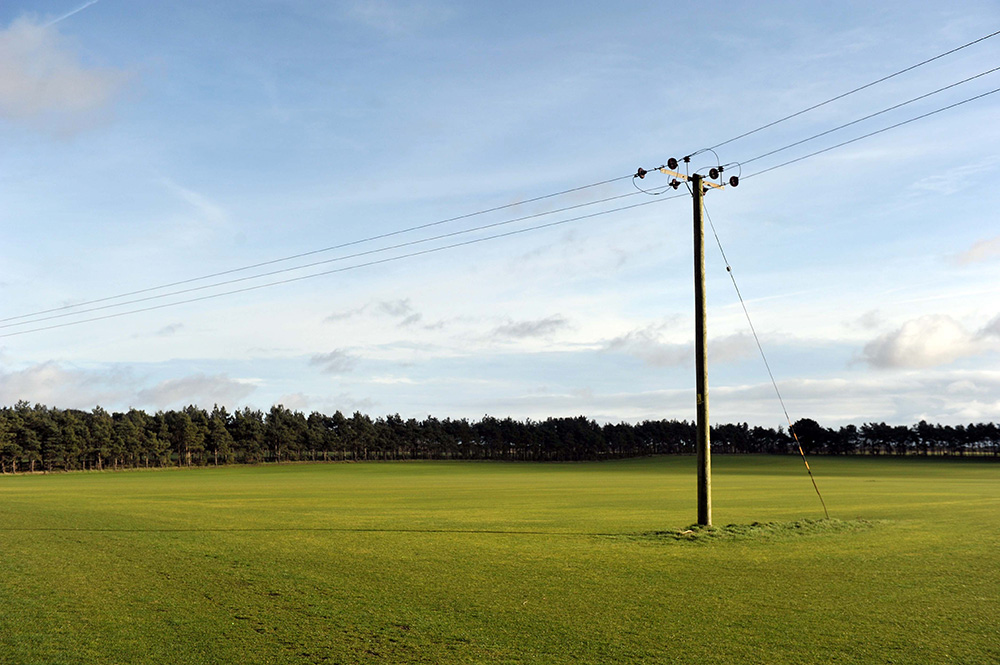
This is what a typical rural HV overhead will look like:
-
Milton is only a 2% bleach (sodium hypochlorite) solution, so weaker than needed to disinfect a water system. You can make "Milton" by just diluting plain domestic bleach with water and maybe adding some salt to it. The reason for needing a stronger hypochlorite concentration when disinfecting a water system is really to do with the limited contact time. Milton works because stuff is kept in contact with it for a fairly long time, but with disinfecting a water system you really just want to flush it through with a strong enough solution to pretty much guarantee killing stuff off in a minute or two.
-
And gloves...
-

New ASHP incoming... Running tips pls!
Jeremy Harris replied to Benjseb's topic in Air Source Heat Pumps (ASHP)
I agree with @ProDave, can't really go far wrong with the Mitsubishi, they have a good solid reputation. I've found that fine tuning the ASHP settings has given a significant performance improvement over the default settings our unit shipped with. As above, defrost frequency seems to be a fairly big hit on efficiency, so anything that reduces the risk of icing tends to make a useful improvement in performance. We can get away with running our ASHP only at night, on E7, really because our house is really slow to lose heat, so with the concrete slab warmed up overnight there's almost always enough residual heat to keep the house warm during the day, especially as our heating requirement is very low, and a fair bit of that is met just from us being in the house with the TV on, cooking, other appliances running etc. I'm not sure that the same would be true for an older house, that's probably a fair bit less well sealed and insulated. My guess is that you will find you need to run the heating during peak rate periods as well, just because the house thermal time constant may be fairly short, especially in cold weather. Even so, the running cost of the ASHP should be significantly lower than pretty much any other heating fuel. With the electricity price set to drop slightly this autumn I suspect that an ASHP may well be cheaper than mains gas. -
Unscented, non-thickened, domestic bleach (the cheapest supermarket own brand) will do the job OK. Bleach is usually around 6% to 9% hypochlorite concentration, so dilute it a bit to get 5% (check the label on the bottle). Pool shock (calcium hypochlorite) is another option (cheaper, in terms of the volume of bleach you can make up from a tub) but may not be as easy to get hold of. I've used both bleach and pool shock and both work fine. Pool shock is usually around 65% to 70% hypochlorite, so a lot stronger than domestic bleach.
-
Timber Frame - who to go with!!
Jeremy Harris replied to rufusmacdoofus's topic in Introduce Yourself
I opted not to bother with outline. IMHO, outline PP is mainly of use if your a vendor looking to sell a plot with PP, so as to increase its value, but want to leave the detailed design to a possible purchaser. Even then I'm not wholly convinced that having two sets of planning delays (typically at least 12 weeks each) makes much sense. Outline is possibly slightly less risky if trying to just establish the principle of development on a site, as it focusses the planners on that, rather than design-related stuff. You still need plans and drawings for outline PP, but they only need to be fairly simple. Whether you choose to use an architect or not is really an individual choice, bearing in mind that architects tend to be a bit costly. Most houses in the UK aren't actually designed by architects, it seems, and there's some merit in using an architectural technician if the design is fairly straightforward. They can generally do all the drawings, look after a planning application, etc, for a bit lower cost than a fully qualified architect. You can also choose to do as I did, and do the whole job yourself. I didn't find the planning process difficult; a bit irritating at times, but not technically demanding. Hardest thing to learn for me was the design aspect, together with researching the building regulations. The drawings weren't hard to do, but then I didn't need to produce lots of structural detail drawings as the timber frame company looked after all that. -
Welcome. Do you know if the cables are LV or HV? Makes a fairly big difference to the cost of the work if it's an HV cable. Also, a wayleave would not automatically be binding on you, as the new owner, as often they terminate upon sale. A wayleave normally has a small annual payment to the landowner, and will give a termination notice period. An easement would normally be registered with the Land Registry and would bind you as the new owner to allow the cables to cross the land. Worth paying the small Land Registry fee to see if there's an easement lodged with the title. We had both an underground cable crossing our plot and an overhead cable, both LV and niether having an easement or wayleave in place. I negotiated a price to have the cables moved to a new underground location around the edge of the plot, and agreed to pay about half of the sum that the DNO would normally charge, as roughly half the work was for our convenience. I also agreed to an easement, so now the DNO have the permanent right to run the cables around the edge of our land, and have a pole in one corner. Assuming it's a relatively light duty LV overhead it's replacing, something like 95mm² ABC, then as an indicator as to price 120m of wavecon 95 underground cable would cost about £3k. You may be able to lay the cable; our DNO were happy to just drop off a drum and have our guys lay it. The only other cost is then the removal of the poles and the cost of jointing. Jointing would be two people for maybe half a day for making off two connections. There would be a cost for the legal stuff, probably two or three hundred on top of that. I'd have thought that a straightforward LV underground replacement cable installation, with the removal of a couple of poles and just a joint at either end, should be somewhere around £8k to £10k. The devil's in the detail, though, as if it's a heftier cable, or if it's HV, then the costs will be higher.
-
Power consumption, summer?
Jeremy Harris replied to JamesJJJ's topic in Mechanical Ventilation with Heat Recovery (MVHR)
The insulation is probably something like rockwool or glass fibre I expect. Should be easy enough to remove it to see how to connect a silencer, I think. The main thing is to ensure that the insulation vapour barrier on the outside is taped up, so that condensation can't form inside and make the insulation wet. -
Soil pipe minimum distance from wall.
Jeremy Harris replied to epsilonGreedy's topic in Waste & Sewerage
I went into this in detail when I had the problem, and someone on Ebuild suggested I use the McAlpine offset connector (can't remember who). I ended up getting advice and was told that the fitting was perfectly OK for use at the base of a vertical soil stack. TBH, I can't see how anything could get caught inside it, as there is a significant slope on the offset step inside. -
-
Soil pipe minimum distance from wall.
Jeremy Harris replied to epsilonGreedy's topic in Waste & Sewerage
I ended up having to fit one of the small offsets (like the lower one in the photo above) at the base of our soil stack for the same reason, the pipe came up a bit too tight to the inside of the wall at the rear of the house. I chipped out a bit of space around the vertical pipe where it came up through the slab and slotted the offset fitting down into it so that the stack then cleared the inside face of the wall OK. Seems to work fine, it's been in and working for over 5 years now. -
Timber Frame - who to go with!!
Jeremy Harris replied to rufusmacdoofus's topic in Introduce Yourself
I'd guess that the vast majority of self-builders get planning consent first and then seek out a builder. Planning can place constraints on the design that may well change the type of construction used. For example, we had a bit of a battle in that the planners initially wanted our house to be constructed from the local stone. I fought this and succeeded in getting them to agree to timber, but that was the exception here, as most of the other new builds in the village have been in stone. -
Solar Dynamic Panels for Water Heating
Jeremy Harris replied to Ferdinand's topic in Solar Thermal (ST)
When I looked into them years ago, I went down to Southampton to visit a UK importer who was looking at selling them here, and who had a demonstration installation fitted to their industrial unit. The main advantage they had for heating water is that the refrigerant heat exchanger is inside the water cylinder. This improves the efficiency a bit, enough to be able to get hot water at around 55°C to 60°C without incurring a big hit on the COP. They also have the advantage of lower power consumption overall, because there's no fan or water circulating pump. Overall, there seems no doubt that they work well under the right conditions, the problem was that we couldn't get any hard data out of the Portuguese manufacturer at all, they just refused to provide it. This was the reason the chap in Southampton pulled out of selling them in the end. -
DAB is broadcast from Four Lanes, medium wave from the old mast at Lanner. A useless fact: The monument on Carn Brea is to one of my ex-wife's relatives. Apparently they owned much of the area around Camborne and Redruth once upon a time.
-
Solar Dynamic Panels for Water Heating
Jeremy Harris replied to Ferdinand's topic in Solar Thermal (ST)
They will probably have to drop the "solar" bit, too, as the last bunch to try and market these as being some form of solar collector system ended up being told to remove this from their advertising, I believe. As I mentioned earlier, it's be nice to see some solid data on how well these work. When mounted vertically on a wall they apparently work quite well, but no one (AFAIK) has been able to provide hard performance data under defined conditions so far, which seems a bit odd, given that they are quite popular in Portugal and Spain. -
I had a summer job before uni working on an assembly line for Gallenkamp, a lab equipment manufacturer, in Chalfont St Peter. The factory was uninsulated and draughty, but had "black heaters" in the roof, which were just radiant panel heaters. That was around 50 years ago. Likewise, practically every big airfield I've ever to has had radiant heaters fitted in the roof space of maintenance hangars. Often these were steam heated at military airfields, run from the station steam supply. All these heaters had the same problem, the heat conducted out to the floor from the soles of your feet exceeded the ability of your body to warm your feet. Ask anyone who's worked in a place with radiant heating how their feet felt and they will tell you much the same thing.
-
I think it's worth examining this from the suppliers perspective, bearing in mind that all "smart" meters have the ability to bill in KVARh (it's something that's on the wish list of suppliers to implement already, has been for some time). Suppliers buy in wholesale energy on the half hourly, 24 hour buy ahead, auction. They pay around 5p/kWh or so on average for it (varies a great deal, January this year averaged about 6.255p/kWh, by April this had dropped to about 3.55p/kWh). A domestic three phase supply is exactly the same to a supplier as three separate domestic single phase supplies. Why should a supplier be happy with a domestic installation that consumes energy on one phase whilst exporting energy on the other two phases, offsetting export against total consumption and which really means the supplier giving the consumer energy on the loaded phase for free? It's a bit like me asking if my neighbour's bill can be reduced by the amount we export, on the basis that the cable that feeds both of us (on different phases) is supplying less net power across all phases. It may well be that domestic three phase kWh net metering may possibly exist for a time, but frankly I can't see the suppliers putting up with it for long. Sooner or later they will want to address the imbalance, if only to keep the network operators happy.
-
This really needs thinking through carefully, to unravel the inherently flawed logic in their explanation. If you take the case of a room with a very high heat loss rate, then what they say sort of makes sense a bit. However, if looking at a reasonably well insulated house, then the explanation only makes sense for a few minutes after the heating has been turned on in a cold house. After that, the radiant heaters will have warmed up the floor, walls and all internal stuff and they in turn will have warmed up the air, so in reality all that's happened is that the air has reached a warm temperature, such that when the heating has been on long enough for the thermostat to cut off the whole room will be warm. In essence this is identical to UFH, but with the disadvantage that a warm floor is generally perceived as being more comfortable than a cold floor and a warm ceiling. I've spent lots of time working in hangars that have radiant ceiling heaters that work just like these, and the combination of cold feet and a warm upper body isn't a pleasant one (it is probably the only way to make an inherently cold space workable, though). UFH delivers most of its heat by radiating it into the room, exactly like these panels. The radiated heat warms the other surfaces in the room in the same way (but from the opposite direction), plus there is some direct air heating, as well as the indirect air heating from the warmed surfaces. The same thing applies after the heating has been on for a time, the air gets up to an equilibrium temperature.
-
Everything I can find just says that TV channels are being moved as a consequence of the 5G changes, not that any channels are being removed. Which have some advice here: https://www.which.co.uk/news/2018/05/have-you-lost-freeview-channels-this-could-be-why/ that suggests that they may offer free replacement aerials for some who cannot get their old channels back by retuning.
