


Temp
-
Posts
10640 -
Joined
-
Last visited
-
Days Won
43
Everything posted by Temp
-
Looks like most of the rise is down to the oil price increasing. UK Oil up about 13%. Pound down about 5%.
-
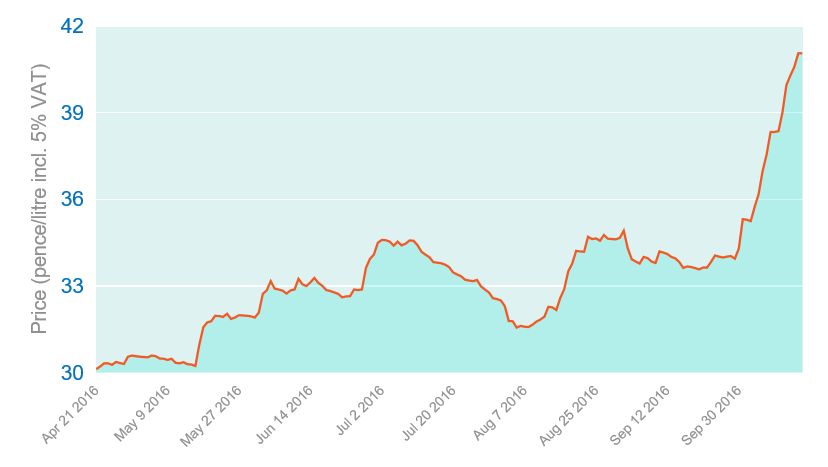
Just a heads up that Heating Oil seems to be on the rise. Up 23% over the past 17 days. Mostly due to the falling £ I guess. Graph care of Boiler Juice...
-
I think the VAT problem I was referring to above only applies if a VAT registered business lets out the flats but you need to check this issue further or you could end up liable for VAT on the rental income... http://www.revenue.ie/en/tax/vat/leaflets/property-guide/letting-property-new-system.html#s4 4. How does a landlord opt to tax a new letting? (Section 97(1)(b) and (c)) A landlord who claims a deduction for input tax incurred on the acquisition or development of a property, which is to be used for letting, is treated as having exercised the landlord's option to tax the letting of that property.
-
Other issues I can think of.. Might be worth thinking about the tax position. eg If the business/shop owns the flats then is it better for the business to divest itself of the flats (perhaps sell them the business owner personally) before or after conversion/refurbishment when the value is higher? Don't let anyone move in before the refurbishment starts or you loose the ability to reclaim the VAT (no longer empty for 10 years before work starts). However they can move in a few days after refurbishment starts as that's allowed! I recall there is an issue with VAT if a property is rented out immediately. I'll try and find out more.
-
I think the first step is to ask the planners what they think the current "use class" is for the bits you want to refurb/convert. If they say they think the flats are still part of the shop/retail A1 or storage then I think you can change them to residential under PDR and reclaim the VAT using the self build VAT reclaim scheme for conversions. If they think they are already residential use class then no need to involve planning and you have to prove they have been empty for 2 or 10 years to get partial/full VAT relief. I think it will only be zero rated if a VAT registered builder does the refurbishment. There is no DIY reclaim scheme for empty houses.
-
Might also be relevant although note the VAT implication I mentioned above if arguing it's already mixed use. http://www.legislation.gov.uk/uksi/2015/596/schedule/2/part/3/crossheading/class-m-retail-or-betting-office-or-pay-day-loan-shop-to-dwellinghouses/made
-
https://www.planningportal.co.uk/info/200130/common_projects/9/change_of_use/2
-
Actually the law changed last year (?) so that converting a shop to residential is now Permitted Development... http://www.homesandproperty.co.uk/property-news/buying/planning-advice-can-we-convert-an-empty-shop-into-our-first-home-a100661.html So it might be easier just to apply for a certificate of Lawfulness on the grounds that the conversion would be Permitted Development. The bonus if this approach is that it's now a conversion so you can reclaim the VAT. If you go the other route you face a contradiction... To prove change of use you have to prove they were used as flats for 10 years and that may make them ineligible for the VAT reclaim scheme (not empty long enough).
-
In the case of an unlawful "change of use" it's 10 years not 4 that they have to initiate enforcement action. eg You would have to provide evidence that the change of use to residential occurred > 10 years ago. Something like paying council tax on the flats for that period might be enough but collect every scrap of evidence you can find.
-
Modesty/privacy options for large south facing glazing
Temp replied to lakelandfolk's topic in Skylights & Roof Windows
I'd wait for the planners to raise the issue rather then raising it yourself. -
Modesty/privacy options for large south facing glazing
Temp replied to lakelandfolk's topic in Skylights & Roof Windows
How about some sort of film that can be removed of changed later? You can get some that makes it look like the glass has been etched, perhaps with something like a band with a tree/vine pattern that adds a level of obscurity just at head height with clear glass above and below. Used a lot on office partitions. Another option might be an internal screen/blind installed a few inches inboard from the window. Lets the light in which heats the screen. When they know you better it can be disappeared? It's possible you may need some sort of blind or screen anyway if you get too much solar gain in summer. Likewise curtains in winter to cut down heat loss or provide you with extra privacy at night when you are backlit? -
Our screed wasn't polished but we did get cracks that could be avoided...The occurred where the screed in two rooms met at a doorway. Looks like each area shrank towards its own center. So I would definitely put expansion joints at doorways.
-
In my experience Building control are generally far more helpful than planning. Planning messed me about for over a year and then agreed my original proposal (long story). Building Control allowed me to get away with a window that was slightly too narrow and another with the sill slightly too low when it would have been difficult to fix either.
-
As I remember Approved Document Part A basically says... "If you build it like this it will meet the Building Regulations". However you are free to build anything you like if you can convince Building Control that it also meets the Building Regulations. So I see no problem with having higher ceilings provided Building Control are happy. To do that they may want evidence that someone like a structural engineer has approved the design. I would just ask them if what you propose is ok.
-
The kitchen/utility is going to be used regularly so I would feed it from the UVC to take advantage of the ASHP COP. If it's a long way from the UVC I would install a well insulated secondary loop so hot water comes through instantly. If the downstairs shower is going to get used regularly I would also feed it DHW from the UVC (also with secondary loop for same reason). I'm not sure about using an instant water heater for the downstairs shower and basin. What sort of flow rate do you want? Personally I like a high flow rate shower and for that you need quite a powerful unit - perhaps 10-12kW although some people are happy with 7-8kW showers. How much PV are you installing? If it was only 4KW you would be importing the rest when using this shower. Would be interested in Nicks views on this? PS Size the ASHP and UVC correctly you shouldn't run out of DHW. We just have a 300L TS and haven't run out although it is recharged fairly quickly by our boiler.
-
Perhaps dab some silicon bath sealer around the screw terminal to keep moisture out (after testing it works!)
-
That's interesting. So it would look something like this if I've understood correctly.... DHW Primary (Presurised): ASHP -> TS -> UVC Stove -> UVC (Dump rad and PRV) Secondary(Mains pressure): Cold incoming -> Coil in TS -> Coil in UVC -> DHW (Mains pressure) UFH/CH ASHP -> TS -> UFH (Presurised) PV PV -> UVC This would mean the TS pre-warms the water on it's way through to the UVC when a tap/shower is opened). TS runs at UFH temperatures so no issues with the temperature uplift (Good ASHP COP). The TS and UVC and UFH are all unvented/pressurised and can be dosed with Fernox and something to stop legionaries if deemed necessary. . The stove heats the DHW but not the UFH. The UVC would/could be 300L-500L and the TS perhaps only 100L ? Have I understood all that Nick?
-
Yes that works. Think it's fairly I think that what I was suggesting just above.
-
I grew up in a house that used a wood/coal burner with back boiler. My parents were more than happy to see the back of it when gas CH was installed. It's not the feeding with wood that gets to you its the emptying ash, cleaning of the glass, relighting etc. On balance I would install a stove (I like a real fire in winter) but I would ditch the idea of using the stove to heat the TS and install ASHP from the outset. The cost saving on the stove and the associated back boiler, plumbing and installation would help pay for the ASHP. There are other reasons for ditching the back boiler.. A new house will be well insulated that it will only be possible to run a small low output stove anyway. Are there many stoves that output little to the room and a lot to the back boiler? I've heard not. I would also want my stove room sealed so it burns outside air not room air. Again that reduces the number of options. Is there a low output stove that can hold enough wood to still be burning next day? How big will the PV system be? Is it worth using it to heat the house or would most of the benefit come from using excess to heat the DHW only? The heating won't be on in summer and excess PV output will be down in winter (more used for lighting). I think I'd be happy with just using the excess for DHW. Taken together (no back boiler and PV for DHW only) the result would be a much simpler system to install and operate......... . ASHP -> small buffer tank -> UFH ASHP -> Mains pressure DHW tank -> mixer -> DHW PV -> Element in Mains pressure DHW tank An off the shelf mains pressure DHW tank is also likely to be cheaper than a custom TS even though there isn't a huge difference in the parts count.
-
I think the idea is you drill holes in the wall. Fit Rawlplugs and then just tap/hammer the screws in (protecting the face of the switch with a block of wood/cloth). Not sure I like this idea. I'd buy another type that can be disassembled. You are bound to get some corrosion issue with the wire to the switch in a few years time and will need to take it apart to fix that.
-
DeeFunFan... My system is much less complicated (oil boiler -> Thermal Store -> DHW and UFH) yet I also had nightmare of a time finding a plumber that understood such a system. My builder recommended someone that claimed to be a retired heating engineer that acted as an expert witness in heating related legal cases. Even he didn't understand how this was meant to work. In the end I drove him 200 miles to visit a company that designed and sold thermal stores. They basically taught him/us how it should all work. The thermal store is the key to the system so I would go visit a few and have them make a proposal. +1 ASHP work best (highest COP) the lower the flow temperature. So they are ideal for UFH, less ideal for DHW. The approach Nick suggests is good but I'm not sure how/if it could be modified to allow the stove to heat the UFH. One possibility might be to have a very well stratified TS that is much hotter at the top than at the bottom (as le-cerveau mentioned) . The stove would heat the top and the ASHP would heat the middle/bottom. Both DHW and UFH would be drawn from around the middle. Little or no mixing down required although I would fit mixers anyway. However I think this would be a difficult system to set up and get working reliably. If the store wasn't perfectly stratified (eg it becomes stirred) then the ASHP flow temperature would have to be higher. You need to be really sure the TS company know what they are talking about and have them take you to see such a system in a customers house. We have two DHW outputs on our TS feeding different parts of the house. So two sets of plate heat exchangers, two pumps, two mixers, one secondary loop pump in addition to what's needed for the UFH. This works very well in that we get two mains pressure showers with good flow rates. However the heat loss from the TS and all that the additional plumbing is significant despite being insulated. The TS is in a room the size of a small bathroom and that room gets quite toasty. I would not want to waste that heat by having it leaking into the loft space. Plan an airing cupboard? PS: In case it's not obvious... I would NOT get your plumber to design this system. Get the TS company to do it and perhaps get your plumber to install it if you are happy with his work. PPS: There is an issue of who is responsible if it doesn't work. Is it down to the TS company to solve or the plumber or you?
-
I agree. Plan 1 first and anything else as a fall back.
-
I think it's also possible to have an above ground soakaway/soakaway mound. The idea being to put the water into a large bank of earth that distributes the water over it's footprint (which is much larger than a normal soakaway). Got a feeling someone on this forum has done one? or was it someone on The Green Building Forum? http://www.moir-environmental.co.uk/pdf/Mound Soakaways.pdf
-
No usually you have to do it or hire someone to do it. The BRE have a guide that explains how to design a soakaway and that includes some info on how to do the test.. http://forterra.co.uk/plugins/downloads/files/BRE365.pdf If you hire someone you get a report you can wave at the planners (to get a planning condition removed) and Building Control to keep them happy. You need a digger to make a few holes and it's common to get both a percolation test and a soil condition report done at the same time to save money. The latter may be needed for the foundation design as it includes info on load bearing capabilities, clay shrinkage etc. However if the soil in the are is well know/understood then you might get away without. May also need a water bowser to fill the hole for the percolation/infiltration test.
-
Has the current owner had a percolation test done to check drainage is as bad as suspected?
