AliG
-
Posts
3211 -
Joined
-
Last visited
-
Days Won
11
Everything posted by AliG
-
On the B&Q website it appears that there are a few options You could go for a vanity under the sink and a separate toilet like this, this is probably much cheaper and maintenance will be easier. I would also argue it is maybe a more modern look. http://www.diy.com/departments/cooke-lewis-romana-matt-grey-vanity-unit-basin-set/1444755_BQ.prd Or they have this unit that is more like the ones you were looking at and has a sit on sink top. You can buy a package with the toilet or buy it separately as you might want a more modern looking toilet - http://www.diy.com/departments/cooke-lewis-ardesio-woodgrain-effect-bodega-grey-vanity-toilet-unit/1005908_BQ.prd Find yourself a 60 year old on a Wednesday and you can get 10% off!
-
I have bought three vanity units from Ebay in the last few years. All were cheaper and better quality than the stuff available in the shops. The last one shipped direct from Germany. As ever the issue for @Crofter is can they deliver to him. The price of decent bathroom units at retail is stupefying. In the new place we are using Porcelanosa's range. At the trade price they fall from laughably expensive to still more than I think is reasonable, but I saw it as part of the package of stuff we are buying and it was easier to get everything in one place. My current house was built with the type of stuff shown in the pics from Bathroomcity. I would be very wary of the issues @Nickfromwales mentioned. Eventually the edges started to blow where items had got wet. I vowed to avoid MDF bathroom furniture as much as possible from now on, particularly the worktops. If I was going for something like those I would want one with a solid surface worktop or vanities where the sink covers the entire top of the cabinet. These can be bought relatively inexpensively for bathrooms and won't look knackered in a few years.
-
It appears that you don't need the self levelling compound. You can go down to 4mm thick with Marmox and 6mm with ProWarm, but obviously the insulation gets better as it gets thicker. They cost around £10 a square metre depending on thickness etc. It would be difficult to get under 25mm with tiles, maybe with 4mm board. I'd probably go for vinyl. It is thinner so you can get a bit more insulation under it. It is warmer and more comfortable underfoot and probably less slippery, although you can get tiles that are less slippery also. There here will be no grout to maintain and people cannot drop stuff on it and crack it. It is easier to clean. Properly fitted, vinyl can look just as good if not better than tiles. Tiles probably last longer and are more durable from general wear and tear. http://www.theunderfloorheatingstore.com/media/wysiwyg/downloads/insulation-boards-manual.pdf https://www.tilefixdirect.com/pdf/marmox-multiboard-floors-adhesive.pdf Having written this up I should probably cancel my bathroom tile orders!
-
Do you already commute to London? I hate commuting, hence I live in London during the week and home in Scotland at the weekend. I actually spend less time commuting than some of my workmates. If you already commute to London, you'll know what places make a sensible commute option. For example the map @Ferdinand has supplied says that Henley on Thames is 45 minutes from london. That is true the train from Paddington to Henley takes between 40 minutes and an hour, mostly an hour. Sadly that means that total commute time is 1.75 hours if you work in The City versus about 1.25hours if you work near Paddington. Sometimes further away places can be a faster cimmute if they are on a direct fast railway line. Basically start with which part of London you will likely be working in and which stations serve that area then find places served by those stations. Then try and narrow it down to a few places that fit your commuting and lifestyle criteria and budget. By the time you then need to find a plot I would imagine it will be a long process.
-
The fact that it is a Georgian style house will make little difference to the cost. Indeed it can be a relatively simple shape so cheaper to build. The more complicated a shape of house you have the more it will cost, think lots of corners and different roof pitches or large areas of glass and curved walls. So £1500 a square metre should be fine. The other big swing factors are the cost of architects and a main contractor. These will add considerably versus managing the project yourself and building something less bespoke. But you should still be able to come in at around £1500 per square metre. There are various hidden costs in planning such as ground surveys, bats, local council fees etc depending on the plot that could conceivably run into 5 figures also. The real issue will be what will a plot cost to buy. As a rule of thumb, I feel that people on the site are finding that they are building houses for roughly what they are worth. Developers spend less building houses due to lower spec and economies of scale. This effectively creates their profit margin and allows you to buy a plot for the same or more than a developer might pay. If a similar 250sq metre house in the area you are interested in costs £750 or less then there is a good chance you can buy a piece of land and build one for the same or a modestly lower price. The harder land is to come by, though the tighter the margins get. Think of it this way - Developer House price 750,000 Profit margin (15-20%) £130000 Build cost (1200/sq m) £300000 Land value £320000 Self builder House value £750000 Profit margin 0 Build cost 375000 Land value 375000 So you should be able to outbid a developer to buy a plot and come in within your budget if that is the cost of a similar house. You might even save some money, although my experience is that developers are willing to bid to lower margins due to the difficulty in finding land to build on. One issue you might have is a developer will often try to squeeze as much as possible out of a site, so if the site can fit a 6 bedroom house or 6 flats it will be worth more to them than you. It won't be easy finding a plot that is just right in the SE within easy commute to London. Generally speaking if a site is well advertised and has not sold it is probably quite highly priced. Certainly in Edinburgh recently I believe individual house plots have gone from uneconomic prices and they are getting a premium because people want to build their own house and their are few nice sites available. I know of two sites that have been sold for similarly sized houses to what you propose for around £400-450k with final house values at £800k they look pretty pricey to me. I would say that SE prices outside London are generally still higher than Edinburgh although it varies enormously by area, some are way more expensive than others.
-
How strong is a stainless steel bar?
AliG replied to reddal's topic in General Self Build & DIY Discussion
All the kinds of steel section you could possibly need! One of them must work. https://www.metals4u.co.uk/mild-steel/c6 -
MVHR and warm roof loft space
AliG replied to Crofter's topic in Mechanical Ventilation with Heat Recovery (MVHR)
You said that the attic would be within the vapour lined space. I think in this kind of build up, it would be normal that the vapour impermeable layer would be the ceiling and the roof would have a vapour permeable layer to allow moisture to leave. Then moisture cannot rise up into the roof space and if it does it can get out through the roof. -
Your suggested build up for tiles would probably be fine. My only issue was that you could lay wooden flooring directly onto the Celotex, and save headroom, but then you could end up with a noticeable step up to any tiled areas.
-
I think you don't need so many layers. Here is some advice from Kingspan on a similar floor http://blog.kingspaninsulation.co.uk/why-and-how-to-construct-a-floating-floor/ You could out T&G flooring direct on top of the Celotex. The problem then would be tiling, you would need two layers before the tiling probably. I have a single layer T&G floor over UFH and the tiles have popped and broken. Theoretically it is stable enough but there is too much movement.
-
A few years ago I had an HP laptop. It was quite an expensive high end one. The power supply gave up the ghost after 18 months. I called to complain and ask for a replacement. They were adamant that it was out of warranty and that was the end of it. I argued that it was not fit for purpose and I had a reasonable expectation that it would last longer. Also that theoretically EU products should have a two year warranty. They put me through to some complaints people. It seemed that they had deliberately hired some nasty belligerent people who's job it was to stonewall complaints. I tried the UK HQ and got nowhere. Basically the complaints people said yes I might have a case under the sale of goods act, but unless I actually sued them they weren't going to do anything about it. I have a MacBook now! I decided that the extra cost was probably worth it in terms of the greater lifespan of the product and the better customer service. Indeed my wife's power pack gave up the ghost via the cable fraying after a similar time. We took it to the local Apple Store and they replaced it. I often say that when I retire and have more time my hands I will probably find myself in the small claims court regularly. Many companies seem to think they can get away with taking people for fools and as @Stones said often its just not worth your time to argue about it. Although the US is overly litigious this is one area where we could learn from them. The ability to bring class action lawsuits where companies consistently disappoint their customers likely leads to better service. I don't know if anyone else had this issue, but a few years ago VW had a bad batch of ABS controllers. If you searched the internet the ABS on Golfs, A3s, Octavias etc would regularly fail after 3-4 years. This happened to my dad's car just outside warranty. They paid 60% of the cost, but it was plainly a manufacturing fault that affected thousands of cars. In the US this would definitely have lead to a class action and a free replacement as has been seen for many products there recently such as iPhone batteries and Xboxes where there were systematic issues.
-
uPVC, Timber or Timber with Aluminium Windows?
AliG replied to Lucy Murray's topic in Building Materials
Hi Lucy, It is not clear, but it sounds like the deal you have is that the timber frame company supply the windows as well as the frame? If so are they giving you a spec for the windows and what is the cost difference. The comments above are correct, so a lot will depend on your budget and your willingness to maintain the windows in the future. -
How do I know if CE mark is genuine?
AliG replied to jamiehamy's topic in Regulations, Training & Qualifications
I am about to order some lights from Aliexpress so this got me thinking. There is no central repository of CE marks, so no way to check if it is genuine. Some high voltage products may come with a certificate that you can then verify with the issuer. Even if a CE mark is genuine it only states that the product complies with EU safety directives. It is no guarantee that each individual product was made in compliance with the original design and there is no requirement to test products. I think quite a few people on here have bought light fittings that were incorrectly grounded. Best thing may be to test individual fittings if worried, or at least some of them. -
Fair, not sure exactly what the screed spec will be yet. Could probably do 60mm PIR and 50mm screed.
-
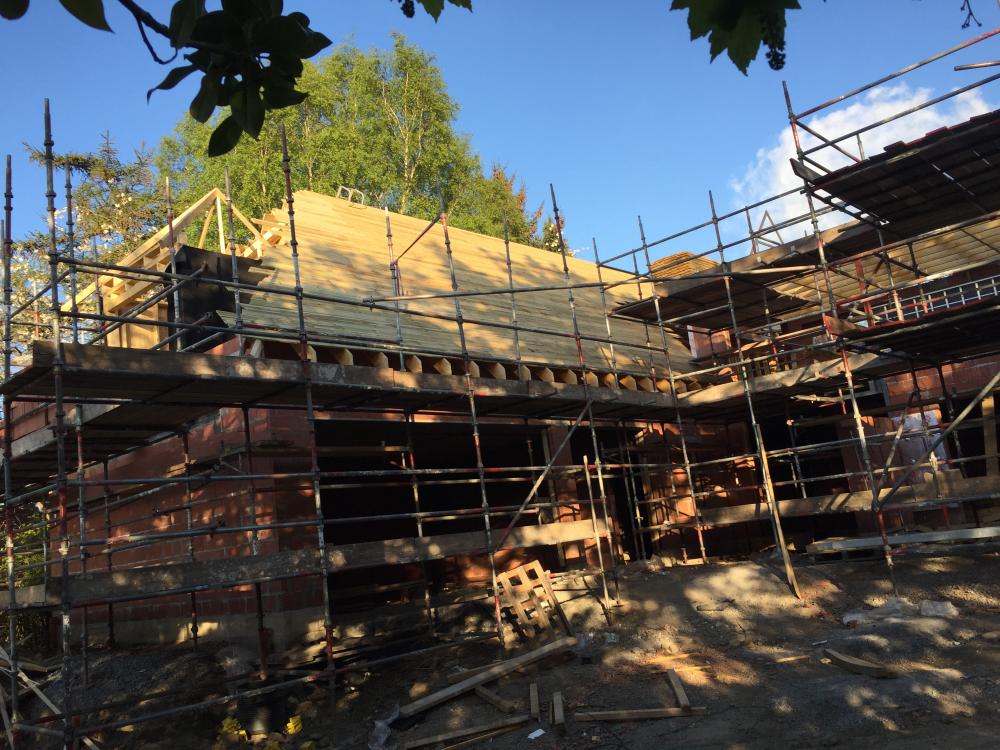
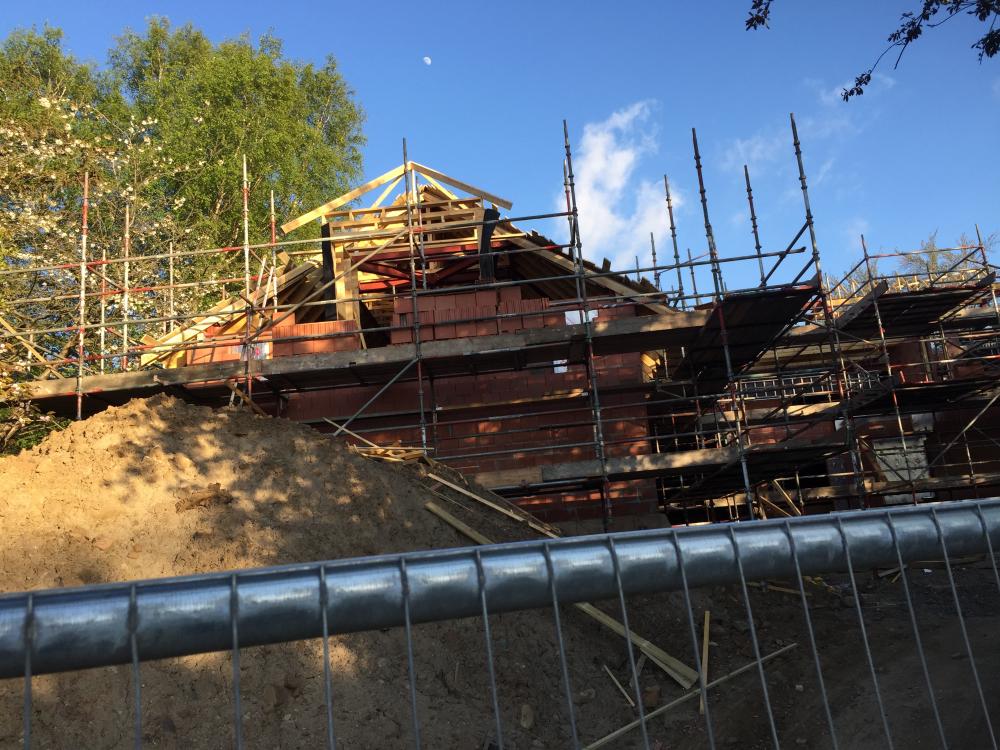
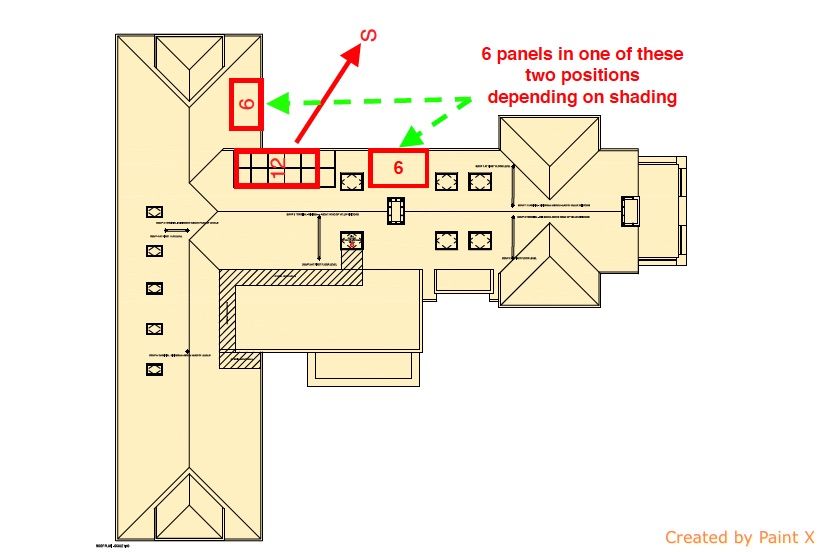
Just a quick update, I maybe should turn this into a blog, but as I am not that involved with the building it probably wouldn't be as helpful as others blogs. I was away for work last week, but in my absence the architect, main contractor and heating engineer had a meeting on site. Due to steel going across the path of some of the MVHR it will have to rerouted. Luckily I had decided to have a stepped ceiling in the lounge and dining room and the MVHR pipework should easily fit in the stepped down area rather than the hall where it was originally to go. We have changed from 80mm sand cement screed to 60mm liquid screed. It isn't really clear why we were not using liquid screed anyway. The heating engineers agree that the UFH should operate more efficiently as there is less chance of air bubbles in the screed. Also the thinner screed should be more responsive. However, having made this change we have to look at the levels to decide on the thickness of the insulation. On the ground floor it may be that we need to change from 100mm to 120mm PIR. I am not necessarily against this as more insulation is better, but it appears that 100mm is more of a standard thickness so 120mm is unexpectedly more expensive. This will depend on precise measurement of the levels. On the first floor we had allowed for 30mm PIR and then 80mm of sand cement screed. Changing to 60mm should allow us to use cheaper 50mm EPS. It also allows me to move some insulation from the garage roof to the floor of the room above. Originally we had 100mm of PIR in the garage roof and 30mm in the floor above as the garage is not officially part of the insulated envelope, although the walls have the same insulation as the house, the problem is the doors. This is fine, but would have meant a lot of heat going into the floor with no rooms below to benefit unlike the rest of the house. Now we can have 50mm of PIR in the floor above the concrete planks and 50mm below. This will be both cheaper and perform better. The other thing to come out of the meeting is that we are 6-8 weeks behind schedule. I have been noting this for some time with the contractor constantly saying he would make it up. I have just ignored this and assumed we would be at least 1 month late. This does give me a bit of an issue as we put our house up for sale last week. If my house sells quickly though I won't exactly be complaining. Regarding the discussion a couple of weeks ago on the under eaves storage, I think it is very useful space but my wife is very concerned how the doors will looks so we will have to wait and see how we get around that. I found a door supplier nearby who I want to buy the garage doors from. For some reason they cannot get a quote from Hormann for the doors I need. Someone else I spoke to in England got a quote in around an hour, the Scottish dealer have had weeks. I really want to give them the business but there is a limit to how long this can drag out. Now that the roof is going on I am having the PV panel installers come out to do a site survey. I had thought of having 12 panels facing south and 6 facing west to get power for a longer period of the day. Now that I look at it I doubt the west facing panels would get power any later in the day whilst losing out in the morning so I suspect that it will be 18 panels facing south for a 5Kw system. Dormer being formed for my daughter's bedroom Main roof going on so we can see roughly how tall the house will be. The parking is coming along nicely.

-
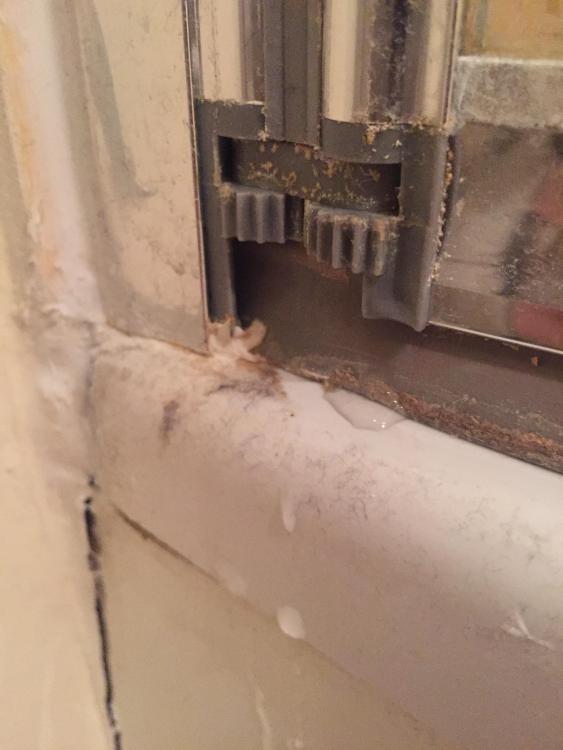
I took some pictures of the screen I have in london. It was the old one that had a small space where the blue square you pointed out was. The new one has a U-shaped plastic channel on the metal post and the seal then disappears into this at the bottom trying to form a better seal as @Triassic mentions. I knew it had been leaking though, so I switched it on with the shower directed at the corner of the bath. I had assumed that the water was getting under the seal, where you see it here. In fact watching from outside the bath, once water hit the door it actually came through the hinge where the grooved wheels can be seen. The drip that you see in the picture came from there but settled at the bottom making me think the seal wasn't working properly. I suspect that when hit by a lot of water these screens will always allow some water through, I find the only solutions is to as much as possible direct the shower head away from the screen. I think @Nickfromwales fixed screen is maybe a better idea, I am not sure that the concept of a moving hinge and watertightness are very compatible. Probably depends on how often you plan to use it, ok for occasional use but not for every day use.
-
Appliances: brand new or brand name?
AliG replied to Crofter's topic in Kitchen & Household Appliances
I would go for Siemens ovens/hob/dishwasher. They tend to look nicer than the Bosch/Neff equivalents for a similar price. You can often get ex display items on Ebay at a nice discount. Although I often notice they are collections only. I would def get new/ex display ones and then pay for the 5 year warranty extensions considering that they may be mistreated. We have a touch control induction hob. People seem to find it OK to use. If I was looking for oven I would go one generation back on Ebay as they have manual control knobs whereas the new ones are digital and more complicated to work. I would consider a pyroclean oven as no one will ever clean it and it makes such a good job of cleaning it. I am going to get Miele washer and dryer in the new place but as I understand it the premium for their other appliances is not worth it. The other appliances I have read don't have the same better reliability although I have only read this anecdotally. They can cost twice as much as Siemens items easily. Also would you let any visitor play around with a £1500 oven. Also Siemens has a very good repair network if things do go wrong. I agree with what everyone says, who uses all these programmes. I always try to buy the basic item from a higher end make. A microwave is likely to be useful for people staying a short time. More useful than an oven. Thus you might consider a combination microwave oven. However, I would note that the Siemens one we have has been the only item we have had that is unreliable and I have heard other similar stories on this specific item. Our Siemens dishwasher on the other hand gets used pretty much every day and the last two we have had have been faultless. You should look for a totally frost free fridge as defrosting it might be a pain. However, they tend to be much more expensive. -
Echo (sound) dampening options - special paints?
AliG replied to readiescards's topic in Sound Insulation
You're right Nick. I wasn't really clear. Thickness makes a big difference as well as density and how porous a material is. Maybe substance is a better word. Paint/wallpaper has neither weight nor thickness. It just cannot absorb sound. Also a heavy but solid material like a brick wall will not help with echos, although it would help sound transmission. So foam works due to its thickness and being porous. The panels that people put on walls are usually foam covered in material. So it is a lot heavier than just thin material but also a lot thicker. However, it is not heavy per se. There is lots of good info here and links to specifics on curtains, wall panels etc as well as how to make them yourself. http://acousticsfreq.com/complete-home-theater-acoustics-tutorial/ As @Nickfromwales says denser material is more needed for lower frequency sounds and echo may be higher frequency and easier to deal with. Even plasterboard helps to reduce echos as it will absorb sound to some extent. The worst materials in a domestic house are probably glass and tiles as they are very bad for reflecting sound, hence the only place I really notice it in our house is bathrooms. -
Echo (sound) dampening options - special paints?
AliG replied to readiescards's topic in Sound Insulation
I googled that paint and found a large thread where people were arguing it was a scam and the company wouldn't provide much in the way of verifiable data. I have been looking into this because we have a cinema room today and in the new house. I asked the installer about it as sometimes notice the dialogue is a bit muffled and he suggested that we had a company do an analysis of the new room to suggest solutions likely involving sound deadening panels. I had indeed thought that we might try some kind of flock wallpaper, but the reading I have done suggests that the material requires sufficient weight to actually absorb the sound. I note that the sound absorbing paint is around 3mm thick which is way thicker than normal paint so it will have some small effect, there is some data on the website suggesting a 2dB improvement, but it is unlikely that lightweight solutions can make a big difference. -
Echo (sound) dampening options - special paints?
AliG replied to readiescards's topic in Sound Insulation
We have hard floors everywhere except bedrooms at the moment, but the only rooms were echoes are a problem are bathrooms as there are no curtains or other soft furnishings. Even the kitchen has no echo issue and just has some quite skimpy curtains. Sound dampening needs weight so I don't see how it is possible with paint.The easiest ways are prob via rugs and curtains. The panels mentioned can be bought quite cheaply off EBAY or made yourself if you want. BTW leather sofas are much worse than fabric for sound deadening as leather reflects sound and fabric absorbs it, something I didn't know until last week. The main time I notice the problem is when I call my wife at home on the phone. If she wonders into a bathroom I can immediately tell as the echo makes her voice indistinct and I struggle to make out what she is saying. Similarly where it might cause an issue is watching TV as if there is a lack of sound deadening in the room, the echoing can muffle the sound from the speakers, so if I worried about any room I would worry about the main place you watch tv. -
Tilt and turn inward opening windows - how to dress them?!
AliG replied to readiescards's topic in Windows & Glazing
In some rooms we are having channels in the edge of the ceiling so that curtain track can be mounted invisibly and then curtains can be drawn back to the corners of the room so they would not interfere with the windows. It is something I have seen in some show homes recently which seems a good solution as curtain tracks are unsightly, but the pelmets we have in the current house would look old fashioned in the new one. You could also mount blinds invisibly in the space so that when they are up you cannot see them at all and they won't snag the windows. -
Help please balancing specification with budget
AliG replied to JohnW's topic in General Construction Issues
I looked into this. It did seems that you can use screed with post-joists which might be the best of both worlds giving a solid floor and a better material for UFH, but still having a service space between the joists. There may be issues with the weight of the screed and its affects on spans. -
I don't believe you can do anything about trees. Hedges but not trees. Edited: Actually a line of evergreen trees might be considered a hedge. This seems like good advice here. https://www.rhs.org.uk/advice/profile?pid=408
-
Help please balancing specification with budget
AliG replied to JohnW's topic in General Construction Issues
I have slab and screed. I pushed really hard for a raft foundation but the architect/SE weren't really up for it. One issue may be the weight of a concrete upper floor. My slab is 200mm thick and the supporting walls for the upper floor bear down on it, indeed in some areas I have 2 concrete upper floors, is it is very heavy. I wonder if an SE may have issue with building a heavier structure on a 100mm floating concrete raft. I am sure there are ways around this, but they are very married to their standard methods. To add to what people are saying about buying better, spec changes etc. If you are using a main contractor this is harder to do. What I did though was get an itemised bill then go through all the items to see where the prices seemed oddly high or the spec could be changed to save money. By far the biggest and easiest savings were in making small changes to the spec of the insulation. I would have a good look at what your heating consultant has recommended as I doubt they focused much on cost benefit of various points and this may be driving much of the spec. For example my architect originally specced Kingsapn Kooltherm which has about 10% better insulating properties than PIR but can be much more expensive. -
You can cut back the branches, if it's a conservation area then you need planning permission, but as long as you don't do any structural damage to the tree you can cut the branches back whenever you like. You just have to offer the cuttings back to the neighbour who owns the tree. There's no safety issue normally, however they get in the way of building work and the leaves will fill up the guttering so it is better to cut them back. Indeed I would recommend cutting them back as long as it won't ruin the look of the trees to stop your neighbours encroaching on your garden. I had to build my house 4m from the boundary due to my neighbour's trees overhanging that far. Like it say it is really annoying, if they didn't have trees there I could build 1m from the boundary and I just have a wasted space there and smaller main garden now. I got permission to cut them all back so that they don't affect my house and don't get in the way of building.
-
The first people to contact are probably the planning department. There are lots of threads on here re planning, neighbours etc. The normal assumption is that people object to almost everything and talking to them isn't necessarily helpful. As long as you comply with local planning guidelines it shouldn't matter what neighbours say. If you live in a conservation area the trees will have more protection. The only real issue is going to be the neighbour 2's birch. The assumption is that roots normally extend as far as the canopy so you would possibly disturb the roots. You would either need a report on this or perhaps you could show that your build method doesn't disturb roots. As it's only one tree then you might get away with this. But it will be the planning department who decide.