Miek
-
Posts
396 -
Joined
-
Last visited
Everything posted by Miek
-
Really? "Any" measurement? I'd love to see someone try and dig all found trenches to 10mm accuracy, not going to happen and very dependent on soil type. You can get the concrete pour to 10mm within level though especially if it's pumped in IMO.
-
Your house has over 40 tons of rebar in it? Holy S#*t !
-
That's a heck of a slab for a summer house!
-
If you think about the actual load on the foundation's it's very very small per unit area. The founds are massively overkill in my view, nowt to worry about, and it will all be hidden anyway.
-
Yes, the BCO will want to check the subsoil before pour, but they won't care about dimensions, that's your job
-
Whacking at an angle - sucking my teeth a bit - advice please
Miek replied to ToughButterCup's topic in Waste & Sewerage
It's only a drainage trench in a garden so no need to go crazy over it, just basic compaction will do IMO.. -
Whacking at an angle - sucking my teeth a bit - advice please
Miek replied to ToughButterCup's topic in Waste & Sewerage
40 degrees is quite a slope! I dont think you can 'Whack' your way uphill at that gradient, that's hard enough just to walk up. Id go downhill with a rope on the wacker to slow it down and hold it from the top with your hands whilst letting it out. bring it back up with your digger. However since you have a digger just thump the trench with the bucket to compact it every 150mm of fill, use the rounded back of the bucket to get harder compaction. -
That said, I presume I'll be getting the formwork level all around the top edge, and that when the concrete is pumped in I would just have to slide a long straight timber across the top of the formwork to get a fairly level top to the slab? Or is it not that simple? Just make sure the formwork is solid enough to jump on without it wobbling. Depending on your soil you might need steel stakes (my ground is very hard and a wooden stake is not an option) rather than wood. Make sure all stakes are sawn off so that they aren't in the way when striking it off.
-
-
Front garden excavation for drive
Miek replied to Margaret dailey's topic in Landscaping, Decking & Patios
You said it! Will need to REALLY reconsider this -
I power floated my shed (14x9m) by myself having never done it before. The mix was pumped in and then strike rollered to get it flat. Floating was easy IMO, depending on your expectations for perfection. How big is your garage?
-
Exactly my thoughts.
-
Bedding thickness for foul drainage pipe: how thick?
Miek replied to ToughButterCup's topic in Waste & Sewerage
Delivered? That's Cheap ! -
Bedding thickness for foul drainage pipe: how thick?
Miek replied to ToughButterCup's topic in Waste & Sewerage
Worth considering the pipe bedding material. Where I live pea shingle (6mm) is £25/t but graded limestone 'pipe bedding' which is basically 6-10mm clean is only 18/t. Better check with your building inspector but mine was happy with either. I'm laying around 100m of it so it does make a difference.- 14 replies
-
- 2
-

-
- foul drainage
- approved document h
- (and 2 more)
-
I would use steel rod. I don't think you will drive a wooden dowel through 3 sleepers unless it's loose, and that defeats the point. You can hide the steel with a wooden plug afterwards.
-
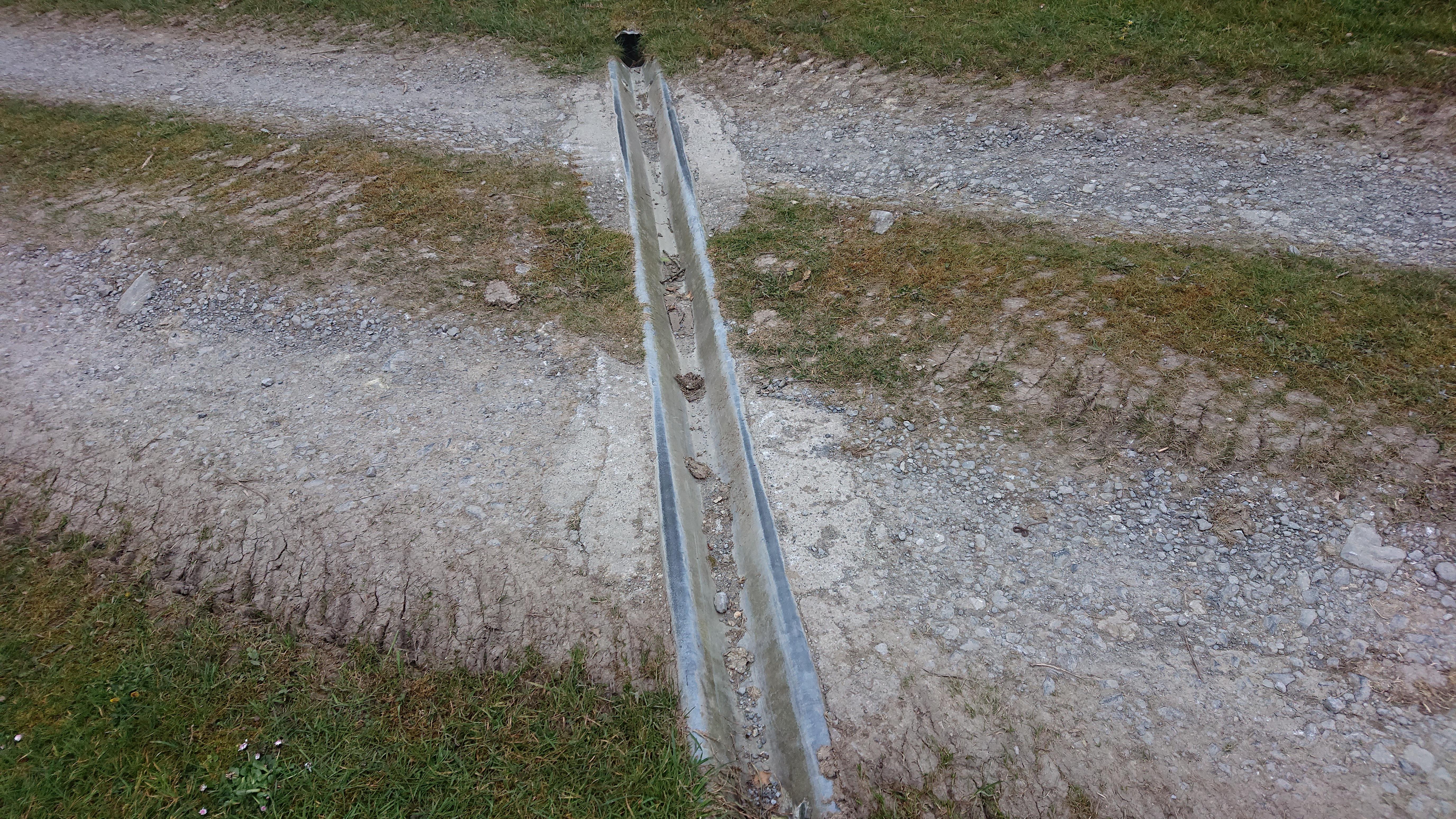
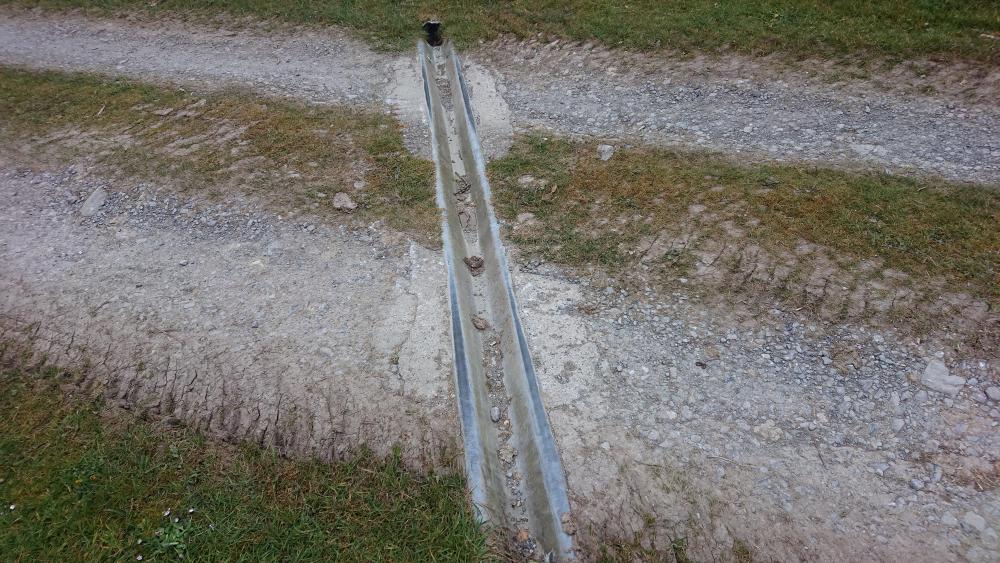
Also important to consider why/how potholes form in the first place. Drainage is key to a stone track as running or pooling water soon errodes the surface and leaves a small pothole which can the grow when a tyre passes through it and throws out the water and some of the stone. If you observe how forestry roads are built they have considerable camber to shed water off the track and a ditch to carry this water away. Road crash barrier makes a cheap gully to shed water off the track and will take a lorry if concreted in no problem. I have a potholed stone track too
-
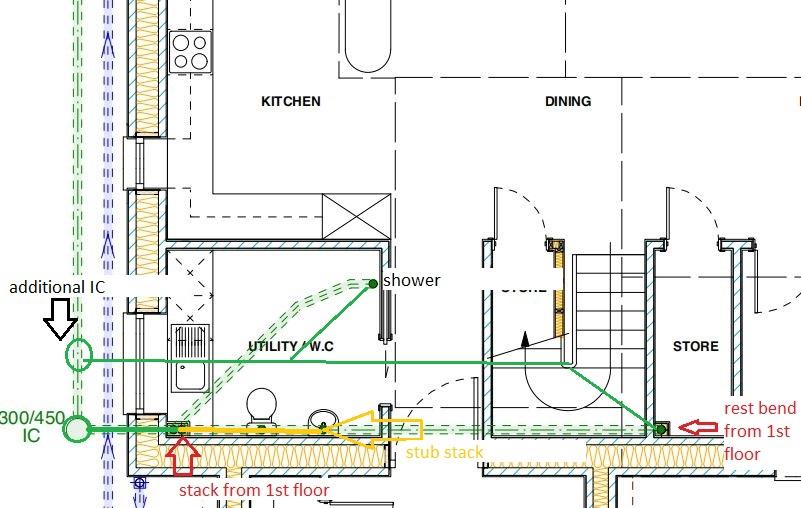
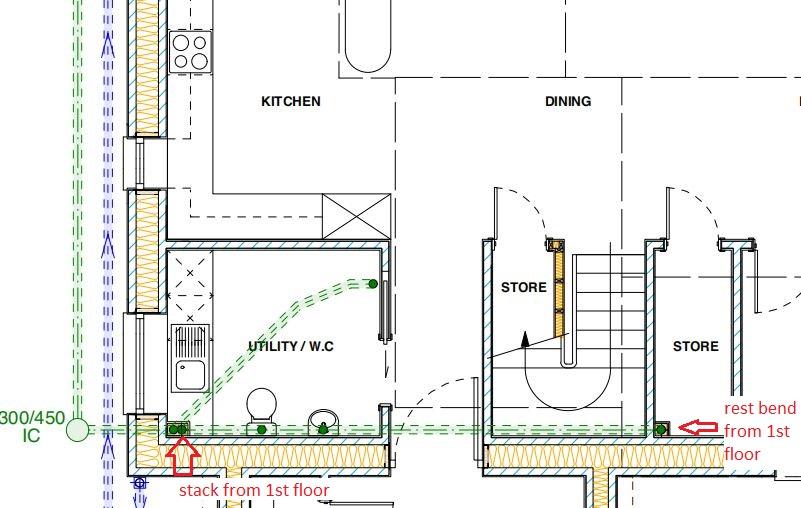
Thanks Folks @PeterW Below is how i've interpreted your explanation, my apologies if i misunderstood, its hard describing these things. Could the original IC on the corner of the house be replaced with a long radius bend? the fewer IC's the better from a cost point of view, as long as access is good.
-
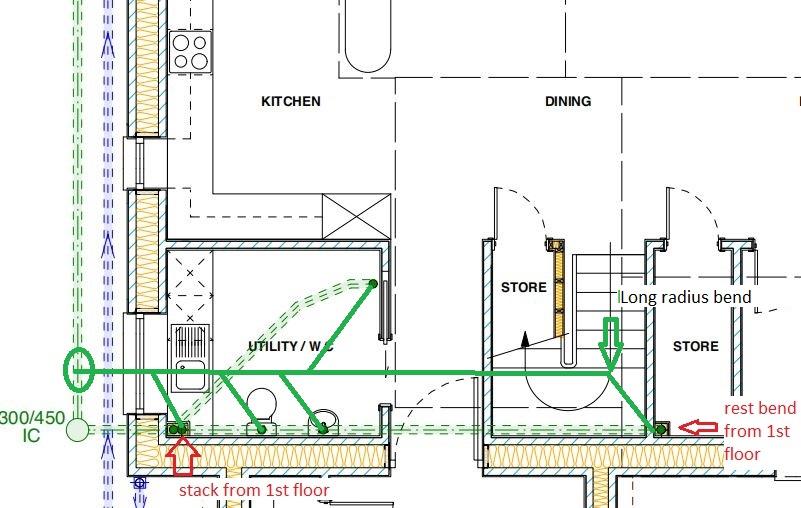
I think i get you. like below? seems overly complicated to me but means all vertical drops end in rest bends.
-
Hi folks Can someone look over this section of my drainage plan and tell me if i can build it as illustrated please? Can i drop a vertical soil pipe (110mm) into a horizontal using a 'Tee' or do ALL vertical connections have to transition to horizontal using a rest bend? even for a single basin? I hoping to dig my founds soon so i want to get this right before i start digging Many thanks in advance
-
You can choose cable 'wrap format' then enter the cable diameter and print, this works well for round cables. Or you can choose 'flag' format an it will print a long strip which wraps around the cable but leaves a long bit with the printing on. You can buy heat shrink tube print medium but it's very expensive for what it is. Just a note on cartridges, as with all printers the cost is in the ink. Cheap clone cartidges work well but the glue is not so good I've found, especially if doing cable wrap, but it's a third the price. I use clone eBay cartridges myself as I can't stomach the brother prices.
-
Calculating radiator output at different Temps
Miek replied to Miek's topic in Central Heating (Radiators)
Thanks, that will help I'll have a dig around some datasheets. -
Hi folks How do I calculate the actual heat output of a radiator at different temperature differences? As far as I can work out a 2kW radiator is rated when it's running at 70 degrees in a 20 degree room, so 50 degrees difference, is that about right? If for example I wanted to run the same radiator at 45 degrees (on a heat pump potentially) what would the output to room be if the rooms at 20? My mind tells me that this relationship is non linear, so what's the maths look like? Thanks in advance
-
Thanks Jeremy, that's very helpful. So the model 3 can't be told what to do by a charger? that is annoying. Also the 6A lowest charging current is a bit of a hindrance on a smaller PV array. It would be great if you could charge the car like a regular lead acid battery with a simple regulator and PV setup where any power, even I it's mA, is put into the battery. Wishful thinking...
-
I have a friend who's just bought a Tesla model 3 and wants to attempt to charge it 'Off Grid' using a PV car port. I can see it's possible to have a PV system with batteries and inverter to provide AC power to charge the car, BUT, Is it possible to charge and EV directly with the PV and inverter but without any battery buffer on the PV side? Assuming say you have 6kW of PV and an inverter capable of running off Grid AND without a battery bank. Will the charger accept a potentially fluctuating amount of power when for example a cloud passes by? My feeling is that this won't work, but does anyone have any ideas to the contrary? I've not found much on line rearding this so any help would be much appreciated.
-
Rocket, one of the fastest and easiest plants ever and adds a lot of flavour.