SteamyTea
-
Posts
23836 -
Joined
-
Days Won
200
Everything posted by SteamyTea
-

Flashing / ending coping stone .
SteamyTea replied to Pocster's topic in General Construction Issues
How about a tanking coating, similar to what is used in dungeons and bathrooms. Or one of the PU flat roof repair liquids, maybe with some glass fibre choppings for added strength and stability. -
Welcome. I don't know how much you know about heating system, or the design/layout of your particular system, but as a general rule, low flow temperature heating systems are left 'on'. They add heat to the building when it is needed, not on a schedule i.e. 5AM to 8AM, 4PM to 10PM. Though it is possible to have times of lower building temperature i.e. when asleep. The reason for this is that simple physics, energy (kJ or kWh) is power (kW) multiplied by time (s, seconds or h, hours). A building uses the same amount of energy to keep a constant temperature difference between outside temperature (OAT) and inside temperature (IAT), it just depends how it is delivered i.e. short, hot bursts, or longer, warm delivery. ASHPs, specially with weather compensation (WC) automatically adjusts for outside temperatures, which helps with the system efficiency (CoP). One spanner in the works is zoning. Zoning is really just the ability to isolate parts of the system, either automatically (radiator or room thermostats) or deliberately (physically isolating via a lock shield or similar). If, after zoning, there is a limited amount of usable fluid in the system, the flow is impeded, or the temperature rises too fast, then the system can shut down with an error. Usually with controllers, there is the ability to reset them to factory defaults. But there is also an 'installer' mode that usually needs a password.
-
Concrete floor insulation retrofit - cold floor
SteamyTea replied to gambo's topic in Heat Insulation
A good thought. This is how insulation has changed over the decades.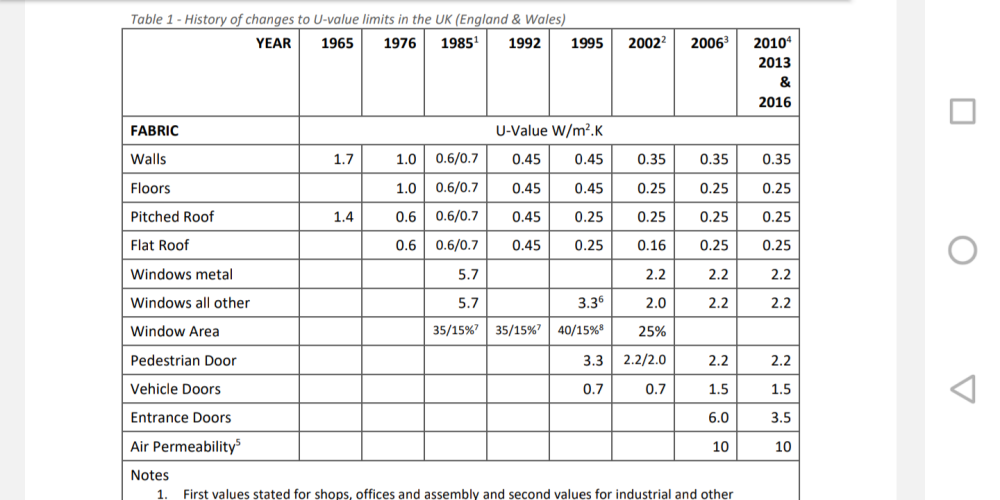
-
Read in your local paper that there is a 250m exclusion zone around your local maternity ward. You anything to do with that.
-
If delivered by drone, what is the returns policy?
-
Concrete floor insulation retrofit - cold floor
SteamyTea replied to gambo's topic in Heat Insulation
Similar to the early failure rate then. VIP are not really a product for buildings. -
Yes, it will fit in the boot of a VW Passat TDi.
-
https://www.hetas.co.uk/enforcement-action-taken-against-major-uk-stove-manufacturer/
-
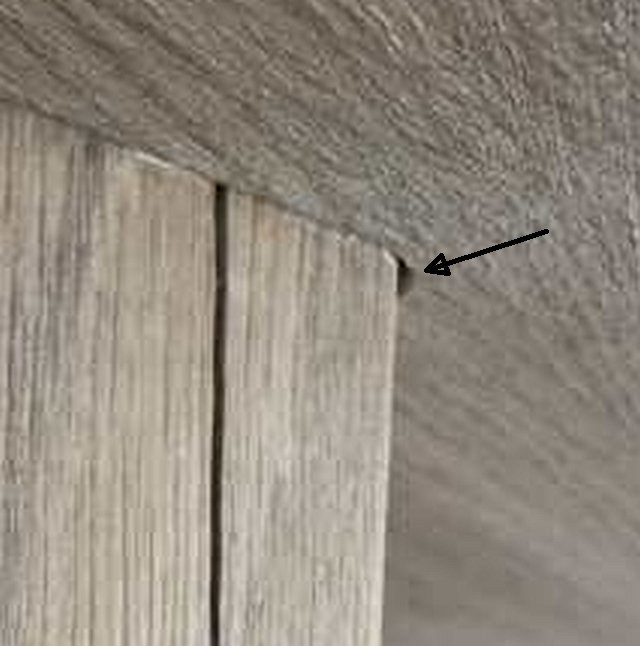
Your problem is going to be finding an adhesive that is both strong enough and 'invisible' enough. Epoxy or a clear, non foaming, PU is probably your best bet. To hold it in place, while the adhesive sets, can you make a small wedge that can be hammered into the stringer.
-
We had a delivery a couple of days ago, 150 scaffold planks. No one on site (not a building site) knew anything about it. The delivery driver was very patient. I told him to unload it with his crane. He got his stabilisers out, was about to lift, then a change of plan. Ended up with the two of if us lifting 2 planks at a time into a shed. He was cheerful right though it (I still ache). That was worth a premium. @bmj1 Are you thinking of a physical store with a good online presence, or an Amazon/eBay type model?
-
Plug a cable in and hook it up.
-
Ooooops - New windfarm cancelled.
SteamyTea replied to MikeSharp01's topic in Environmental Building Politics
Same (PM on R4?). Maybe the reason that they are pulling out is that they know the link between gas prices and electricity prices may be broken, taking away the ridiculous situation that pays some wind farm developers, what is in effect, a bonus. There may be secondary reasons like grid connection (time and cost). As an aside, as I drive up the M5 near Hinkley Point, I see the new pylons that have been installed, I wonder how many people objected to the erection of them and how it has ruined the view of the pristine countryside. -
Starting a business helping Self-Builders, advice?
SteamyTea replied to LDNRennovation's topic in Surveyors & Architects
Don't actually tell them, just design to a similar standard. Try designing a car (what I first studied). I work as a chef, no formal qualifications in it, just over 40 years of doing it when I can't be arsed to do a better job. Being a chef is no different than cooking at home, apart from scale and pace (and most people can't cook at home and talk a lot of bollocks about it, thinking that spending extra money on equipment makes a difference). I trained hard as an automotive engineer, then retrained in the renewable energy field, then environmental science. But you only have to read on here how many spats I get into against others opinion. So take my opinion about house design as you like, from an engineering perspective, they are pretty easy, and if you go into most houses, it is hard to believe that anyone with any training has ever tried to live in their creations. -
Starting a business helping Self-Builders, advice?
SteamyTea replied to LDNRennovation's topic in Surveyors & Architects
Only on insulation thickness. I suspect that over the last 3 years many people wish they had an extra 100mm of insulation fitted. Infiltration is linear, wall to glazing ratio is probably linear (may model that to find out). Form is important, as are the thermal bridges. Passuvhaus ovesells basic thermal design, almist as much as the 'lifestyle', to the extent that they give the impression to customers that they wrote the 4 Laws of Thermodynamics (only 2 of them are relevant normally). -
Has the SE specified adhesive as well as bolting? As for getting them straight and level, much will depend with what you start with. Even a relatively short but of timber will be unlikely to be 'flat' in both planes. Once clamped together (bolts clamp, screws don't), they are highly likely to twist. Are Posi-Joist type joist an option, they are usually made in a jig and the metal webs are more stable.
-
Battery Storage - Lifespan and Replacement
SteamyTea replied to marmott2334's topic in Energy Storage
@Pocster shrivels to a walnut when he is not in the West Undies blazing sunshine. -
Starting a business helping Self-Builders, advice?
SteamyTea replied to LDNRennovation's topic in Surveyors & Architects
TL:DR Being a house designer is nothing special, though some are better than others. A few hours reading in here will show up two problems pretty quickly. 1. Architects don't understand thermal performance, though there may be the odd one that does. 2. They cannot manage all the trades needed. So if you want a USP. Design to Passivhaus standard, or better, without adding a premium. Get a big list of good, reliable and tidy trades that can work together. -
Battery Storage - Lifespan and Replacement
SteamyTea replied to marmott2334's topic in Energy Storage
As long as we don't get Reform involved, we can be as diverse as we like. -
Battery Storage - Lifespan and Replacement
SteamyTea replied to marmott2334's topic in Energy Storage
No, just realised that you could download porn via the internet, on demand. Oh how I miss dialing up a Nigerian number on my old 9600 baud modem. -
Looks like a Sunyboy 3.6 kW model. Do you tap on the display to make it light up. Many of the SBs had Bluetooth built in. TL in the SB range stood for transformerless. See if the manual makes sense, though this may be a newer model. https://manuals.sma.de/SB30-50TL-21/en-US/index.html
-
Battery Storage - Lifespan and Replacement
SteamyTea replied to marmott2334's topic in Energy Storage
Instead don't have a TV, 31 years without one now. -
Battery Storage - Lifespan and Replacement
SteamyTea replied to marmott2334's topic in Energy Storage
Is there any mention of charge/discharge percentage and the total number of cycles? -
Trying to understand Heat Loss and UFH options
SteamyTea replied to yellowbert's topic in Underfloor Heating
No idea, I had had a long day, had to move, by hand, 150 scaffold planks. If I had left work on time, I would not have had to do that. -
There are.
-
Trying to understand Heat Loss and UFH options
SteamyTea replied to yellowbert's topic in Underfloor Heating
All that @JohnMo says, he is very, very, really wrong. Have you looked at overheating though. Simple, room by room, heat losses at low outside air temperatures is a rare occurrence, and usually happens at night, use it to just set the maximum size of the heat source (allowing for CoP reducing if using and ASHP and DHW heating as well). Overheating is much harder to calculate as you have to take into account OAT (outside air temperature), ventillation rates, window and wall orientations . You can get a lot of useful data from PVGIS. Just knowing the U-Values of each element is not really enough, you need to know the effective surface areas and how they interact with the local weather. As an example, my house is small, terraced and faces NE-SW. There is a lot of glass compared to wall, so when the morning and evening sun hit, the places is bright and warm (so bright in the mornings I close the curtains as I cannot read the laptop screen. During the day though, the sun is higher in the sky, so hits the roof mainly, and less on the windows, so the peak IAT (inside air temperature) is generally below the OAT, makes it quite nice. There is often a lot of talk about natural solar energy getting absorbed by the mass of the building and released later. Don't bother to calculate that, mainly because when you want those advantages i.e. winter and summer, the day lengths are working against you. A lot of nonsense is spoken about 'thermal mass', but very little evidence is shown that it is effective. Regarding UFH upstairs. While it is probably not needed, if you sell the house, most people will not believe that you do not need it, and it can be used for cooling, a bit.