SteamyTea
-
Posts
23368 -
Joined
-
Days Won
190
Everything posted by SteamyTea
-

I fell off my bike, so I'm ravin' mad ....
SteamyTea replied to ToughButterCup's topic in General Self Build & DIY Discussion
I was with your old Mayor on Tuesday, he is a relative on mine. Did not mention your problems as he now deals with nuclear stuff. Was interesting as we had not seen each other since 1968. -
I fell off my bike, so I'm ravin' mad ....
SteamyTea replied to ToughButterCup's topic in General Self Build & DIY Discussion
One pothole at a time. -
Never go that far in the conversation. That is for another day with them, which I have no idea when it will be, but she is looking to retire to Spain, so less of a journey.
-
Just spent a few days with my colonial cousins, one who lives in Walnut Creek, California. She is a very clever, ex banker, and fully qualified accountant, so hates paying for anything. Got chatting about energy bills and she said they were paying $1000/month. Now her house is a lot larger than mine, and they work from home now, so would be more expensive. Now I am home, I thought I would have a look at Californian prices. California prices are 58% higher than the national average, makes my penny per kWh rural surcharge seem quite reasonable. PG&E Rate Rate type Rate per kWh RESIDENTIAL TIME-OF-USE SERVICE FOR PLUG-IN ELECTRIC VEHICLE CUSTOMERS TOU 30-61¢ RESIDENTIAL TIME-OF-USE (PEAK PRICING 4 - 9 p.m. EVERY DAY)- All Electric TOU 36-61¢ Southern Californian Edison Rate Rate type Rate per kWh Option B Residence All-Electric Allocation TOU 18-77¢ Option DT - Single Family All-Electric Allocation TOU 34-59¢ Option DT - Single Family TOU 34-59¢ Time-Of-Use Residential (5-8 PM) Single-Family Residence TOU 29-82¢ Time-Of-Use Residential (Prime) All-Electric Allocation TOU 27-64¢ Option A Single-Family Residence All-Electric Allocation TOU 12-92¢ Time-Of-Use Residential Rate (4-9 PM) Single-Family Residence All-Electric Allocation TOU 30-66¢ Time-Of-Use Residential Rate (4-9 PM) Single-Family Residence TOU 30-66¢ Option A Single-Family Residence TOU 12-92¢ Option B Residence TOU 18-77¢ Data last updated by our partner WattBuy on Feb 8, 2026 San Diego and Electric Co Rate Rate type Rate per kWh DOMESTIC TIME-OF-USE FOR HOUSEHOLDS WITH ELECTRIC VEHICLES, ENERGY STORAGE, OR ELECTRIC HEAT PUMPS TOU 34-72¢ RESIDENTIAL - TIME OF USE SERVICE - DR TOU 29-53¢ COST-BASED DOMESTIC TIME-OF-USE FOR HOUSEHOLDS WITH ELECTRIC VEHICLES TOU 10-71¢ DOMESTIC TIME-OF-USE FOR ELECTRIC VEHICLE CHARGING TOU 27-75¢ DOMESTIC TIME-OF-USE FOR HOUSEHOLDS WITH ELECTRIC VEHICLES TOU 21-70¢ DOMESTIC TIME-OF-USE FOR HOUSEHOLDS WITH A SOLAR ENERGY SYSTEM TOU 31-66¢ RESIDENTIAL TIME-OF-USE - DR2 All Electric TOU 28-68¢
-
Interesting couple of days with the new heat pump.
SteamyTea replied to MikeSharp01's topic in Air Source Heat Pumps (ASHP)
70 tonnes of concrete holds about 15.5 kWh.K-1. The losses are about 650W in total, with about 500W going usefully into the house. -
VID_20260211_181431387.mp4
-
I think that may be a problem with the OS. Dedicated hardware does not need the same sort of heavy overhead systems to run. But yes, (expletive deleted)ing stupid idea.
-
Heat pumps. Any negative points about 3 phase?
SteamyTea replied to saveasteading's topic in Underfloor Heating
Why not one HP and some supplementary resistance heating for the coldest times? -
WTF Just put a switch or dial on the wall FFS.
-
I fell off my bike, so I'm ravin' mad ....
SteamyTea replied to ToughButterCup's topic in General Self Build & DIY Discussion
Not like the Dutch, they are allowed to put a finger in a dyke to stop the dribbling. So much more liberal. -
Misread that as Bellend.
-
I fell off my bike, so I'm ravin' mad ....
SteamyTea replied to ToughButterCup's topic in General Self Build & DIY Discussion
Is one allowed to repair a public asset without permission? -
I fell off my bike, so I'm ravin' mad ....
SteamyTea replied to ToughButterCup's topic in General Self Build & DIY Discussion
I hit a new pothole at work. Two hours later 20 metres of the car park was disintegrating, that became 40. Pot hole is now about 3 metres deep. VID_20260130_080418062.mp4 -
Only with consent, or a face mask and rubber suit, don't want to leave 'evidence'.
-
Well, this is just plainly naive, isn't it? What about all the infrastructure and energy required to run all the cloud functionality? That is a really good point and one I have not thought about. A very quick web search seems to show that 1 TB of data uses between 40 and 70 kWh/year. If each 'user' has 1 GB of data, that is around 0.055 kWh/user.year, or 6W. A Raspberry Pi, running headless uses about 3 W, with a bit of tuning, about a watt (what mine uses. An ESP**** about a tenth of that. To that figure, the energy usage of 'smart switches' needs to be added, regardless of if it is cloud or locally connected. Another quick web search gives a result of 1W for a Shelly Relay. So that could be another 10W for a few connected devises, or ~90 kWh/year. With a cloud connected service, the energy usage of the data transport has to be taken into account. So a local router, a share of the local telephone exchange (or 4/5G), 3 to five internet servers etc. So it is probably cheaper to use a local service, that is hard wired if possible, but not as good as a manual switch. Food for thought.
-
No shit.
-
There is also 'stick' build.
-
Unvented hot water cylinder (electric)
SteamyTea replied to AidanGee93's topic in Boilers & Hot Water Tanks
My off peak times covers both circuits, so I run the washing machine during off peak hours as it is cheaper. When it is really cold, I run a fan heater in the morning to heat up rooms. But I am often up by 4AM. I have also put timers on my off peak circuits, this limits the time to the last 3 hours of the E7 window. This works fine for me as my storage heaters and DHW are charged closer to the times I need them. My life is easy as I live alone. -
Unvented hot water cylinder (electric)
SteamyTea replied to AidanGee93's topic in Boilers & Hot Water Tanks
You can usually hear an immersion heater work by the fizzing sound. So during the day, try keeping the kitchen switch off, and flick the 'Peak Supply' switch on, you should be able to heat some noise from the cylinder, or you can check the meter and see if you have an extra 3 kW load on. The kitchen switch may be just a secondary switch to make life easier i.e. not having to open a cupboard. Most of us on here like to keep water temperature as low as possible to save parasitic losses. I have a 200 lt DHW cylinder and store, via E7, water at 50°C. That is enough for a bath and a shower. Check the thermostats as the upper one (peak) should be higher temperature than the lower one (off peak). -
Oh how I miss these storage devices in every town.
-
Welcome I like an Indian. Pocahontas is buried in Gravesend, Kent.
-
CO2 is routinely injected into oil seams to help extract more, seems an expensive method. That is already happening.
-
37 gigatonnes of CO2 produced in 2022. Relying on plant growth is not going to cut it.
-
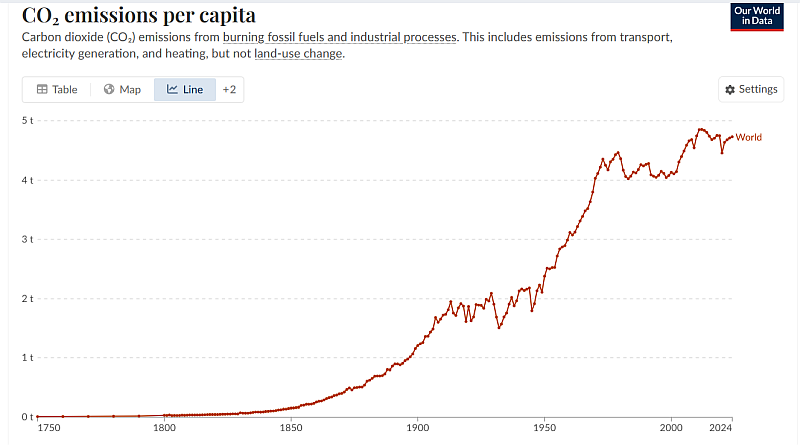
That has been know for at least 2 decades, why very little time is spent on it on Renewable Energy courses. It has been cheaper, for at least a decade and a half to just install wind and solar, which do not need CCS at the point of generation. In 2025, the UK's Per Capita CO2 emissions was 4.53t. World Average was 4.73t. https://ourworldindata.org/grapher/co-emissions-per-capita?tab=table
-
First thing to make sure is correct is your CIL entitlement.