SteamyTea
-
Posts
23956 -
Joined
-
Days Won
203
Everything posted by SteamyTea
-

Europe’s heatwave is the hottest and most humid ever
SteamyTea replied to SteamyTea's topic in Boffin's Corner
@Spinny I am surprised at our comments considering the article came from the DMGT stable. -
Dewpoint Temperatures and Absolute Humidity Spreadsheet
SteamyTea replied to SteamyTea's topic in Boffin's Corner
That's odd, anyone else have that problem? -
Europe’s heatwave is the hottest and most humid ever
SteamyTea replied to SteamyTea's topic in Boffin's Corner
Not sure, but down here, on 24/06/2026, the temperature was at its peak at 33.7°C (very good for here), the air pressure was 1017.71 hPa, which is not exceptionally high. It was about the same the week before, but the temperature was 10°C lower (18.6°C peak). -
Proposed changes to building regs, limiting the use of timber
SteamyTea replied to saveasteading's topic in Timber Frame
No, to save any grey areas, confusion and builders/supplier being chancers, I am suggesting all materials used have to meet a set level of thermal/structural/failure safety standard. There should e no opportunities for people to wriggle out of their civic duty. I suspect this is what will happen when people start to get prosecuted for the Grenfell tragedy. It every one knows some simple rules, then they are easy to follow. -
Proposed changes to building regs, limiting the use of timber
SteamyTea replied to saveasteading's topic in Timber Frame
If one assumed that a window is at 10m, then the fall time is 1.43 seconds. The velocity will be around 14 m/s (50 kmph). An 80 kg (12.5 stone) person will impart 7845 J on impact, which is a force of 1.12 kN. One could argue that the height should be lower. It would be easier to draft legislation that says all building materials are non combustible (and fumes must be taken into account as well) and must still be rated at 150% of the elements designed capabilities after 2 hours of temperatures above 320°C. That way, any material can be used, just that it has to be designed better. I am a great believer that safety legislation can improve quality and reduce costs. Industry has never liked 'being told what to do', but they always step up and have creative solutions in the end. -
Environment Europe’s heatwave is the hottest and most humid ever The current temperatures in western and central Europe would have been virtually impossible 50 years ago, and unprecedented humidity levels make this heatwave especially dangerous Alec Luhn26 June 2026, updated 29 June 2026 Extreme heat was felt across much of Europe on 24 June Sylvie HUSSON/AFP via Getty Images This week’s heatwave is the hottest ever recorded in Europe, as well as the most humid, and it is likely to cause thousands of deaths. Although a potential “super El Niño” is forming in the Pacific Ocean, this didn’t play a role in the heatwave, a study by the World Weather Attribution network of scientists has found. Instead, global warming is clearly to blame. The study analysed how likely the average daily maximum temperature projected for 26 to 28 June in western and central Europe would have been in the cooler climates of 1976 and of 2003. While the weather pattern – a low-pressure heat dome that is trapping hot air from the south – isn’t unusual, the temperatures are. Fifty years ago, a typical June heatwave would have been about 3.5°C cooler, and the temperatures seen over the next three days would have been a less-than-one-in-10,000-year occurrence. Daytime temperatures have exceeded 44°C (111°F) in one French town, and nighttime temperatures have remained above 30°C (86°F) in parts of Spain. “This event would not have been possible in June without climate change,” Theodore Keeping at Imperial College London said at a media briefing on 25 June. “The three-day nighttime temperatures would not have been possible at any time of year without climate change.” The humidity has also been unprecedented, reaching more than 50 per cent in many British cities. Dew-point temperatures have been in the low 20s, as compared to the single digits during the July 2022 heatwave that set the UK’s temperature record. The wet-bulb globe temperature, which measures not just air temperature but also humidity, heat radiation and air movement, has broken or is expected to break records in almost half of European cities, the study found. Humidity amplifies health risks because it slows evaporation, making sweating less effective. While older people or those who have a chronic illness are in particular danger, so are migrants and people experiencing homelessness. “What we see very clearly… is how unequal the effects of this heatwave are and how that really demonstrates the inequality that widens due to climate change,” said Friederike Otto, also at Imperial College London. “Because it’s of course people who are particularly vulnerable who are most likely to lose their lives.” While it is too soon to look at excess mortality, a previous study found a smaller heatwave in June and July 2025 killed 2300 people in London and 11 other European cities. “The health impacts of this heatwave are likely to be extremely high across large parts of northern and central Europe,” said Keeping. Heatwaves will become even more intense and frequent unless we rapidly cut fossil fuel emissions, the researchers stressed. And Europe, the fastest warming continent, is not ready, as it has an ageing, urban population living in cities built for a cooler era. In the UK, only 5 per cent of homes have air conditioning. Besides AC, Europe should invest in passive cooling like building insulation, ventilation, green roofs and walls and trees along streets, they said. It should also expand its heat response to include oft-forgotten groups like people with mental health conditions and those who are pregnant, said Carolina Pereira Marghidan at the Red Cross Red Crescent Climate Centre. “Europe has heat action plans, but research has also shown that sometimes they do not cover all the groups that may be vulnerable,” she said.
-
Dewpoint Temperatures and Absolute Humidity Spreadsheet
SteamyTea replied to SteamyTea's topic in Boffin's Corner
Can be used to take a lot of the guess work out of it. Could also be useful for controlling UFH in cooling mode, especially when you consider the statistical nature of thermodynamics. -
-
Whenever we get extreme weather, the same questions come up. So to answer them, I have created a calculator that works out the dewpoint temperatures and absolute humidity from air temperature and relative humidity. You should be able to change the relevant cells, though I cannot check this as I do not have Excel (only Calc). There is a text box giving instructions. I have also added some of my local weather data as a time series. This is as an example only and can be deleted, or replaced with your own data. I hope it is useful. Dewpoint and Absolute Humidity Calculator(Excel).xlsx
-
Have I lost the plot a bit here. I seem to remember that you wanted to automate the toilet light. Now you are creating an alternative universe. I have a tree in the garden that sways in the wind, and the shadows are in the right place (over my neighbours garden). I left a light in and went to work, came back several hours later, light was still on. 3W x 13h = 39 Wh.
-
I have a camping stove. But in 21 years I have only used it once. The power was out for 4 hours. A lot of gas 'stuff' still needs mains power to run. Over the last year and a bit, I have worked with 12 different chefs. The only ones that hated induction technology fell into two categories. The ignorant The (expletive deleted)
-
Do they show a black beard? Or Seaman Stanes.
-
You have read this haven't you.
-
If you have MVHR then in the ductwork just before the unit. If you don't, then it gets tricky. A hallway used to be the place that thermostats were placed, but that was pointless as in the 'olden days' people keeps interconnecting doors closed. Really a case of monitoring where you think there will be a problem i.e. floor in living room or kitchen. Place the monitor close to the problem area as it is common to have a temperature and RH height gradient in a room.
-
Recycling the heat. We take gas out of the ground, combine it thermally with atmospheric oxygen, use the by product to make your fish supper, and allow the rest to eventually vent to the environment to cool. Some of the waste ends up in the sea, slightly increasing the acidity, some gets absorbed by the local plant life where it gets changed to carbon based structures and oxygen. Eventually, it all ends up back in the ground, gets buried by more of the same, and if the geology is right, turns into a gas to be reused. It is hard to say what the excess released gasses have contributed to this week's weather, but there will be something. What I do know is that compared to some other times when the weather has been similar, strategically places fans have kept the temperature 15°C lower. Makes me wonder how much A/C or slab cooling is really needed in the UK. Maybe just better controlled forced ventilation will do the job.
-
Yes, you need to monitor temperature and relative humidity, then apply Td = (b × α(T, RH)) / (a − α(T, RH)) Where Td = Dew point temperature Td = dew point temperature T = actual air temperature (in °C) RH = relative humidity (in percent) a = 17.27 b = 237.7°C α(T, RH) = [(a × T) / (b + T)] + ln(RH / 100) Then use the Td result to adjust your UFH flow temperature up or down.
-
I helped a mate out in his chip shop tonight. Careful placement of 3 fans kept the temperature down. Have known it to be 50°C for 4 hours. So not too bad.
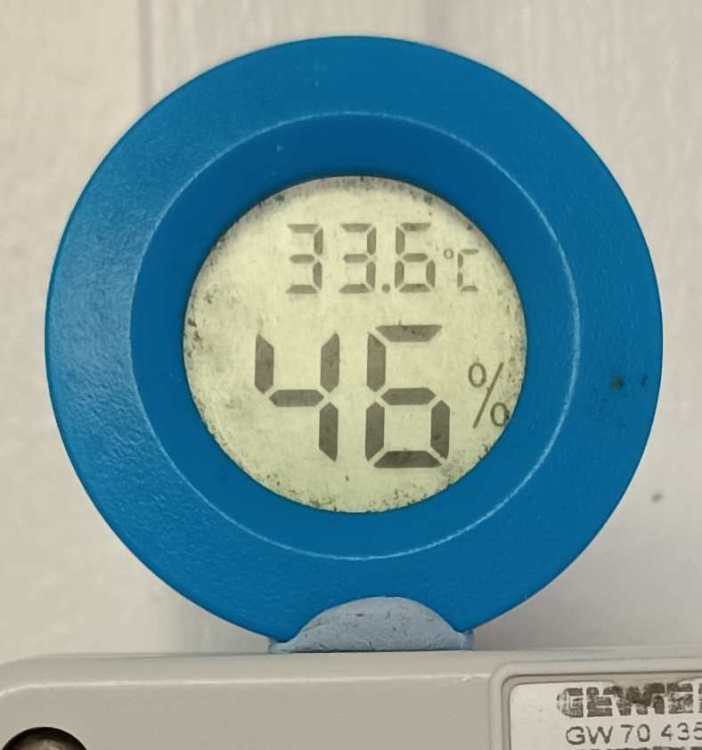
-
'Where We Live' - a survey of the decline in British housing.
SteamyTea replied to MAB's topic in Housing Politics
Right now, there is a bit on the radio about local councils and flags. Someone compared the money spent on enforcing and prosecuting people that hang flags on lampposts to the lack of pot hole repairs. Potholes, or flags, are not an indicator of 'better offness'. But this is from worldometer. PPP = Purchasing Power Parity. The figures are in US currency so that it is easier to compare countries. It shows how as the population has got bigger, we have to work less to buy the same 'stuff'.
-
'Where We Live' - a survey of the decline in British housing.
SteamyTea replied to MAB's topic in Housing Politics
Neither, just that any figures present to you will not be accepted or the question gets changed. There is the whole of the ONS for you to explore, but I suspect you would not trust the numbers. -
'Where We Live' - a survey of the decline in British housing.
SteamyTea replied to MAB's topic in Housing Politics
I am not your secretary. -
Modern PUs are pretty benign once set. Furniture has used if for cushion for 60+ years.
-
'Where We Live' - a survey of the decline in British housing.
SteamyTea replied to MAB's topic in Housing Politics
I have been hearing that all my adult life, numbers don't back it up though. -
There will be a solvent that works, but unless you know which adhesive was used, it will be trial and error. Start with the easy solvents. White Spirit, Methylated Spirit, Acetone, gasoline and WD40. Don't convince yourself that with a bit of solvent and a huge amount of elbow grease that it is working. A solvent should make it dead easy to remove. If none of them work, then it is a case of internet shopping for things like Dichloromethane, my favourite and Xylene (my least favourite), or even Toluene. I think it was @Onoff that found a cleaner in Lidl that seemed to remove most things, so maybe trip there on Thursday.
-
'Where We Live' - a survey of the decline in British housing.
SteamyTea replied to MAB's topic in Housing Politics
I do wonder if we really have, or maybe polarisation is human nature when resources get scarce.