


SteamyTea
-
Posts
23857 -
Joined
-
Days Won
200
Everything posted by SteamyTea
-

Kingspan aeromax plus - flashing code 14?
SteamyTea replied to RossG21's topic in Air Source Heat Pumps (ASHP)
Was my second thought to. -
MVHR + ASHP Post Heater control
SteamyTea replied to john0wingnut's topic in Mechanical Ventilation with Heat Recovery (MVHR)
And at 125 quid each, they are pretty cheap, and being electrical resistance heater, about as reliable as you can get. Just getting a control and safety system for them may be a bit tricky, unless there is an off the shelf one. Maybe incorporate a smoke sensor. -
2020 ends on a high note (surprisingly)
SteamyTea replied to ProDave's topic in General Self Build & DIY Discussion
We have shut for 17 days, like most small places down here. That will learn them. I was having my daily coffee, and this 'Northerner of some flavour' was asking, rather loudly, the woman on the next table, where he could get some presents for a baby. That behaviour will be the end of out Tier 1 status. -
2020 ends on a high note (surprisingly)
SteamyTea replied to ProDave's topic in General Self Build & DIY Discussion
I am bored to, but then I am doing some overdue housework. -
2020 ends on a high note (surprisingly)
SteamyTea replied to ProDave's topic in General Self Build & DIY Discussion
I know a stained glass person. Though you could have a crack at it yourself. -
MVHR + ASHP Post Heater control
SteamyTea replied to john0wingnut's topic in Mechanical Ventilation with Heat Recovery (MVHR)
I would not say that. When you only need a small increase, or decrease, in temperature, you may find it works well. Really just a case of doing the numbers and seeing how much can be transferred on the highest flow settings. -
Calculating heating and thermal transferrance per room
SteamyTea replied to Jeremy's topic in Central Heating (Radiators)
I know what you are saying, but that is a problem with incorrectly designed and sized systems, it is not an intrinsic problem with ASHPs. -
Calculating heating and thermal transferrance per room
SteamyTea replied to Jeremy's topic in Central Heating (Radiators)
One of those "Yes and No". For sizing radiators/UFH, then the maximum load is what matters. To get an efficient system, then the most likely loads is needed. The truth is somewhere between the two (I may have to look at that as it is an interesting statistical problem). -
Calculating heating and thermal transferrance per room
SteamyTea replied to Jeremy's topic in Central Heating (Radiators)
Incidental heating may make a difference, you can work out solar gain easily enough using PVGIS. Just set the window area angle to vertical, then see what the table shows. -
Combining AC and MVHR
SteamyTea replied to moldy's topic in Mechanical Ventilation with Heat Recovery (MVHR)
Increasing the diameter of the MVHR ducting can greatly increase the ACH figures. That may be enough to have some useful contribution from the AC or heating system. Pi x r2 It is the 2 bit that makes a huge difference. -
Calculating heating and thermal transferrance per room
SteamyTea replied to Jeremy's topic in Central Heating (Radiators)
You need to know the transfer between rooms as well, unless you are modelling the place with only 1 internal temperature. -
Let's tackle the problem from another direction. What is the power range of your heat pump? i.e. 3 to 12 kW What is the heat load range? 4 to 7 kW Then it should be easy to work out if a buffer is needed.
-
Pronounced Colin, in French. Why it smells like it does.
-
The Fishermen do that, they spend too long at sea.
-
Yesterday, there was a trail of collies leading out of Penzance, we have loads, but as they are all Brexiteers down here, they are going to keep them for the fishermen.
-
I remember it all too well, mate of mine is a farmer. But the science (regarding human health) was patching and quickly discredited. Did not stop the Red Tops stirring up trouble, and it was a good reason to kick Edwina a bit more. Science is really discredited by schools, they need to make it relevant, or it is just another maths lesson. It is a shame, as it can be fun.
-
On a very small, selected sample. This test seems to work best on people that are relatively ill with it already i.e. high load. As much as I like the idea of a very quick test, it needs to be at least 99% accurate. To put that into perspective, MCS need, for RHI purposes, 99% of the heat load covered. Or Would you get in a taxi if there was a 1% chance that it would have an accident, with the outcome unknown. And this test, at its realistic best, is allowing over a quarter of the positive people getting a negative result. So like taking a taxi for the 4th time.
-
That will be the test that misses 58% of positive results. https://www.bmj.com/content/371/bmj.m4469
-
No. Damn, onto my next liberal tactic then, I am getting a new box of them for Christmas.
-
Does that mean I have won.
-
You really talk bollocks don't you.
-
No, a biased, fake correlation. We have moved on from the 1970s in both statistics and attitude. The very nature of immigration is that it works both ways. Why the French are introducing a 'protocol'. Ours will be better, World Class in fact.
-
Thought you would approve, keeping immigrants out.
-
Adding a Buffer Tank to Ashp Setup
SteamyTea replied to Scotland's topic in Air Source Heat Pumps (ASHP)
Just a general observation. Putting in a buffer will reduce short cycling of the heat source. Taking a simple example of allowing a 100 lt buffer to vary between 30°C and 45°C, and not taking any external draw from it, the times will vary for different power sources. (this chart breaks convention by putting time on the y-axis, but is correct as time varies with power, with power being the controlled variable)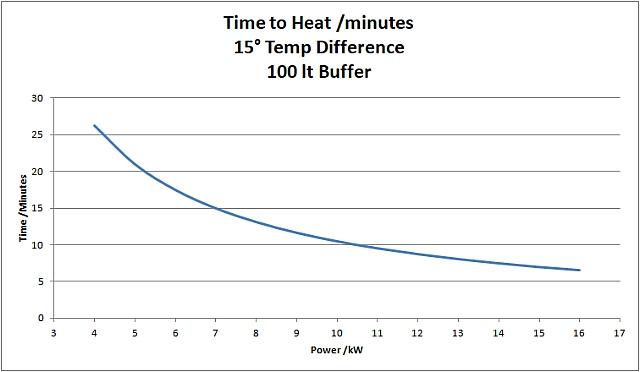
-
Yes, I assumed it was an electric one. Must have missed it was coming from a UVC. Or use Bernoulli's empirical formula: P1 + 1/2 ρv12 + ρ_gh_1 = P2 + 1/2 ρv22 + ρgh2 Where P = Pressure v = Volume ρ = Density g = Gravity h = height For a level pipe run, ρ_gh_1 cancels out with ρgh2

