SteamyTea
-
Posts
23375 -
Joined
-
Days Won
190
Everything posted by SteamyTea
-
What does that even mean? Falls into the category of eco or green to my mind.
-

How best to heat and ventilate this small building?
SteamyTea replied to Tony K's topic in Ventilation
Interesting series about it this week on R4. -
How best to heat and ventilate this small building?
SteamyTea replied to Tony K's topic in Ventilation
Just knocked up a quick spreadsheet. I assumed the insulation has a k-Value of 0.03 W.m-1.K-1, is 0.1m thick, all surfaces covered, ground temperature is 8°C and airf temperature is 7°C, then the total losses, if heated for 24 hours, will be 3 kWh/day. Air changes an hour are 2. If you have a time of usage electricity tariff i.e. E7, pop a second hand storage heater in, a 10 kWh one (1.5 kW input, 0.6 kW output). -
Welcome @Alice67 Are there any particular things you want to learn about. The main thing I have learnt on here is that too many people start with the inside of the building, then wonder why they cannot get the building to actually fit properly.
-
How best to heat and ventilate this small building?
SteamyTea replied to Tony K's topic in Ventilation
If you change the air every half hour, that is about 30 kg/hour. A kg of air takes 1 kJ/kg.K to heat. So taking a really cold day, with a 30K temp difference, that would be 1MJ of energy. 0.3 kWh, or 10p. There will be losses through the fabric, but I cannot work them out at the moment as too tired. Maybe when I get home. -
I lived in one during the winter of 82/83, never thought it was particularly cold. I suspect that even basic ones are now better insulated than new ones from 40 years ago. As I said earlier, get an A2AHP fitted and an induction hob that way no need for gas.
-
I believe you can do this. It is the overall losses that really matter. I am not sure if there is a minimum you cannot go below, I think it is in the building regs. Forget products like vacuum panels, aerogel and multifoils, they will fail, not be as good as stated, or just useless. Tiny air bubbles trapped in a thermally low conducting material is the way to go.
-
Wireless Access Points or Mesh?
SteamyTea replied to YorkieSelfBuild's topic in Networks, AV, Security & Automation
I try very hard to reduce bandwidth and the associated energy usage. We are heading to a 5G world now, 6, 7 and 8G will be along soon. Why bother with old hardwired hardware. -
Then you should have typed is as 0.27, 0.26, 0.25
-
They are getting worse then.
-
That is true for all materials, just how nature works. You really need to decide how willing you are to pay for future heating in the knowledge that a fraction of it is lost. You only fit floor insulation once, thermal losses are constant.
-
Pop into B&Q with a tenner and get a cable tester. Useful thing to have anyway. https://www.diy.com/departments/live-ac-voltage-detector-tester-pen-led-torch-non-contact-detect-cable-wire-mains/5055538125065_BQ.prd
-
If you are going to the trouble of coating it, then use an epoxy resin. May cost more but it will last as long as the floor. Alternatively, how about a posh 'vinyl', they don't have to look like the 1980s (though I looked better back then).
-
Realistically you will need to use PIR. You can easily look up the thermal conductivity if the difference materials, the you can convert them to R-Values (thickness divided by k-Value). Add all the R-Values up, and divide that number into 1 to get your U-Value. Avoid sprayed insulation, lenders are refusing to give mortgages on it, regardless of how good or bad it is.
-
If SIP exhibitors have some panels on show, have a look at how flat the faces are. Last time I saw some at a show, they were as wavey as (expletive deleted).
-
Why not a cheap A2AHP, get cooling that way. Well worth insulating under the floor. Down here, for 10k, you can get one on a site.
-
Should I be happy with this decrement delay?
SteamyTea replied to MikeSharp01's topic in Boffin's Corner
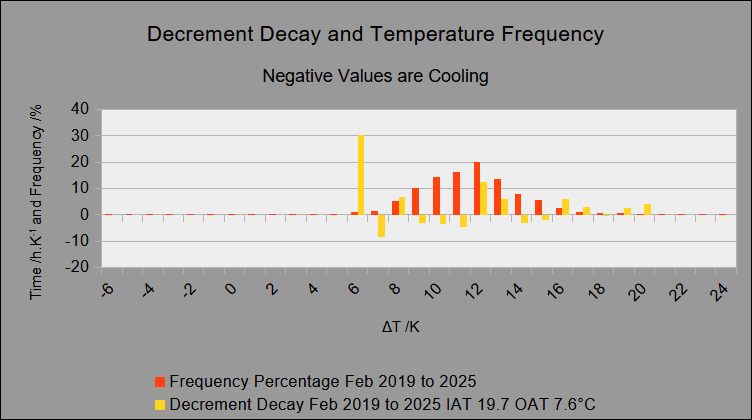
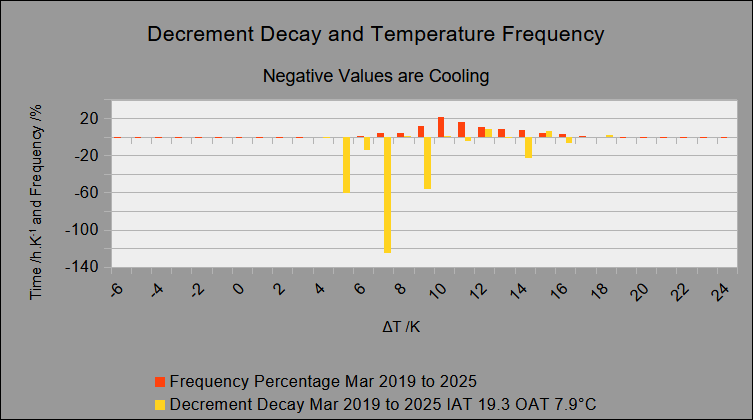
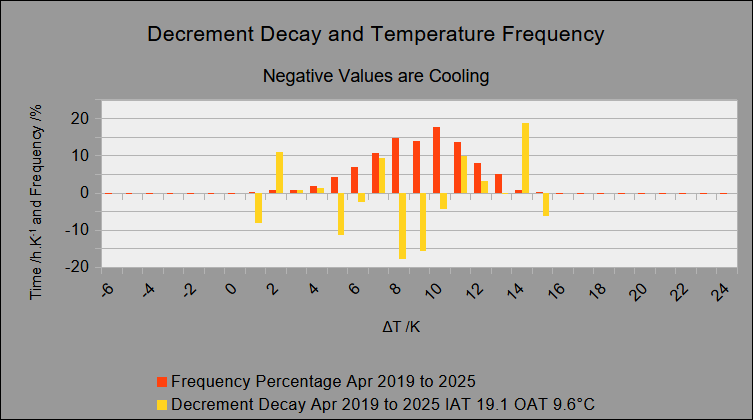
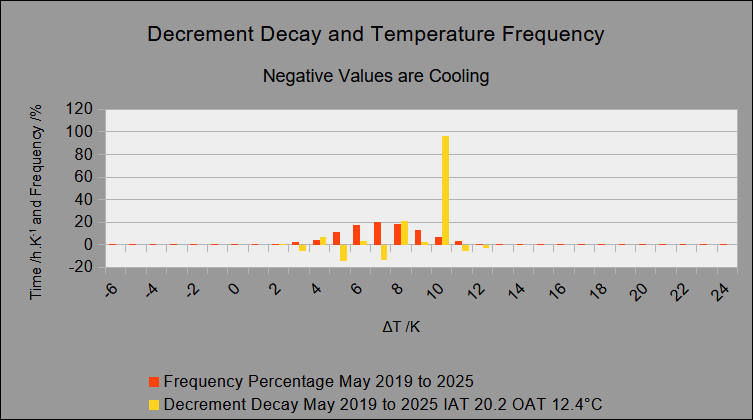
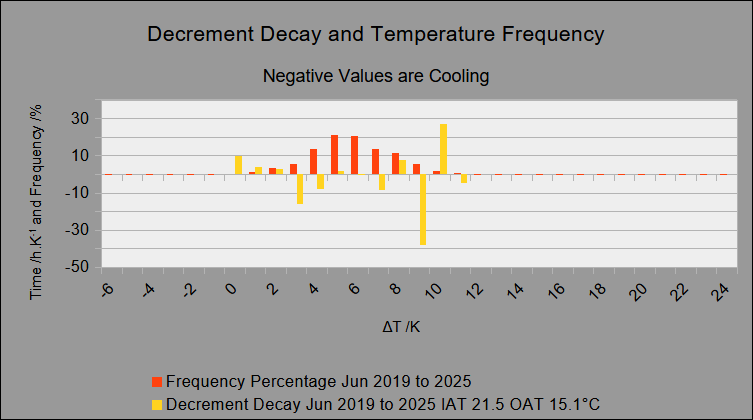
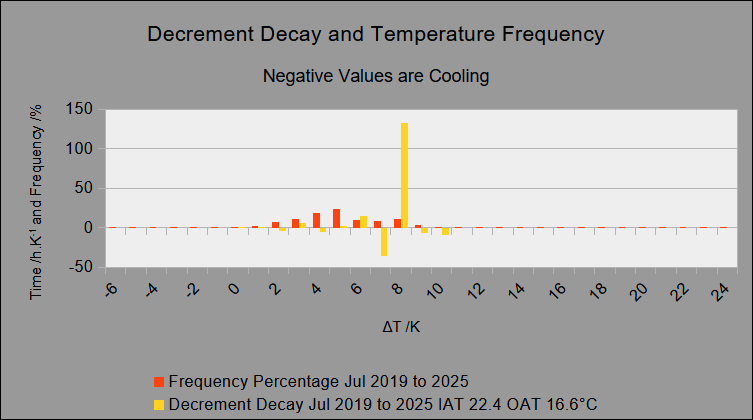
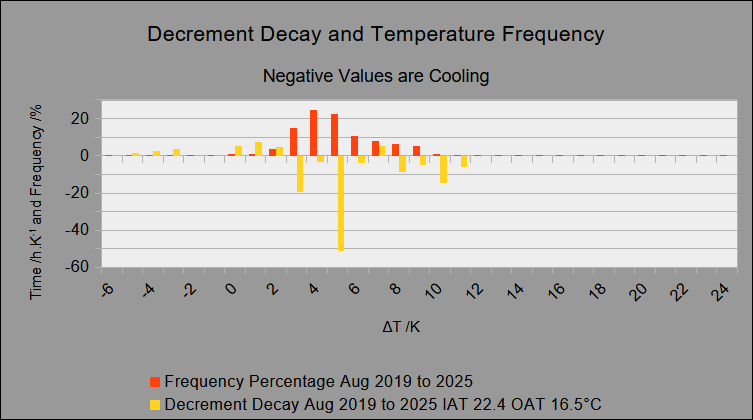
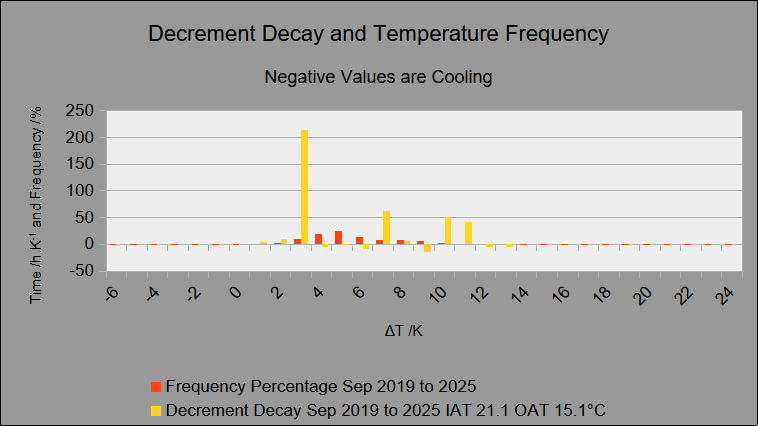
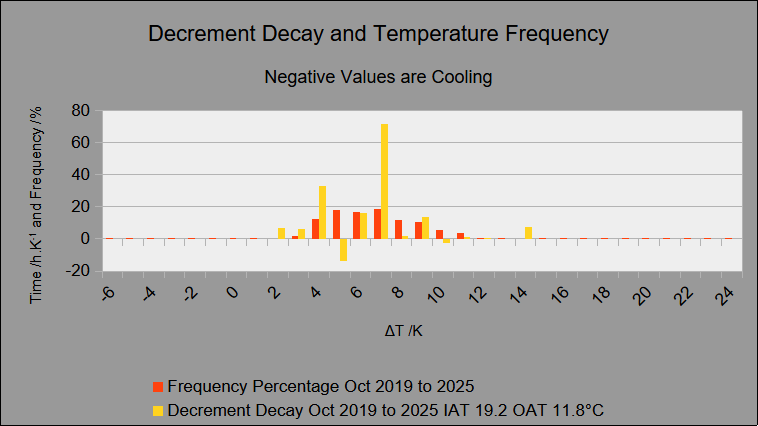
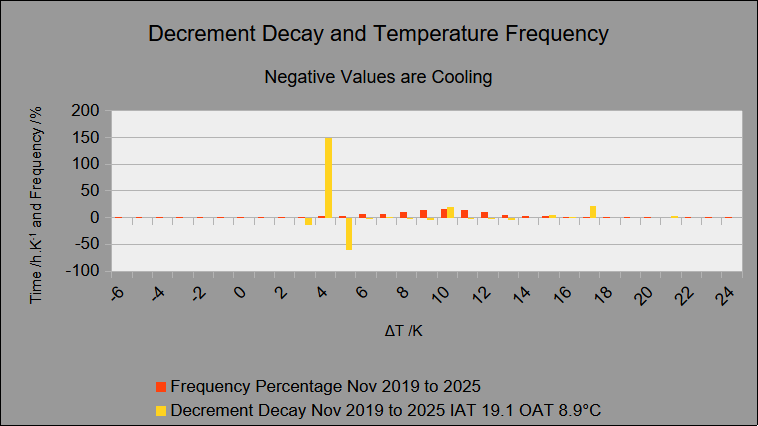
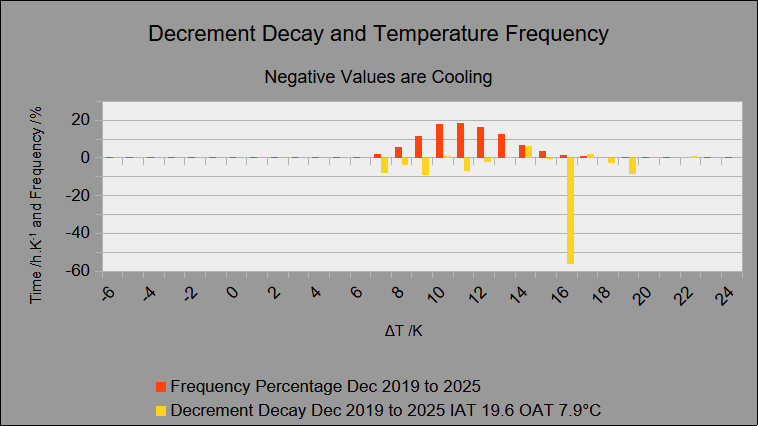
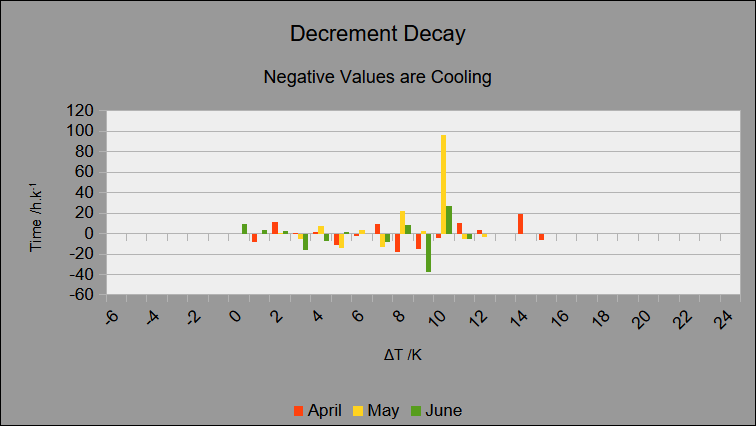
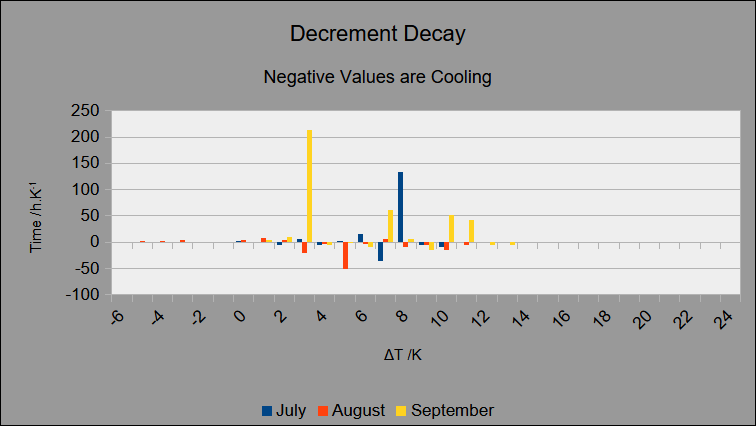
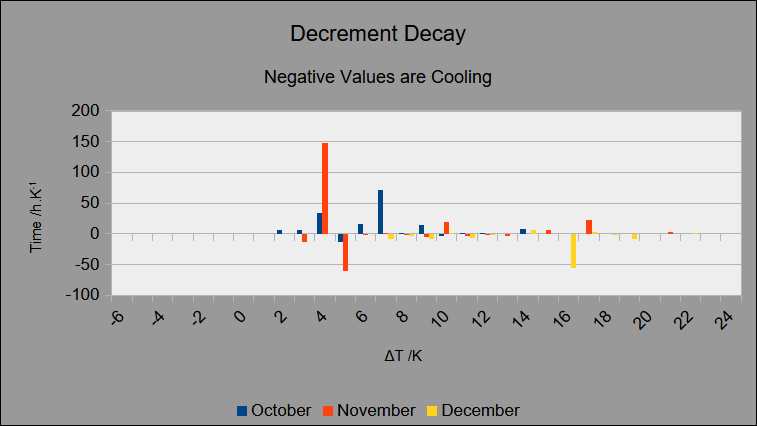
Right Here are the more interesting charts, Decrement Decay, Frequency that they occur, grouped monthly. As I suspected, the large variations are at the extremes, so don't really matter that much. Where there are large variations in the middle of the distribution, the decrement decay is still quite large i.e. April taking 15 hours to drop 1K when the mean IAT is 19.1°C. It is also worth remembering that my house is small, terraced and timber framed. So not an ideal form thermally (it is basically a corridor), and it has disproportionally high window area, at each end. I also have E7 storage heaters (modified to be only on for up to 4 hours), so a maximum of 16.8 kWh.day-1, but usually half that. I am not really sure if it is worth looking at hourly data (these charts are based on 6 hourly means so I could split them into heating input times and daylight times, but then when, on average, the decay is several hours, not really important for 1K temperature difference. My internal temperatures are stable enough, and since the latest improvement (fixed the draughty door and added secondary glazing onto the double glazing), I seem to be using less energy anyway (may have a look as it is only a matter of comparing charts, but tonight).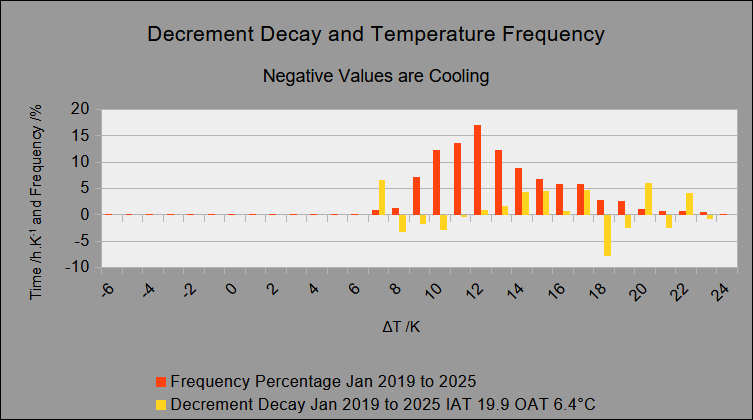
-
Should I be happy with this decrement delay?
SteamyTea replied to MikeSharp01's topic in Boffin's Corner
Right Knocked up the basic data, grouped it by ΔT to show the hours it takes to change by 1K. I have created 4 charts to split the year up, generally the April, May, June, July, August and September have no heating on. Usually I turn the heating on some time in November and it goes off sometime in March. The data spans the years 2019 up to 2025, so 6 years. I will create some charts that show the frequency of the ΔTs, but they will almost certainly be monthly or they will be very busy (LibreOffice Calc is not as fast for chart making as MSO Excel). Note that the y-axis scale changes wildly. Generally, as expected, the greater the ΔT, the faster the temperature changes. I suspect that the anomalies are when the heating is turned on and off, which in itself is useful to know.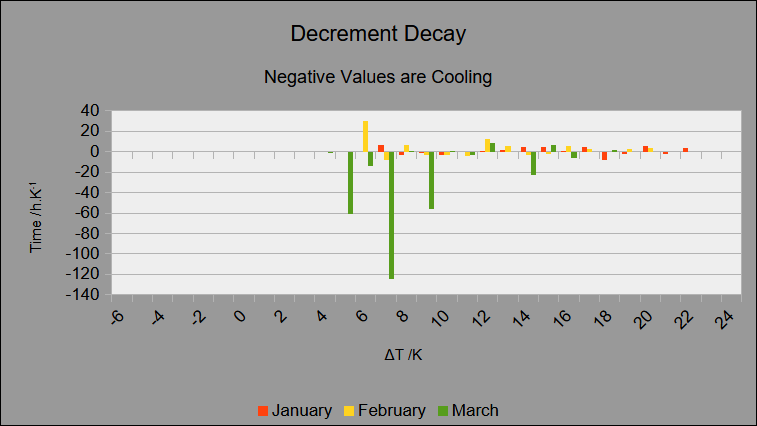
-
Should I be happy with this decrement delay?
SteamyTea replied to MikeSharp01's topic in Boffin's Corner
I am looking at that now. That as well. Why, it is basic mathematics, statistics and easy physics. He is right. -
Should I be happy with this decrement delay?
SteamyTea replied to MikeSharp01's topic in Boffin's Corner
Have just done a very basic calculation on my place, without filtering for inputs. Heating, on average, takes 15.6 hours per sustained degree increase, cooling, as expected, takes longer at 19.6 hours per degree. That is based on 6 years data. -
Should I be happy with this decrement delay?
SteamyTea replied to MikeSharp01's topic in Boffin's Corner
I have been doing that for nearly 2 decades since I did my dissertation on it. -
Should I be happy with this decrement delay?
SteamyTea replied to MikeSharp01's topic in Boffin's Corner
The time it takes for the building to heat, or cool, when there are either very small, or very large, temperature differences? -
Should I be happy with this decrement delay?
SteamyTea replied to MikeSharp01's topic in Boffin's Corner
Are you concerned about the tails (extremes)? -
Should I be happy with this decrement delay?
SteamyTea replied to MikeSharp01's topic in Boffin's Corner
Assuming your definition of decrement decay is t.K-1 you have to slice (bin) by the ΔT or bin by the OATs (internal temperature does not have enough variation). Work out the time between 1K variations, then plot them. This should produce a natural logarithmic curve i.e. the greater the ΔT, the shorter the time to change. The problem seems to be, when I look at my data, is that it regressed to zero (ideal would be zero i.e. no inputs, no temperature change). I find it better to look at temperature distribution over a fixed time period, then look at the most likely variation. Maybe when I get home I may look at my data and play with it a bit. -
This is true in so many fields, opinion is often quoted as fact. That happens on here as well. You understand how different heating systems work, is it the concept of a low temperature system that you find hard to accept. As I frequently say, temperature is not energy.