SteamyTea
-
Posts
23848 -
Joined
-
Days Won
200
Everything posted by SteamyTea
-
Put the obvious bits right and ask him to do a free secondary report. Then offer to sell your services as a quality manager.
-

Does anybody remember the game SimCity2000?
SteamyTea replied to Adsibob's topic in General Alternative Energy Issues
It is strange how frequency always causes the 'damage' rather than energy levels. Ionising means removing the electron from the atom, leaving an ion. It happens all the time and at different energy levels how we make plasma). Frequency has very little to do with the process, other than the speed and quantity of the processes. It is all to do with the amount of energy needed to knock the electron into a higher orbit. Ionisation is a useful process as we can create molecules that would not normally exist in large quantities, or decay into the constituent parts very quickly. Ozone (O3) is probably one of the most common ones made and has many indirect advantages (sterilisation), though in large quantises can be damaging (it makes the body 'rust'). -
Where is the kWh price heading in 2022?
SteamyTea replied to epsilonGreedy's topic in General Self Build & DIY Discussion
Select the whole text and replace with a period . Unless you are on a phone and then it seems to be impossible. -
Is it based on the MPAN number, they tend to be outside, in an easily identifiable box. You can pull the main fuse, then stand around with an indigent look, while complaining about the Russians/Government/Power Company/ noisey neighbours. Claim you have been onto the power company and they say power will be restored in an hour.
-
Does anybody remember the game SimCity2000?
SteamyTea replied to Adsibob's topic in General Alternative Energy Issues
What is this sun you speak of? None down here today. -
Has anyone worked out what the price difference is for upping consumption during the timed usual usage session, then using as little as possible for the rebate session?
-
And this is what made me turn my heating on.
-
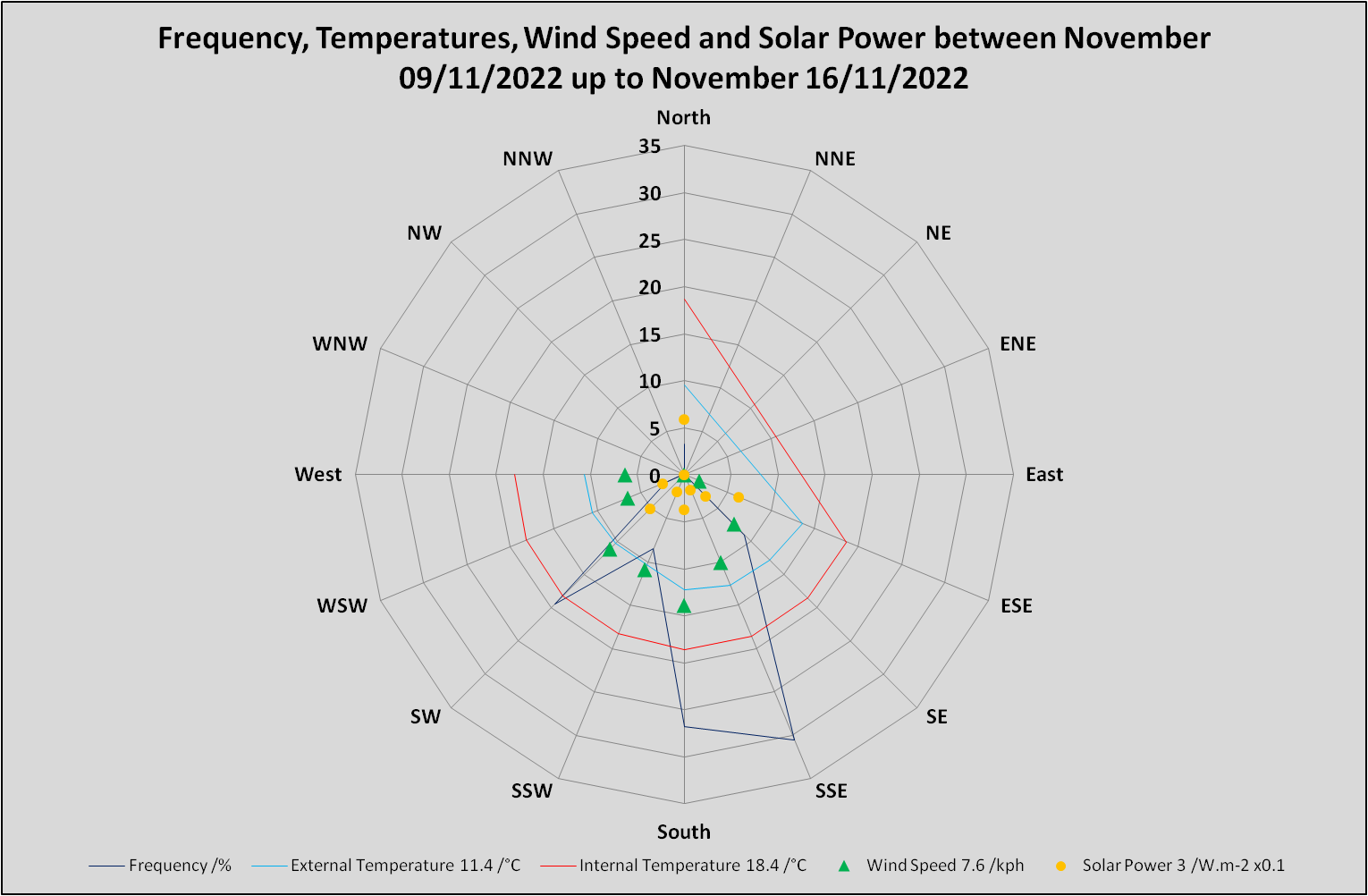
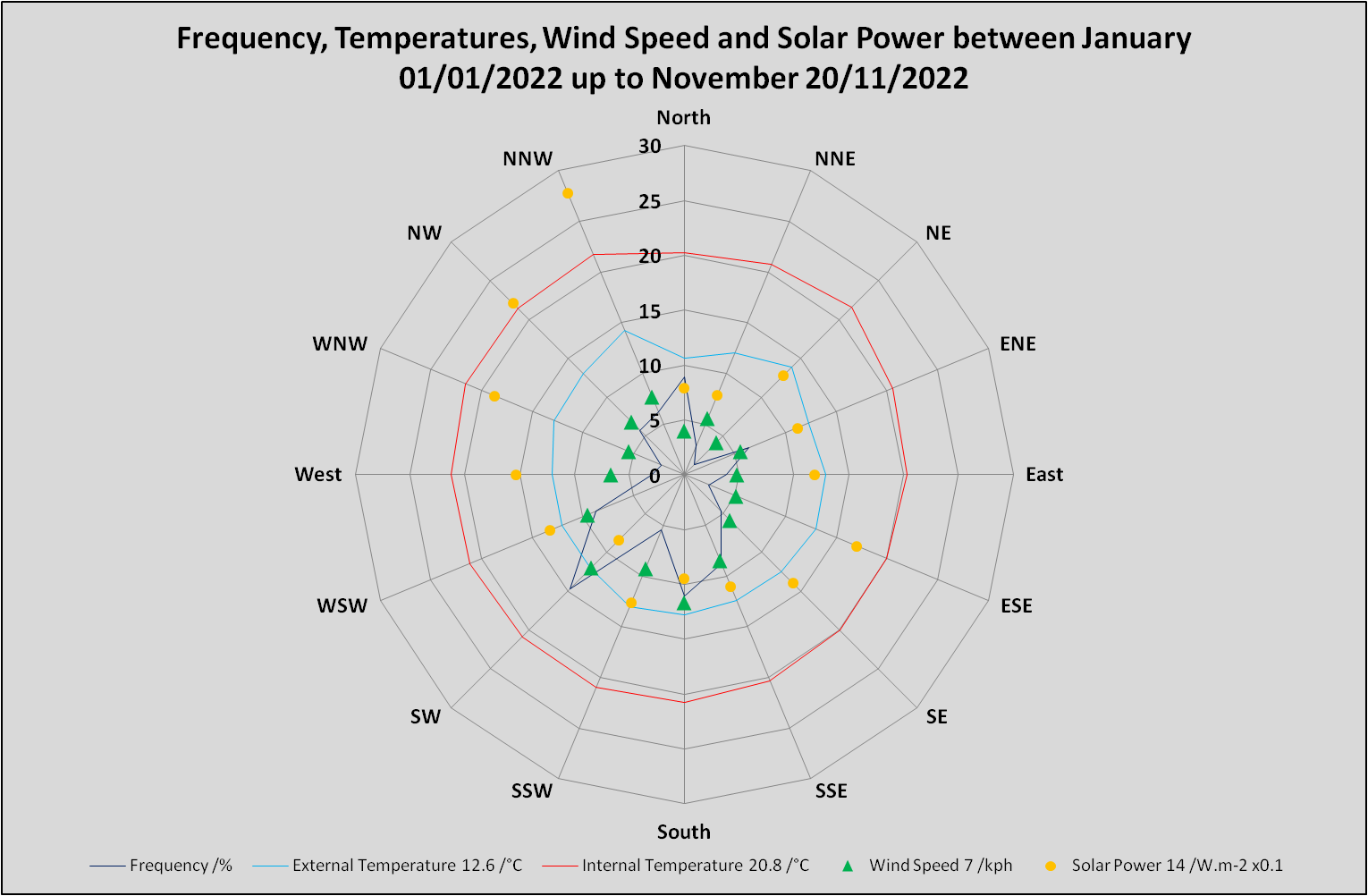
Here is what I measure and chart. Frequency is the wind direction, so when from the North, and the house and outside is coldest, it is about 8% of the time. West wind is when the house is warmest, but that is about 2% of the time. North wind is very slow, SW is very fast, Generally sunniest when the wind comes from between the West and NNW, SW winds are dreadful for sunshine, it is raining then. It rains a lot, except this year.
-
No. Power is the Energy flow rate i.e. 1 W per second. A watt is a joule per second, so if you divide that by time, the seconds cancel out and you are left with just the joule, which is the the SI derived unit for energy. There are: 3,600,000 J in a kWh k for 1000 x 1 W [for j/s] x h for hour [for 3,600 seconds].
-
Depends on what is limiting the potential overspill to the grid. Generally speaking your inverter limits the amount of power that comes out our the battery storage. Think of your inverter as a tap, and your batteries as the water cylinder. Small tap, little flow (kW) large tap, bigger flow. The longer either tap is on, the less water is stored, eventually it runs dry, until it is topped up.
-
I have found very little correlation between weather and internal temperature. There is a general trend of the house getting cooler as the external temperature drops, but wind speed and direction don't affect it much, same with solar gain. My place is a terrace so less exposed area, but as it is small, it should react faster.
-
Right, it is a 12.6 kWh battery and the inverter will draw at 3 kW. So about 4.2 hours at maximum power. A normal electrical heater is about 2 kW, so you could run 1 on full power, and another on half power. Or get some 1 kW ones. Your solar panels are 6.2 kWp. kWh is energy, kW is power. Power is the rate that you use the energy.
-
Does anybody remember the game SimCity2000?
SteamyTea replied to Adsibob's topic in General Alternative Energy Issues
Just go North and then a short hop across the Bering Strait, which will soon be Chinese. Actually, don't really need to cross the Pacific, they can have local geothermal and wind energy. -
Does anybody remember the game SimCity2000?
SteamyTea replied to Adsibob's topic in General Alternative Energy Issues
Like perpetual motion machines, they just need to be a bit bigger. Probably not the best route. Better to take the shortest route between major population centres, which would predominantly be Northern Hemisphere, and over more land than under the sea. The most productive 'sunshine' belt is on a latitude with Toronto, Madrid, Shenyan, Aomori, Eureka and Harrisburg. Basically Lat40°. -
Does anybody remember the game SimCity2000?
SteamyTea replied to Adsibob's topic in General Alternative Energy Issues
The astronomers will be upset, they are upset enough with the current number and orbit of satellites. I wonder how much energy would be saved by turning off all street lights in the UK. -
Does anybody remember the game SimCity2000?
SteamyTea replied to Adsibob's topic in General Alternative Energy Issues
It is always 5 PM somewhere. Not exactly a new idea, and a lot of technical challenges to overcome. But as @ProDave says, we are not short of land (even in the UK). Think I worked out once that half the area of Cornwall would produce enough GWh (but may have been enough to electrify all out transport, really can't remember). The middle bit of Cornwall is pretty miserable, so no loss, but anyway, they would not be installed in one contiguous block. I think I read about beaming power from space in Jerry Pournelle's, 1981, A Step Further Out, and it was not a new idea then. Also a bit hard to replace the inverter when it goes wrong. -
Does anybody remember the game SimCity2000?
SteamyTea replied to Adsibob's topic in General Alternative Energy Issues
Won't it turn all the 5G conspiracists into robots, and give the rest of us (an unspecified) cancer (it is always cancer, never something more mundane but equally as deadly). -
Would power my house, I am usually at work then.
-
https://www.bbc.com/news/uk-england-humber-63707463.amp That has to be a better way to load balance.
-
Build a large shed, then make a jig to enable corner angles to be true, then start nailing up panels. Be up in no time.
-
To highlight why it is a bad, and unnecessary, experiments. I have very little usage during the day, generally under 2 kWh, usually 1.3 kWh, over 16 hours. Most people could do what I do, but won't save any money for the reasons that usage will just happen at other times. I think I read somewhere that on a previous trial the saving was 0.3 kWh.
-
Several, but only 1 would be used
-
Don't think you have. That is the problem. Putting in 25A fuses to peoples houses, and a £100 replacement fee would sort the problem pretty quick. Basically what they have in some countries.
-
Yes it is. It saved them buying even more nuclear plants Easier for the French to buy in power for connected countries i.e. Spain, Germany, Italy, Netherlands via Belgium, Switzerland. The concept of relying on individual households to save a few pence to 'help the grid out' is what is flawed. I can't see that each house saving 0.5 kWh over a busy period is the long term solution. Make the problem smaller and then the solutions are smaller.
-
Yes I do, because by reducing total energy, less primary fuel is used, this reduces (at the moment) emissions. There is a bit of a myth that the grid reacts to demand. Actually the other way around, capacity is increased, or decreased, to match predicted demand. This works very well, and our system is currently set up to favour RE over FF generation. Probably because it is not new. France has been doing it for decades. It is not so different to what I was doing in my ResM either, and that was over a decade ago. Why I think that it is an experiment that has been set up to give a negative result. It is like proving that more motorist in Devon and Cornwall are speeding, by measuring at more points (except the 'customer' does not get any rewards).