SteamyTea
-
Posts
23848 -
Joined
-
Days Won
200
Everything posted by SteamyTea
-
You need to work out the area that the feet it sits on and then the total mass. Convert to MPa (Mega Pascals) then see what the compression strength of OSB is (I am sure a bit of googling will reveal it). Then wish you had a bit more oak. Higher quality ply wood may work i.e. marine or birch faced. https://www.researchgate.net/figure/Performance-of-OSB-in-Compression_tbl1_319095057 Stress-strainconstitutiverelationofOSBunderaxialloadingAnexperimentalinvestigation.pdf
-

What building regs apply to a wooden garage,?
SteamyTea replied to joe90's topic in Garages & Workshops
Rounding errors. Both of us are quote short, I am 5' 6 1/2". That half inch is important, so once rounded, I am 6 foot tall. (sometimes imperial units are better for comical affect) -
New member - stuck for what to do next to warm the house
SteamyTea replied to Sparrowhawk's topic in Introduce Yourself
Might be. Outside Air Temperature (OAT) can be modelled quite accurately using a Normal Distribution. Plug in the mean air temperature for your area, adjust the standard deviation until he coldest temperature you have every known there is reached i.e.-10°C (or in my case -2°C), then multiply by 8760, which is the hours in a year.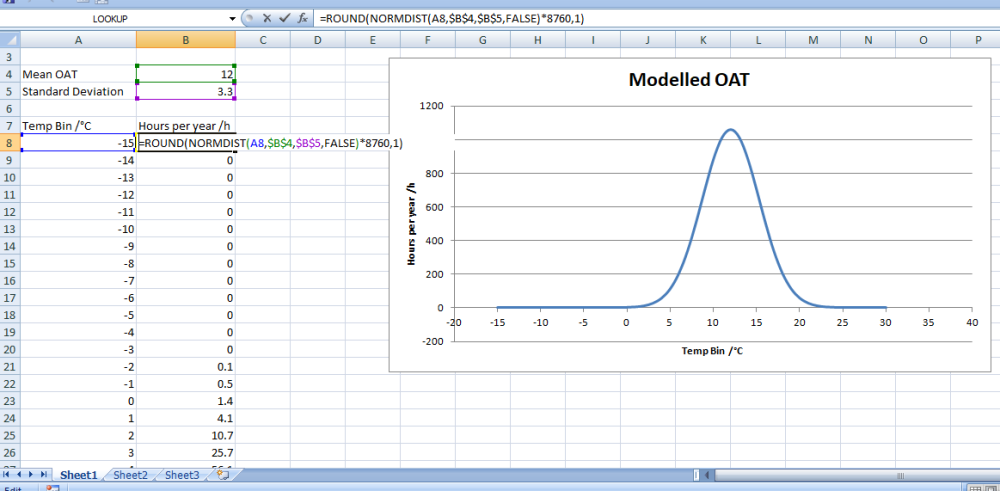
-
To Raspberry Pi or not, that is the question.
SteamyTea replied to TerryE's topic in Boffin's Corner
Just for a laugh, put an energy monitor in it and see what it uses. As an aside, I have found out why my cheap 'solar UPS' failed. It was an old, and very cheap, battery bank, so when it was left for a few hours, the voltage dropped too low to run the RPi, even when plugged into a 2A charger. Was still worth a go, and I know not to do it again. -
New member - stuck for what to do next to warm the house
SteamyTea replied to Sparrowhawk's topic in Introduce Yourself
Almost. It does depend on what the losses of the building/room is as well. A floor slab is no different to a wall, except the angle it is at. There is a hot side and a cold side. The hot side is the mean flow temperature (give or take a little bit because it will have some concrete above it). The cold side is the ground, which varies with external temperature, but with a quite long delay/response time. The easy way to get an idea of what the ground temperature is, is to run the kitchen cold tap for a minute or two, then measure the temperature. Underfloor heating is generally considered to use more energy that radiators (which are really convection heaters), the amount extra used is generally considered 20%, but that is dependant on so many other things it is only a rule of thumb, just as easy to work it out more reliably with a thermometer and ten minutes with a spreadsheet. -
New member - stuck for what to do next to warm the house
SteamyTea replied to Sparrowhawk's topic in Introduce Yourself
I worked out if the flow temperature, in an UFH system, was 32°C and ground was 8°C, the with a U-Value of 0.27 W/m2K, then it is about 400 W lost to the ground, and at 0.12 W/m2K, then 175 W will be lost to the ground. So about half the losses with better insulation. That is probably a worse case, so maybe halve it. But if you have less insulation, the mean flow temperature will probably be higher, so even greater losses. Insulation is not an exciting product, but it works all the time and consistently. While it might be easier to say that the losses are relatively small in the scheme of things, having UFH in the house will probably make it a nicer place to be. -
Yes.
-
New member - stuck for what to do next to warm the house
SteamyTea replied to Sparrowhawk's topic in Introduce Yourself
How many m² and what is the ∆T. -
What building regs apply to a wooden garage,?
SteamyTea replied to joe90's topic in Garages & Workshops
That could be any size though. -
Holier than a........ Just no!
-
A flue works by having a lower pressure at the outlet than the inlet. The pressure difference is caused by temperature related density changes. Flow rates are affected by the ratio of cross sectional area to circumference ratio, which changes greatly during a bend. Flow rates, or more accurately, mass flow rates, are complicated to calculated as increased velocity can actually stall the system. Much easier to just put a fan heater in.
-
Must I insert the thermometer to prove it, again, again, again. The difference between an oral and anal thermometer. The taste.
-
About the same as ore body temperature. But I have a hot body. That may be how you make a pasty, not how thy make them down here. No one knows what goes in them.
-
For me 37⁰c starts to feel chilly.
-
What building regs apply to a wooden garage,?
SteamyTea replied to joe90's topic in Garages & Workshops
Make the slab the size, and shape, you really want, then build to just under 30m2. Not sure how well you want to insulate it, and if that has to be inside the foot print or outside. If you make it of TF, or SIP construction, it should be easy to make it longer then no one is looking. -
I might sound like Bruce Willis, but I have a much better memory.
-
When I was at school, we used to call people that finger pointed 'sneaks'.
-
And I thought that special orange message about behaviour on here was directed solely at me.
-
You as well as @pocster Will budgie smugglers be allowed again.
-
GRP every time. Think of it as a boat. Do you want something that is capable of being sailed around the world, or something that almost makes it across the Channel. You do need to get it done properly, and that is where the challenge is.
-
Do some measuring and the sums. Td = T - ((100 - RH)/5.) where Td is dew point temperature (in degrees Celsius), T is observed temperature (in degrees Celsius), and RH is relative humidity (in percent).
-
Fit two, separate ones. One near the boiler, and one in a suitable living area.
-
Let us know if it works, and is a practical solution.
-
Where is the kWh price heading in 2022?
SteamyTea replied to epsilonGreedy's topic in General Self Build & DIY Discussion
Do you have two separate businesses, one for quotes and one for contracts. I just hope my pension find invested wisely in energy production companies, and now pulls out of them. -
Where is the kWh price heading in 2022?
SteamyTea replied to epsilonGreedy's topic in General Self Build & DIY Discussion
Not to be too controversial, but isn't HS2 really just a reflection of our under investment in the rail infrastructure. The kind of thing that we should have done decades ago. Unlike Wales and its roads, where all development is stopping.