SteamyTea
-
Posts
23848 -
Joined
-
Days Won
200
Everything posted by SteamyTea
-
Is it worth asking your bank. They must deal with this all the time.
-
 Or just get a maid, from the Philippines.
 -
Start the search query with site:www.https://forum.buildhub.org.uk Much better than the built in search.
-
Solar PV and hot Water Diverter - Advice
SteamyTea replied to bob the builder 2's topic in General Plumbing
That will be 10 kWp, the peak is for peak. I take it the system is going to be 3 phase and that is why you have 3, 2 kW immersion heaters in your cylinder. I don't know too much about 3 phase systems, but depending on your meter, it may do net metering and you could divert just on one phase and let the other phases export, but the meter will cancel out the imports. May be simpler to buy 3 diverters. The one things to check is that your phases are balanced as well as they can be. That can be quite a challenge. -
Not the distance between the generators and the main consuming area though, it is the local substations that are the main areas of losses, though, and inefficient old home appliances. I suspect that more energy is lost though old fridges/freezers, unattended 'entertainment' i.e. TVs on but no one watching, poorly insulated DHW cylinders (which is most of them), security lighting left on unnecessarily, unemptied vacuum cleaners....
-
It is 4.18 J to raise 1g of water, 1 K. A watt is a joule per second. The joule is the SI unit for energy. This gets 'corrupted' to the kWh, which is 3,600,000 J. Both the joule and the watt are derived units from the SI standards of mass, distance and time. Different materials have different heat capacities and specific heat capacities, the J/kg.K. It is more usual to use specific heat capacities when dealing with fluids, though there are times when just the heat capacity is more useful i.e. evaporation losses. Evaporation, condensation and fusion HCs are often different for the same material. It is what allows a heat pump to work.
-
Was my first thought. My car has both. One involves opening the window.
-
Update on Timeshifting to Minimise Heating Costs.
SteamyTea commented on TerryE's blog entry in The House at the Bottom of the Garden
Pitifully small. I think the relevant detail is hidden in this spreadsheet. https://assets.publishing.service.gov.uk/government/uploads/system/uploads/attachment_data/file/1131436/RHI_monthly_official_stats_tables_Dec_22.xlsx Sheet S.1 show median costs of installing a kW of ASHP is £980, with lower quartile at £770 and upper quartile at £1710. What that actually covers I have no idea. As a comparison with combustion technology, small biomass is coming in at a median of £590/kW (LQ 480, UP 800) -
If you write a similar letter to your builder, you may get the electricity bill paid. Then, start on everyone you have every purchased stuff from, with a bit of luck, you will reclaim enough to pay for you building. Talkin' New York Bob Dylan After weeks and weeks of hanging around I finally got a job in New York town In a bigger place, bigger money too Even joined the Union and paid my dues Now, a very great man once said That some people rob you with a fountain pen It don't take too long to find out Just what he was talking about A lot of people don't have much food on their table But they got a lot of forks and knives And they gotta cut somethin'
-
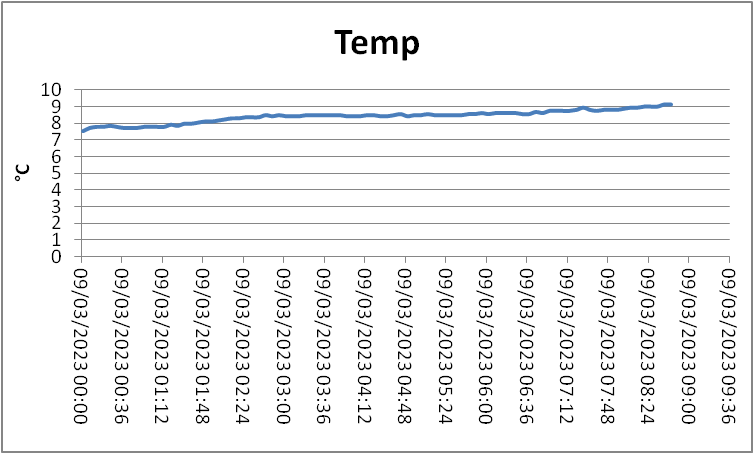
Was 11°C when I left work an hour ago, 7.8°C in my back garden at the moment. Going to turn the input knob on my storage heaters down a bit as I turned them up in anticipation of snow and cold weather.
-
Update on Timeshifting to Minimise Heating Costs.
SteamyTea commented on TerryE's blog entry in The House at the Bottom of the Garden
People have been saying that for a decade now, does not seem to be happening in the UK. Here is a bit about lithium batteries. https://ourworldindata.org/battery-price-decline Here is a bit about PV https://ourworldindata.org/cheap-renewables-growth I can't find any data on heat pumps at the moment, but shall keep looking when I remember. I think one of the problems is that because we like high price houses, heating systems are considered a high mark up add on. There was a small estate of new houses built in St, Agnes about 12 years ago, nearly all of them had ASHPs fitted. Those houses were no more expensive than similar 'gas powered' ones built in Newquay, or Redruth, once the St. Agnes premium had been paid (the snob premium). Much of the high prices we pay are because of incentive schemes to implement domestic renewables, a recent report highlighted the low take up of the BUS scheme. The only scheme that was successful was the original FiTs on PV, but in reality, very few people could afford to spend between £8000 and £12000 on a PV system to get the 41p/kWh and the deemed 5.6p export. Realistically, I doubt that domestic generation is every going to compete with grid power and I say that as someone that would love to live off grid for the technical challenge. To get close to being self sufficient in electricity, I would have to halve my winter usage to around 600 MWh for December, January and February, which may be possible, and cover my house in PV, and my 5 neighbours houses. Or just buy in 90% of my power at 15p/kWh, which I currently do, and wince when I see the 10% at nearly 60p/kWh. -
kWh not watts. Have to convert that in energy loss. About 1 kWh. Can you fit it into the loft space, or outside in an insulated shed?
-
D Tube heat transfer technology. A, B, C must have failed.
-
A 300 lt TS does seem quite small. Assuming you can get away with a minimum temperature of 35°C and a max of 85°C, then: 4.18 [SHC of water] x 300 [mass of water] x 50 [delta temperature] x 0.0002778 [kWh factor] = 17.4 kWh. Now my small house in Cornwall, uses, at this time of year, about 20 kWh/day, 4 of that is for DHW and everything else. So just about enough to heat a 50 m2 place when the outside temperature is around 7°C.
-
Welcome. Isn't North Bucks Milton Keynes. Just kidding, I know the area reasonably well.
-
What is that white stuff
-
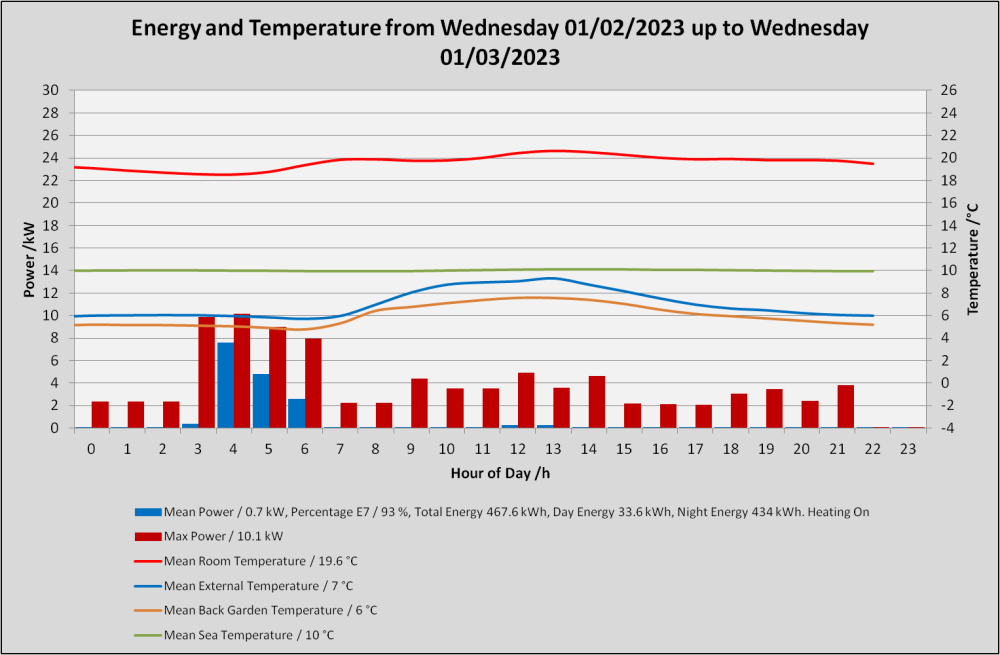
And you don't need a slab weighting tonnes. My storage mass is less than 100 kg. Pump the heat in between 4 AM and 7 AM, job done.
-
Cut my Sampson locks of yesterday. All part of my energy saving regime.

-
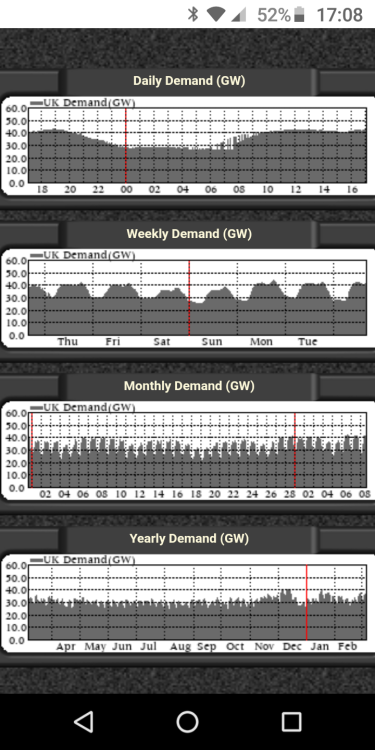
Work out the cheap times.
-
We should have installed air conditioning… now what?
SteamyTea replied to Adsibob's topic in Other Heating Systems
I think that is a zombie number that just won't die. I heard in the radio the other day that fitting an ASHP can cost up to £14k. Would be a bargain for some properties. The only way to get a proper price is to know what you want, then get people to quote for it. Then laugh at the sily ones. -
The big phone switch over/off in 2025
SteamyTea replied to Temp's topic in Networks, AV, Security & Automation
Not down the Cot Valley. You know that scene from Deliverance, the one in the woods, well it is like that there. So I just slip a CD on and crank up Suckin' the Corn. Get the whole place to myself then. -
Then you can explain how to incorporate the heat losses better, and how to convert them to energy from the existing known, and unknown, parameters.
-
Why not store at the temperature the UFH needs. Then blend that in with a smaller volume of much hotter water when needed. Sometimes you need piping hot water, like greasy dishes. I checked my water usage the other day, 170litres/day. Way too high again, but I do like a hot bath to start the day, gets rid of most of the aches and pains. Maybe I just need to take more paracetamol, would be cheaper.
-
If you say @SteamyTea three times, he will appear Easy. (4.18 [kJ/kg.K] x kg [mass of water] x ∆T [temperature to increase by] x 0.0002778) / kW [input of thermal source] This is the theoretical minimum time. There are heat losses to consider that rise as the temperature increases. These follow Newton's Law of Cooling. Easier to just add a bit of time, say 15%.

-
The big phone switch over/off in 2025
SteamyTea replied to Temp's topic in Networks, AV, Security & Automation
I put all my trust in the Lincolnshire Poacher. If Gawcott was still there, then so was Aylesbury. 17 31 7 23 19 27...