SteamyTea
-
Posts
23847 -
Joined
-
Days Won
200
Everything posted by SteamyTea
-
Say, after 20 years you redo it. Worth staying in the house, will end up as sexy as this once all the cracks, holes and wrinkles are filled. Might be PVC in the image, but you get the idea.

-

GRP Roof Internal Down Pipe Leaking or Condensation
SteamyTea replied to GrantMcscott's topic in Flat Roofs
Looks a little dry in places to me. Really, then why do they sell it, what do they claim it is for? -
GRP Roof Internal Down Pipe Leaking or Condensation
SteamyTea replied to GrantMcscott's topic in Flat Roofs
That may be your problem. Water can easily find a path though the matrix, especially if there are some dry patches i.e. too much mat, not enough resin. Sand well and get the top/flow coat on. Then see what happens. -
There is a fair bit on emulsion polymers here, I say a fair bit, I cannot be bothered to read it.
-
What would you do differently if you could do your PV install fresh?
SteamyTea replied to Gill's topic in Photovoltaics (PV)
Why I mentioned it, I don't have an EV. But it seems that, with the Teslas, if you leave some features on, then it is quite a high standing loss. Would be nice if you could measure it though, say when you park it up for a few days without usage. -
If you look at the Met Offices' Central England Temperature data set (just happens to be the longest in the world), between 1900 and 2023, there has not been one full day when the temperature has been lower than -9°C. The distribution starts at -8.7°C, and that has 1 instance, or one full day. For temperatures below, for a full day, 0°C, there has been 1177 instances out of 44908. That is 2.62% of the days. Now if we look at the last 30 years 1993 up to 2023 then the lowest temperature is -7°C (1 full day), below 0°C is 175 days, or 1.59% of those days. Now non of us can actually live at the CET location, but it shows that we remember exceptionally cold weather because it is exceptional, not because it is common.
-
Assuming the areas are the same, you would use less energy with the 150mm under the floor. The reason is that the floor will be at a higher temperature than the air in the building. The truck is that it is all in the formula. W=U-Value X Area X Temperature Difference. Increase any one of them and you have a greater power loss.
-
It will know if Nigella is on your telly and you are watching Whack Off.
-
Welcome. First things first. Have you done an energy audit of your house? Do you currently have enough hot water for your needs? The CoP of an ASHP is affected by more than just flow temperature.
-
Sounds like it only has 4 functions on it. On Off Zero Export Maximum Export Now what other products you got in the house that have limited functionality.
-
I suspect you are really after temperature and humidity control. Standard MVHR is not going to help much there.
-
What would you do differently if you could do your PV install fresh?
SteamyTea replied to Gill's topic in Photovoltaics (PV)
From the horse's mouth. https://www.tesla.com/en_gb/support/range#:~:text=It is expected for a,aftermarket equipment when not needed. Why does estimated range decrease overnight while my car is off? It is expected for a Tesla car to consume around 1% of charge per day while parked. In some cases, you may notice that consumption is higher. We recommend deactivating features such as preconditioning, Sentry Mode, Keep Climate On and any aftermarket equipment when not needed. It’s best to keep the vehicle plugged in when using those features when possible. Note: Aftermarket equipment connected to the 12V system and/or third party mobile applications which collect data about your vehicle can decrease range while parked and reduce the battery lifespan. Tesla does not recommend using aftermarket equipment, and any damage to your vehicle’s hardware or software resulting from unauthorized access to vehicle data through non-Tesla parts or accessories is not covered by warranty. -
Set it to Richard.
-
What would you do differently if you could do your PV install fresh?
SteamyTea replied to Gill's topic in Photovoltaics (PV)
That is just the charger right? Not how much the car uses when not being driven. -
Been watching Pennyworth, the undertaker eats people's organs for supper. They look just like the sausage I sell, before they are cooked. At least Breaking Bad has helped kids pass Chemistry in exams.
-
Turn it up to 11.
-
What would you do differently if you could do your PV install fresh?
SteamyTea replied to Gill's topic in Photovoltaics (PV)
If the UK government tried to organise that, it would be a disaster. How would you know how many miles a car that is taken off the road had done. And can you imagine trying to collect the payment when someone moves, or just does not have the cash. Much easier to just have a fixed fee, payable monthly, 6 monthly or annually, we are used to that, and we have the systems already in place. What it really comes down to is what the charge should be, trying to make 'fair' for everyone just means we all loose out. We really should treat personal transport as a privilege, not a right. I hate public transport, really hate it. Why I pay the price to have private transport. Running my car cost me more than running my house. -
What would you do differently if you could do your PV install fresh?
SteamyTea replied to Gill's topic in Photovoltaics (PV)
It is interesting that we tend to think that we should be allowed to charge our vehicles at home whenever and however we like. Good job that gasoline car owners are not allowed to do the same. -
I generally use Leicester as my generic England PV spot. It is about halfway up, and halfway across the country, and reasonably flat. I have been to Banbury, made me cross.
-
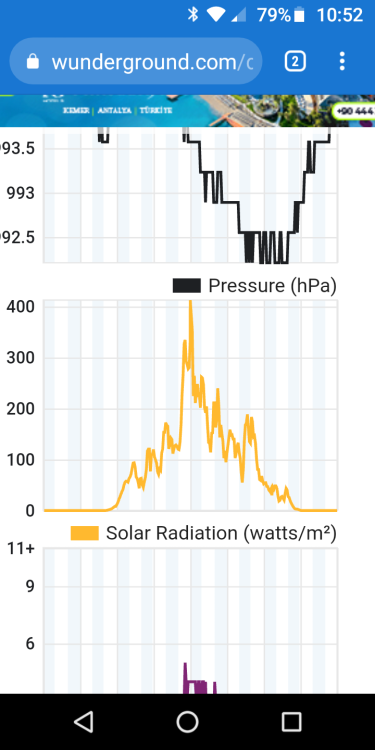
We may be talking about different things. But here is a chart of horizontal plain solar power from Banbury on Saturday. Not a very impressive day, quite peaky.
-
I explained that.
-
You are cruel. Just think how much electricity could have been bought it, years worth.
-
What would you do differently if you could do your PV install fresh?
SteamyTea replied to Gill's topic in Photovoltaics (PV)
Have you ever had a look at the parasitic losses on an EV? I think I read (may have been about Our Jeremy's Model 3) that they can easily chew through 3 kWh/day. So around 125W while doing nothing. So you may be better off, if your tariff allows, charging it later. -
From what I understand about hempcrete, it is inherently non airtight, and absorbs moisture. The tapes used are not the same as cheap roll of gaffer tape from the pound shop. They are engineered products. You will be needing to use them anyway to pass your airtightness test. If 'nasty' chemicals were used, they would be banned. Not as if we are ignorant of this anymore, we don't see people dropping dead from industrial diseases these days. When I started working in the 1970s, raw asbestos fibres were still mixed in, by hand, with the polymers we were using, the world has moved on, thankfully (thankfully my Mother told me I was not going to work for Railko). It is very easy to fall down the environmental rabbit hole, trouble is the conclusions end up the same that people are the problem (not one I subscribe to). My view when it comes to housing is that with our current housing replacement rates, what we build today will have to last 500 years (saw an interesting talk about it a few years back). Trouble is, apart from building with natural stone and a lot of ongoing maintenance, that is not going to work out. So second best is to reduce energy demand of housing, which means either more land is used overall per square metre of living area, or more modern materials. The international space station is not insulated with hemp and lambs wool for a reason, my car does not have cart wheel made from ash. And then you may end up with a misguided neighbour with a wood burner who thinks 'it is carbon neutral' and 'the smoke is alright in the countryside'.