SteamyTea
-
Posts
23847 -
Joined
-
Days Won
200
Everything posted by SteamyTea
-

Solar - Where to start?
SteamyTea replied to DazRave's topic in Energy Efficient & Sustainable Design Concepts
There seems to be some confusion about my comment on storing energy as hot water. It was never meant to mean store all your energy as hot water. That would be a bit silly. It is also silly to heat and store more water than you actually need. So while the volume of a cylinder may be fixed i.e. 200, 220, 250, 300 litres, the mean stored temperature and be varied, within limits i.e. not too hot, not too cold. There is, as @pocster and @ProDave illustrate with their set ups, a zealous need to export nothing and overstore. That is a bit silly as well. When the original question was asked by @DazRave, apart from spending £10k on a system, which says nothing about the size of the system, I was also unaware that he had gas already. But let us look at the cost of gas. I don't have it, but there is a standing charge, is that similar to electricity i.e. 60p/day? How much is an annual service £150? Assuming a combi boiler, how efficient are they when heating water for a few minutes shower, 80 to 85%? Never seen anyone work that one out. There is also the added benefit that roof integrated PV can decrease solar energy entering a loft/roof void by about 18 to 20%. This may help, depending on house design, reduce the need for summertime cooling. Cooling should not really be necessary though, it is a building design failure. -
Solar - Where to start?
SteamyTea replied to DazRave's topic in Energy Efficient & Sustainable Design Concepts
Hard to wash in a TV. Now stop being a twat. -
I don't see why not. Not really infinite depth, semi infinite. So long since I had to do this sort of thing that I would have to do a lot of research. My simple method of expanding the slab size, by the slab thickness will be close enough.
-
With a bit of Fourier thrown in I seem to remember. I once, over at the other place, model the heat flow in two dimensions though a solid, seem to remember that it is just a cone made with exponential curved sides. That is the losses for a cylinder, but should not be hard to chop it into a rectangle and take away the 'off cuts'.
-
Solar - Where to start?
SteamyTea replied to DazRave's topic in Energy Efficient & Sustainable Design Concepts
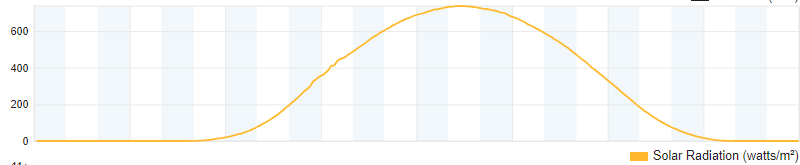
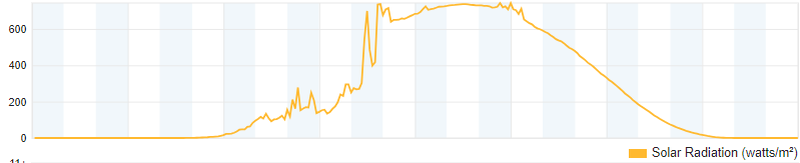
You can get 'diverters' that sense when the system is exporting power to the grid and turn on the water heater, or battery charger. The thing to remember is that PV is not a constant power, or even a normally distributed power curve. It is very variable. If you can find a local WeatherUnderground station that has a solar meter on it, you will see how, even on a sunny day, there is often a lot of variation. Two very very rare days in a row. 3-6-23 4-6-23 5-6-23 6-6-23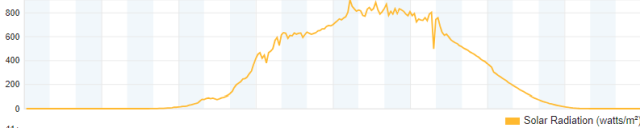

-
Solar - Where to start?
SteamyTea replied to DazRave's topic in Energy Efficient & Sustainable Design Concepts
What is hard to put a price on is the satisfaction that you are are generation clean energy at source. You can make a game out of planning when the washing is going to be done, and for a lot of the year your hot water will be solar heated. Storing the PV energy in a cylinder as hot water is the cheapest type of storage, way cheaper than batteries. -
What has the increase actually been each year, 1%, 0.5%. Data is needed to back that up. I have to agree, and have no idea what the answer is. They died of hyperthermia back then as well.
-
Solar - Where to start?
SteamyTea replied to DazRave's topic in Energy Efficient & Sustainable Design Concepts
Pretty good, most people find it under estimates a bit, maybe 3 to 5%. Some of that will be down to quality of modules (the real term for panels). This is because, to offer a guaranteed output in a decade of say 80% performance, the manufactures actually supply higher powered modules, but marked up as lower powered ones i.e. 320W modules but marked as 305W. -
Solar - Where to start?
SteamyTea replied to DazRave's topic in Energy Efficient & Sustainable Design Concepts
It shows that So for me, 48/1060 * 100 = 4.5% Huge daily variation though.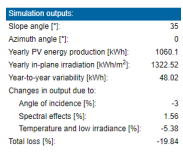
-
Solar - Where to start?
SteamyTea replied to DazRave's topic in Energy Efficient & Sustainable Design Concepts
Penzance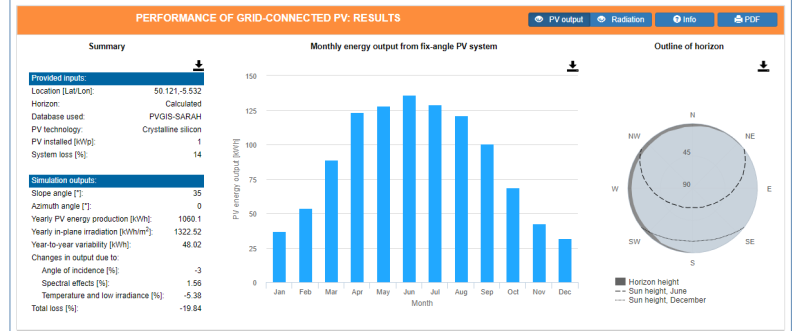
-
Solar - Where to start?
SteamyTea replied to DazRave's topic in Energy Efficient & Sustainable Design Concepts
This is for a 1 kWp system in Manchester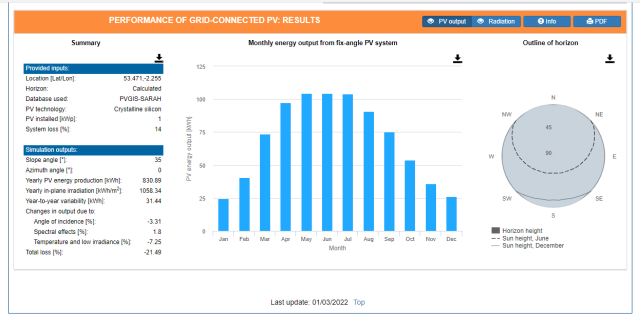
-
I took a stab at it and posted it up somewhere on here. Really just a case of taking the slab thickness i.e. 0.15m, add it to each edge, to a 0.15m thick slab that is 5m by 10m become 5.3m by 10.3m. Then multiply that by the U-Value below the UFH system, and the temperature difference. The temperature difference is the ground temperature in mid winter i.e. 4°C and the mean UFH system temperature i.e. 35°C. So a delta T of 31°C.
-
Solar - Where to start?
SteamyTea replied to DazRave's topic in Energy Efficient & Sustainable Design Concepts
Where did you learn to say that from? -
If you knocked out the whole of India, then that would be 1.45bn less. Back to 2005 levels, and people where saying them there are too many of us. in 1970, Limits to Growth and Population Bomb were popular reading, there were 3.7bn people, people said too many. 1951, 2.6bn. Was it a problem then? I was not born. Now let us look at energy usage by person since 1950. Year Pop billions Energy TWH Energy per person /kWh/y Power per person /kW 1950 2.6 28600 11000 1.3 1960 3.1 42000 13548 1.5 1970 3.7 66400 17946 2 1980 4.5 88000 19556 2.2 1990 5.3 107000 20189 2.3 2000 6.1 123000 20164 2.3 2010 7 153000 21857 2.5 2020 7.8 168000 21538 2.5 I wonder if we have reached peak energy/power per person? I also wonder if we can reduce usage to 1 kW per person. Data from Population Energy
-
Ohms Law. Get the voltage to 3.3V on the data wire. https://raspberrypi.stackexchange.com/questions/41234/max-length-of-wire-w-3-3v-or-other-issue
-
I think that has almost happened. It is amazing how fast the fertility rate has dropped, and in the most unlikely places. Sub Saharan Africa, which has plenty of land, water, and mineral resources, but even worse politics than us, is the next place to transform it selves (plural as many countries). Could be a good place to to help out. No need to interfere with all the countries, just ones that are internally willing to change.
-
Probably. I have some ESP8266 but not got around to playing with them much. Going to wait till I am housebound for whatever reasons.
-
Well it should be. But that really entails getting people to change. The SW already has the most expensive water in the country, and has shown it can save a bit easily. Getting flows restricted may be a step too far at the moment. Cornwall is a relatively low density county, about 160 people per km2. With less than 600k people, all infrastructure projects are expensive. Add to that the unique problem that the population more than doubled in the summer, our infrastructure has added costs. Still functions amazingly really. Not many places can cope with the variations in all aspects of life i.e. food supply, energy, water/sewage, policing, medical facility, housing...
-
Solar - Where to start?
SteamyTea replied to DazRave's topic in Energy Efficient & Sustainable Design Concepts
https://midsummerenergy.co.uk/ Look at the GSE in roof system. -
One of the posters about saving water was to save it for our visitors. Did not go down well in some quarters. Really a case that climate change has shifted weather patterns more northerly, so Cornwall is gradually getting dryer. More reservoir will have to be built. If it it accepted that some land will have to go to reservoirs, there is an opportunity to float solar farms on them. And part could be turned over to holiday homes and recreational/educational facilities. I think we tend, as a nation, to be too small minded about development. No reason something cannot be multifunctional. Hard to legislate for, but new developments could contribute to local carbon sequestration projects. So say 100 hectares need to be developed for housing, 50 local hectares could be turned into woodland or wetlands. There are secondary opportunities for tourism as well. Trouble we have is that it seems to be one thing, and one thing only. Much imagination is needed. One area is the existing housing overheating, no one wants roofs covered in solar reflecting bitumen paint, which is cheap and effective, or put a tinted film on windows. PV on roofs and walls is effective at reducing some energy input into buildings, but is seen as expensive, so not done by many, and not done at all for overheating reasons. Local food production, while it seems sensible, probably isn't. Different areas of the country/world have different climates, topology, geology and transport links. Our transport links are based on old industries and agriculture. Be a shame to neglect what is already there and works. Like power delivery, the inefficiency is in the last few miles, not the bulk transport. Companies don't look for the most expensive and environmentally damaging way to trade in goods, they look at the cheapest. Most of the developed world has similar standards and taxes, but some have better skill sets or other resources. Tulip, that turns pigs into bacon and sausages, is in Redruth, not where the market is. But it does make for cheap bacon. Half a pound of offcuts pressed into a mould. Not many local farms will do that for you.

-
Yes. we got some money knocked off our bills if we could, collectively, each save 5 lt a day. We managed that. It is not over development or anything sinister down here, just been, for a very wet area, a little bit dryer. I don't think that SWW pumps much underground water, most of it is radioactive, or polluted with tin, copper, arsenic, lithium...
-
We have had one since last summer.
-
Similar to a Steely Dan?
-
Is there a no-frills R290 heat pump?
SteamyTea replied to sharpener's topic in Air Source Heat Pumps (ASHP)
Care to share them? -
On the RPi it is easy to assign more GPIO pins to 1-Wire protocol.