


SteamyTea
-
Posts
23847 -
Joined
-
Days Won
200
Everything posted by SteamyTea
-
So most of the time you could be exporting, so MCS then.
-

Samsung Gen6 ASHP, 40kw used in a day (HW only)
SteamyTea replied to Andeh's topic in Air Source Heat Pumps (ASHP)
I suspect it is a recording error on the meter. As other have said, something would be very hot. Can we also get kW and kWh sorted. There is a big difference between power and energy. -
You what?
-
Can you cover it in rubber. Makes for a nice kneeling surface and can usually be washed down.
-
The views are set by your distance from the window, I get a good view of the telegraph pole outside.
-
Oh dear. Not going to happen.
-
Did you not think about this at the design stage? There is a lot to unpack here. When you say 'apartment', do you mean a flat in a block? The exposed areas, glass and walls, may be suck that you can easily collect several kWh of solar energy every day, but it cannot escape easily as it is walled in by other flats, that have the same problem. We really do need to get away from over glazing and 'lots of natural light'. In is an energy use nightmare.
-
Can I turn the water off from my tank cupboard
SteamyTea replied to Roz's topic in Boilers & Hot Water Tanks
Often, an easy way to check if water is from the mains is to put your thumb over the tap outlet and turn the water on. If from a tank in the loft, you can stop the water. If mains or pumped, you can't stop it. -
A really bad start to the day ...
SteamyTea replied to ToughButterCup's topic in Environmental Building Politics
That is about 60 quid per current house. Good on him, the Government lent me, interest free, £550 last year to pay my electricity bill. £2bn is about £8k a home when it is spread over 250k homes. Not a life changing amount. Another way to look at it, is by region, which is what levelling up is all about. So take a scummy area of Cornwall, and assume that 1000 homes will be build, average price £230k. That is £230,000,000, so almost a 1/8th of the budget used up, in one small part of, one sparsely populated area. -
I am with the installer here. Having made tooling for blowing expanding and structural PU, inserts, which the existing sheets are, will cause problems. Isothane are probably talking about reactivity between different materials, and not the practicalities of installing. Generally, when expanding flexible PU is moulded, it is poured into an open mould, then the mould is closed and clamped. Vent holes are usually added after a few trial shots to remove air/gasses where voids appear. Voids are not always caused by the liquid resin unable to reach an area i.e. flow around a solid insert. They are often caused by the ongoing shrinkage after initial curing.
-
Your favourite cheap gloves for painting (and for gardening)?
SteamyTea replied to Adsibob's topic in Tools & Equipment
Pulp's Pink Glove -
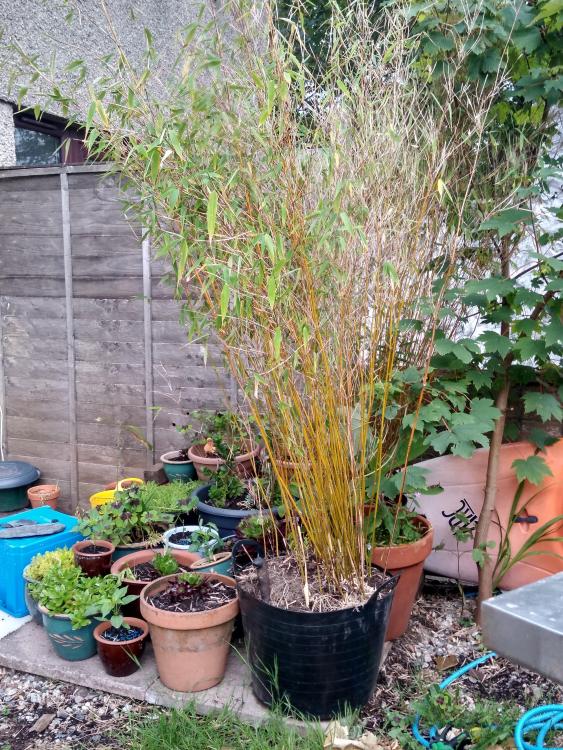
Are you saying that the common/herring gull is vermin, it is a protected species you know. I like having black bags, wheely bins blow down the street on a windy day, damaging cars. I have some golden rod bamboo and it grows easily in a builders bucket.
-
Can you take loads of pictures please as this issue comes up quite often.
-
I could not remember who had done a good job. You used the right amount of resin I think. How it should look. How far from Slough are you?
-
How does your garden grow?
SteamyTea replied to recoveringbuilder's topic in Landscaping, Decking & Patios
Yes. Seems ideal for an irrigation system. -
Does he. Part of the processes of laying up composites is to exclude all the air from the matrix. One could argue that it is the fundamental part of the job. The whiteness, this is dry mat i.e. no resin impregnation, and the longer, and larger, 'bubbles', this is a sign that the mat was not consolidated with the resin before it started curing.
-
When if the first heavy rain due? It is really a shockingly bad job and when the winter freezes come, that will degrade it even faster.
-
How does your garden grow?
SteamyTea replied to recoveringbuilder's topic in Landscaping, Decking & Patios
That frame you have made. Can you make them leakproof, then put water though them, introducing holes where you want to water the plants? -
No. It should be semi transparent and you should be able to see the substrate though the mat/resin matrix.
-
Oh dear. That has been done by someone that has never done it before.
-
Glad I am not loosing my touch, it has been a few years since I did GRP work every day. It really is going to have to be ripped off. If you have no luck with the builder, ca you claim on your insurance?
-
But not too hot and not in direct sunlight if possible.
-
Bad luck, I am 290 miles from you. Do you have any pictures of the work being done? I suspect that they over catalysed the resin and it started setting before they managed to get the mat impregnated properly. As it rained during the process, I also think there will be uncured parts as well. As @TonyT says, is looks like a tarpaulin.
-
Where about in the country are you?
-
Oh dear. Another builder that think GRP is a job anyone can do. Regardless of the price (an iPhone is not really worth more than an Android) this looks to be a case of grind it off and start again. Just about everything that could go wrong, has. I have no idea how you are going to recover the costs from your builder, not easily I suspect.


