


SteamyTea
-
Posts
23847 -
Joined
-
Days Won
200
Everything posted by SteamyTea
-
Makes me wonder if there is a market for a simple, repayment load, say half a % above BoE base rate. Variable, so not fixed, no set up fees. Say a fixed period of 25 years. Oh hang on. Maybe an insurance backed loan, borrower just pays the interest and the lender takes a small payment to invest wisely. When maturity comes, the lender cashes in and pays of the loan. Oh hang on.
-
What is that actually telling us? That they think a very serious crash is coming (if the borrower defaults then, I think, the lender has to step in and collect rent). If a serious crash does come, landlords will loose their customers as they will be buying. Going to be interesting.
-
I would think that the banks know what outstanding loans they have, and what percentage of defaults they can stand, that is just normal business practice. What they cannot know, but can influence a bit, is property price deflation, one they they do not want as it affects their balance sheet. By dropping the interest rates a bit, they will reduce their default rate and maybe reduce house price deflation. It is a bit like a short term sale when someone has over order a part, better to get something for those fresh buns than get nothing for them.
-
Can we still get DDT. Side benefit is you won't get malaria. Always find it odd that what we can smell may discourage what we don't want. I very really see suggestions that smearing human excrement around foot paths will discourage dogs. Different fauna have very different senses to us.
-
There comes a point where low temperature renders something useless though. Think having a shower, the bathroom may be at 21⁰C, but you won't enjoy a shower at 25⁰C (unless you are weird). Same with cooking, a salad at ambient temperature can be alright, but too much above it and it wilts, cooking a chicken needs much higher than ambient. I put swimming water into the latter group, needs to be 34⁰C or above. I hate shivering and goosebumps.
-
My parents had a polytunnel over their pool. I can assure you that they don't stay warm in winter.
-
Welcome Really will need a lot more information about the building. Pictures would help as well.
-
Not watched the video (watching the mist come in over Mount's Bay instead), but are those symptoms a sign of a poorly designed system, rather than just one component?
-

Low energy density, but interesting all the same.
SteamyTea replied to SteamyTea's topic in Boffin's Corner
Capacitors are generally quite good on the power density side. The size quoted would have a mass around 120 tonnes, for 10 kWh of storage. Concrete has a specific heat capacity of around 0.8 MJ/tonne.K. That is about 0.22 kWh. While electricity is useful, even if there was a minimum price increase, store a bit if thermal energy would still be better I think. -
Heatpump output vs efficiency dilemma
SteamyTea replied to Archer's topic in Air Source Heat Pumps (ASHP)
Because 7⁰C does not happen very often. Go for the larger one, less chance of frosting up. -
Heatpump output vs efficiency dilemma
SteamyTea replied to Archer's topic in Air Source Heat Pumps (ASHP)
Because they are using statistical averages. Take a simple journey in two very different cars. A small diesel and a heavy petrol. The journey takes the same time, but the small diesel uses less fuel. But we can also measure it another way, the speed variations. Say the small diesel never goes above 50 MPH, but never below 20 MPH, but the the large petrol does 70 MPH but also 0 MPH. Mean speed is the same, 35 MPH. Then we can measure how the speed us distributed, this may swing the the MPG figure in favour of one or the other vehicles i.e. lots of town driving or lots of open road driving. -
Technology Energy-storing concrete could form foundations for solar-powered homes A mixture of cement and fine charcoal can become a supercapacitor that could someday charge homes or electric vehicles 31 July 2023 By Jeremy Hsu A mixture of cement and charcoal powder could enable houses to store a full day’s worth of energy in their concrete foundations. This new way of creating a supercapacitor – an alternative to batteries that can discharge energy much faster – could be incorporated into the foundations of both buildings and wind turbines. When paired with renewable energy sources, it could also someday let concrete road foundations wirelessly recharge electric vehicles as they drive along. “The materials are available for everyone all over the place, all over the world,” says Franz-Josef Ulm at the Massachusetts Institute of Technology (MIT). “Which means we don’t have the same restriction as with batteries.” Ulm and his colleagues showed how cement and carbon black – a very fine version of charcoal – can mix with water to create a hardened block containing many branching, wire-like structures filled with the carbon. When the concrete is soaked in a common electrolyte solution such as potassium chloride, the charged particles from the electrolyte settle on the carbon-wire structures to provide energy-storing potential. They then turned two thin slabs of the material just 1 centimetre wide and 1 millimetre thick into a supercapacitor by separating them with a thin insulating layer such as paper. Connecting three of these supercapacitors produced the equivalent of a 3-volt battery capable of lighting up a small LED. The researchers say that the next step might be to create 12-volt supercapacitors that can also be connected to provide more charging power for larger devices. They calculated that a concrete block equivalent to a cube 3.5 metres on each side could store 10 kilowatt-hours of energy. That is about a third of the average daily household electricity use in the US and about 1.25 times the average in the UK. The material maintained its charging and discharging capabilities beyond 10,000 cycles, which means, in theory, that it could provide energy storage for a solar-powered home for more than 27 years. One engineering complication is that traditional concrete slabs would need to be replaced by the equivalent of “concrete plywood” made with the supercapacitors, says Yury Gogotsi at Drexel University in Pennsylvania. He suggested that keeping the supercapacitor wetted with the conductive salt solution for the lifetime of the building or road would be challenging. Still, the MIT team expressed optimism about how many people worldwide could start experimenting with this relatively simple blueprint for a low-cost supercapacitor. “The fundamental aspect of this technology is it’s two historical, ancient materials that come together, that we have known for millennia”, says Admir Masic at MIT. Journal reference: PNASDOI: 10.1073/pnas.2304318120
-
Really
-
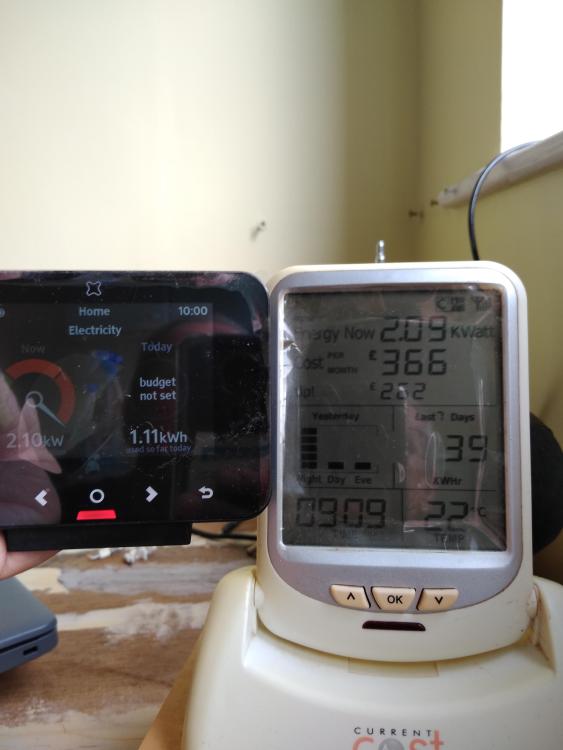
As a trivial test, I put the kettle on, and had a look at my old CC Opti display and the new EDF display. Pretty close, just rounding error I suspect. Much more interesting is that you can manually disconnect them. Shall have to look into that, will stop the music playing from the neighbours.
-
Horizontal cylinder in a 'cold' loft. Bad idea?
SteamyTea replied to Post and beam's topic in Boilers & Hot Water Tanks
Thermocline boundary layer. More to do with salinity than temperature. The melting Greenland icecap is going to change that quite a bit in the coming years. -
Could it have been caused by nitrates concentration increasing due to the heave rainfall recently. Farmers have a lot to answer for. Never worked for me when I had a pond.
-
Horizontal cylinder in a 'cold' loft. Bad idea?
SteamyTea replied to Post and beam's topic in Boilers & Hot Water Tanks
Except for the same top of cylinder temperature you can store more energy. Stratification is a bad term to use as it implies a boundary where the temperature makes a discrete step. That is not the case in a cylinder, why I use the term gradient. There will also be a temperature gradient between the sides of the cylinder and the middle. That gradient will 'flip' between heating mode, cooling mode and usage mode. -
Horizontal cylinder in a 'cold' loft. Bad idea?
SteamyTea replied to Post and beam's topic in Boilers & Hot Water Tanks
May need a bit of ceiling strengthening -
Horizontal cylinder in a 'cold' loft. Bad idea?
SteamyTea replied to Post and beam's topic in Boilers & Hot Water Tanks
Not idea if it is right, but seems to make sense. Basically, with good insulation around the cylinder, and keeping the top of cylinder temperature as low as practicable, the losses are probably the same. Could be why there is no information on it. -
Horizontal cylinder in a 'cold' loft. Bad idea?
SteamyTea replied to Post and beam's topic in Boilers & Hot Water Tanks
I have never seen it modelled, so hard to tell. Take a cylinder with a 0.5m diameter ad a 1.2m height. Assuming a U-Value of 0.2 W.m-2.K-1 Volume will be 235 lt. Surface Area will be 2.28 m2 Base of cylinder temperature, once settled, 36°C, top of cylinder temperature 60°C. Ambient Temperature 10°C. If one assume a temperature gradient of 20K.m-1 (about what mine is), then the power losses, when vertical, will be the sum of the top end, plus the area of the diameter (hoop), then the sum of the hoops, and finally the sum of the last band and the base area. Using a course 0.1m down the cylinder, the power losses are 18W, or if the cylinder is unused for a day, 0.44 kWh. Now lets turn the cylinder horizontally. Working out the surface area is not quite so easy here as for every 0.1m loss in height, the end area and the hoop area do not scale in a linear fashion, so I sketched it up in CAD, sliced it, triangulated it, then worked out the dimensions. Accumulative errors was between 1 and 8%, so shall use 4% as the error. The cylinder power losses are now 20W, 0.49 kWh.day-1. A difference of 0.05 kWh. The above is on a static model, but there will be some turbulence. With a mean temperature of 48°C for the vertical temperature, the mean density of the water is 988.7 kg.m-3, at the top of tank temperature, the density is 5.53 kg less, 4.48 kg more at the bottom. A total of 10 kg.m-3 difference The horizontal cylinder only has a 12°C temperature difference (because I used the same temperature gradient of 20K.m-1), so the density difference is only 5.6kg.m-3. Now without getting into Reynold Numbers and tangential surface areas, a simple way to model it would be to look at the difference in stored energy and the difference in mass as energy is the ability to do work, which can be reduced to moving a mass a distance. The vertical cylinder will have 233 kg of water in it, the horizontal one 232.4 kg, so 0.6 kg less. To move 1 kg of water, 1 metre, will take 1 joules of energy. So to move 232.4 kg 1.2 metres will take 279.6 J in the vertical cylinder. There is only 0.5 metres of height in the horizontal cylinder, so 116.2 J, so the turbulence losses will be in thee order of 42% less. So I would not worry about the cylinder orientation. I am going outside to sand some wood now the glue has set. -
Have you a link to it?
-
Yes, and everything is highly unionised, and closed on a Sunday. I play a game with my Canadian Cousins, called "Name 4 interesting Canadians? Been playing it since 1989, still not got a definitive list.
-
'Packaged' UVC, larger than 200l?
SteamyTea replied to Post and beam's topic in Boilers & Hot Water Tanks
Have you ruled out a Sunamp? -
I binned a load the other day. My new draws just slide out in a shelf, couple of plywood strips as guides. Works well.
-
How to design a domestic plumbing and heating system
SteamyTea replied to Annker's topic in General Plumbing
You can design the condensation risk out with a bit of thought. Temperature is not power, or energy. As long as your thermal emitters have a large enough surface area, then they can deliver enough thermal energy at quite low temperature differences.


