


SteamyTea
-
Posts
23844 -
Joined
-
Days Won
200
Everything posted by SteamyTea
-
Well no, but you are comparing a technology that has been used for over 100 years (large scale centralised generation) with a technology that has only been commercialised in the last 20 or so, with 90% of the capacity installed in the last 7 years (ish). Like saying a 5 year old at school has not worked out what dark matter is. No one is every claiming that wind and solar can match existing generation today. 5 years ago, who would have thought that around 850,000 BEVs were on our roads, the same argument about 'not enough capacity to charge them' was said back then. Probably accounts for all the BEVs I see on the side of the road when I drive, they must go into cloaking mode to save embarrassment. Our National Grid is an engineering marvel, we should be proud of what it does, not saying that it has reached its peak and nothing else can be done. As for the French, and other interconnects, much of this is to do with economics, not capacity. We, like France, Holland, Belgium etc would be mad not to swap power at times it is not needed locally. The whole of physical Europe is interconnect, it is the way it has been designed, it is not a bail out.
-
17% as I type this. Wind is 26% Gas 32% French Interconnect 8% You cannot compare installed capacity of renewables and traditional generation. If you really want to compare them, you have to take the capacity factor into account.

-
The national grid data has never shown that. It is a bit of a myth that the whole of the UK gets hit by a winter high pressure and windturbines just stop generating. Just a matter of scaling the system up. We really do not need nuclear these days, we can manage without it, we almost are as it is.
-
How do you square that with Nuclear, which has a 60 + year history, is the most expensive form of low carbon generation, by a factor of 4.
-
-
What do you mean by that. What are you actually comparing? Also, why should we stop installing the cheapest form of electrical generation just because someone else isn't. That seems ridiculous, it is like deciding to buy your own Boing 777 because your neighbour flew to Spain for a holiday. I take it you are a bit drunk, it is Friday evening after all. You get one as well, use it wisely, that way you may end up what you wish for.
-
Well it should make people actually do something about improving the building. One problem will be crap 'life hacks' from internet tossers and con artists. But then Joe Public is welcome to join here and get some genuine advice. The ONS released heat and cold excess death data today. You would think that will our numbers, people would be doing something about it for themselves. https://www.ons.gov.uk/peoplepopulationandcommunity/birthsdeathsandmarriages/deaths/articles/excessmortalityduringheatperiods/englandandwales1juneto31august2022
-

New member - stuck for what to do next to warm the house
SteamyTea replied to Sparrowhawk's topic in Introduce Yourself
My internal RH is generally above 65% all year round. I live in one of the wettest parts of the country though. I can get condensation internally, seems worse behind my thermal curtains. Could be that locally the temperature is just colder there. Try leaving the curtains undrawn and see if the problem is still there. -
New member - stuck for what to do next to warm the house
SteamyTea replied to Sparrowhawk's topic in Introduce Yourself
Possibly, or a leak causing very high local RH. As you say, the internal numbers are above the dewpoint. -
New member - stuck for what to do next to warm the house
SteamyTea replied to Sparrowhawk's topic in Introduce Yourself
Was that condensation on the inside? -
If you want to cut CO2e emissions, tax the bollocks off CO2 emitting fuels. It would not matter, environmentally, if a house used 1 MWh/year or 30 MWh/year if the energy source is CO2 free. If gas and electricity cost £1/kWh, house prices would soon drop.
-
Top Gear did that in 2011, when they tested the Leaf and the iOn.

-
"Time for bed"

-
Quite possibly trueish. The media seem to paint a picture that all houses are bought to rent out at inflated prices. As a general note, I don't think the the EPC rating is about saving money for the owner or renter, it is about reducing CO2e emissions. Why we really need a simple, and well understood, carbon tax.
-
If you decide to become a landlord, why not buy a place that is already an A, B or maybe a C to start with?
-
Energy storage is really a case of where we store it. Can easily store thermal energy in a cylinder of water or a few bricks in a storage heater, or even in a concrete slab. Storing gas involves disused salt caverns, highly automated processes and a lot of post processing of the raw material (gas), after it has already been processed from its place of origin. Electricity is, currently, very expensive to store, and takes a lot of land area, pumped storage especially.
-
A GSHP would freeze the ground in the UK. May work in a desert. A WSHP could be made to work, but the flow rate of the ambient temperature water, or ideally sea water, would be huge to stop freezing.
-
Oh Lord not my strong point!! Both are fairly easy, at the level needed here. Think of Physics as what you already know, intuitively. There are only 3 'units' to remember, the kilogram (kg), the metre (m) and time (s). Just about everything comes from those 3. So you know, from experience, that catching a small ball, gently thrown towards you is easy, Say that ball has a velocity of 2 metres per second and a mass of 0.1 kg as you catch it (this is momentum and has the unit p, for pellere, which means push, or drive). The momentum is p = kg.v, so p = 0.1 x 2, p = 0.2 kg.m.s-1. When you catch it, the equation changes to the energy equation, 1/2 mass times velocity squared, E = 1/2.kg.(m.s)2, E = 0.1 x (2)2, E = 0.1 x 4, E = 0.4. Energy what is called a derived unit, the joule (J), this is important as ANY energy, be it a moving mass, electrical energy, thermal energy stored energy, gravitational energy, can me expressed in joules. The main thing is to remember that a joule is very small, the force needed to move a mass. This force is known as a newton (N) and is equal, in everyday life a mass (kg) x acceleration (m.s2). As you can see, those basic units of kg, m and s, keep appearing. As a J is a very small unit, we tend to multiply them by 1,000,000 and talk in mega joules (MJ). An MJ is still quite small, and in the domestic setting, we talk about kilo watt hour (kWh). The kWh is a dreadful unit and causes lots of problems, but can easily be broken down into the base International System of Units (SI). So let's try it. k = 1000 W = J.s-1 (joule per second) h = hour, which is 3,600 s. Multiply that lot together 1000 x 1 x 3,600 = 3,600,000 J So there are 3.6 MJ in a kWh. Say you buy 2 kWh of electricity. That will be, 1000 x 2 x 3600 = 7,200,000 J, or 7.2 MJ. As a J is mass times acceleration, and if we assume, for simple arithmetic that we start with that ball of mass 0.1 kg, then to get to 7,200,000 we have to throw it quite fast. E = 7,200,000 (J) 7,200,000 = 0.1 (kg) x ?2 (m.s-1) (we normally use x where I have used ? to save confusion with the multiply sign, which is normally a period, .). Let us rearrange so that ? becomes the subject (as they say in arithmetic lessons). 7,200,000 / 0.1 = ?2 72,000,000 = ?2 72,000,0000.5 = ?, which is 8485.28 m.s-1, which is really fast, about 19,000 MPH. If you are wondering how I went from ?2 to 72,000,0000.5, 0.5 is the same a taking the square root. The Economics bit is really just accountancy, if your 2 kWh of energy cost you 30p/kWh (electricity price), then that is 60p, but if 'passed though' a heat pump, you should on average, get 3 times the amount of thermal energy out, at the temperature that you want, so 6 kWh of hot water or warm air in your house. If it is gas, and it cost 10p/kWh, you will only get, on average, about 0.9 kWh out (this does depend on the efficiency and usage of the boiler, you can get close to 1.1 kWh out on a condensing boiler). So a heat pump would work out at 60 (p) / 6 (kWh) = 10p/kWh. Gas 10 (p) / 0.9 (kWh) = 11.1p/kWh and 10 (p) / 1.1 (kWh) = 9.1p/kWh. The real Economics bit is double guessing where the electricity and gas prices will be in a few years times, and how they are impacted by not only supply and demand (we have good historic data on that side) and government intervention (currently electricity is priced by the gas price). If there is one thing that is certain, it is that government intervention is unreliable and inconsistent. I hope that helps explain what Energy actually is, and from it you can quite easily work out the energy to heat things up, move things, change things etc. Just think of it as a mass moving and going from moving to rest, quickly. (disclaimer, it is late and I have had a busy day, and it is strange for me to work during the day and do the fun stuff on here in the evening, had 15 years of having the day free and working the evenings, so may have made an arithmetic error.)
-
I missed the second half of PM. Purely from a technical view point, hot needs to be defined, for any given mass flow rate. Plumbing in 10, 5 kW Heat Pumps in parallel could deliver water at 45⁰C and easily at 10 kg/min. Be a bit silly though. The BBC does tend to take polarised views in heat pumps, they get a few people that can't make them work, and a few people that can make them work, forgetting about the thousands that have them that don't know, or care how they work, but get enough hit water and space heating out if them to not have to worry.
-
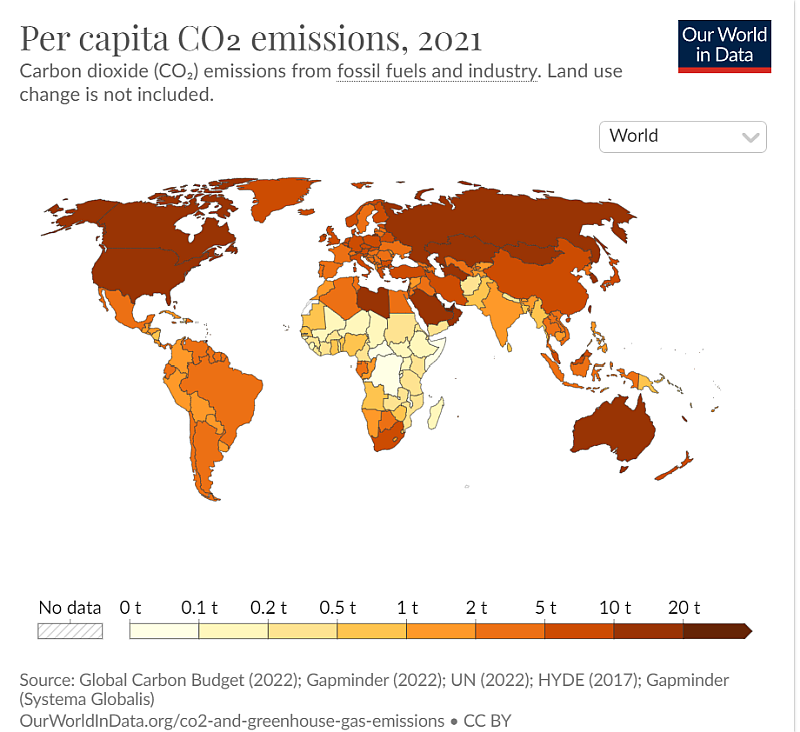
Just had a quick Google and it seems to be 531 g/kWh in 2022. High, but no worse than we were a decade ago. "The leading sources of China’s emissions are the power sector (48% of CO2 emissions from energy and industrial processes), industry (36%), transport (8%) and buildings (5%)" https://www.iea.org/reports/an-energy-sector-roadmap-to-carbon-neutrality-in-china/executive-summary
-
There had just been a bit on PM about EV quotas not being changed in the UK. So by 2030, any brand of car has to sell 80% EVs. Think they said next year it is 22%, but may have misheard that as was driving. So while we will be able to get an ICE up to 2035, they may be impossible to actually buy. I wonder if that was forgotten, or done on purpose.
-
I don't know the grid intensity for China. Doubt anyone does. Probably worth splitting the country up as it is physically a large place. Then see what the industrial areas use.
-
Not really so. Installed capacity is not the same as generation, RE generated differently from FF, i.e. you cannot schedule up to the Betz's Limit for a windturbine, but you can for a hydro (usually), gas or nuclear. This means they are integrated into the national grid differently. Demand side management can take up a lot of the slack. 2 decades ago there was a few studies done showing that anything more than 25% RE would cause grid stability, we now frequently hit close to 60% RE penetration. While it is still early days for demand side management, storage is moving ahead. So it may be fairer to say that for every MW of RE name plate capacity, we would need a MWh of storage (or whatever the numbers say we need). As for EVs, if you buy a Tesla, it is almost certainly made in China. They make good cars now.
-
Hung in my butchers you mean.


