SteamyTea
-
Posts
23844 -
Joined
-
Days Won
200
Everything posted by SteamyTea
-
That would only be another 600 W.
-
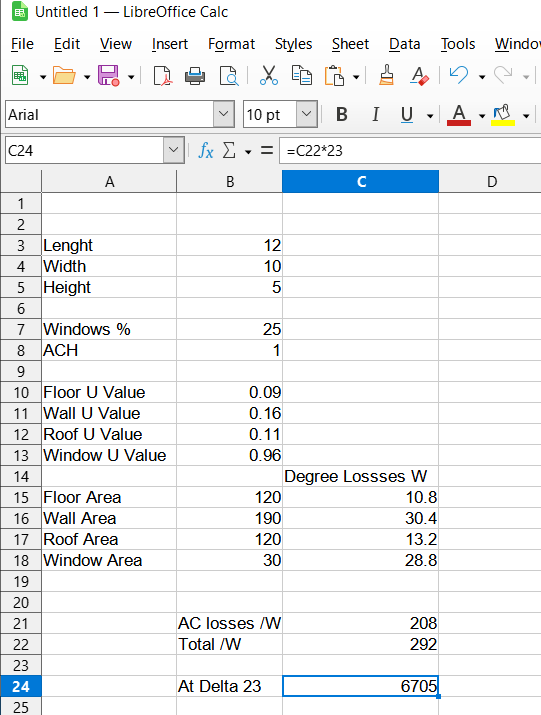
I just quickly modelled your house as a simple cube. 12 m long, 10 m wide and 5 m high. Came out, as 292 W/°C at 1 ACH. So at a delta of 20°C, that would be 5831 W, at 23°C, 6705 W, or 6.7 kW. Have you mixed up some units somewhere i.e. metres and feet.
-
 It does, press and hold the zero 'key', the ⁰ symbol will reveal itself.
 -
Just to clarify something. ° is for degrees. ' is minutes, a 60th of a degree. I degree. °, is 60 minutes,'. And, just to be a pendant, 3600 seconds, which has the sign, ".
-
We have Arthur C Clarke to thank for that. Rendezvous with Rama
-
Which floor is your greatest daylight power usage going to be? If one floor is just lights, say for bedrooms/bathrooms, then usage will be so low i.e. 30 or 40 W, it is not worth worrying about.
-
By the looks of it you started in mm, rather than converting to m. So the answer will be in mm. And it is Phi.
-
The cut, considering the wall type, is probably as good as can be expected by hand.
-
Angle Grinder - Wattage, Button/Trigger, and Recommendations?
SteamyTea replied to Oxbow16's topic in Tools & Equipment
@Oxbow16 Can you still type? We all want to know how you got on. -
150mm or 125mm concrete screed over insulation for ufh?
SteamyTea replied to JayDee's topic in Underfloor Heating
I think it changes the ratio by 30% if you put the pipework half way up in the concrete. This assumes equal thickness of insulation and screed. 30% sounds a lot, but it is not great, but then it does depend on the temperature differences between the pipe temperature, slab/insulation temperature and ground/air temperature, If I was not so busy I would try and calculate, been a while since I have looked at differential equations. -
Recommendations for a lock box
SteamyTea replied to Adsibob's topic in Networks, AV, Security & Automation
Interesting, is all the drug associated crime centered around the cities. -
150mm or 125mm concrete screed over insulation for ufh?
SteamyTea replied to JayDee's topic in Underfloor Heating
Because of the potential greater heat losses. Not considered a problem raising mesh up 50mm or so, and not considered a problem attaching UFH pipe to steel mesh. Probably not that hard to get different height posts that are suitable to attach UFH pipework to. May seem extra work and expense, but probably isn't in the scheme of things. -
150mm or 125mm concrete screed over insulation for ufh?
SteamyTea replied to JayDee's topic in Underfloor Heating
Yes, seems odd to me and lacking in thought. -
150mm or 125mm concrete screed over insulation for ufh?
SteamyTea replied to JayDee's topic in Underfloor Heating
Can glass fibre chippings be added to a concrete mix to reduce cracking? As for where the pipes go. I would say never next to the PIR, that just heats the insulation more than needed, which increases the temperature delta to the ground. The closeness to the surface is really set by the pipe spacing. So if your pipes at at 150mm spacing, then 75mm depth, 100mm spacing, 50mm depth. Depth from surface equals half pipe centre spacing. -
Not many probably, and it should be highlighted to both the ARB and RIBA.
-
@ETC Do you, or any other architect, report back to your governing body about the perception that the ordinary public have of your profession? When I have a complaint, i.e. the recent price rise in my coffee (third this year), I say something to the manager of the place. I also ask if they report back on customer comments. If they say 'no' or 'yes, but nothing happens', I write to the complaints department and let them know that I am not a happy customer. It is not really up to an individual to take the wrath of potential customers/lost customers, without the organisation that charges you for professional membership, offering support.
-
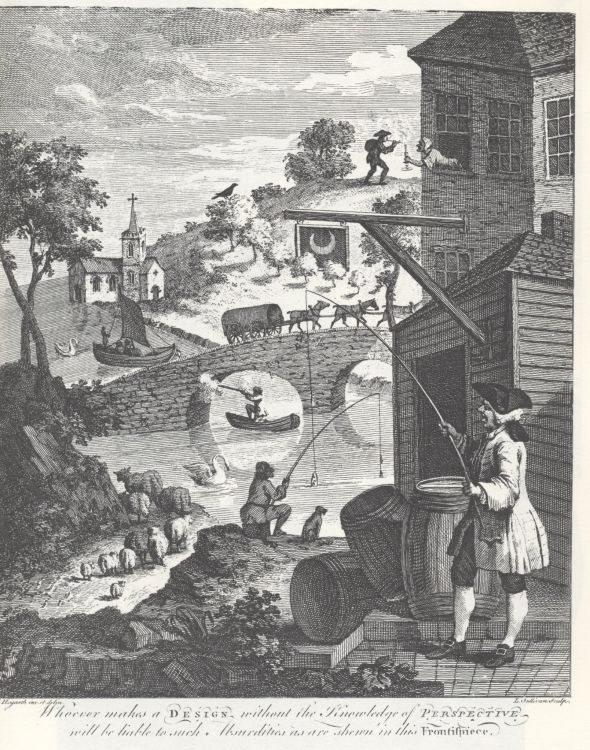
Hogarth said "Whoever makes a design without knowledge of perspective will be liable to such absurdities as are shown in this frontispiece"
-
A couple of A2A heat pump questions
SteamyTea replied to Andyh's topic in Air Source Heat Pumps (ASHP)
That is a very good point. I wonder if there is a standard was to calculate the size of A/C units. Just a case of changing the sign to make it heating (near enough). -
A couple of A2A heat pump questions
SteamyTea replied to Andyh's topic in Air Source Heat Pumps (ASHP)
At the moment you do need your F-Gas though. -
Keep fish, if potassium permanganate don't work, flush them down the bog.
-
A couple of A2A heat pump questions
SteamyTea replied to Andyh's topic in Air Source Heat Pumps (ASHP)
Welcome There does not seem to be that much general information about A2AHPs, a few on here have them and rate them highly. The main think about wall mounted, is about noise transmitting though the wall. The other thing is any planning restraints i.e. it is ok to have one, but not two, not at the front of the building. I do wonder why, for self install, one cannot get an ordinary monoblock ASHP, then just plumb it is to fan assisted radiators. I bet the drop in efficiency is not that bad. No messing about with F-Gas, flanging tools, vacuum pump that way, and ordinary plumbing fixtures and fittings. -
You have never seen the shirts I buy, or the ones I have been given as gifts.
-
Is using an architect a bit like buying a shirt. If you choose it yourself, go out in it and feel comfortable, maybe even the odd positive remark, you think "I chose well". If your better half chooses it, you go out and don't feel comfortable, you can blame them. Now it gets a bit more complicated, you can choose yourself, feel comfortable, but everyone else thinks you are a twerp. So everyone else is wrong. Your better half can choose it, you feel comfortable in it, but everyone else think you look a twerp. That is 4 differences so far. You choose, feel uncomfortable, but get positive comments, or negative comments, that is 6 differences. Your better half chooses, you feel uncomfortable, but get positive or negative comments, that is now 8 differences. I will not go on, except to say, some people look good in some shirts, other look silly. There are too many permutations to make a real decision. So it is probably easer to make a wish list of what you really dislike, which you probably know already, then let others, be they professionals or amateurs, suggest ideas. Professionals will probably have a larger knowledge base of 'products' than amateurs, let them offer up that information.
-
the man who built his London house from DIY tutorials
SteamyTea replied to joe90's topic in Surveyors & Architects
Like the GPO then, they don't want to do anything on a weekend, or when it is dark, or wet, or too hot. Hang on, have I got the wrong topic here, it is because I am waiting for Thursday's comic to come though my letterbox.