SteamyTea
-
Posts
23842 -
Joined
-
Days Won
200
Everything posted by SteamyTea
-

Decoding information from, well, code between glass panes
SteamyTea replied to Garald's topic in Windows & Glazing
https://www.explainthatstuff.com/how-low-e-heat-reflective-windows-work.html -
Rapid aging. Cycle the tapes though the expected temperature and humidity ranges several times a day, when you get to 50% adhesion, you then extrapolate that to 100 years. Alternatively you set a lower bound to the adhesion limit and rapid cycle until you reach it. Rapid aging, time to failure and time between failures is an interesting engineering field, uses the Poisson Distribution to predict the end points.
-
Oh yes, Ramsgate. If you look in the background of the other picture, you will see the oil storage units. I find the colour of the sky interesting. One is in Kent, the other the West Indies, both overcast days.
-
Powrmaric r290 A2A monoblocs
SteamyTea replied to Beelbeebub's topic in Air Source Heat Pumps (ASHP)
They seem quite expensive. I think someone here fitted a similar, but cheaper version. I am a interested in one, but when I looked at the noise level I talked myself out of it. -
Decoding information from, well, code between glass panes
SteamyTea replied to Garald's topic in Windows & Glazing
@craig is our glass guru. Do you know if the glass has a costing on it? -
Good times. Just found a pile of pictures from then.


-
The 'transformer' will be built in. The inductance/capacitance will be in the mains wiring leading to the light, not in the light itself.
-
Ideally yes. But as it is not a practical idea, rather a moot point See what @Marvin said. GSHPs are taking advantage of stored energy. As are ASHP and WSHP.
-
15 months and a 6 months. Second ban was for speeding, but had unspent endorsements.
-
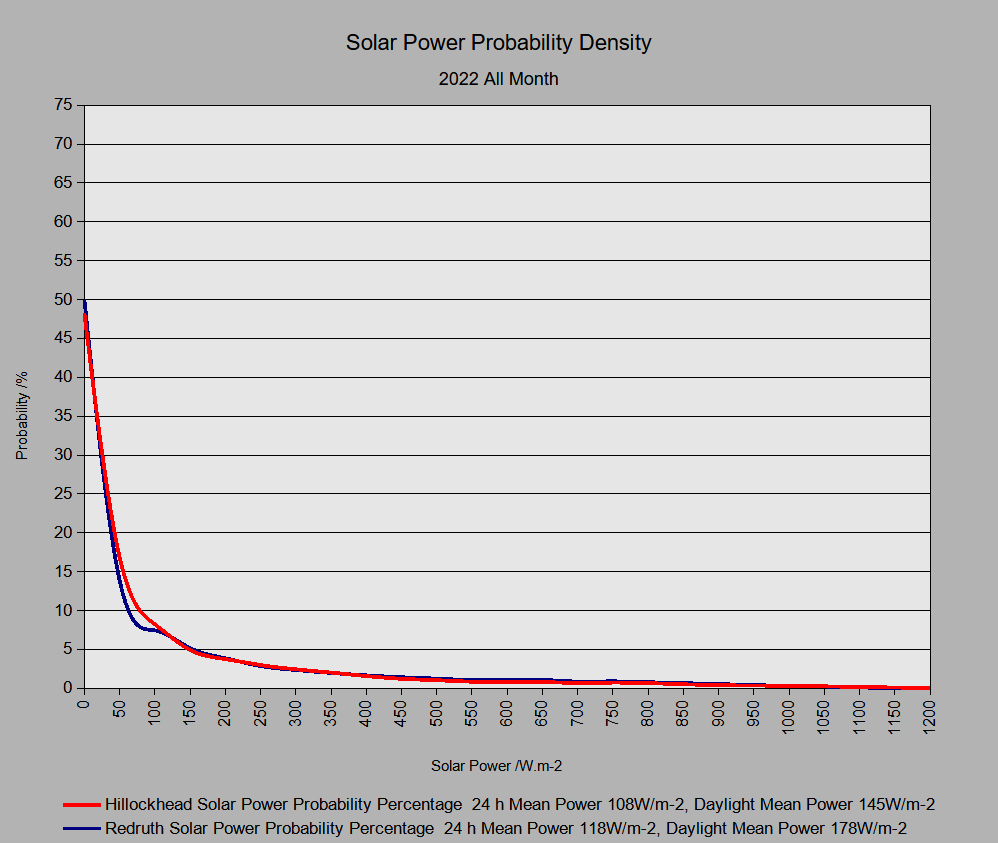
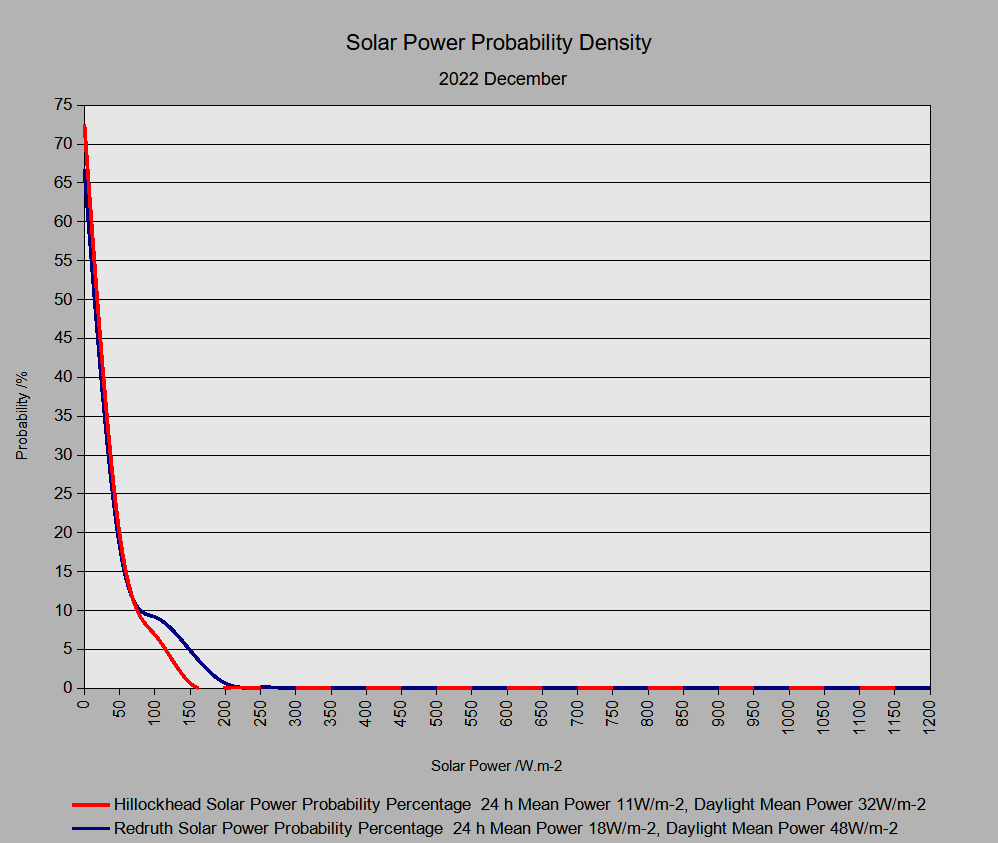
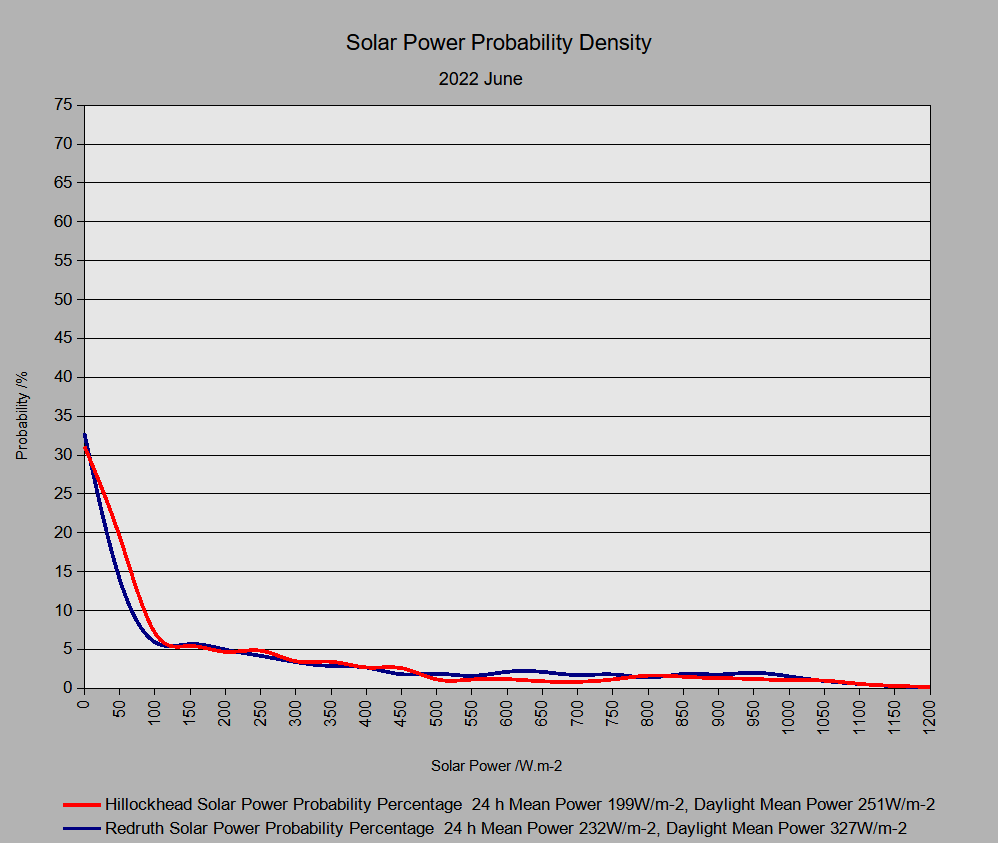
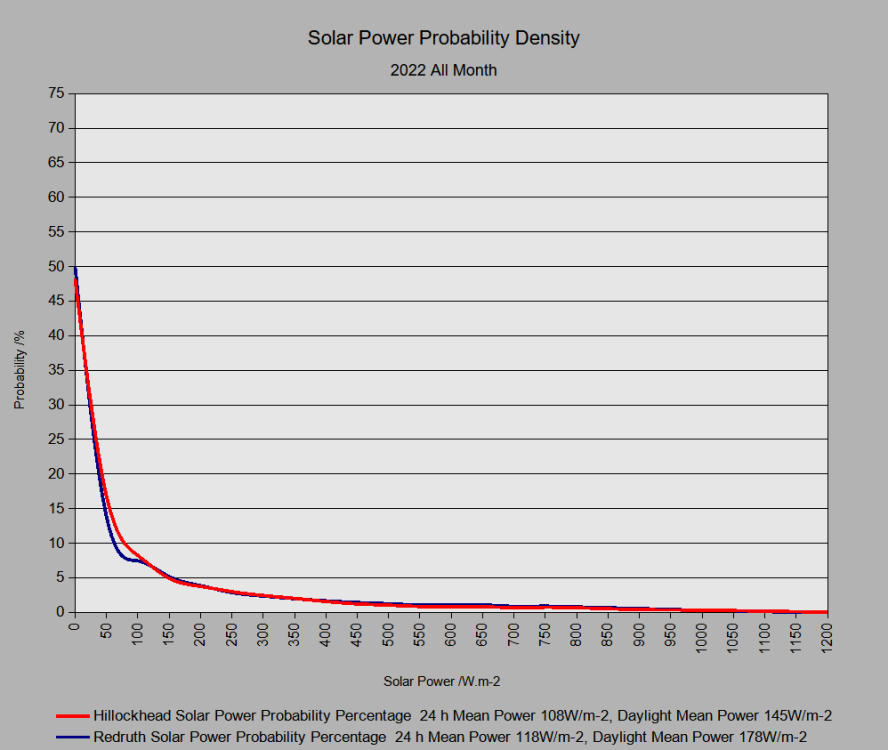
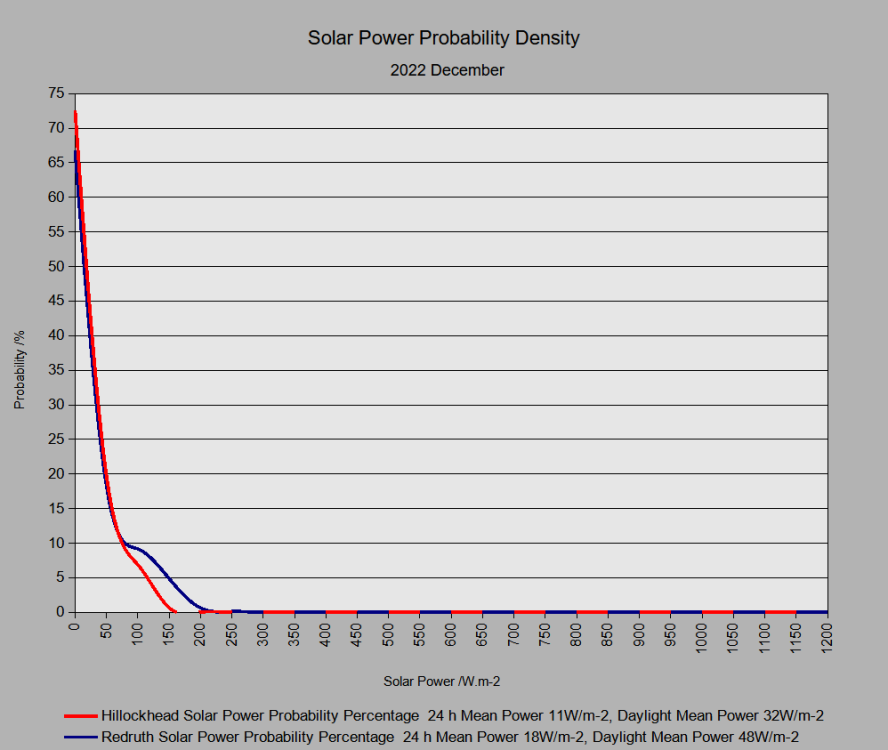
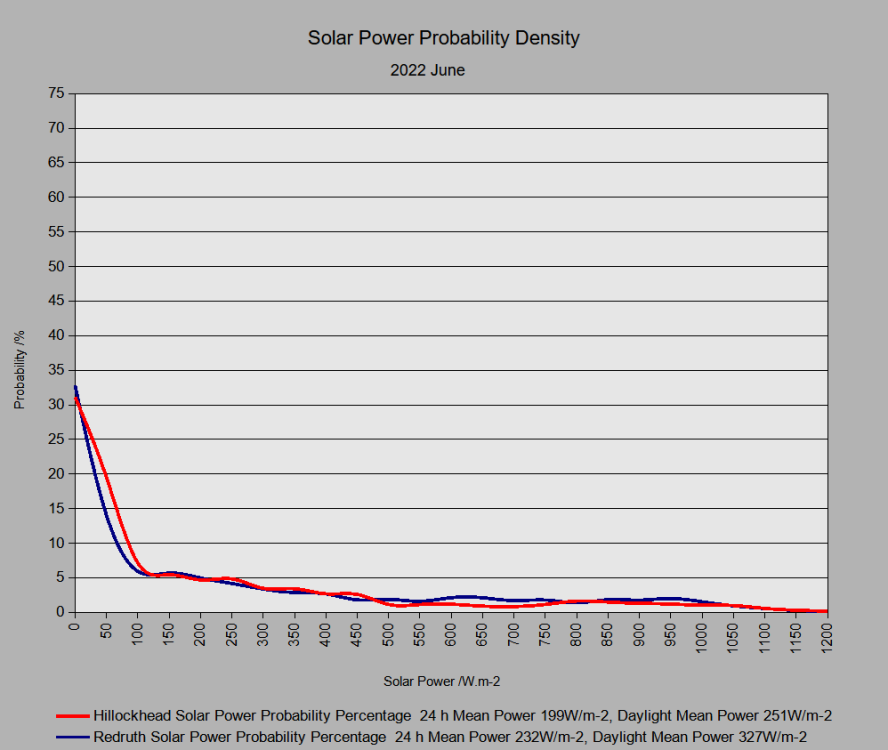
After a question from @joe90, and some comments and data from @JohnMo about solar energy, I made a bit of a sweeping statement and a simple model that showed half the time it is dark, and then is roughly halves for each increase in power. Now that was a very simple model and was in now way meant to be used for prediction. As I wanted to know what was happening, I have spent a few hours today getting some data from WeatherUnderground stations, on in a place called Hillockhead near Inverness and another load from Redruth, Cornwall. The data covers the whole of 2022. The solar gauges on these weather stations are generally horizontally mounted, so do not produce the same readings that say a south facing solar module would. To do that, so jiggery pokery with geometry has to be done. What is interesting to me, is that even though Inverness is in the far north, and Redruth is in the far south, how similar the solar distributions are, the mean power per square metre readings are different. Over the year, Hillockhead has a daylight men of 145 W.m-2, Redruth 178 W.m-2. Here is a chart showing the full year. December, while different, shows the same similar pattern. As does June The hours of daylight are, to my surprise, very similar, just a bit time shifted (about an hour). I am surprised just how similar the data traces are considering the geographic locations, about 7.6° of latitude. If I get time, I shall try and create a more accurate model of the power distribution, then see how it fits to other locations in the country. I could also try and do another short term prediction model Ed Davies and myself tried a few years back but got nowhere, but I have a few more ideas on it now.
-
Decent VOIP cordless handsets
SteamyTea replied to PeterW's topic in Networks, AV, Security & Automation
I ditched my landline over a decade ago. I really do not see the point of them these days. I use mobile broadband as well, 4G is plenty fast enough for me, but in the not to distant future we will all have 5G. For the last extreme rural people, satellite is available. -
I seem to remember that storage heater bricks (Feolite) are about double the capacity of sand/stone/brick/concrete/earth. They are properly designed not only to store extra energy, but not degrade when in contact with a electrical element at 800°C+. Just found this on Stackexchange about Feolite specific heat = 920.0 J·kg−1·°C−1, density = 3,900 kg·m−3, thermal conductivity = 2.1 W·m−1·°C−1. maximum operating temperature 1000 °C So a bit better than brick on the SHC, but due to the much higher density than sand, the volumetric capacity is higher, about 1 kWh/m3.K Just a bit better than sand at 0.6 kWh/m3.K. I think I may have made an error in the conversion, but not in favour of sand. The reason storage heaters can store more energy is that the bricks are very hot >200°C. Commercial sand systems also also stored at higher temperatures, but a domestic system in an polypropylene/polyethylene container is limited to about 70°C.
-
My neighbour has one, made in Vietnam. Quite small and pretty.
-
Can I draw Tehidy Woods on it, including the North Carpark (the one without the lockable gate). It is great up there at dusk, get to meet loads of men and one or two women.
-
Ah, a child's game.
-
What the (expletive deleted) is it. I used to make models out of fag packed and Swan Vesta boxes when I was a kid. My favourite box was the one that my Mother's vacuum cleaner came in, has Goblin on the side. Three ways to interpret that.
-
Passed at what level. 0.2 or 5? I passed my driving test, crashed sister's car 2 nights later, then my motorbike, twice, then my father's brand new car, got banned twice for my troubles. Then, at 20 years old, I got glasses and it all seemed to stop happening.
-
Logging OVO Actuals Data and Octopus Agile Half-hourly Prices
SteamyTea replied to TerryE's topic in Boffin's Corner
Can you look at the correlation between price distribution. I have a feeling that when maximum price is high, the minimum price sill also be high, just a hunch as it is all based on the demand/capacity ratio. May be wrong as, in the scheme of things, the domestic side of this Octopus deal is relatively small. -
We all look forward to the ACH figure from the leakage test, no pressure.
-
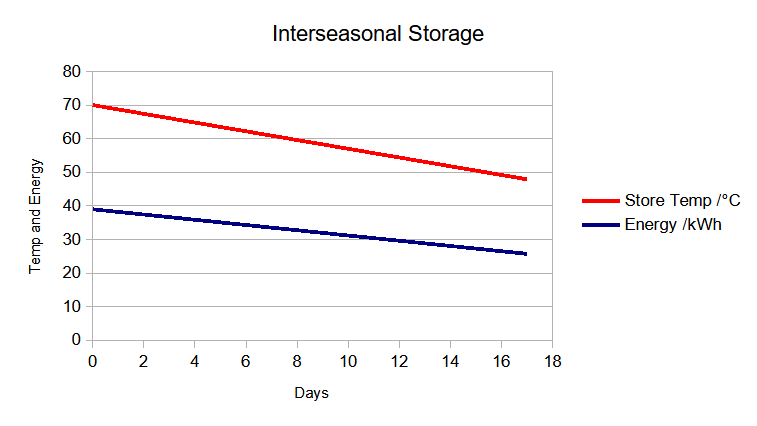
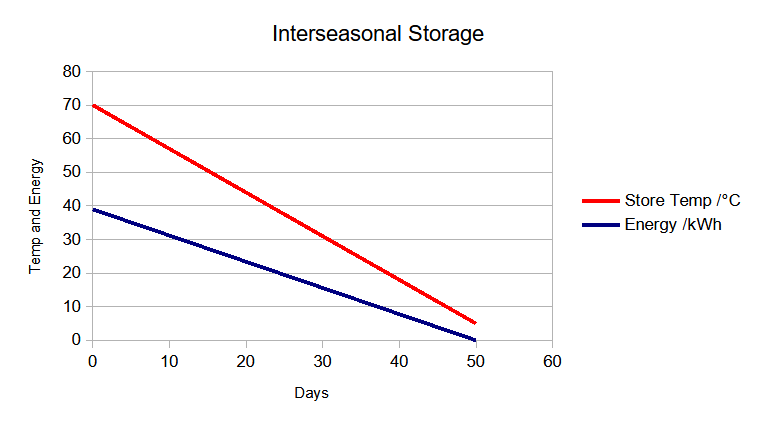
A bit of arithmetic can help here. Let us start with a box, 1 m on each side. So 1 m3, that will hold around 2,700 kg of sand, which has a specific heat capacity of around 0.8 kJ/kg.K, so 2,160 kJ/K or, 0.6 kWh/K If we add 0.5 m of insulation around it, we then have a cube that is 2 m on each side, and a volume of 8 m3. so a volumetric capacity (AKA Heat Capacity) of 0.075 kWh/m2.K. Why so much insulation you may well ask. Well the sand will have to be kept at a high temperature, so the thermal losses will be quite high without it. If we choose a phenolic insulation with a thermal conductivity of 0.02 W/m.K we can work out the losses. The total surface area will be 12 m2, and let us say that the ground is, during winter, at 1 m depth 5°C and we store the sand at 70°C, a temperature delta of 65 K and an initial energy storage of 39 kWh. Converting the thermal conductivity to a U-Value give us 0.042 W/m2.K (about half what a Passivhaus uses). 0.042 [W/m2.K] x 12 [m2] x 65 [ΔT] = 33 W [2 significant figures). After a day, 0.8 kWh will have leaked out, leaving 38.2 kWh, the temperature will have dropped by 1.3K, to 68.7°C, day two, there will be 37.4 kWh of storage and the temperature will be 67.4°C. After 15 days of losses, the energy stored will be 27.3 kWh and the temperature will be at 50.5°C, about as low as to be useful. Now you can top up to counteract the losses with relatively small amounts of energy, 0.8 kWh/day, but that just covers the losses, not usage. If you run the heat store down to 50.5°C every day, then you need to replenish it with 11.7 kWh for usage, plus the 0.8 kWh for losses, 12.5 kWh/day. Now I have a small storage heater in my kitchen, a 10.5 kWh model. It is 0.56 m wide, 0.18 m deep from the wall and sits 0.71 m high from the floor. That gives a volume of 0.072 m3. A volumetric capacity of 146 kWh/m3. Compare that to the sand storage of 4.9 kWh/m2. Now my storage heater does not have anything like the insulation levels of an intersessional storage system, but then it does not need to, as all the thermal losses end up heating the room, which is what heaters are meant to do. So for less space, less price and thermal losses where they are wanted, my storage heater is better, by a factor of 30. If intersessional storage was so brilliant, all our houses would be built on them. (as usual, quickly calculation things can introduce errors, so I may have made one that could turn the whole thing on its head) Just had a thought, GSHP would be easier and cheaper, it effectively works the same. Done a chart. After 50 days, the losses have depleted the store. It is 45 days till Christmas day.
-
They will if you pay. I currently pay 65p/day, £237.25 a year, part of which is for network upgrades. I have recently paid £200 to put my car on the road for a year, I want a larger road between my house and work, not going to happen at £200 a year.
-
Ah, probably won't get one that does all that. The point I was making was that if there total disconnection, the problem goes away.
-
You can use corrugated cardboard to thicken up a laminate, or get some Cormatt XF if you want to do it properly. I would lay down two layers of 450 g/m2 mat, a bit resin rich, pre-wet the cardboard on the rough side, lay into place, then one layer of 450 g/m2 mat over the top in the usual manor. Same with Cormatt.
-
What are you using to insulate the orange juice containers and how are you going to stop them melting?
-
National Grid Connection
SteamyTea replied to SteamyTea's topic in General Alternative Energy Issues
Not really the same thing. Local connections are down to your local DNO (mine just happens to be called National Grid instead of Western Power).